
Introduction
When I first found the name Aguero on a map, tucked away in the Huesca province of Aragon, I felt as though something was calling to me. My heart was captured by the Mallos de Aguero—those vertical rock formations rising dramatically behind the village—and so this journey began.
This region in northeastern Spain, spread beneath the foothills of the Pyrenees, possesses a distinctive landscape woven from ancient culture and nature. The village is home to the Church of Santiago, built in the 12th century and renowned for its exquisite Romanesque capitals. Though the population numbers only a few hundred souls, the rock walls towering more than 200 meters behind it stand like natural ramparts, as if protecting the village in their eternal embrace.
The dry winds of Aragon and the unique sense of time created by the stone houses—here exists a profound stillness that refuses to be hurried. As a place to step away from modern chaos and confront oneself, there could be no land more fitting than Aguero.
Day 1: Welcomed by Giants of Stone
The morning train from Madrid raced through the vast plains of Castile, gradually giving way to the undulating landscape of Aragon. The view from the local train after changing at Zaragoza was like a patchwork of olive trees and wheat fields. When I stepped onto the platform at Huesca station just past two in the afternoon, I sensed immediately that the quality of the air had changed. Dry, yet carrying a faintly sweet fragrance.
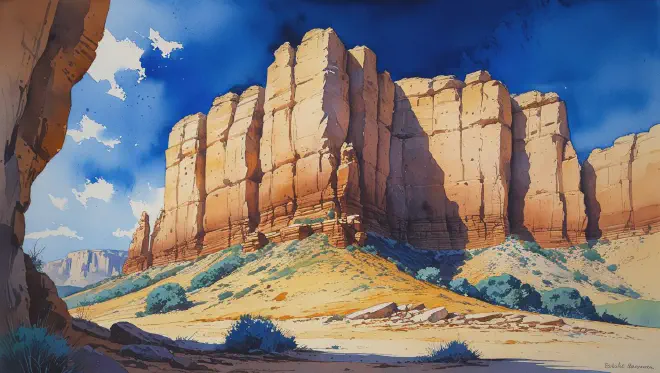
After forty minutes of swaying on a bus, the village of Aguero came into view, and I caught my breath. The village appeared as if framed by rock—a scene spread before me that photographs had never quite captured. The rock formations called Mallos were entirely different in person. Their power and beauty were like sculptures crafted by nature itself.
I checked into a small hotel called “Casa Rural Los Mallos” in the village center, dropped my bags, and immediately set out to explore. Walking along the cobblestone streets, the owner Antonio called out to me. Past seventy, his face was marked with deep wrinkles carved by the sun and wind of this land.
“First time in Aguero? Then walk up to the church this evening. The moment when the sunset strikes the Mallos is a beauty beyond this world.”
Following his advice, I began walking the narrow path leading from the village to the Church of Santiago, perched on the mountainside. When the asphalt gave way to a stone path, the sound of my footsteps changed. Thinking that pilgrims had walked this same path for over a thousand years, I felt a strange sense of wonder rising within me.
By the time I reached the church after about twenty minutes, the western sky had begun to take on a pale orange hue. The Romanesque church, built in the 12th century, presented a simple yet solemn presence. The doors were closed, but even the exterior alone conveyed the weight of its history.
And then came the moment Antonio had spoken of. The setting sun struck the rock walls of the Mallos, and the reddish-brown stone began to glow gold. That light gradually deepened, eventually transforming into a burning red. The patterns of shadow created by the surface irregularities seemed to move as if alive.
Sitting on a small bench before the church, quietly watching this spectacle, my sense of time grew hazy. Except for birdsong and the distant sound of bells, I was wrapped in complete silence. A profound peace settled into my heart—something I could never experience in urban life.
When I returned to the village after dark, Antonio had prepared a home-cooked meal. Simple yet deeply flavorful dishes made with local ingredients. What impressed me most was the “ternasco asado”—roast suckling lamb. Slowly roasted with rosemary, thyme, and other herbs, the meat was so tender it melted in my mouth, allowing me to savor the traditional flavors of Aragon.
After the meal, Antonio poured the local wine, Somontano, while telling me about Aguero’s history. How this village had once been an important stop on the pilgrimage route, how the Mallos formations came to be—one fascinating story after another. Listening to him, I savored the deep complexity of the wine.
Past ten o’clock, I stepped outside to find a canopy of stars spread across the sky. Countless stars that could never be seen from the city filled the heavens completely. The rock walls of the Mallos rose as black silhouettes against this starry backdrop, looking for all the world like sleeping giants.
Returning to my room, I opened the window to feel the cool night breeze while reflecting on the day’s events. Sensing that this small village of Aguero had already worked its way deep into my heart, I drifted quietly into sleep.
Day 2: Conversations Between Rock and Wind
I woke to morning light streaming in, accompanied by birdsong. Looking out the window, the Mallos rock walls were bathed in sunrise, dyed a pale pink. Different from yesterday’s gold, there was a gentle beauty here.
The breakfast Antonio had prepared consisted of locally made bread and cheese, along with homemade jam. The “queso de cabra”—goat cheese—was particularly memorable: rich yet with a clean finish, carrying a distinctive flavor nurtured by Aragon’s dry climate.
“Why not walk through the Mallos today?” Antonio suggested. There was a circular hiking route of about three kilometers, taking roughly an hour and fifteen minutes on average. I changed into walking shoes, grabbed a water bottle and light snacks, and set off.
The trail beginning from the north side of the village started as a gentle uphill slope. Before long, the rock walls of the Mallos loomed close. Their overwhelming scale amazed me once again. Vertical walls rising over 200 meters stood like enormous fingers reaching toward the heavens.
Looking closely at the rock surfaces, I noticed countless patterns etched by wind and rain over long ages. They looked like fingerprints left by giants, or perhaps ancient script. Before this natural artwork, any human architecture seemed small.
Taking a short rest at the trail’s midpoint, I gazed down at the distant village of Aguero. The stone houses looked like toys from this height. This was truly a bird’s-eye view. The breeze caressed my cheeks, its pleasant coolness easing my fatigue.
Following the narrow path threading through gaps in the rock, the view suddenly opened up. Here was a small flat area where wild thyme and rosemary released their fragrance. Small wildflowers bloomed at my feet, and butterflies fluttered about. I was surprised to find such a peaceful place amid these rugged rock mountains.
I decided to have lunch here. The “bocadillo”—sandwich—that Antonio had packed was simple, made with local ham, tomato, and plenty of olive oil, but eating it amid this magnificent natural setting made it taste exceptional.
As the afternoon sun grew strong, I began my descent. The way down offered yet another angle from which to view the Mallos. I could see how the rock colors changed subtly with the sun’s position. From the pale pink of morning to the whitish tones of midday, then to the warm browns of afternoon—the formations changed expression as if alive.
I returned to the village around three o’clock. Following Spanish custom, I decided to take a siesta. Back in my room, lying down with the window open, the faint sounds of wind and birdsong became a lullaby, and I naturally fell asleep.
Waking around five, the sunlight had softened. I decided to take a leisurely stroll through the village itself. Aguero has two churches—in addition to Santiago, there is also the Church of El Salvador. Located in the village center, El Salvador is newer than Santiago and displays late Gothic characteristics.
In the small plaza before the church, local elders sat chatting on benches. Their conversation was in the Aragonese dialect, much of which I couldn’t understand, but the warmth of the atmosphere came through clearly. One of them, Manuel, addressed me in English.
“Where have you come from? Japan? That’s quite far. What do you think of Aguero?”
When I shared my impressions from the day’s hike, Manuel smiled with pleasure.
“We see this scenery every day, so sometimes we forget how wonderful it is. But when travelers like you come and rediscover the beauty of this land, we too are reminded of how fortunate we are to live here.”
For dinner, I went to a different restaurant called “El Mirador.” True to its name—meaning “the viewpoint”—this small restaurant overlooked the Mallos. I ordered “migas,” a local specialty. This humble dish of finely crumbled and fried bread, seasoned with garlic and paprika, was traditionally shepherds’ food. Simple yet profoundly flavorful, it let me taste the history of life in this land.
Finishing my meal and stepping outside, the time approached for the sunset to illuminate the Mallos again. Wanting to view this beauty from a different spot than yesterday, I headed to a small hill on the village’s eastern side.
The view from that hill had a different beauty from the day before. I could see the entire form of the Mallos, feeling their grandeur anew. As the sun sank, the rock walls glowed gold once more, gradually deepening to red. Watching this, I sensed that something precious had been growing within me over these two days.
That evening back at the hotel, I talked with Antonio. He had been born and raised in this village, had once left for the city, but ultimately returned to his hometown.
“Cities offer convenience, but here there is peace of soul. The rocks of the Mallos teach us the meaning of time. A human lifetime is but a moment to those rocks. But that is precisely why we must treasure each present moment.”
His words resonated deeply. They made me reflect on what is truly important—things we tend to lose sight of in the busyness of modern life.
Day 3: A Door to Eternity
On my last morning, I rose especially early to watch the sunrise. In the still-dark hours, I followed yesterday’s path by flashlight toward the Church of Santiago. By the time I arrived, the eastern sky was just beginning to brighten.
I sat on the bench before the church, waiting for sunrise in the silence. Even the birds seemed still asleep; I was wrapped in complete stillness. Gradually, the outlines of the Mallos rock walls emerged. When the sun finally showed its face above the horizon, the first light touched the rock surface.
The morning light was exceptional. In contrast to the sunset’s passionate reds, it shifted quietly from gentle pink to pale gold. In that moment, the Mallos looked like giants full of compassion—gentle guardian spirits who had watched over this land for ages.
By the time the sun had fully risen, the church doors opened, and I was able to see inside. The interior was even more solemn than the exterior, and the Romanesque capitals were simply magnificent. Each sculpture told a different story, speaking to the skill and deep faith of medieval craftsmen.
What impressed me most was the plant motifs carved into a capital near the altar. Grapevines and leaves intertwined in complex patterns, with small animals and human figures hidden among them. It seemed to express the richness and complexity of life itself, and I could gaze at it endlessly without tiring.
The various stonemasons’ marks carved into the stone were also fascinating. Over 800 years ago, nameless craftsmen had carved their marks into each stone. Their names may not have survived in history, but their skill and spirit are certainly etched into this church.
Walking back to the village after leaving the church, I reflected on these three days. The time spent in the small village of Aguero had not been flashy. I hadn’t toured famous tourist sites or enjoyed lavish meals. Yet in this quiet time, I had been able to confront myself deeply.
The rock walls of the Mallos seemed like an existence transcending the concept of time. They had maintained their form for millions of years despite exposure to wind and rain. Human endeavors are but momentary events in that flow of time. Yet precisely because of this, each moment is precious and beautiful—this is what these rocks taught me.
Over my final breakfast at the hotel, Antonio said:
“Aguero has the power to change people. Everyone who visits here goes home somehow changed. You too must have found something precious, yes?”
He was right. Over these three days, I felt I had recovered something I had lost in the busyness of daily life. It’s difficult to express in words, but it was something like a peace that had settled deep in my heart.
The time came to pack my bags and head for the bus stop. Looking back at the rock walls of the Mallos, they seemed to be saying, “Let’s meet again.” Boarding the bus, watching the village landscape grow smaller through the window, I silently vowed to return here someday.
On the way to Huesca station, the scenery from the window looked different from when I had arrived. The same landscape, and yet somehow it appeared more beautiful, more vivid than before. The time spent in Aguero must have changed the way I see things.
Memories of an Imaginary Journey That Felt Real
This journey is a product of imagination. I have never actually walked the cobblestones of Aguero, nor seen the moment when sunset strikes the Mallos. Antonio and Manuel are merely figures from my imagination.
And yet, strangely, the memories of this journey exist within me with certainty. The beauty of the capitals in the Church of Santiago, the flavor of the ternasco asado, the splendor of the starry sky—I can recall them all as vividly as if I had actually experienced them.
Perhaps this is the mysterious power of imagination. Even for places we have never visited, by traveling carefully through them in our minds, we can gain experiences as rich as real memories. Aguero may be just a single point on a map, but now it holds a certain place in my heart.
The meaning of time that the Mallos rock walls taught me, the peace of heart found in silence, the warmth of people’s hospitality—all of these were born from imagination, but that does not diminish their value. Perhaps, precisely because they were created in imagination, they became something purer and more beautiful.
Someday, I may have the opportunity to actually visit Aguero. When that time comes, how similar will the landscape be to what I saw in this imaginary journey? And how different? Discovering that will be another pleasure.
But for now, I will carefully treasure these beautiful imaginary memories. When my heart grows weary, when I feel lost, recalling the landscape of this fictional Aguero will surely offer some comfort or answers. The rock walls of the Mallos will continue to stand there forever in my imagination, supporting my heart.