
The Town Called the Queen of the Alps
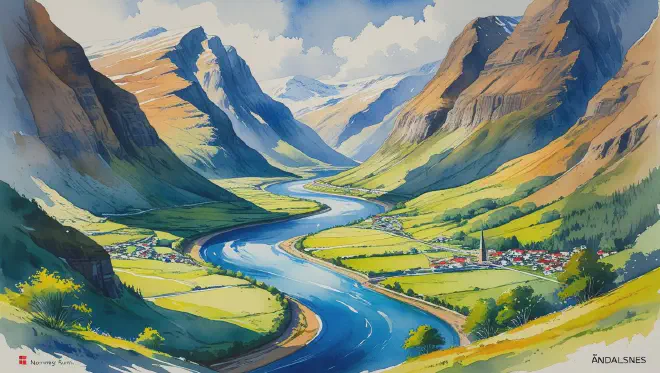
Åndalsnes — this small town in the Romsdal region of western Norway, home to just around 2,000 people, is affectionately known as the “Queen of the Alps.” The name derives from Old Norse, meaning “Andal’s headland,” and true to its name, the town sits at the innermost reaches of Isfjord, surrounded by formidable mountains.
What makes this town extraordinary is, above all, its geographic setting. Peaks reaching over 2,000 meters encircle the town, including the renowned Romsdalshorn at 1,550 meters, while the deep blue waters of the fjord stretch out below. As the terminus of the railway line, Åndalsnes serves as a gateway to fjord tourism and a sacred destination for mountaineering enthusiasts.
From the late 19th to early 20th century, European climbers flocked here to challenge its daunting rock faces, earning the town the nickname “Norway’s Chamonix.” Though the town’s history is not particularly ancient, it has served as a gateway to this magnificent wilderness since the railway arrived in 1922.
The people who live here, having endured harsh winters and brief summers, lead quiet lives in harmony with nature. During the season of the midnight sun, a dim twilight lingers past ten in the evening, and the silhouettes of mountains reflected on the fjord’s surface create scenes of almost painterly beauty.
Day 1: Through the Door to the Fjord’s Inner Sanctum
It was just past three in the afternoon when I stepped off the train at Åndalsnes Station, after a six-hour journey from Oslo. As befitting the terminus of the Dombås Line, only a handful of travelers stood on the small platform, and the station building itself was a modest but warmly inviting wooden structure. The moment I passed through the exit, a landscape beyond anything I had imagined unfolded before me.
Directly ahead stood Trollveggen — the Troll Wall — famous for its sheer vertical rock face. The granite wall, rising over 1,000 meters, caught the soft afternoon light and shifted subtly from gray to pale violet, radiating an overwhelming presence. In the foreground, the Rauma River wound through a lush green valley, its gentle murmur the only sound breaking the silence.
My accommodation, Hotel Aak, was about a five-minute walk from the station. The wooden building, said to date from the late 19th century, retained traditional Norwegian architectural elements, with its red roof and white walls creating a striking contrast. A woman in her sixties greeted me at the front desk and spoke to me in fluent English.
“You’ve come from Japan, I see. You’ve chosen a wonderful season to visit. This time of year, during the white nights, it stays light until around eleven, so you’ll have plenty of time to enjoy the scenery.”
Following her suggestion, I set out to explore the town center. Åndalsnes is truly small — walking the main street from end to end takes no more than fifteen minutes. Yet the rows of wooden houses were charming, each painted in different colors, making me feel as though I had wandered into a storybook world.
Around five in the afternoon, I stopped for a late lunch at a small café called Kafé Haugen. The interior was lively with locals, and the walls were decorated with old climbing equipment and photographs of famous mountaineers who had visited the area. I ordered a Norwegian salmon sandwich and a waffle with locally produced cloudberry jam. The salmon was remarkably fresh, generously garnished with dill on the bread. The cloudberries had a slight tartness, and their simple sweetness seeped into my tired body.
The man who appeared to be the café owner, upon learning I had come from Japan, addressed me in broken Japanese.
“Konnichiwa! Trollveggen, kirei desu ne!”
He told me that many Japanese climbers visit this town every year. From spring to summer, advanced climbers come primarily for rock climbing, but recently, general tourists like myself have been increasing as well.
For dinner, I ate at the hotel restaurant. The menu centered on Norwegian cuisine featuring local ingredients, with particularly abundant seafood from the fjord. I ordered a salad with the local specialty geitost — goat cheese — and sautéed cod from Isfjord. The geitost had a distinctive rich, slightly sweet flavor that was initially surprising but quickly became addictive. The cod was firm-fleshed, and the simple preparation with butter and dill brought out the natural taste of the fish.
After dinner, I stepped outside to find it was past nine o’clock, yet still quite bright. The silhouettes of the mountains across the water were mirrored perfectly on the fjord’s surface, and faint orange clouds drifted in the sky. Standing by the shore before this dreamlike scene, I forgot the fatigue of my long journey.
When I returned to the hotel after ten, the sun was casting its final light behind the mountains as seen from my room’s window. Tomorrow, the real sightseeing would begin. What discoveries awaited me in this beautiful land? With such thoughts, I drifted into a deep sleep.
Day 2: A Viewing Platform in the Clouds and Traditional Flavors
I awoke at seven, roused by light filtering through the gap in the curtains. Despite the season of white nights, early morning was still dim, and the air had a crisp chill to it. Opening the window, fresh mountain air flowed into the room, accompanied by birdsong.
The hotel breakfast was simple but substantial, in true Norwegian fashion. Various breads, cheeses, and hams were laid out, along with several kinds of jam. What particularly caught my attention was the presence of local honey and the cloudberry jam I had tasted at the café the day before. Sipping coffee, I reviewed my plans for the day: the Romsdal Gondola to the Nesaksla viewing platform in the morning, a museum visit in the afternoon, and a traditional cooking class in the evening.
At nine, I headed to the gondola station, about a ten-minute walk from the hotel. The Romsdal Gondola, which opened in 2021, carries passengers to the Nesaksla viewing platform at 708 meters in about five minutes. Being a weekday morning, there were only four of us on board, myself included.
As the gondola ascended, the view below expanded steadily. The town of Åndalsnes grew small beneath us, and the blue surface of Isfjord sparkled in the morning sun. Most magnificent of all was the massive rock face of Trollveggen drawing closer. Seeing the vertical wall of over 1,000 meters up close was truly awe-inspiring, and I found myself speechless before nature’s artistry.
Arriving at the platform, a 360-degree panorama stretched out before me. To the north stood the majestic form of Romsdalshorn, to the south the sharp ridge of Morgedalshorn, and to the west the fjord extending toward the sea. The viewing platform bore the name “Queen’s View,” and according to an information board, it was named after Queen Alexandra, consort of Britain’s King Edward VII, who visited in 1906 and praised this very scenery.
At the platform café, I slowly took in the magnificent view while sipping a warm coffee. Occasionally, a large bird — likely an eagle — circled around the rock face, and only the sound of wind broke the silence. Spending such tranquil moments made the noise of everyday life feel like a distant memory.
Before noon, I descended by gondola and visited the Romsdal Museum on the main street. Though small, the museum offers a careful introduction to the region’s history and culture. Particularly fascinating was the history of rock climbing undertaken by European mountaineers from the late 19th to early 20th century. Displayed climbing equipment, photographs, and journals from the era conveyed the passion of those who risked their lives on the rock faces without today’s high-performance gear.
The exhibition of traditional folk costumes called bunad was also beautiful. The Romsdal bunad features a deep blue base with gold thread embroidery, an elegant design that conveyed the pride and traditions of the local people.
Around two in the afternoon, on the recommendation of a museum curator, I visited a small farmhouse on the outskirts of town to participate in a traditional cooking class. The farmer’s wife, Astrid, a woman in her sixties, had lived in this area for generations and was teaching recipes passed down from her grandmother.
“Today, let’s make fiskesupe — fish soup — and lefse — potato flatbread.”
Under her guidance, we started with the lefse. Boiled potatoes are mashed, then mixed with a small amount of flour and salt to form a dough, which is rolled thin and cooked on a special griddle. Rolling the dough thin proved surprisingly difficult — my first attempts came out too thick — but with Astrid’s patient instruction, I gradually got the hang of it.
The fiskesupe was a cream soup made with white fish from the local fjord, filled with vegetables like carrots, onions, and potatoes. The fish broth was rich, and the flavor gentle and warming.
“This is an important dish for getting through our long winters. It warms the body and provides plenty of nourishment.”
As she cooked, Astrid told me about the harsh winters here and life in the old days. Stories of times without electricity or gas, when people relied solely on wood stoves for heat and preserved foods to survive winter, felt fresh to someone like me, accustomed to modern conveniences.
Around five, on my way back to town after the cooking class, I came upon a small church. Åndalsnes Church, built in 1896, is a wooden structure with beautiful white walls and a red roof. Inside, the décor was simple but warm, with soft light filtering through stained glass windows. In that quiet space, empty on a weekday evening, I sat for a while and let my mind settle.
For dinner, I went to a small restaurant near the harbor called Fiskerestaurant Sjøbua. Run by local fishermen, the restaurant prided itself on dishes made with seafood caught that very morning. I ordered the local specialty king crab and grilled Isfjord salmon. The king crab was surprisingly large, its meat springy and sweet. The salmon was rich with oil, and the simple salt-grilled preparation reminded me that sometimes the simplest method brings out the best flavor.
Past nine, under a sky still faintly bright, I walked along the fjord shore. The mountains on the opposite bank were reflected on the water, and time flowed in silence. Thinking that tomorrow would already be my last day, a tinge of sadness crept in.
Day 3: A Morning Farewell and Landscapes Etched in the Heart
On my final morning, I woke early and started with a walk through town. At six o’clock, the streets were still empty, wrapped in silence. Walking down the main street, I spotted a bakery preparing to open. When I called out to the owner, he shared a freshly baked croissant with me. I bit into the warm croissant, its butter fragrance wafting up, as I strolled along the fjord shore.
Trollveggen, bathed in morning light, showed a different face from the days before. The morning sun struck the rock surface, turning it orange, like a massive flame. Such a beautiful sight made the early rising worthwhile.
After returning to the hotel for breakfast and before checkout, I browsed a small souvenir shop in the town center. Inside were local handicrafts, traditional Norwegian knitwear, and locally produced honey and jams. As a memento, I bought mittens knitted with traditional Romsdal patterns and a jar of cloudberry jam. The elderly couple who ran the shop, upon learning I had come from Japan, treated me with great kindness and said warmly, “Please come back again.”
Around eleven, for one last memory, I went to see a small waterfall on the northern edge of town. One of the Romsdal waterfalls, it was only about 20 meters high but had abundant flow and considerable force. A small path ran around the falls, allowing me to feel the spray up close. Bathed in negative ions, I reflected on the memories of the past two days.
The beautiful mountains, the transparent fjord, the warm people, and the traditional food that touched my heart. Each experience was unforgettable. What impressed me most was the respect for nature held by the people of this small town and their commitment to preserving their traditions. I could sense the wisdom cultivated in a harsh natural environment and the strong will to pass it on to future generations.
At one in the afternoon, the time came to head to Åndalsnes Station. The hotel proprietress came to see me off and said, “Please come in winter next time. The snow-covered mountains have a different kind of beauty.”
While waiting for the train on the platform, I happened to run into Astrid, who had taught me at the cooking class the day before. She handed me a small package wrapped with homemade lefse.
“Please enjoy these on your journey. Don’t forget our flavors.”
Her kindness warmed my heart, and I nearly shed tears.
I boarded the 2:15 p.m. train and gazed at the now-familiar sight of Trollveggen through the window. As the train began to move, the town of Åndalsnes gradually grew smaller. Yet that beautiful landscape was surely etched into my heart.
On the train, eating the lefse Astrid had given me, I thought about this journey. Though my stay was only two nights and three days, I had deeply felt the beauty of this land’s nature, the warmth of its people, and the richness of its traditional culture. In particular, witnessing the harmony with nature and the strong bonds of community — things often lost in modern society — was a great gift for me.
What Felt Real, Though Only Imagined
On the train toward Oslo, watching the beautiful Norwegian landscape flow past the window, I found myself dwelling on this journey. The deep blue of the fjord, the majesty of the rugged mountains, and above all, the encounters with warm people. Everything remained vivid in my heart.
The gentle warmth of the traditional dishes Astrid taught me, the overwhelming presence of Trollveggen, the 360-degree panorama from the Nesaksla viewing platform, and the dreamlike light of the white nights. These memories are etched within me as if I had truly experienced them.
Travel is a mysterious thing. Even without physically going to a place, by deeply learning about and imagining its culture, history, and people’s lives, the experience can remain in the heart as something genuine. This journey to Åndalsnes was one such “journey of the heart.”
The kindness of the people I met in this beautiful fjord town, the taste of traditional cuisine, and the overwhelming beauty of nature — all of these may have been born in imagination. Yet that imagination is infused with deep respect and understanding for the real land’s history, culture, and people’s lives. Perhaps that is why, even as fiction, it carries the feeling of something truly experienced.
These two nights and three days spent in the small Norwegian town of Åndalsnes have become an unforgettable memory for me. If I ever have the chance to truly visit this place, I would like to see how it compares with the landscapes and encounters I imagined this time. And I hope that the actual journey will be just as warm and beautiful as this journey of the heart.