
An Island of Happiness Floating in the Caribbean Sea
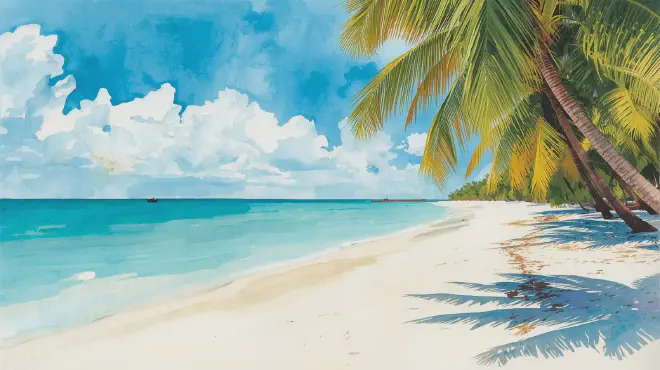
Aruba. A small island floating just thirty kilometers off the coast of Venezuela in South America. Among the Caribbean islands, this one lies south of the hurricane belt, blessed with mild weather year-round. Its nickname, “One Happy Island,” is no exaggeration. With over 300 days of sunshine annually—an astonishing rate—constant trade winds, white sandy beaches, and transparent turquoise waters, it seems almost too perfect.
But Aruba’s charm extends far beyond its beautiful beaches. There’s the unique culture born from its history as a Dutch territory, rock paintings that preserve traces of the indigenous Arawak people, and Papiamento, the island’s own distinctive language. On the island’s northern side, rugged rock formations spread across the landscape, and divi-divi trees lean diagonally, bent by the relentless wind. Their posture seems to embody the very history this island has traversed.
In just two nights and three days, I wouldn’t be able to know everything about this island. Even so, I was seeking something here on this small patch of land. To spend time slowly, away from daily life. That alone, I thought, would be enough.
Day 1: Led by the Wind
Stepping off the plane at Queen Beatrix International Airport, the harsh Caribbean sun immediately stung my skin. But just as quickly, a pleasant breeze caressed my face. This wind, I would later learn, is the magic that transforms Aruba from a scorching hell into paradise.
I took a taxi from the airport to my accommodation in Oranjestad. The scenery passing by the window differed slightly from my imagined Caribbean image. Instead of lush tropical rainforest, I saw a dry landscape dotted with cacti. “Aruba has a desert climate,” Manuel, my driver, explained. His English, accented with Papiamento inflections, had a musical quality that was pleasant to hear.
After dropping my luggage at the hotel, I decided to walk through central Oranjestad. It was past 3 PM, but the sun remained strong. Still, thanks to the wind, it wasn’t unbearable. Walking down the main street, pastel-colored Dutch-style buildings caught my eye. It was a curious sight, as if a European streetscape had been transplanted into the Caribbean.
I had a late lunch at a café tucked away in an alley. I ordered “keshi yena,” a local dish. It’s made by hollowing out a round of Dutch Edam cheese and filling it with chicken, tomatoes, olives, raisins, and other ingredients, then baking it in the oven. One bite revealed an exquisite blend of rich cheese flavor and sweet-savory filling. The shop owner told me it originated during colonial times when servants would stuff leftover ingredients into cheese shells. History condensed into a single dish.
After eating, I walked to the Willem III Tower. This small fortress, built in 1868, is one of Oranjestad’s oldest structures. Now it houses a tourist information center, but once it must have served as a lookout point over the harbor. Around the tower, locals gathered, chatting leisurely. No one seemed in a hurry. I was beginning to understand this island’s rhythm of time.
At dusk, I headed to Eagle Beach, about fifteen minutes by car from Oranjestad—one of the island’s most famous beaches. I arrived just as the sun was approaching the horizon. Walking barefoot on the white sand, I found it surprisingly fine and silky. Standing at the water’s edge, transparent waves gently washed over my feet.
I sat in a beach chair and watched the sun slowly sink. The sky turned orange, then shifted to purplish pink. Around me, others were watching the same sunset—couples, families, and solo travelers like myself. Each person quietly savored the moment. No one spoke loudly. Only the sound of waves and wind could be heard.
When the sun had completely set, I made my way to a beachfront restaurant. I chose a small seafood place popular with locals. I ordered “pisca cora pampan”—fried fish with tostones, twice-fried plantains. The fish was incredibly fresh, crispy on the outside and tender inside. The sweetness and saltiness of the tostones seeped into my tired body. Drinking Aruba’s local beer, Balashi, I reflected on the day.
I returned to my accommodation past 10 PM. After showering, I lay down on the bed. Opening the window, I could hear distant waves. Though it was only my first day, I felt an odd sense of familiarity, as if I’d been to this island many times before. A strange illusion. Closing my eyes, I immediately fell asleep.
Day 2: Touching the Island’s True Face
I woke at 5:30 AM. Not from jet lag, but naturally. Outside was still dim, but I could hear birds singing. I got ready and headed to a bakery near the hotel. At this small shop bustling with locals, I bought “pan boli,” a traditional breakfast bread filled with ham, cheese, and tomatoes. Sitting on a bench with hot coffee, I ate while people on their way to work greeted me. “Bon dia.” Good morning. The sound of these words felt comforting.
In the morning, I decided to explore the northern part of the island. Renting a car, I drove north along the coastal road. The scenery gradually changed. In contrast to the gentle beaches of the south, the north was rugged. Rocky shores met violent white waves. The wind was noticeably stronger.
Entering Arikok National Park, I encountered a sight of divi-divi trees all leaning uniformly to the southwest. These trees have been sculpted like living art by the relentless trade winds. I felt both the power of nature and the adaptability of plants. Parking the car, I walked for a while. Cacti grew at my feet. Lizards sunbathed on rocks. It felt like another planet.
I visited the Ayo and Casibari rock formations. Massive granite boulders were stacked in mysteriously balanced formations. On the rock surfaces, petroglyphs left by the indigenous Arawak people were visible. Geometric patterns and animal figures painted in red pigment. Hundreds of years ago, what were they thinking, what were they praying for in this place? Climbing between the rocks, I reached a viewpoint overlooking the entire island. Blue sea, brown earth, white sandy beaches. I could see everything the island had to offer.
Around noon, I arrived at the California Lighthouse at the island’s northern tip. Built in 1914, this white lighthouse still serves as a landmark for passing ships. The area around the lighthouse was crowded with tourists. I bought fresh coconut water from a nearby stand and gazed at the sea with the lighthouse at my back. The wind was strong. My hair whipped across my face. But this wind felt good.
For lunch, I went to a local eatery in the Savaneta district frequented by residents. The menu was written in Papiamento, which I could barely read. When I asked the woman working there, “What do you recommend?” she smiled and pointed to something. What arrived was “carne stoba,” a beef stew with rice, and “funchi,” a dish made from boiled cornmeal. The stew had a deep, rich flavor, clearly slow-cooked over time. The simple taste of funchi paired well with the hearty stew. Eating among the locals, I almost forgot I was a traveler.
In the afternoon, I headed to Baby Beach at the southeastern tip of the island. True to its name, it’s a beach with calm, shallow waters, popular with families. Being a weekday afternoon, it was relatively quiet. The water clarity was exceptional—even at knee depth, I could see countless tropical fish swimming. I rented snorkeling gear and entered the water.
Underwater was another world. Blue, yellow, purple, orange. Colorful fish swam gracefully, seemingly unbothered by my presence. Weaving through the coral reefs, I spotted a sea turtle swimming slowly. I held my breath and stayed still. The turtle passed beside me and disappeared into the depths. I must have spent over an hour underwater. I’d lost all sense of time.
Leaving the beach, I stopped in the town of San Nicolaas. Once an industrial town with an oil refinery, it’s now known as the “Art Capital of the Caribbean.” Every wall in town is painted with vibrant street art. Works by local and international artists have transformed the entire town into a gallery. With each turn down a new alley, I encountered new pieces. Some carried social messages, others were purely beautiful, some humorous. Through the art, I could feel how this town was being given new life.
In the evening, I returned to Oranjestad. For dinner, I went to “The Old Cunucu House,” a restaurant near the harbor. It was a charming place housed in a renovated historic building. I ordered “Red Snapper Creole,” fish cooked in a spicy tomato-based sauce. One bite filled my mouth with complex spice flavors. Africa, Europe, South America, and the Caribbean. Aruban cuisine, a blend of various cultures, truly embodied the island’s history.
After dinner, I walked along the harbor. Oranjestad at night showed a different face than during the day. Buildings were illuminated, and music flowed from restaurants and bars. But it wasn’t noisy. Everything felt moderate, pleasant. Sitting on a bench, I watched people passing by. Tourists and locals alike wore peaceful expressions. Perhaps this island had something that made people calm.
Day 3: Farewell and Memory
On my final morning, I decided to visit Eagle Beach one more time. At 6 AM, there were still few people around. I sat on the sand and watched the sky slowly brighten. Darkness gradually took on a blue tinge, then orange light emerged from the horizon. How many years had it been since I’d watched a sunrise? As the sun rose, the color of the sea changed. From purplish blue to bright turquoise.
I walked along the beach. Strolling at the water’s edge, I reflected on the past two days. The places I’d visited, the food I’d eaten, the people I’d met. It had been a short time, but dense. And more than anything, I’d had time to face myself. Away from daily chaos, simply existing “here and now.” Just that brought a sense of fulfillment.
After returning to the hotel for breakfast, I visited the Aruba Aloe Museum to spend my final hours. Aruba has long been known for aloe cultivation, once one of the island’s major industries. The museum taught me about aloe’s history, cultivation methods, and the manufacturing process. Viewing the exhibits, I contemplated the economic transitions this small island had undergone. The gold rush, aloe, oil, and now tourism. Yet the island’s people remained peacefully unchanged.
Before noon, I went to a stall near the local market for my last meal. I chose “pastechi,” a fried pastry filled with meat or cheese. The freshly fried pastechi was piping hot, the filling juicy. I also had a “batido,” a traditional fruit smoothie made with papaya, mango, banana, and condensed milk. Drinking it somehow made me nostalgic. Probably because I’d grown accustomed to the island’s flavors over these two days.
The time to head to the airport was approaching. As I packed, I burned the view from my window into my memory. Blue sky, white clouds, and the distant sea. When the taxi arrived, I greeted the driver. It was Manuel again. “Will you come back?” he asked. “Surely,” I replied, unsure whether it was politeness or sincerity.
On the way to the airport, I gazed out the window. Familiar scenery flowed past. Divi-divi trees, cacti, pastel-colored buildings. After just two nights and three days, everything felt nostalgic. “You know,” Manuel said, “people who come to Aruba once always come back. This island has that kind of magic.” I had no reason to dispute his words.
After checking in, I headed to the departure gate. One last time, I looked out the window. Beyond the runway, the Caribbean Sea spread out. Was the sea turtle I saw yesterday still swimming beneath those waters? Were the petroglyphs at Ayo still quietly marking time? Were the divi-divi trees still bending in the wind?
The plane took off. Through the window, I watched the island grow smaller. The outline of white sandy beaches, brown earth, and blue sea. I could see Aruba’s entirety. I was struck again by how small this island actually was. Yet this small island contained countless untold stories.
Above the clouds, the island disappeared from view. I leaned back in my seat and closed my eyes. In my mind, I replayed the journey’s memories. The sound of wind, the sound of waves, the rhythm of Papiamento, the taste of keshi yena, the image of the sea turtle, the colors of sunrise. All of it had truly been there.
A Virtual Journey, Real Memories
This journey is imaginary. I never actually went to Aruba. Boarding a plane, watching the sunset at Eagle Beach, eating keshi yena—none of it happened in reality. Everything is a fictional journey woven through words.
Yet strangely, this journey has a tangible presence. The path I traced through writing remains as vivid imagery in my mind. The texture of sand, the strength of wind, the flavors of food, and above all, that island’s characteristic gentle flow of time. These feel so real they’re indistinguishable from actual memories.
Human imagination sometimes transcends reality. Even without visiting a place, with sufficient information and imagination, we can experience being there. Of course, the value of actual travel is irreplaceable. The local air, unexpected encounters, unplanned discoveries—these can only be obtained by actually going to a place.
But there are times when we cannot travel for various reasons. Time, money, health, or global circumstances. In such times, virtual journeys become keys that open doors in our hearts. By reading text, viewing photos, listening to music, we can travel to distant places.
Aruba is a real island. It truly exists, floating in the Caribbean Sea. The landscapes, cuisine, and culture described here are all based on reality. Someday, if I have the chance, I’d like to actually visit this island. And I’d like to discover how close—or how far—what I felt on this virtual journey is to reality.
Until then, this text will remain as a modest travel record. A memory of a journey experienced in my heart, though imaginary. The wind of Aruba continues to blow within me still.