
One of the World’s Loneliest Islands
Ascension Island floats in the South Atlantic. Lying approximately 1,300 kilometers northwest of Saint Helena and some 1,600 kilometers from the African coast, this small British Overseas Territory spans a mere 88 square kilometers.
Formed by volcanic activity, the island was discovered by a Portuguese navigator in 1501 and named for the feast of the Ascension, on which day it was sighted. Rising at its center is Green Mountain, standing 859 meters tall—a symbolic presence that brought life to what was once barren land. In the nineteenth century, the Royal Navy undertook a planting program, and today a miraculous cloud forest spreads across its slopes.
Around 800 people call this island home: personnel working at military installations, staff from the BBC relay station, and researchers devoted to sea turtles. Ascension Island is known as one of the world’s largest nesting grounds for green turtles, with thousands coming ashore to lay their eggs between November and May each year.
Though the island has an airport, scheduled flights arrive only about once a week—either via Saint Helena or aboard Royal Air Force aircraft. This is, in every sense, one of the world’s loneliest islands.
Day 1: Volcanic Memories and a Starlit Welcome
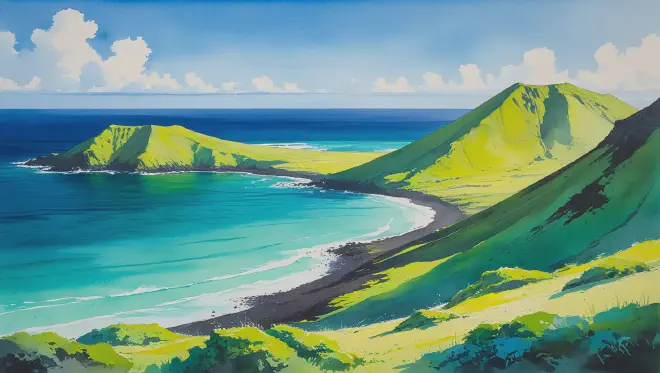
As morning light filtered into the cabin, I caught my first glimpse of a black volcanic island below. Landing at Wideawake Airfield felt like touching down on the surface of the moon. Rust-red lava fields stretched around the runway, and in the distance, the sea shimmered an impossible emerald green.
Immigration was remarkably simple. Mike, the officer on duty, greeted me with a warm smile. “Welcome to Ascension Island. You’re the third tourist this month,” he said with a grin. On an island this small, a new face must be something of an event.
The drive to Observatory Lodge was a journey into another world. On both sides of the paved road, bare black lava stretched toward the horizon. Here and there, patches of green clung stubbornly to the rock, testaments to life’s persistence. Jim, my driver and something of an amateur geologist, explained that the island was relatively young in volcanic terms, with its last eruption occurring several thousand years ago.
I had lunch at a small café beside Saints Store, the island’s only supermarket. The menu was limited, but the fish and chips—made with tuna caught in local waters—exceeded my expectations. Simple preparation let the freshness of the fish speak for itself. Sarah, the café owner, laughed as she told me, “The fish here is always fresh and delicious. Vegetables, though—that’s another story. Everything has to come in by ship.”
In the afternoon, I wandered through Georgetown, the island’s capital. The center of an island with 800 inhabitants was even smaller than I had imagined. A post office, a police station, a hospital, and a church stood scattered across a quiet townscape. Most buildings shared a uniform look—white walls beneath red roofs—lending the place a faintly Mediterranean air.
St. Mary’s Church, a small stone structure built in 1843, carried the weight of the island’s history. Inside, stained glass cast colored light across the silence, and I found myself forgetting time. In the churchyard, headstones marked the resting places of naval servicemen who had died far from home. Something tightened in my chest as I thought of their stories—lives lived and ended on this remote speck of land.
Toward evening, I made my way to Long Beach on the southwestern coast. The black volcanic sand made a striking shoreline. With only the sound of waves for company, I watched the sun sink toward the horizon. In that moment when it slipped beneath the water, the sky burned orange, and I found myself without words.
That night, I sat on the terrace of the lodge and looked up at the stars. Free from light pollution, the sky above Ascension Island was like an overturned jewel box. The Southern Cross hung within reach, and the Milky Way arched overhead. Never in my life had I seen such a sky. Tom, the lodge’s caretaker, lent me binoculars and said quietly, “This sky is the island’s greatest gift.” A simple supper of local bread and tea shipped from England felt more than sufficient. Eating in such silence was a luxury unknown in city life. On my first night here, I already knew I had fallen under the island’s spell.
Day 2: Cloud Forest and Ancient Seas
The morning began with a climb up Green Mountain. The path to the island’s highest point was also a journey through one of Ascension’s most remarkable stories. As I gained elevation, the landscape shifted from barren volcanic rock to lush forest—a transformation nothing short of miraculous.
Before the mid-nineteenth century, when the Royal Navy began its planting program, this peak was known simply as “the bare mountain.” At the suggestion of botanist Joseph Hooker, plants were brought from around the world and set into the soil. Today, a cloud forest flourishes here. Walking the trail and imagining how this man-made forest had slowly become its own ecosystem, I could not help but feel humbled by human effort and perseverance.
Near the summit, thick clouds wrapped the mountain in mystery. Ferns and mosses grew in profusion, and I felt as though I were walking through some primordial wood. Endemic plants appeared here and there, quietly living out their existence as part of this singular ecosystem.
From the top, the view stole my breath. Through gaps in the clouds, the entire island spread below—a volcanic cone surrounded by the deep blue of the Atlantic. Standing there, I felt anew the miracle of this small island adrift in such a vast sea.
I ate lunch in a small hut near the summit: sandwiches I had packed and a thermos of hot coffee. Drinking coffee in the mist was a pleasure of its own, and the calls of birds filled the silence. Among them I heard the cry of the Ascension frigatebird, endemic to this island—a reminder of the richness of life that has taken hold here.
In the afternoon, I visited Two Boats Village in the north. One of the island’s oldest settlements, it preserves traces of the nineteenth-century naval base. Stone ruins stand scattered across the landscape, speaking of lives once lived. Peter, my guide and a local historian, said with a reflective tone, “This village was built as a naval outpost in the early 1800s. I often wonder what those soldiers felt, living so far from home.”
Walking among the ruins, I felt the weight of the island’s past. During the Napoleonic Wars, Ascension served as a vital supply station; countless ships stopped here for water and provisions. The silent ruins must once have bustled with activity.
As evening approached, I went to Comfortless Cove to watch for sea turtles. This was nesting season for green turtles, and with luck I might witness a laying. As darkness fell, a large green turtle finally emerged from the surf. Over a meter in length, she moved slowly up the beach, searching for the right place to nest.
To witness the moment of laying was nothing short of miraculous. Using her back flippers with surprising dexterity, she dug a hole and deposited nearly a hundred eggs. Watching this sacred act, I was moved deeply by the mystery of life and the wonder of nature’s ways. Dr. Harris, a researcher stationed on the island, explained, “Ascension Island is one of the most important green turtle nesting sites in the world. Around 15,000 females come here each year to lay their eggs.”
That night, I was invited to the home of David, who works at the BBC relay station. The fish stew he prepared—made from fish caught in the waters around Ascension and seasoned with spices—was exquisite. “The cooking here,” David told me, “is a fusion of British, African, and the many cultures that sailors brought with them over the years.”
After dinner, we talked at length about life on the island. “Everyone here is like family,” he said. “When someone needs help, we all pitch in. There’s a depth of connection here that you don’t find in city life.” Material wealth may be scarce, but the strength of human bonds is this island’s greatest treasure.
Day 3: Farewell Shores and Lasting Memories
My final morning began with a visit to Devil’s Riding School, a formation of strange rock spires. Shaped by volcanic forces, the landscape looked almost extraterrestrial. The sculptural beauty of the black lava was a work of natural art.
This site also tells the story of the island’s geological past. Mark, my guide, explained, “These rocks were formed by an eruption about a million years ago. They’re valuable evidence of how violent the volcanic activity once was.” Tracing the patterns of ancient lava flows on the rock surfaces, I found myself imagining the island’s dramatic birth.
Later in the morning, I visited the Ascension Island Museum. Small though it was, it offered an essential window into the island’s history and culture. Naval artifacts, materials on turtle ecology, and photographs documenting daily life on the island wove together a rich tapestry of stories.
What moved me most were letters written by nineteenth-century sailors. In their words of longing for distant homes, I sensed both the hardships of life on this isolated island and the quiet strength of those who never lost hope. These were precious reminders of a resilience that we in the modern world too easily forget.
Lunch—my last meal on the island—was at a restaurant near English Bay. Simple fish dishes and a proper British roast beef brought my two days of memories to a delicious close. Through the window, the blue of the Atlantic seemed to quietly announce that my time of departure was near.
I spent the afternoon at Comfortless Cove, letting the sound of the waves carry my thoughts back over the past two days. The warmth of the people I had met, the untouched beauty of the natural world, the weight of the island’s history—all of it had carved itself into my heart.
Walking along the sand, I remembered the turtle laying her eggs the night before. That glimpse into the mystery of life, the wonder of nature’s rhythms—I knew I would carry it with me always. I understood now why this place is called one of the world’s loneliest islands, and yet within that loneliness I had found a richness all its own.
On the way to the airport, Jim said, “You’ll come back. Everyone who experiences Ascension Island comes back.” I nodded deeply. There is something about this place that draws people in.
Waiting in the departure lounge, I tried to gather my thoughts about what I had experienced. This journey had made me think about what true richness really means—not material wealth, but connection between people, harmony with nature, and the quiet time to face oneself. This small island had taught me the value of these things.
As the plane lifted off, I looked down at the island one last time. It lay below like a jewel floating on the sea—the green of Green Mountain, the black of volcanic rock, the blue of the encircling Atlantic. That contrast of colors seemed to capture everything the island is: its diversity, its beauty.
From above, Ascension Island was already becoming a distant memory. And yet I knew with certainty that what I had experienced here would live on within me forever. The richness found in solitude, the mystery of nature, the warmth of human kindness—all of it had given me something new to carry forward in my life.
A Journey That Felt Real, Though Imagined
This journey was born of imagination, and yet in my heart it remains as vivid as any memory I have truly lived. The texture of volcanic rock beneath my fingers, the damp air of the cloud forest, the quiet awe of watching a turtle lay her eggs, the warm conversations with the island’s people—all of it breathes within me with a reality that surpasses imagination.
Travel is not only about physical movement. Journeys of the mind, journeys of imagination, can enrich our lives just as profoundly. Through this imaginary voyage to Ascension Island, I came to understand once more what travel truly means.
The longing for unknown places, the anticipation of new experiences, the discoveries and emotions found along the way—perhaps there is no essential difference between a journey taken and a journey imagined. What matters is the openness to receive a new world and the will to learn from it.
This imagined journey to a faraway island became, for me, more real than reality itself. Each time I return to these pages, I know I will see again the beautiful landscapes of that island and revisit it in my heart. As a memory born of imagination yet undeniably real, this journey will walk beside me through the rest of my life.