
A City Quietly Beating in the Heart of South America
When you mention the name Paraguay, many people conjure only a vague image of somewhere in South America. Nestled between the two giants of Brazil and Argentina, this landlocked nation without access to the sea is often called “the heart of South America.” And the place where you can feel that heart beating most clearly is the capital city, Asunción.
This city, standing quietly along the banks of the Paraguay River, is one of the oldest in South America, founded by Spanish conquistadors in 1537. The streets where colonial architecture mingles with modern buildings tell the story of time passing like rings in a tree trunk. With a population of around 500,000, the city feels small compared to South America’s major metropolises—but that intimacy brings people closer together, and you can feel the warmth of human connection everywhere you go.
Paraguayan culture is an exquisite blend of indigenous Guaraní traditions and Spanish colonial influences. Both Spanish and Guaraní are official languages, and walking through the streets, you’ll naturally hear both flowing around you. This bilingual culture forms the very core of Paraguayan identity.
The climate is subtropical, and March, when I would visit, marks the transition from late summer into autumn. Though the heat still lingers, pleasant breezes caress your cheeks at dusk. During this season in Asunción, mangoes and papayas ripen, and sweet fragrances drift through the street corners.
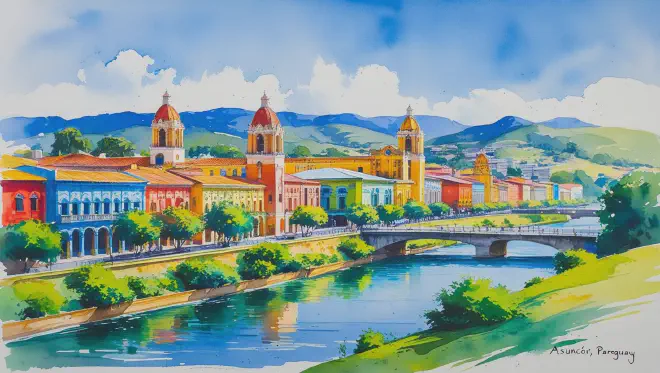
Day 1: First Steps into the Ancient City Cradled by the Paraguay River
It was just past ten in the morning when I touched down at Silvio Pettirossi International Airport. The airport isn’t particularly large, but that only adds to its welcoming, homey atmosphere. The male immigration officer responded to my clumsy Spanish greeting with a warm smile. “¡Bienvenido a Paraguay!” (Welcome to Paraguay!) Those words lifted my anticipation for the journey ahead.
On the taxi ride into Asunción’s city center, red earth and scattered low-rise houses stretched beyond the window. My driver, Carlos, was a cheerful middle-aged man who enthusiastically shared Paraguay’s charms through broken English and animated gestures. “Asunción is a small city,” he said, “but its heart is big.” Those words stayed with me.
At half past eleven, I checked into my hotel in the city center. The building was a colonial-style structure reimagined with modern touches, its lobby adorned with paintings by local artists. From my room’s window, I could see the Paraguay River flowing by, with the town of Lambaré visible on the opposite bank. I gazed at the sunlight sparkling on the water’s surface, letting the fatigue from my long journey melt away.
For lunch, I walked about five minutes to a popular local restaurant called Don Pedro. Facing a menu I couldn’t make heads or tails of, a waitress named Mariana kindly explained each dish. I ordered “sopa paraguaya,” one of Paraguay’s signature dishes. This warm, soupy creation made from corn flour and cheese was rustic yet deeply satisfying—a flavor I had never encountered before. The accompanying “chipa,” a bread made from cassava flour, had an addictively chewy texture.
In the afternoon, I wandered through Asunción’s historic district. My first destination was Plaza de Armas (Arms Square). This central plaza has served as the heart of the city since its founding in 1537. In the center stands a bronze statue of Francisco Solano López, one of Paraguay’s national heroes. Surrounding the square are significant buildings: the Presidential Palace (Palacio de López), the National Congress, and the Cathedral. The white walls of the Presidential Palace were particularly beautiful, gleaming in the afternoon sunlight.
Stepping inside the Cathedral, the clamor of the outside world seemed to vanish, replaced by profound silence. Colorful light filtered through stained glass windows into the dim interior, creating a mystical atmosphere. Watching local people deep in prayer, I could sense the profound faith rooted in this city.
Around the plaza, vendors had set up stalls selling handicrafts and folk art. What caught my eye most was “ñandutí,” a traditional form of lace-making. The delicate patterns, reminiscent of spider webs, were exquisitely beautiful. When I spoke with the woman crafting them, she told me it takes several weeks to complete a single piece. Moved by such painstaking craftsmanship, I purchased a small coaster.
As evening approached, I strolled along the “Costanera,” the riverside promenade along the Paraguay River. The river was wider than I had imagined, its leisurely flow calming my spirit. People fishing, young joggers, couples chatting on benches—everyone passing their time as they pleased, a scene that spoke to the gentle rhythm of daily life in this city.
As the sun began to sink westward, the river’s surface turned golden. The lights of Lambaré across the water started flickering on one by one, creating a landscape tinged with nostalgia. In that moment, I felt I had truly become part of this city called Asunción.
For dinner, I went to a steakhouse called La Cabaña, recommended by a local. Paraguay has a thriving cattle industry, and the quality of beef is exceptional. The “asado” (grilled meat) I ordered was tender beef slowly cooked over charcoal, simply seasoned with rock salt to bring out the meat’s true flavor. The “mandioca” (cassava) I ordered alongside it had a fluffy texture that paired perfectly with the meat.
During the meal, I naturally fell into conversation with a family at the next table. They had come out to celebrate the weekend, and through them I glimpsed the strong family bonds so characteristic of Paraguayan life. The father, Luis, worked in construction and told me they were planning to visit Itauguá, a town famous for pottery, the next day.
Walking back to the hotel, I enjoyed the city’s nightscape. Asunción’s nights are far from flashy, but the streets bathed in warm lamplight have their own unique charm. The distant sound of a guitar drifted through the air, bringing my first day to a wonderful close.
Day 2: A Day Immersed in Traditional Crafts and Nature’s Blessings
I woke at six to the sound of birdsong. Mornings come early in Paraguay, and the city was already beginning to stir with life. The hotel breakfast consisted of fresh fruit, bread, and local “mate” tea. Mate is beloved throughout South America, but Paraguay’s version has a slight sweetness that makes it easy to drink. Locals share mate with family and friends from morning to night, passing the gourd around as a way of deepening connections.
At eight o’clock, my day began with a chance reunion with Luis’s family from the night before. We ran into each other in the hotel lobby, and they invited me to join them on their trip to Itauguá. Not wanting to miss the opportunity, I accepted their offer to ride along.
Spending the roughly forty-minute, thirty-kilometer journey with Luis’s family was an unexpected gift. Their twelve-year-old son, Marcos, was studying English and peppered me with earnest questions. “Are there soccer teams in Japan?” “Is sushi really made with raw fish?” I answered his pure curiosity with equal enthusiasm.
Itauguá is a small town known as “the town of pottery.” When we arrived, the contrast between the reddish-brown earth and the blue sky was striking. Pottery workshops dotted every corner of the town, with artisans quietly dedicated to their craft. We visited “Alfarería Tradicional,” a long-established workshop with over fifty years of history.
The workshop’s master, Don Emilio, was a skilled potter in his seventies. In his hands, simple clay transformed before my eyes into beautiful vases and plates. “The key is to have a dialogue with the clay,” he said—words that captured the philosophy of a true craftsman. I tried my hand at it too, though the clay wouldn’t cooperate with my intentions. Still, through the sensation of the clay, I felt a primal joy of creation.
In the workshop’s courtyard, Don Emilio’s wife served us lunch. It was “locro,” a traditional stew made with beans, vegetables, and a little meat—simple and nourishing. The homemade “empanadas” (stuffed pastries) that came with it radiated warmth that only handmade food can offer.
After lunch, I said goodbye to Luis’s family and returned to Asunción to visit the botanical garden in the afternoon. The “Jardín Botánico y Zoológico” is about a twenty-minute bus ride from the city center. It serves as both a botanical garden and a zoo, offering a precious opportunity to experience Paraguay’s rich natural heritage all at once.
Upon entering, I was immediately struck by the massive ceiba tree. This centuries-old giant embodied the very majesty of nature. Surrounding it were numerous plants native to Paraguay, which a female staff member patiently explained to me. Particularly memorable was the jacaranda tree. This tree, which blooms with beautiful purple flowers, is also Paraguay’s national flower.
In the zoo section, I encountered animals unique to South America. Armadillos, capybaras, and vibrantly colored parrots. Most impressive was the “jaguarundi,” a small wild cat known for being wary and rarely showing itself—but that day, I was lucky enough to spot one sunbathing. I found myself captivated for some time by its expression, wild yet endearing.
On the bus back to the city in the late afternoon, the sunset view from the window was magnificent. The evening sun painting Paraguay’s landscape cast a special kind of beauty beneath the endless sky. An elderly woman sitting next to me on the bus smiled and said, “Our country may be small, but our sky is the biggest in the world.” In those words, I felt the pride and love Paraguayans hold for their homeland.
That night, I visited “Peña Folklórica,” a live folk music venue in the Mercal district. Being a weekend night, the place was bustling with locals. On stage, musicians performed on guitar and arpa (Paraguay’s distinctive harp). The arpa’s sound, in particular, was delicate and beautiful, resonating deep within my heart.
They played “guarania,” a traditional Paraguayan music form. The lyrics, mixing Spanish and Guaraní, often speak of love and longing for home. Even without fully understanding the words, the emotions conveyed through the melodies and the singers’ expressions were universal—I found myself moved to tears.
Many in the audience sang along. Watching this scene, I was reminded anew of music’s power to connect hearts. During intermission, a young couple at the neighboring table struck up a conversation with me, passionately teaching me about Paraguayan music. Their love and pride for their musical heritage warmed my heart as well.
Walking back to the hotel that night, the beautiful sound of the arpa still echoed in my mind. Throughout this day, I had touched the depth of Paraguay’s traditional culture and the richness of heart in those who carry it forward. That was the great treasure of this journey.
Day 3: A Morning of Farewell and Scenes That Linger in the Heart
On my final morning, I woke earlier than usual. Perhaps somewhere in my heart, I sensed that my time in this city was drawing to a close. Looking out the window, I saw a thin mist hovering over the Paraguay River. The dreamlike scene held my gaze for some time.
After packing, I enjoyed one last breakfast before checking out. The familiar mate tea tasted somehow special that morning. The hotel staff called out to me warmly, “Please come back again.” Even in such a short stay, I felt the small bonds we had formed.
That morning, I decided to explore “Mercado 4,” a market I hadn’t yet visited. This is Asunción’s largest market, a kitchen for the common people where you can find everything from food to daily goods to clothing. Though it was only eight in the morning, the market was already crowded with shoppers.
Inside, the market was like a maze, a swirl of various smells and sounds. In the vegetable section, unfamiliar South American produce was piled high. In the fruit section, mangoes, papayas, and passion fruits were arranged in vivid colors. A vendor let me sample a mango—it was sweeter and richer than any mango I had ever tasted.
In the meat section, enormous cuts of beef hung from hooks, butchers slicing off portions to order. The fish section displayed freshwater fish caught from the Paraguay River. Among them was “surubí,” a large river fish that I was told is essential to Paraguayan cuisine.
In one corner of the market, I found a stall where an elderly woman was making “sopa paraguaya.” Nostalgically recalling the taste from my first day, I ordered it again. It was just as warm and gentle as before, soothing my travel-weary soul. When the grandmother realized I was a foreigner, she asked, “How did you find Paraguay?” When I answered, “It’s a wonderful country,” her eyes, framed by deep wrinkles, lit up with joy.
Leaving the market, I walked along the Costanera one last time. Unlike the previous day, it was a weekday morning, and there were fewer people about. The Paraguay River still flowed leisurely, the view of the opposite bank still peaceful. I sat on a bench and reflected on the past three days.
The faces of everyone I had met floated through my mind. Carlos the taxi driver, Mariana from the restaurant, Don Emilio in Itauguá, Luis and his family, the staff at the botanical garden, the elderly woman on the bus, the young couple who taught me about music, the grandmother at the market. Every one of them had welcomed me with warmth.
Paraguay may be a small country in the scheme of the world map—not particularly well-known on the global stage. But that very smallness brings people closer together, and travelers are treated like members of the family. Though perhaps not wealthy in economic terms, in richness of heart, this country yields to no other.
At one in the afternoon, I called a taxi to the airport. The driver was different from the one who brought me, but he too was a cheerful and kind middle-aged man. When he asked, “Did you like Paraguay?” I answered from my heart: “Yes, I fell in love with it.”
At the airport, with some time to spare, I did my final shopping at the souvenir store. A ñandutí tablecloth, pottery from Itauguá, and Paraguayan honey. Each item was a tangible memory of this journey.
After completing my boarding procedures, I looked out at Asunción from the waiting area. A small city—but one that had left a profound impression on my heart over these three days. Surely, I will think of this city again and again in times to come.
As the plane took off, Paraguay’s landscape spread out below. Red earth, green grasslands, and the Paraguay River flowing gently. Even from above, the serenity and beauty of this country remained unchanged. Leaning against the window, I whispered in my heart: “Thank you, Paraguay.”
What Was Felt Though Imagined
This journey was imaginary, and yet it feels as though it truly existed somewhere within my heart. The streets of Asunción, the flow of the Paraguay River, the smiles of the people I met, the beautiful sounds of traditional music, the simple and warming taste of the food—all of these remain vivid in my memory even now.
Paraguay may be a small presence on the world map. But the warmth of its people, the richness of the culture passed down through generations, and the beauty of its nature are far from small. If anything, this country seems to carefully preserve the precious things that modern society tends to forget.
Travel is not only about visiting new places. It is also about seeing ourselves anew through new encounters. Through this imaginary journey, I was reminded once again of the importance of human connection, the meaning of respecting culture, and what richness of heart truly means.
The “bigness of heart” that the people of Paraguay showed me is surely the true charm of this country—something anyone who actually visits would feel as well. Should the day ever come when I truly set foot in this land, I dearly hope to be greeted by the same warm smiles as those I met in this imaginary journey.