
Introduction
Avebury. Just speaking this name aloud seems to stir something from deep within my memory. This small village nestled in the verdant hills of Wiltshire is embraced by one of the world’s largest Neolithic stone circles. Located about 30 kilometers north of Stonehenge, the place remains relatively unknown as a tourist destination, which only deepens its silence and mystery.
The construction of Avebury’s stone circle is believed to have begun around 2600 BCE. It boasts a monumental scale, with an outer circle approximately 340 meters in diameter. Within this great circle lie two smaller circles, and it’s thought that over 100 megaliths were once positioned throughout. Even today, 27 standing stones preserve their ancient form, and woven between them, a modern village breathes with life.
This is not merely an ancient ruin. It is a living stage of history where stone and humanity coexist. Villagers hang their laundry beside 5,000-year-old megaliths, and children play around what were once ceremonial sites. In this place where time seems to flow gently, I decided to spend three days.
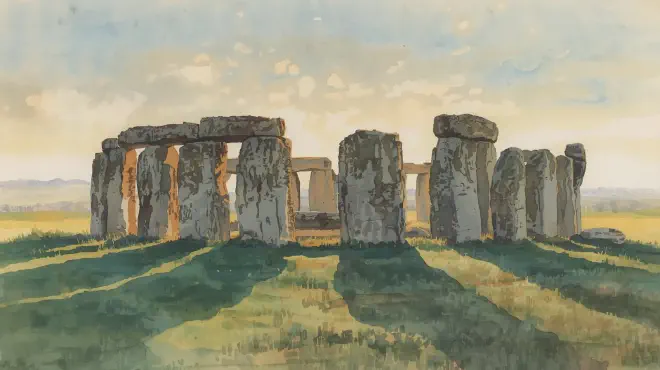
Day 1: Arrival in a Village Where Time Stands Still
From London’s Paddington Station, I took a train to Swindon, then swayed along on a local bus for about an hour. Around 11 AM, I stepped off at the edge of Avebury village. The moment I began walking from the bus stop, a massive stone loomed before me. This was the outer perimeter of Avebury Stone Circle. No information boards, no fences. The stone simply stood there, serene and imposing.
I approached and placed my palm against it. The rough surface was cold, carrying the weight of 5,000 years. These sarsen stones, as they’re called, are sandstone transported from the nearby Marlborough Downs, each weighing dozens of tons. How did ancient people move and erect these enormous stones?
I spent the morning wandering through the village center. What’s peculiar about Avebury is how the ancient sacred site and modern life naturally blend together. The Red Lion pub, built in the 16th century, sits right in the center of the stone circle. It’s one of the few pubs in the world located in the middle of an ancient monument.
I decided to have lunch at the Red Lion. Stepping into the thatched-roof building, I found a warm space enclosed by low ceilings and old wooden beams. I ordered shepherd’s pie made with local lamb and enjoyed it with a pint of Wadworth 6X. Through the window, standing stones were visible, giving me the strange sensation of dining with ancient deities.
In the afternoon, I visited Avebury Manor and its gardens on the southern side of the village. This 16th-century manor house is now managed by the National Trust. The beautiful stone building and the geometrically designed gardens behind it exuded an artificial beauty that contrasted with the wild, ancient stone circle. Walking through the gardens, I felt the layered charm of Avebury, where different eras of aesthetic sensibility overlap.
My accommodation was a small B&B on the village outskirts called The Old Vicarage. Converted from a 19th-century vicar’s residence, the stone-walled building was draped with ivy, and colorful flowers bloomed in the small garden. The proprietress, Margaret, was a kind woman in her seventies who welcomed me with tea and homemade scones.
“Avebury is a special place,” she said. “Living here, sometimes I feel as though the stones speak to you. Especially on misty mornings or moonlit nights.”
For dinner, I went to the Circle Café, a small village restaurant. The establishment is known for its simple cuisine focusing on local ingredients. The main course—Wiltshire pork tenderloin with local vegetables—was a dish that allowed me to savor the bounty of the land.
After nightfall, I walked through the stone circle once more. The village, without street lights, was darker than I’d imagined, and a canopy of stars spread overhead. The standing stones, illuminated by moonlight, showed a completely different face than during the day. In the silence, the only sound was the distant bleating of sheep. It was a mystical night where time seemed to stand still.
Day 2: A Day Tracing the Memory of the Land
Around 6 AM, I woke to birdsong. Outside the window, thick fog enveloped everything, with only the tops of the standing stones faintly visible. Remembering Margaret’s words, I quietly stepped outside. The stones in the mist truly seemed alive—like ancient guardians who had remained unchanged since time immemorial, protecting this place.
Breakfast was a traditional English breakfast: eggs from a local farm, Wiltshire bacon, homemade black pudding, fresh toast with Margaret’s own marmalade. Everything was simple yet carried the authentic taste of the land.
In the morning, I walked along West Kennet Avenue, which extends north from Avebury. This is an ancient processional way about 2.5 kilometers long, connecting the stone circle to The Sanctuary to the south. Standing stones once lined both sides, though only some remain today. Still, tracing the stones scattered across the green hills, I felt as though I could relive the experience of ancient pilgrims.
Along the way, I met a local shepherd named John, a gentle man in his sixties. “My grandfather’s generation has kept sheep on this land,” he told me, sharing fascinating stories about the stones.
“The sheep graze while avoiding the stones. It’s as if there’s an invisible boundary around them. Perhaps animals can sense something we humans cannot.”
In the afternoon, I visited West Kennet Long Barrow, about a 15-minute drive from Avebury. This Neolithic burial chamber, approximately 100 meters long, is even older than Avebury, dating to around 3700 BCE. Entering through the entrance, I found stone corridors divided into five chambers. Stepping into the dim interior, along with the cool air, I was enveloped by a sense of the prayers and thoughts of ancient peoples lingering there.
On the return journey, I stopped at Silbury Hill. This is the largest artificial mound in Europe, an impressive conical hill 40 meters high. Climbing to the summit is prohibited, but simply gazing at its orderly, beautiful form fills one with wonder at the advanced technical skill and aesthetic sense of ancient people.
In the evening, I returned to the village and purchased local ingredients from a small shop. Wiltshire cheese, wholemeal bread baked at the local bakery, apples harvested from a nearby orchard. I had a simple dinner in the B&B’s garden while reflecting on the day.
That night, I walked the stone circle again. Unlike the previous night, countless stars twinkled in a cloudless sky. In Avebury, with almost no light pollution, even the Milky Way was clearly visible. Did ancient people gaze up at this same starry sky? There are theories that the stone circle was used for astronomical observations, and looking up at the stars, I felt such possibilities were entirely plausible.
I remembered Margaret mentioning that “on special nights, some people have seen glowing orbs floating between the stones.” There’s no scientific explanation, but this place certainly possesses something special. Whether one can perceive it perhaps depends on individual sensitivity.
Day 3: A Morning of Farewell and Lingering Thoughts
On my final morning, I woke early again. Today I would begin my journey home. As I packed my belongings, I mentally organized what I had felt during this brief stay. Avebury was not merely a tourist site but a place with the power to work on something deep within the human heart.
After breakfast, I shared a final cup of tea with Margaret in the garden. “Everyone who comes to Avebury is searching for something,” she said. “And many find something before they leave. I wonder if you found something too?”
I couldn’t answer immediately, but I certainly felt that something had shifted within me. These three days had made me reconsider things easily forgotten in urban life—the richness of time’s passage and the relationship between nature and humanity.
In the morning, I slowly walked around the stone circle one last time. Each of the 27 standing stones had its own character, and looking closely at them, it felt as though each held a different story. The largest stone, called the Diamond Stone, stands about 5 meters tall and weighs over 60 tons. Bathed in morning light, it stood with majestic dignity.
I also stopped by the village’s small museum, the Alexander Keiller Museum, named after the archaeologist who conducted excavations at Avebury. The museum displays excavated pottery and stone tools, along with reconstructions of ancient life. Particularly striking was the history of how many stones of the circle were destroyed or buried during medieval times. With the spread of Christianity, the megaliths—symbols of old beliefs—were despised as pagan relics.
For lunch, I returned to the Red Lion. This time I ordered a Ploughman’s Lunch, a local light meal. Wiltshire cheese, ham, pickles, crackers, and local chutney combined into a simple dish, yet each ingredient had a strong flavor that allowed me to feel the earth’s bounty.
At 2 PM, it was time to leave the village. Walking to the bus stop, I bid farewell to the standing stones. “I’ll come again,” I whispered in my heart, and the stones seemed to nod in agreement.
I gazed at Avebury’s stone circle through the bus window until it disappeared from view. The small village, cradled in green hills, rested in an unchanged silence that has endured since ancient times. In this place far removed from the clamor of modern civilization, I felt as though I had remembered something important.
On the train back to London, while writing this three-day journal, I thought about what Avebury had given me. Though difficult to express precisely in words, it was an experience that profoundly shifted my sense of time, awakened my awareness of the relationship between nature and humanity, and made me deeply consider the value of silence so easily forgotten in daily life.
Conclusion
The three days in Avebury, though an imagined journey, remain in my mind as vivid memories as if truly experienced. The time spent within the 5,000-year-old stone circle reminded me of something we in the modern world are losing.
It was the importance of savoring time slowly. Of listening to the rhythms of nature. And of contemplating the thoughts of those who lived on this land long before us. Margaret’s mention of “the stones’ voices” might perhaps be the manifestation of such ancient memories and thoughts taking form.
Though I’ve never actually set foot in Avebury, through this imagined journey, I could genuinely feel the atmosphere of the land, the warmth of its people, and the flow of time continuing since antiquity. I close this travel record with the hope that someday I will truly walk that ground and bathe in the morning sun within the stone circle.
Sometimes, journeys of the heart bring deeper experiences than journeys in reality. The three days in Avebury were precisely such a journey.