
An Ancient Capital Where a Thousand Spires Speak
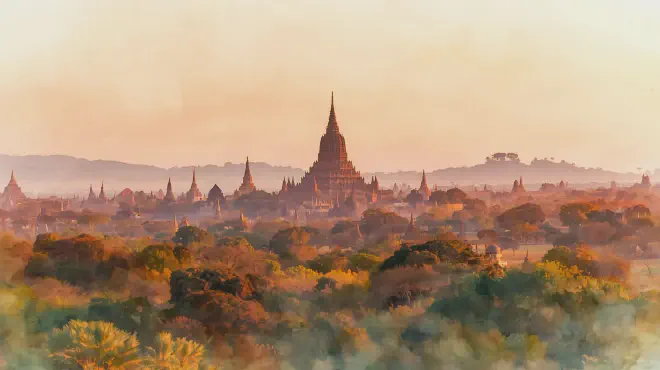
Bagan is an ancient city stretching along the banks of the Irrawaddy River in central Myanmar. During the golden age of the Bagan Kingdom from the 11th to 13th centuries, more than ten thousand Buddhist temples are said to have been built across this plain. Today, roughly two thousand temples and pagodas remain, scattered across the rust-colored earth, wrapped in a stillness that feels as though time itself has paused.
The moment when the gilded tips of pagodas emerge through the morning mist. The sight of brick temples bathed in sunset, extending to the horizon. There is something in this land that makes one forget the noise of the modern world. The devout lives of people steeped in Theravada Buddhism and the memories carved into stone over a thousand years resonate deeply with all who visit.
The Irrawaddy flows leisurely onward, and in the villages along its banks, ox carts still traverse the roads while the scent of thanaka, applied from bamboo containers, drifts on the breeze. Bagan continues to quietly radiate its presence as the spiritual homeland of Myanmar and a sacred site of Southeast Asian Buddhist culture.
Day 1: When the Gates of the Ancient City Open
It was around ten in the morning when I landed at Nyaung-U Airport, having taken a domestic flight from Yangon. From the plane, the Bagan plain had spread out far more vast than I had imagined, with brick-colored dots extending to the horizon, and my heart raced at the sight. The airport was small and humble, but I was greeted by the warm smile of my taxi driver, Min Tun.
“Is this your first time in Bagan?” he asked in fluent English, and I felt my nerves begin to ease. Through the window, the landscape unfolded: palm trees lining red dirt roads, and golden pagodas appearing here and there, gleaming in the sunlight. On our way to the hotel in Old Bagan, he stopped the car and said, “Please, take a look.” It was there that I first beheld the temple complex of Bagan in its entirety. I could barely breathe.
After checking into my hotel, I decided to explore the Old Bagan area on foot that afternoon. My first destination was Ananda Temple, the largest in Bagan. With its white exterior walls and golden spire, this temple was built in 1105 and houses massive standing Buddha statues facing each of the four cardinal directions.
Inside the temple, it was dim, and my footsteps echoed softly. As I stood with my hands pressed together before the south-facing Buddha, an elderly local woman sat down beside me and began chanting prayers in a low voice. Watching her serene expression, I felt the depth of faith rooted in this land. Though we shared no common language, when she smiled at me, something warm settled into my heart.
As evening approached, I headed to Thatbyinnyu Temple. This is the tallest structure in Bagan, and from its upper levels, one can look out over the entire plain. The stairs were steep and narrow, and I was out of breath by the time I reached the top, but the sunset I witnessed there was unforgettable. The western sky turned a deep orange, and the silhouettes of countless pagodas emerged against the light. A breeze brushed my cheek, and from somewhere came the sound of bells.
That night, I had dinner at a small eatery near the Old Bagan market. When I ordered mohinga, a fish soup noodle dish, the owner’s wife smiled and assured me, “Not too spicy, don’t worry.” The broth was rich with fish stock, the noodles thin like somen, and the fragrance of lemongrass stirred my appetite. At the next table, a local family was eating together noisily, the children’s laughter filling the room.
Back at the hotel, I sat in the courtyard with a cup of tea, reflecting on the day. The stars were more beautiful than anything visible in a city; the Milky Way appeared clearly overhead. The faint sound of chanting from somewhere far away deepened the silence of this ancient capital’s night.
Day 2: Adrift on River Winds and the Rhythm of Prayer
I woke at half past four. A hot air balloon ride at dawn, I had heard, was an essential Bagan experience. While it was still dark, a car from the balloon company came to pick me up and took me to the launch site. Together with the other passengers, I climbed into the basket, and slowly, we rose into the sky.
As we gained altitude, the full panorama of Bagan revealed itself below. Temples scattered like jewels across a plain shrouded in morning haze. As the eastern sky began to lighten, the tips of the pagodas started to glow gold. The moment the sun peeked above the horizon, I caught my breath. The view of the ancient city spreading in a 360-degree panorama was nothing short of magnificent.
“Beautiful, isn’t it?” said an elderly German couple standing beside me. “We’ve wanted to come here for fifty years,” the wife said, her eyes glistening. The balloon drifted slowly on the wind, passing over the Irrawaddy River. On the water below, small fishing boats floated, and I could see fishermen casting their nets.
After landing, we toasted with champagne, then I returned to the hotel for breakfast. There was Burmese-style congee, fried dough sticks called “e kya kway,” and sweet milk tea known as laphet yay. The congee was gentle in flavor, with a warmth that seemed to seep into my body.
In the morning, I explored the New Bagan area. First, I visited Shwesandaw Pagoda. While famous for its sunset views, the scenery was also beautiful in the morning. Climbing the steps, I looked out over the Bagan plain, with the distant flow of the Irrawaddy visible in the distance.
Afterward, I took a horse cart ride from Old Bagan to New Bagan. The driver was a man in his sixties named U Tin. “I’ve been doing this job for forty years,” he said with pride. The cart was more comfortable than I had expected, and the time spent moving slowly, feeling the wind, was pleasant. Along the way, we stopped at a small temple, where I met a monk who told me about the history of Bagan.
In the afternoon, I joined a sunset cruise on the Irrawaddy River. On the way to the dock, village children waved at me. The boat was a small wooden craft carrying about fifteen passengers. The river was wide, with lush farmland lining both banks. The boatman pointed and said, “Look, there’s an elephant over there.” Sure enough, I could see an elephant drinking water at the river’s edge.
As the sun began to set, the surface of the river glowed gold. The temples of Bagan on the opposite bank became silhouettes, as beautiful as shadow puppets. On the boat, we all watched the sunset in silence; no one could find words. I heard a French couple nearby murmur softly, “Magnifique.”
That evening, I enjoyed a course of Burmese cuisine at a restaurant in New Bagan. There was tea leaf salad, fish in curry sauce, and sweet-sour tamarind soup, all dishes I was tasting for the first time. Particularly memorable was fish steamed in banana leaves, with a delicate, spiced flavor.
In the restaurant garden, a traditional dance performance was underway. Dancers in glittering costumes moved gracefully to the sounds of Burmese instruments, and the music melted into the night air.
Day 3: Memories Etched on a Morning of Farewell
On my final morning, I decided to visit Ananda Temple once more. Seen at a different hour than on the first day, the temple revealed a different expression. In the main hall, where morning light streamed in, local people were offering fervent prayers, and their devotion moved me deeply.
Walking around the temple, I met a girl selling flowers. In fluent English, she said, “Would you like some flowers? They’re for prayers.” I bought a small bouquet of white blossoms and offered them before a Buddha statue. The girl said “Arigatou” in Japanese, and her smile stayed with me.
Afterward, as a final memento, I visited the Bagan Archaeological Museum. Here were displayed Buddha statues and murals from the Bagan Kingdom era, along with historical documents. Particularly striking were fragments of ancient murals discovered in temples, which spoke to the remarkable skill of people a thousand years ago. A curator explained everything in English, helping me to understand the cultural significance of Bagan more deeply.
At the end of the morning, I wandered through the Old Bagan market in search of souvenirs. Bamboo crafts, lacquerware, and local textiles, all handmade, lined the stalls. What caught my eye was a cosmetic made from thanaka, the powder of a certain tree. The shopkeeper, a woman, applied some to my cheek and said with a laugh, “This will make you beautiful.” The cool sensation was pleasant, and I felt the blessing of nature on my skin.
Lunch was my last meal, taken at the hotel restaurant. I ordered Shan noodles, called shan khauk swe. It was a dish of rice noodles in tomato-based broth, topped with cilantro and fried garlic. The balance of sourness and spice was perfect, a fitting final taste.
In the afternoon, before heading to the airport, I stopped once more at Shwesandaw Pagoda. This time, I explored the interior in detail. The murals depicted the Jataka tales, stories of the Buddha’s previous lives, and the vivid paintings conveyed the weight of history. A local guide explained, “These murals are eight hundred years old. They reflect the deep faith of the people of that time.”
From atop the pagoda, I gazed one last time at the scenery of Bagan. In the afternoon sunlight, the temples stood quietly. My stay had been only two and a half days, but what this land had given me was immeasurable. Time to forget the busyness of modern life and face myself in silence. Time to feel the weight of history and contemplate both the fragility and the beauty of human endeavor. And encounters with people, hearts connecting beyond the barrier of language.
In the taxi, driver Min Tun said, “Please come again. Bagan will always be waiting for you.” Watching the scenery flow past the window, I thought that surely, I would return. Bagan is that kind of special place, one that becomes a home for the heart after just one visit.
At the airport, after finishing the check-in procedures, I looked up once more at the sky over Bagan. Sunlight streaming through the clouds gently embraced this ancient capital. From the plane, Bagan was still beautiful, and somehow, it already felt like a nostalgic scene.
What Felt Real, Though Imagined
This two-night, three-day journey through Bagan was an experience born of imagination, yet it has been etched unmistakably into my heart. The temple complexes with a thousand years of history, the leisurely flow of the Irrawaddy, the sunrise seen from a balloon, and the warm smiles of the people I met. All of it remains vivid in my memory, as though I had truly lived it.
What this imaginary journey taught me is that travel is not merely moving from place to place; it is the heart reaching out to touch a new world. Through the setting of Bagan, I felt understanding for a different culture, reverence for history, and the importance of human connection.
Free from the constraints of time and distance that shape real travel, I was able to savor the charm of Bagan deeply. The pagodas gleaming in the morning sun, the plains dyed by sunset, the sound of chanting beneath a starlit sky. Even in imagination, these beautiful moments stirred something profound within me.
And more than anything, through this imaginary journey, my longing and respect for Bagan, this real place, has deepened. If one day I am able to visit this ancient city in truth, then surely, these imagined memories will make that real experience all the richer.
Perhaps Bagan is a special place that exists even in the imagination, leaving an eternal impression on the hearts of all who visit.