
A Small Pearl on the Antrim Coast
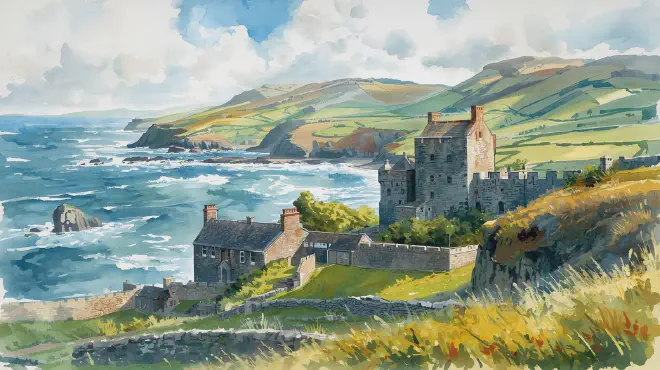
When I first heard the name Ballygally, there was something almost magical about its sound. This small village along Northern Ireland’s Antrim Coast is a quiet seaside settlement with a population of barely 1,000 souls. Surrounded by cliffs overlooking the Irish Sea and verdant rolling hills, a 17th-century castle stands watch over the waters.
The land’s history runs deep, with people inhabiting it since Celtic times. The village name “Ballygally” derives from the Irish “Baile na nGall,” meaning “town of the strangers”—a testament to the Scottish settlers who put down roots here. Even today, the Ulster Scots accent of the villagers carries echoes of that history.
Ballygally Castle, a fortified manor built in 1625, now operates as a hotel. It’s said to be haunted, particularly by a spirit known as the “Grey Lady,” whose sightings persist to this day. Around the castle, manicured gardens spread out, and ancient rose bushes swaying in the sea breeze quietly tell the story of time’s passage.
The village economy has long been sustained by fishing and farming. Even now, local fishermen set out from the small harbor each morning, bringing in fresh catches. In recent years, tourism has also flourished, making it a resting place for travelers touring the Antrim Coast Road. While it serves as a waypoint to famous attractions like the Giant’s Causeway and Carrick-a-Rede Rope Bridge, Ballygally’s own tranquil beauty leaves a deep impression on those who visit.
Day 1: Arrival Wrapped in Sea Winds
About forty minutes north of Belfast by car, driving along the Antrim Coast Road, my eyes were drawn to the blue expanse of the Irish Sea spreading out to the left. Arriving in Ballygally around 10 a.m. in May, the sea breeze caressed my cheeks. I drew a deep breath of the unique air of this place—a mixture of salt and the scent of green grass.
I checked into Ballygally Castle Hotel. The 17th-century stone building has gained a deep character through the long years. The woman at the front desk welcomed me with a warm smile, saying, “Please enjoy the sea view from your room.” My room was on the third floor, with windows overlooking the Irish Sea. In the distance, the silhouette of Scottish islands was faintly visible.
After leaving my luggage, I set out to explore the village in the morning. The main street was beautifully cobblestoned, lined on both sides with white-walled cottages. Thin smoke rose from chimneys—a somehow nostalgic scene. At the village center stood a small church, St. Patrick’s, built in the 12th century, its moss-covered gravestones quietly telling the passage of time. In the churchyard stood an ancient Celtic cross, and I found myself absorbed in the beauty of its carvings.
I had lunch at the village’s only pub, “The Harbour Inn.” Local fishermen and farmers were already enjoying pints in the afternoon. I ordered fish and chips. The cod, landed that very morning, was firm-fleshed and wrapped in crispy batter. The chips had a sweetness to their potatoes, and when I doused them with malt vinegar, they were exquisite. An elderly gentleman at the next table struck up conversation: “Beautiful day, isn’t it?” He’d lived in the village for seventy years. “There used to be more fishermen, but now there might be more tourists,” he said with a laugh.
In the afternoon, I walked along the coastline. Ballygally Beach is a sandy shore in a small cove, where the receding tide leaves numerous small rock pools. Children played, searching for crabs and hermit crabs. The sound of waves was soothing, occasionally mixed with seagull cries. Looking down from the cliffs, the sea’s color transitioned beautifully from deep navy to pale green.
In the evening, I strolled through the castle gardens. May in Northern Ireland has long days—it was still bright around 8 p.m. The garden roses were still in bud, but ivy wrapped the old stone walls, creating a medieval atmosphere. A small chapel in one corner of the castle is still in use and occasionally hosts local wedding ceremonies.
For dinner, I ate at the castle restaurant. I ordered Ulster Fry, a traditional dish from the Ulster region. Bacon, sausages, black pudding, white pudding, egg, tomato, and potato bread—all piled on one plate in a hearty serving. It came with locally made soda bread, which spread a simple, rustic flavor when eaten with butter.
After the meal, I gazed out the window while drinking local beer at the bar. Moonlight illuminated the sea surface, and the sound of waves quietly echoed. The young bartender, a local, cheerfully told me, “This castle really is haunted, you know. But it’s not a scary ghost. The Grey Lady is a gentle spirit—sometimes you just see her walking down the hallways.”
Back in my room, the sea visible from the window glittered in the moonlight. In the distance, ships’ lights dotted the darkness. The warmth and quietude of this place I’d felt throughout the day sank deep into my heart. As the clock by my pillow pointed to eleven, I fell asleep wrapped in the sound of waves.
Day 2: A Day Woven by Nature and History
Around 6 a.m., I awoke to birdsong. Opening the window, the morning sea breeze brushed my cheeks. The sky was tinged pale pink, and the sun slowly emerged from beyond the horizon. It had been a long time since I’d greeted such a beautiful morning.
I had breakfast in the castle’s dining room. Another Ulster Fry would be too heavy, so today I chose porridge. Oatmeal with honey and cream, accompanied by warm tea. Simple, but it warmed both body and soul. The local honey had a rich floral aroma, calling to mind flowers blooming in May meadows.
In the morning, I decided to visit Galgorm Dolmen, located a short distance from the village. About fifteen minutes by car, this Neolithic megalithic monument sits quietly nestled in green hills. The stone structure speaks of human endeavor from over 5,000 years ago. Massive stones balanced in exquisite harmony—a testament to ancient people’s technical prowess.
Sheep grazed around the dolmen. The white-fleeced animals were friendly, not fleeing when approached. The sea was visible in the distance, and I thought perhaps ancient peoples saw this same view, feeling the layering of time. When the wind blew, it carried that peculiar rural scent—a mixture of grassland and sheep.
Returning to the village before noon, I visited the fishing harbor. Small, colorful fishing boats were moored at the little port. A fisherman named John was mending his nets, so I struck up conversation. In his sixties, he’d been fishing these waters for over thirty years. “This sea is between Scotland and Northern Ireland, so the tidal currents are complex. But that means the fish are plentiful,” he explained.
He let me board his boat and we went a bit offshore. Ballygally showed a different face from the land. The castle stood with dignity on the cliff, and the white village buildings dotted the green hills. Seeing the beauty of home from the sea, I understood well why the locals take such pride in it.
I had lunch at a small café near the harbor called “Seabreeze Cafe.” The seafood chowder made with local seafood was exquisite. Large shrimp, scallops, and chunks of salmon filled a creamy soup that let you savor the sea’s bounty to the fullest. Mary, the owner, was a local, and proudly told me, “The fish here is really fresh. We use what’s caught in the morning that same day.”
In the afternoon, I joined a tour of Ballygally Castle to learn more about its history. The guide, Patrick, was well-versed in local history and passionately recounted the story from the castle’s construction to the present. Built in 1625 by James Shaw, it was constructed as part of the Scottish Plantation policy. The thick stone walls and small windows speak to the unstable times.
The most impressive part of the castle was the Great Hall. Ancient beams stretched across the high ceiling, and a coat of arms was carved into the large fireplace. Here, for four hundred years, many people had shared meals and celebrations. Portraits of successive castle lords hung on the walls, quietly watching over the changing times.
In the evening, I attended a small concert held in the castle gardens. Local musicians performed Irish traditional music. The sounds of fiddle, bodhrán, and Irish flute resonated in the twilight sky. The audience mixed locals and tourists, and through the music, I felt a sense of unity. When “Danny Boy” was played, many people sang along. I realized how important music is to Irish culture.
For dinner, I returned to The Harbour Inn. This time I ordered lamb stew. The locally raised mutton was tender, stewed with potatoes, carrots, and onions. The accompanying colcannon (a mixture of potatoes and cabbage) was also simply delicious. The pub’s atmosphere felt more familiar than yesterday, and I exchanged light conversation with locals at neighboring tables.
On the walk back, I looked up at a sky full of stars. In this village with few city lights, the stars were clearly visible. The Big Dipper and Orion were easily identifiable, and the Milky Way showed faintly. As the wind from the sea brushed my cheeks, I reflected on the day’s events. From ancient megalithic monuments to modern music—it had been a fulfilling day, like layers of time overlapping.
Day 3: Farewell and Lingering Memories
On the final morning, I again woke to birdsong. Unlike yesterday, the sky was somewhat cloudy, but that somehow created an authentically Northern Irish atmosphere. While packing, I once more burned the view of the sea from my window into my memory.
After breakfast, I used the time before checkout to walk through the village once more. This time, I chose paths I hadn’t taken yesterday. In the back of the village stood an old watermill—no longer in use, but the beautiful stone building remained. A stream flowed by, and wildflowers bloomed around the waterwheel. Daffodils and bluebells were in full glory, emblematic of Northern Ireland’s May beauty.
Walking along the stream, I came upon a woman who appeared to be a local painter working on a landscape. When I spoke to her, she introduced herself as Margaret, a local artist. “I was born and raised in this village, but I discover new beauty every day,” she told me. Her paintings were watercolors, expressing Ballygally’s landscapes in soft tones. Particularly striking was a painting of the castle wrapped in morning mist.
I decided to buy souvenirs at the village shop. I purchased a locally made wool sweater, Irish linen handkerchiefs, and postcards depicting village scenes. The shopkeeper, a grandmother over eighty but very energetic, offered warm words: “Thank you for understanding the goodness of this village.”
Before noon, I checked out of the hotel and walked through the castle gardens one last time. The gardens, illuminated by midday sunlight rather than morning light, showed yet another expression. I noticed the rose buds had swollen slightly. As the season progressed, they would surely bloom beautifully.
Before departing, I had a final lunch at The Harbour Inn. This time I ordered Irish steak. The locally raised beef had delicious lean meat, and the accompanying vegetables were fresh. For dessert, I ordered traditional apple tart. Crispy pastry filled with sweet-and-sour apples. Eating it with custard sauce, it was simple but heartwarming.
After lunch, it was finally time to depart. Loading my luggage into the car, I recalled the faces of the people I’d met during these two nights and three days. The front desk woman, John the fisherman, Mary from the café, Margaret the painter, and the grandmother at the shop. Everyone had welcomed me warmly and taught me their love for this small village.
Driving away, I gazed at Ballygally Castle in the rearview mirror. The castle standing on the cliff facing the sea seemed like a guardian of time. For four hundred years it has watched over this place and will continue to welcome many travelers.
Heading south on the Antrim Coast Road, I reflected on these three days of memories. The weight of time felt at the ancient megalithic monument, the beauty of the sea viewed from the fisherman’s boat, the warmth of the locals, and the beauty of the night sky full of stars. All are deeply engraved in my heart.
As Belfast approached, I already felt nostalgic for Ballygally. That quiet village, those gentle people, that beautiful nature. It was a place that reminded me of the human pace of time, so easily forgotten in modern busy life.
What Was Felt Despite Being Imaginary
This two-night, three-day journey to Ballygally in Northern Ireland was an imaginary trip never actually experienced. Yet, following the words, the landscape of that place, the warmth of its people, the taste of food, and the sensation of sea breezes resonate in the heart as if truly experienced.
Perhaps the essence of travel lies not necessarily in physical movement, but in discovering new worlds within the heart and encountering different cultures and landscapes. The events in the small village of Ballygally, while imaginary, remain as certain memories in the reader’s heart.
The 17th-century castle, the Neolithic megalithic monument, the warm local people, fresh seafood, and the star-filled sky. The story woven by all these elements reaches our hearts with reality precisely because it’s based on actual places and culture.
Now that this imaginary journey has ended, Ballygally remains as a special place in my heart. When the day comes to truly visit that land, surely this imaginary memory and real experience will overlap, creating even richer travel memories.
Travel may be a bridge connecting our imagination with the real world. And by crossing that bridge, we discover new aspects of ourselves and deepen our understanding of the world.