
A City Where Three Nations Meet
Basel, a city where the Rhine flows in quiet dignity. Here, at the point where Switzerland, Germany, and France converge, lies what feels like a microcosm of Europe itself. Though home to only about 170,000 people, this modest city houses the headquarters of some of the world’s largest pharmaceutical companies and boasts over forty museums and galleries scattered throughout its streets.
Walking the cobblestones of the Altstadt—the old town—one cannot miss the red sandstone of the Münster cathedral, its Gothic silhouette rising from foundations laid in the thirteenth century. Yet modern architectural masterpieces designed by world-renowned architects also dot the cityscape, ancient and contemporary existing in natural harmony. The true charm of Basel, I would come to realize, lies in this layering of history, its international character, and above all, the gentle rhythm of daily life its inhabitants have cultivated over centuries.
Day 1: Footsteps on Cobblestones and the Song of the Rhine
Shortly after eight in the morning, I stepped off the train at Basel SBB station, having traveled roughly an hour from Zürich. The station concourse was already alive with commuters and students, yet a certain calm pervaded the atmosphere. Beyond the barriers, the main avenue leading to the city center stretched before me.
On my way to the Hotel Drei Könige, I found myself captivated by the trams gliding quietly through the streets. Their sleek green and white carriages wove through the city like arteries carrying lifeblood. Passengers read morning newspapers or gazed out windows in silence, existing in a time entirely removed from hurry.
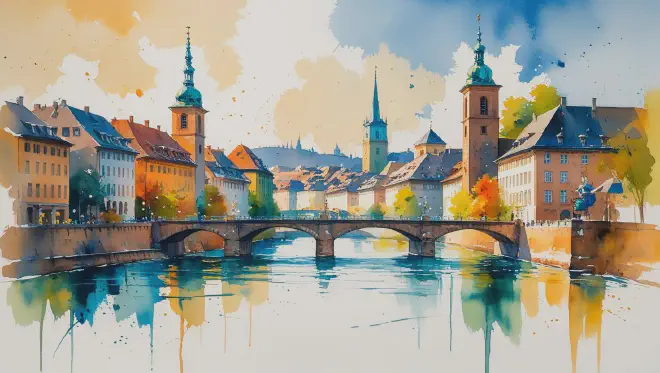
After checking in, I set out to explore the old town. Crossing the Mittlere Brücke over the Rhine, I turned to admire the view of Grossbasel from the opposite bank of Kleinbasel. Rows of red-brown roof tiles stretched toward the twin spires of the Münster rising behind them. Morning light danced on the water’s surface, and occasionally a tourist boat passed by at an unhurried pace.
My morning wanderings took me first to Marktplatz, the market square. The sixteenth-century Rathaus—the town hall—commanded the square in vivid red sandstone, its color so striking it seemed to hold the light within itself. Intricate decorations adorned its facade, and the clock tower marked time with quiet authority. A morning market had set up in the square, and locals browsed stalls of fresh vegetables and flowers.
At one corner of the market, an elderly woman was selling homemade jams. “This one is apricot, grown just outside Basel,” she explained in fluent German. The gentle cadence of Swiss German dialect was pleasant to the ear, and the sound itself became a memory I would carry with me.
For lunch, I found my way to Zum Roten Engel in the old town, a restaurant housed in a thirteenth-century building. Stone walls and wooden beams created an atmosphere thick with history. Scanning the menu, I spotted Mehlsuppe—Basel’s traditional flour soup—and ordered without hesitation. The soup arrived in a gentle cream color, and when I tasted it, the humble sweetness of wheat spread across my palate. Paired with local bread, this simple dish warmed something deep within me.
The afternoon found me in Bellevue Park, a hilltop green space not far from the city center offering panoramic views of Basel. I lay on the grass, gazing at the distant Rhine and the rooftops of the city, wrapped in a stillness that seemed to stop time itself. Local families and readers enjoying books shared the park with me, and I felt I was participating in the ordinary, unhurried afternoon that belonged to this place.
As evening approached, I returned to the old town to visit the Münster. Looking up at the twin towers from below, I was struck by their solemnity. The red sandstone glowed warm in the setting sun. Inside, stained glass windows cast colorful shadows across the stone floor. I sat for a while on one of the long benches, reflecting on the day in the cathedral’s profound silence. It was a fitting beginning to this journey—solemn and beautiful.
Dinner was at Riverside, a restaurant along the Rhine. From my window seat, I watched the city lights shimmer and sway on the water’s surface. The main course was grilled salmon from the Rhine—the skin crisp and fragrant, the flesh tender with the refined flavor characteristic of river fish. The server, a young man with an easy smile, told me the seasonal vegetables accompanying the dish came from local farms.
After the meal, I walked along the Rhine. Street lamps illuminated the cobblestones beautifully, and the murmur of the river dissolved into the evening quiet. Buildings on the opposite bank were wrapped in warm light, and I felt as though I were walking through a painting. By the time I returned to the hotel, I knew I had already fallen under this city’s spell.
Day 2: Where Art and Nature Compose Together
The second day began with breakfast at the hotel. Swiss müesli with local yogurt and berries, freshly baked croissants, and deeply aromatic coffee—a luxurious way to start the morning. Through the window, I could see the city already in motion, trams passing at regular intervals.
The morning was devoted to the Fondation Beyeler. Designed by architect Renzo Piano, this museum is renowned for its masterful use of natural light. Stepping inside, I was immediately embraced by the soft illumination filtering through the ceiling, enveloping the artworks in gentle radiance. Before Monet’s Water Lilies series, I stood transfixed for a long while. The play of light and shadow rising from the canvas created an illusion so convincing I might have been gazing at an actual pond.
The museum’s gardens were equally remarkable. Sculptures were arranged in harmony with lawns and trees, creating a space where art and nature became one. As I sat on a bench contemplating the garden, an elderly local woman took a seat beside me. “This museum is my pride,” she said in English. According to her, Basel has the highest number of museums per capita in the world. I sensed how deeply the love of art is rooted among the city’s residents.
A light lunch at the museum cafeteria preceded an afternoon Rhine River cruise. At the dock, I boarded a small excursion boat, and the captain waved a friendly greeting. As the boat began its slow descent of the river, Basel revealed itself from an entirely different angle than any view from land could offer.
The Münster seen from the water was extraordinary—its red sandstone towers rising magnificently against the blue sky. The boat passed before the old town, then gradually made its way toward Basel’s outskirts. Lush forests lined both banks, with small villages and farms appearing now and then to compose a pastoral landscape.
During the hour-long cruise, I contemplated the historical role the Rhine has played as one of Europe’s great arteries. This river flows all the way to the North Sea, carrying people and goods since ancient times. Even today, large cargo vessels pass regularly, sustaining modern commerce. The wind off the water brushed my cheeks, and I felt the river’s grandeur in my very bones.
After returning to the dock, I continued exploring the old town’s cobblestone lanes. Wandering into narrow alleys, I discovered antique shops and artisan craft stores lining the way. In one shop, I purchased a small carved wooden bear made by a local craftsman. The elderly shopkeeper explained, “This is the symbol of Bern, but it’s also a guardian spirit for all of Switzerland.”
As evening approached, I strolled around the University of Basel. Founded in 1460, it is the oldest university in Switzerland. The stone buildings bore the weight of centuries, and watching students pass by felt like witnessing past and present intersecting in a single moment. In a courtyard before the library, I could hear groups of students engaged in lively discussion, the air thick with intellectual energy.
For the night, I visited Zur Harmonie, a wine bar recommended by locals. The underground stone chamber retained a medieval atmosphere, and candlelight cast dancing shadows on the walls. The bartender was well-versed in local wines and suggested a Swiss Fendant, a white wine. Poured into my glass, it shone pale gold, and when I tasted it, fruity notes unfolded across my palate.
Over wine, I fell into conversation with a local artist seated nearby. He spoke passionately about Basel’s art scene, saying, “In this city, art is simply part of life.” His words rang true—not only in museums, but in street galleries and building murals, art breathed everywhere in this city. It had been a day of discovering the unique richness of a place where art and daily life merge so naturally.
Day 3: A Morning of Farewell, Etched in Memory
On the final morning, I walked along the Rhine while the sky was still dim. The river’s surface, shrouded in morning mist, lay still as a mirror, and buildings on the far bank floated as hazy silhouettes. Occasionally I passed an early jogger, and we exchanged small nods of acknowledgment. The gentle character of this city’s people left an impression that would stay with me long after departure.
After breakfast, with time still remaining, I returned once more to Marktplatz. Watching vendors prepare for the morning market, I felt as though I were participating in the daily rhythm of this city. A florist called out in German, “Come back again,” and I was reminded once more of how warmly this city welcomes travelers.
Before checking out, I climbed to the hotel’s rooftop terrace for a final view of Basel. The red roof tiles stretching across the cityscape, the Rhine visible beyond, and green hills rolling toward the horizon—this scene would surely be etched deep in my memory. Clouds drifted slowly across the sky, quietly marking the passage of time.
Gathering my belongings and leaving the hotel, I stopped at a small café on the way to the station. I wanted one last taste of Swiss coffee, with its deep, rich flavor. Local artwork adorned the café walls, and every glimpse of the street corner through my coffee cup seemed precious.
Standing on the platform at Basel SBB, I watched my train glide quietly into the station. As the city’s landscape gradually receded in the window, the people I had met and the moments I had experienced over these two nights and three days played back in my mind. The sound of footsteps on cobblestones, the murmur of the Rhine, the silence of museums, the warm exchanges with local people. Though my stay had been brief, I felt I had touched something essential about this city called Basel.
As the train sped through the Swiss countryside, I watched the scenery flow past and thought: perhaps travel is not merely about visiting new places, but about breathing in the air and the lives of those who live there, allowing something new to take root within oneself. The time I spent in Basel had undoubtedly left something behind in me.
What Felt Real, Though Imagined
This travel essay is entirely a product of imagination. I never actually walked Basel’s cobblestones, never felt the wind off the Rhine. And yet, while writing these words, I was wrapped in a sensation as if I had truly been there.
The sounds and scents of the city experienced in imagination, the encounters with people, the silence of museums, the murmur of the river—all of these exist with a certain tangible texture in memory. A journey that feels real, though it was imagined. It teaches me the power of imagination, the wonder of reconstructing a world through words.
With longing and respect for the beautiful, real city of Basel—and with the hope that someday I will truly walk those cobblestones, gaze upon the Rhine, and exchange words with the people who call it home.