
The Jewel of the Lake: Bellagio
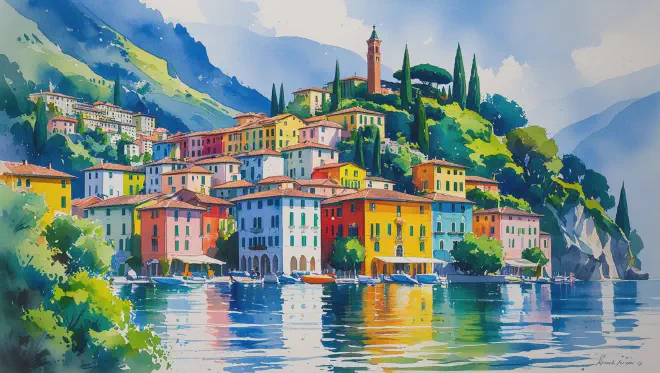
Perched atop a small promontory jutting into the center of Lake Como, Bellagio is known as “the Pearl of Lake Como.” The deep blue waters, fed by Alpine snowmelt, reflect the colorful houses along the shore—a sight of painterly beauty.
The town’s history stretches back to Roman times, when aristocrats first chose this spot for their summer retreats. In the 19th century, European nobility competed to build villas here, and their elegant structures still speak to the town’s refined character today. Narrow cobblestone alleys, terraced gardens overflowing with roses, and above all, the lake itself—changing its expression with every shift of light—make this small town a truly extraordinary place.
From late spring into early summer, Bellagio bursts into bloom with azaleas and rhododendrons, entering its most beautiful season. Late May, the time I chose to visit, was precisely that moment.
Day 1: An Ideal Vision Rising from the Lake
I traveled by bus from Milan Malpensa Airport to Como, then by ferry to Bellagio. Lake transportation here serves not merely as a tourist attraction but as a vital part of daily life for the local residents. While waiting at the dock, I watched locals casually boarding ferries as part of their routine, and I began to feel myself dissolving into the rhythm of lakeside life.
Around eleven in the morning, the ferry to Bellagio finally arrived. Standing on deck, feeling the lake breeze against my face, I was overwhelmed by the view. The mountains lining both shores were draped in fresh green, and villas and churches dotted the slopes as if they had grown naturally from the landscape. As the ferry progressed, Bellagio’s distinctive triangular promontory gradually grew larger before me.
“Ecco Bellagio!” The boatman’s call brought me back to the present. Before my eyes rose what could only be described as an ideal vision—pastel-colored buildings stacked upon one another atop cliffs rising vertically from the water. As we approached the landing, I could see people enjoying meals at terrace cafés and locals chatting by the harbor.
My accommodation, Hotel Villa Serbelloni, sits near the highest point of the promontory—a historic hotel converted from a 19th-century aristocratic mansion. The imposing stone exterior and classical interior decorations left a strong impression. After checking in, I was shown to a room facing the lake. From the balcony, I could see the full panorama of Lake Como: the mountains on the opposite shore, ferries crossing the water, and the afternoon sunlight dancing on the surface. Simply gazing at this view seemed to melt away all the weariness of travel.
In the afternoon, I set out to explore the town. A steep cobblestone path led down from the hotel directly into the heart of the old town. In the small square before the Church of San Giacomo, locals sat on benches in quiet conversation. The simple beauty inside the church moved me deeply, and I spent some time in its stillness. An elderly woman praying softly before the altar revealed to me the devout spirit that still lives in this town.
The narrow lanes leading from the town center toward the lakefront were lined with bougainvillea and jasmine. Under the late May sun, their fragrance hung heavy in the air. Along the way, I stopped at a small gelato shop called Gelateria del Borgo. I chose pistachio and lemon—the lemon’s bright acidity was perfect for a lakeside afternoon. The owner, Marco, was a cheerful man who proudly declared in halting English that Bellagio was the most beautiful town in the world.
In the evening, I walked along the lakeside promenade. The lake reveals a special beauty at this hour. The westward-tilting sun painted the water gold, and the mountains on the far shore became dark silhouettes. Sitting on a bench along the path, watching this unfold, I nearly lost all sense of time.
For dinner, I went to Ristorante La Punta near the harbor—a venerable establishment beloved by locals and tourists alike, especially renowned for its lake fish dishes. For antipasto, I ordered marinated agone (a small whitefish from Lake Como), and for the main course, risotto with persico (a type of perch). The agone was simply dressed with salt, olive oil, and lemon, allowing the fish’s delicate flavor to shine. The risotto had a deep, satisfying taste, the fish broth thoroughly absorbed into each grain of rice—as if every bite contained the lake’s blessing.
After dinner, I walked through the evening streets of Bellagio. The daytime bustle had quieted entirely, and warm lamplight fell on the cobblestones. Occasionally, laughter or music drifted from a restaurant or bar, but even these sounds seemed to dissolve naturally into the town’s peaceful night. The lake reflected the moonlight in a soft glow, and the lights from the opposite shore drew long ribbons across the water.
Back at the hotel, I had a final glass of wine on the balcony. Gazing at the lake’s nighttime face—so different from the day—I felt my heart swell with anticipation for tomorrow and drifted off to sleep.
Day 2: Dreams of Nobility in the Gardens
The morning lake held a particular beauty. Rising early before breakfast, I stepped onto the balcony to find the still-misty water illuminated by the first rays of sunlight, golden ribbons of light dancing across its surface. The air was crystalline, and the contours of the distant mountains stood out with startling clarity. This serene moment felt like a gift to begin the day.
Breakfast was served on a terrace overlooking the lake. A cornetto and cappuccino—a typical Italian breakfast—but tasting them amidst this scenery gave them special meaning. I exchanged a few words with an elderly couple from Milan at the neighboring table. The wife said she loved Bellagio and visited every spring. “It’s a place where time seems to stand still,” she told me—a phrase that lingered in my mind.
In the morning, I visited Villa Melzi Gardens, Bellagio’s greatest attraction. Created in the early 19th century by Count Francesco Melzi d’Eril, Napoleon’s vice-president, this garden is celebrated as a masterpiece of Neoclassical design. I purchased a ticket at the entrance, received a map, and began my walk.
The moment I stepped into the garden, I caught my breath. Every element had been calculated for beauty. Terraced across a slope facing the lake, the garden revealed different expressions at each level. Near the water stood a greenhouse with exotic plants and a pavilion decorated in ancient Egyptian style. The middle level featured a French formal garden enclosed by geometrically trimmed boxwood hedges. Above that spread an English-style landscape garden.
Most striking was the view from a small temple-like structure at the garden’s center. Through its columns, the lake and mountains appeared as if framed in a painting. I lingered there, imagining what 19th-century aristocrats might have felt standing in this same spot.
The plants were magnificent. In late May, rhododendrons and azaleas were in full bloom, and the pink and white flowers covering the slope near the lake were breathtaking. Sculptures placed throughout the garden added to its historical atmosphere—statues in the ancient Roman style and monuments evoking the Napoleonic era.
I had a light lunch at the café within the garden. A panino and espresso on the terrace, with simultaneous views of the garden and lake—pure luxury. At the next table sat a young Japanese woman, a graduate student studying architecture on a post-graduation tour of European gardens. “The harmony between nature and artifice here is perfect,” she observed—an astute comment.
In the afternoon, I visited the gardens of Villa Serbelloni. Though located on the grounds of my hotel, these gardens require advance booking and can only be entered via guided tour. I joined the two o’clock tour.
The Villa Serbelloni gardens offered a different kind of charm from Villa Melzi. More naturalistic in the English style, they were filled with plants and trees left nearly wild. Our guide, Giulia, explained the history and flora in detail. Particularly fascinating was learning how the garden had evolved through various eras to reach its present form.
From the highest point in the garden, I could see where Lake Como’s three arms converge. “From here, you’ll understand why Bellagio is called the Pearl of Lake Como,” Giulia said, and indeed, the view confirmed the town’s unique geographical beauty.
In the evening, I ventured into streets I hadn’t yet explored. Up a steep stone stairway, I found a small square where local children played soccer. Watching them reminded me that Bellagio is not merely a tourist destination but a place where people truly live.
I spent aperitivo hour at a small wine bar in the town center called Enoteca Cava Turacciolo—sampling local wine, cheese, and olives in the Italian manner. The bartender, also named Marco, spoke enthusiastically about wines from the Lake Como region. “These wines aren’t famous,” he said, “but the lake’s microclimate gives them a unique character.” I found his words intriguing.
Dinner that night was at a different restaurant, Mistral, which has a terrace overlooking the lake. I ordered a platter of local prosciutto and cheese to start, followed by veal Milanese. The prosciutto had a perfect balance of salt, carrying the deep flavor of pigs raised on mountain herbs. The Milanese cutlet, perhaps due to Milan’s proximity, tasted authentically close to the original.
After dinner, I strolled along the lake eating gelato—stracciatella and chocolate tonight. Gelato savored in the evening breeze had a different pleasure from daytime. Watching the moon and stars reflected on the water, I felt a pang of sadness knowing tomorrow would be my last day.
Day 3: Farewell in the Morning Light
On my final morning, I rose early again to watch the sunrise over the lake. Today’s air was even clearer than yesterday’s, and the Alpine peaks stood out sharp and distinct. When the sun crested the mountains, the entire lake surface turned to gold—a beauty that truly stopped my breath. I stood on the balcony a long while, wanting to etch this scene into my memory.
After breakfast, I used the time before checkout for one last walk, extending my route to the tip of the promontory—a part I hadn’t yet explored. The town in this quiet morning hour, with few tourists about, seemed even more beautiful. Morning light slanted through the cobblestone alleys, and dewdrops glittered on the flowers.
I arrived at a small park near the promontory’s tip called Punta Spartivento—“the point that divides the wind”—where Lake Como’s three arms separate. Sitting on a bench, gazing at the lake, I reflected on the past three days.
As departure time approached, I walked heavily back to the hotel. While checking out in the lobby, I again met the couple from Milan. “We’ll be back next year,” the wife smiled. “I’ll definitely return too,” I replied—not mere politeness, but words from the heart.
Walking to the ferry landing with my luggage, I bid farewell to the shops and places that had become familiar over these three days. Marco at the gelato shop waved, calling out “Arrivederci!” Passing the Church of San Giacomo, I removed my hat and gave a small bow.
I left Bellagio on the eleven o’clock ferry. As the boat pulled away from the harbor and the town grew smaller, I watched from the stern of the deck. The pastel buildings layered atop the promontory, the lush gardens, and all of it reflected on the lake—like a single perfect painting.
An elderly Italian man standing beside me noticed my expression and spoke. “Your first time in Bellagio?” he asked in English. “Yes, but I’ll definitely come back,” I answered. He smiled gently. “Bellagio has that kind of magic. Everyone who visits once always returns.” I already understood exactly what he meant.
Arriving in Como, I took a bus to Malpensa Airport. Even from the window, I could catch glimpses of the lake, and each time I turned back, searching for the direction of Bellagio. At the airport, waiting to board, I scrolled through the photos I’d taken over these three days again and again. Every image was beautiful, but none captured the feel of the air, the scents, or the warmth of the people I had met.
What Felt Real in an Imaginary Journey
Though this journey was a product of imagination, it has etched itself into my heart as a genuine memory. The deep blue of Lake Como, the sound of my footsteps echoing on Bellagio’s cobblestones, the sweet fragrance of rhododendrons, the delicate taste of lake fish, and the warm smiles of everyone I encountered—all of it feels as vivid as if I had truly experienced it.
Perhaps the memory of a journey is shaped not by whether we physically went, but by our longing for a place and the power of our imagination. Through this imaginary trip, my feelings for this beautiful town called Bellagio have crystallized into something that feels like real memory.
If I ever visit Bellagio in reality, I believe this imagined memory will intertwine with actual experience to create an even deeper emotion. Until then, I want to hold this journey of the heart close.
Bellagio, called the Pearl of Lake Como. Though imagined, it continues to shine in my memory as an eternal ideal—a place that surely exists, somewhere.