
A Quiet Jewel on the Basque Coast
The first time I heard the name Bermeo, something about its sound resonated warmly in the depths of my heart. This small fishing port on the coast of Spain’s Basque Country, situated about an hour’s drive from Bilbao, seems wrapped in a stillness where time itself has paused.
With a population of roughly 17,000, this town carries a fishing heritage stretching back to the 14th century, having flourished particularly through tuna fishing. In Basque, the name is written “Bermeo,” its etymology derived from “ber” (lower) and “mendi” (mountain)—literally a town that developed at the foot of the mountains. The old quarter, built upon a small peninsula jutting into the rough waters of the Cantabrian Sea, still conveys the beauty of traditional Basque architecture, with colorful houses lined up as if watching over the harbor below.
I decided to visit this town out of a desire to experience the “real Spain” that guidebooks don’t cover. I wanted to spend time in a place untouched by mass tourism, where the daily lives of local people still pulse with authenticity. Carrying this wish, I set out for Bermeo as autumn drew to a close.
Day 1: An Afternoon Welcomed by the Salt Wind
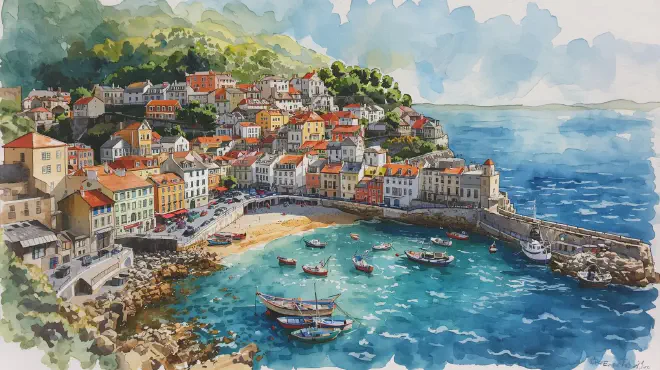
I arrived in Bermeo around two in the afternoon, having rented a car at Bilbao Airport and navigated the winding mountain roads. The view from the hill just before entering town took my breath away—it was like a postcard come to life. A small peninsula surrounded by blue sea, densely packed with houses of orange-tiled roofs and white walls, and at its center, an old church spire reaching toward the sky.
My accommodation, Pensión María Antonia, was a small family-run guesthouse near the harbor. From the window of my second-floor room in the three-story building, I could see the entire fishing port spread before me. After setting down my luggage and opening the window, the scent of the sea and the sound of fishing boat engines flowed into the room.
I decided to begin my afternoon stroll at the harbor. Walking down the narrow cobblestone streets, I noticed fishermen tending to their nets. A man in his sixties was silently mending torn netting. He called out something in Basque, but when I responded in Spanish, he showed a gentle smile and asked, “Are you from Madrid?” When I answered that I had come from Japan, a surprised expression crossed his face, and he said happily, “It’s rare to find a Japanese person who knows Bermeo.”
About twenty fishing boats were moored in the harbor, most of them small vessels operated by families. The boat names painted on the hulls were all written in Basque—“Eder Ontzi,” “Gabon Ona”—letters that spoke of this land’s distinctive culture. The fishermen were quietly preparing for the next morning’s departure. Watching them, I felt the weight of an enterprise that has continued unchanged for centuries.
As evening approached, I made my way to the town center. The Church of San Francisco, a beautiful Gothic structure built in the 15th century, stands as a symbol of Bermeo’s history. In the small plaza before the church, local elderly residents sat on benches, watching the twilight settle. Observing their peaceful expressions, I realized that time flows fundamentally differently here than in the cities.
For dinner, I chose a small tavern near the harbor called La Gaviota. The menu was written in both Basque and Spanish, and the owner recommended “besugo a la espalda”—a salt-grilled local fish. The fresh fish was tender and plump, and the simple preparation with just a squeeze of lemon brought out the full flavor of the ingredients. The accompanying patatas arrugadas, a Basque-style steamed potato dish, had a gentle seasoning that warmed my heart.
The local white wine, Txakoli, was lightly sparkling with a crisp acidity that paired perfectly with the fish. According to the owner, this wine is made from vineyards around Bermeo and is a precious variety rarely found outside the Basque Country. Tilting my glass while gazing at the harbor bathed in the evening light through the window, I nearly forgot I was in a distant foreign land.
On my way back to the inn late that night, I walked along the harbor jetty. The lighthouse beam illuminated the water’s surface, and in the distance, fishing fires flickered here and there. In the silence broken only by the sound of waves, I reflected on the day’s events. Though I had been here only half a day, I had already felt the unique charm that Bermeo possesses. Lying down on my bed, I thought about how I wanted to delve deeper into this land’s culture tomorrow.
Day 2: A Day Embraced by Sea and Mountain
I awoke at half past five to the sound of fishing boat engines. Looking out the window, I saw fishermen busily preparing for departure. The air at this hour was crisp and clear, and the sun was beginning to rise beyond the sea. Since I was already awake, I decided to go down and see the fishermen off.
When I reached the harbor, I found José, the fisherman who had spoken to me the day before. “Good morning, Japanese friend!” he called, waving his hand. His boat, “Ama María” (Holy Mary), was a small vessel of about twelve meters that he had inherited from his father. Today, he said, he would be going out for mackerel with his son. “Bermeo’s mackerel is the best in the world,” he declared proudly, his face showing the honor he took in his work.
Around six o’clock, the fishing boats began leaving the harbor one after another. Watching about twenty boats pass through the harbor mouth and head out to sea felt like witnessing a pilgrimage to the ocean. I stayed at the harbor until the last boat disappeared from view, then returned to the inn for breakfast.
Breakfast at the pensión consisted of locally baked bread, Bermeo’s famous anchovies, and a rich café con leche. The anchovies were elegantly salty yet refined, pairing well with the sweetness of the bread. They were completely different from any canned anchovies I had eaten before. The proprietress, María Antonia, told me, “Bermeo’s anchovies are delicious because each one is carefully processed by hand.”
In the morning, I set out on a hike up Mount Gaztelugache, which rises behind the town. Though it’s a small mountain at only 289 meters, the locals all agree that the view from the summit is magnificent. From the town center, it took about thirty minutes on foot to reach the trailhead. The path was well-maintained and seemed to serve as a walking course for the locals.
Along the trail, eucalyptus and pine trees grew thickly, with occasional glimpses of the sea through the foliage. As it was late autumn, some trees were beginning to show their autumn colors. An elderly local woman I met along the way told me she walks this mountain every morning. “I’ve lived in Bermeo for seventy years, and seeing this view is how I start each day,” she said with a smile.
When I reached the summit, a 360-degree panorama unfolded before me. Below, I could see all of Bermeo, with red-roofed houses surrounding the harbor. Beyond the sea, the blue horizon of the Bay of Biscay stretched to the edge of the world. To the east spread the lush green hills of the Basque interior, and to the west, the coastline extending toward Bilbao. From this height, Bermeo looked like a jewel floating on the sea.
After descending the mountain, I visited the town’s cultural center. Though it was a small building, it housed exhibits introducing Bermeo’s history and culture. The young woman at the reception spoke fluent English and explained the exhibits thoroughly. I learned that Bermeo was granted fishing privileges by the Kingdom of Castile in the 14th century, that it served as one of the departure points for explorers heading to the New World in the 16th century, and that the Basque language and culture remain deeply rooted in daily life today.
Particularly fascinating was the exhibit on traditional fishing techniques. In the waters around Bermeo, an ancient tuna fishing method called “almadraba” is still used—a sustainable technique that captures migrating tuna using nets. I was moved by the wisdom of fishermen who continue to protect the ocean’s resources while combining modern fishing technology with traditional methods.
For lunch, I stopped at a small restaurant in the old quarter called El Puerto. The owner was a woman in her sixties who had run the establishment for forty years. The menu featured a “menú del día” with dishes made from local ingredients. For my appetizer, I chose an “ensalada mixta”—a seemingly simple mixed salad that included Bermeo anchovies and mushrooms gathered from the nearby mountains, with an olive oil and vinegar dressing that brought out the sweetness of the vegetables.
The main dish was “merluza en salsa verde”—hake, a white fish, simmered in parsley sauce, a representative Basque dish. The fish was carefully prepared, its flesh remarkably tender. The parsley sauce, despite its green appearance, had a complex flavor with white wine, garlic, and olive oil blended perfectly. The accompanying potatoes, having absorbed the fish’s umami, were also delicious.
While eating, I talked at length with the owner, Rosa. According to her, Bermeo’s population is gradually declining, and young people in particular are leaving for jobs in larger cities like Bilbao. “But those who were born and raised here always come back. Once you’ve lived here, you can never forget this land’s charm,” she said, looking somewhat wistful yet proud.
In the afternoon, I decided to visit San Juan de Gaztelugatxe, located about fifteen minutes by car from Bermeo. This place features a 10th-century hermitage built on a small island, famous for the sanctuary reached by climbing stone steps. Recently, it has gained popularity as a filming location for an international television series, drawing more tourists.
When I arrived at Gaztelugatxe, the scenery was even more beautiful than I had imagined. The small sanctuary perched atop rocks battered by rough waves was wrapped in a truly mystical atmosphere. Reaching the sanctuary, situated about eighty meters above sea level, required climbing 241 stone steps. The stairs were steep, and I had to rest several times along the way. Looking back, the magnificent Basque coastline spread out below.
Upon reaching the sanctuary, I found several local pilgrims offering prayers. The interior was small and simple, but it was a sacred space wrapped in silence. This is a place dedicated to Saint John, long cherished by fishermen as a site for prayers for safe voyages. The view of the sea from the window was so beautiful it seemed otherworldly, and I understood well why a monastery had been built here.
On the way back, I bought local honey and Txakoli wine at a small souvenir shop. The elderly shopkeeper told me, “This honey comes from wild mountain flowers and can only be tasted in Bermeo.” Indeed, when I tried a taste, it had a complex, deep floral fragrance.
In the evening, after returning to Bermeo, I stopped by the market near the harbor. The fishing boats that had departed in the morning had returned, and fresh fish were on display. I spotted José among them. Today’s fishing had been bountiful, with large quantities of mackerel and anchovies being unloaded. “You should eat mackerel tonight,” he recommended, so I bought some fresh mackerel at the market.
For dinner, I chose a different restaurant than the previous night—Casa Amelia. This was a homey establishment bustling with locals. When I brought the mackerel I had purchased, they happily agreed to prepare it for me. “Saba a la plancha”—grilled on a iron plate—was a simple dish, but the freshness of the fish caught that very morning shone through. It was rich with fat, and the simple seasoning of just salt and lemon was more than enough.
During dinner, I had the chance to talk with a local family at the next table. The father worked in port operations, and the mother was an elementary school teacher. Their two children were learning both Basque and Spanish at school. “The Basque language is our identity,” the mother said proudly. The children, though shy, taught me some simple Basque phrases—“Kaixo” (hello) and “Eskerrik asko” (thank you).
That night, I walked along the harbor breakwater. A sky full of stars reflected on the water’s surface, creating a fantastical scene. The beauty of stars that cannot be seen in urban areas left me speechless for a while. Fishing fires dotted the distance, looking like stars floating on the sea. Thinking that tomorrow I would already be heading home made me feel a bit lonely. In these two days, I had deeply touched the unique warmth of Bermeo and its people.
Day 3: A Morning of Farewell and Memories to Carry Home
On my last morning, I woke again to the sound of fishermen’s engines. Today the sky was overcast, and the sea seemed a bit rough. The view from the window felt somehow melancholy, different from the previous two days.
Before breakfast, I decided to walk around the harbor one last time. The fishermen were preparing for departure just as they had every other day. When I found José and greeted him, he said, “Leaving today? I’ll miss you.” Then he handed me a small package. Inside was a small jar of homemade anchovies. “These are made with my family’s secret recipe. Remember Bermeo when you’re back in Japan,” he said, and my heart swelled with emotion.
At breakfast, I expressed my gratitude to the pensión’s proprietress, María Antonia, for these two days. “Be sure to come back,” she said warmly. “Bermeo will always be waiting for you.” When I tried to pay for my stay at checkout, she refused to accept it, saying, “I don’t take money from friends.” In the end, I rather forcefully pressed the payment upon her, but I was deeply moved by her kindness.
Before departing, I walked through the town one last time. At the Church of San Francisco, the elderly still sat on benches gazing at the sea. Passing in front of El Puerto, the family restaurant where I had spoken with Rosa, I saw her preparing the shop. When I waved, she called back loudly, “Adiós, amigo japonés!” (Goodbye, Japanese friend!) and waved broadly.
Walking along the cobblestone streets, I reflected on these two days. Despite the language barrier, the warmth and kindness of the people transcended borders. The people of Bermeo, unaccustomed to tourists, were pure and genuine. What stayed with me most was how they welcomed a lone traveler from Japan and treated me like family.
When I drove out of Bermeo, I made sure to burn the town’s image into my memory through the rearview mirror—the orange-roofed houses with white walls, the blue sea spreading beyond, and the small fishing boats floating in the harbor. This scene, I knew, I would never forget.
On the way to Bilbao Airport, I kept recalling the view from the summit of Mount Gaztelugache. Looking down at Bermeo from that height, it had a beauty as if time had stopped. There are no modern large hotels or tourist facilities here, but perhaps that is Bermeo’s greatest charm.
Arriving at the airport and returning the rental car, the attendant asked, “How was your trip?” When I replied that I had been to Bermeo, his face brightened. “That’s where my grandparents are from. Wonderful place, isn’t it?” he said happily. According to him, people of the Basque Country all have a very strong attachment to their homeland. “If you trace the bloodlines, everyone is connected somewhere,” he said—words that left a lasting impression.
While waiting for boarding, I sat in the airport café drinking coffee and tried to organize what I had learned on this journey. Bermeo is certainly a small town, but within it breathes a long history and deep culture. Fishing—a way of life lived with the sea—stands at the center of people’s lives here, shaping their identity. I was deeply moved by the generosity of people who carefully preserve their unique language and culture while warmly welcoming outsiders without exclusion.
The people of Bermeo’s sense of time also impressed me. There is no hurried pace like in cities; instead, a gentle rhythm flows in harmony with nature. Mornings begin with the fishermen’s departure, and evenings see their return to harbor. Life is conducted according to each day’s weather and sea conditions. This way of living, often lost in modern society, still remains firmly here.
I made countless unforgettable memories through the food as well. Beyond the fresh seafood, the local wines and vegetables, and above all the handmade anchovies, were exceptional. The passion with which people at restaurants and markets spoke about their ingredients and dishes made the food taste even better. I realized that eating is not merely taking in nutrition, but experiencing culture.
Boarding the plane and looking down at the lush green hills of the Basque Country through the window, I vowed to myself that I would definitely return to Bermeo someday. Next time, I would stay longer, perhaps go out on a fishing boat, or participate in a local festival. And I look forward to reuniting with the people I met this time.
Holding the small jar of anchovies from José, I felt anew how these two nights and three days in this small fishing port had become an irreplaceable experience. Travel is not just about visiting new places—it is also an opportunity to reflect upon oneself through encounters with the people there. The days in Bermeo were precisely that kind of precious time.
What Felt Real Though Imagined
This travel essay is an imaginary journey to a place I have never actually visited. Yet as I wrote it, and now reading it back, I find myself wrapped in a sensation as if I had truly walked Bermeo’s cobblestone streets, felt the salt wind on my skin, and exchanged words with the local people.
The power of imagination is a mysterious thing. Even for a land one has never set foot in, by researching its history, culture, and natural environment and exercising the imagination, one can leave behind an experience that feels surprisingly real. This story, woven while learning about the characteristics of Bermeo—a real and beautiful fishing port—and contemplating the culture of the Basque region, has become a travel memory etched in my heart despite being imaginary.
Someday, I hope to actually see with my own eyes the scenery I depicted in this imaginary journey, to make real the encounters with people I only imagined. When that day comes, this imaginary voyage will surely enrich the actual experience.
Travel does not necessarily mean only physical movement. A journey traveled in the heart may also be one of the precious experiences that color our lives. This imaginary trip to Bermeo taught me that valuable lesson.