
A Paradise Woven from Rock and Forest
Bohemian Switzerland National Park is a natural treasure located in northwestern Czech Republic. Bordering Germany, this region has been shaped over eons as Cretaceous sandstone was gradually carved away, creating a fantastical labyrinth of rock formations. The Elbe River cuts deep gorges through the landscape, while lush forests spread across both banks.
The name “Bohemian Switzerland” was given to this land by Swiss artists in the 18th century. Captivated by scenery that reminded them of their homeland mountains, they popularized this designation. In Czech, it’s called “České Švýcarsko,” and it remains a cherished place for local people.
The natural arch called Pravčická brána stands as the park’s iconic symbol. This stone arch—16 meters high and approximately 26 meters wide—is known as the largest natural arch in Central Europe. Other spectacular viewpoints dot the landscape, including Tiské stěny (the Tiské Walls) and the Jan Žižka viewpoint, captivating the hearts of hikers.
The region has historically been home to many German-speaking residents, creating a distinctive atmosphere where Czech and German cultures blend. After the historical transformations following World War II, it now functions as a cross-border nature reserve, managed jointly with Germany’s Saxon Switzerland National Park.
In this brief span of 2 nights and 3 days, I wanted to face this mystical nature, walk through forests wrapped in silence, and touch the lives of local people. That was the hope I carried into this journey.
Day 1: Passing Through the Stone Gate
Two hours north of Prague by car, I arrived at the small village of Hřensko through morning mist. My accommodation was a family-run pension in the village center, an old stone building that had been renovated. After checking in, the owner, Jana, explained the park’s highlights in fluent English. Her grandparents had been German-speaking residents who, unlike many others, never left this land but lived here for generations.
“First, you should visit Pravčická brána. In the morning there are fewer people, and the light is beautiful.”
Following Jana’s advice, I decided to leave right after breakfast. The morning meal consisted of dark bread with cheese and ham, and bread thickly spread with local honey. The coffee was strong, with a somehow nostalgic aroma.
Leaving Hřensko village behind, I began walking along a forest trail. My footsteps were absorbed into the soft earthen path. Beech and oak trees spread overhead, with morning light occasionally dancing through the leaves. After about thirty minutes of walking, the view suddenly opened up.
What appeared before me was truly a gate made of stone. Pravčická brána. I had seen photographs, but witnessing it in person, I was overwhelmed by its power. The 16-meter-high sandstone arch towered like the entrance to an ancient temple. Beyond the arch, a deep valley spread out, with distant mountains visible through a haze.
I sat on a bench for a while, gazing at this mysterious sight. Tourists were still few, and only birdsong and the sound of wind could be heard. Trees grew thickly atop the arch, as if nature itself had become an architect and created this masterpiece. I could now understand the feelings of painters and poets who visited this place during the Napoleonic era and were moved by what they saw.
In the afternoon, I headed to nearby Tiské stěny. The ruins of a medieval fortress built into the rocky mountains, now abandoned but exuding an even more mystical atmosphere. Stairs and passages carved into gaps between rocks continued like a labyrinth, making me feel as if I’d wandered into the setting of an adventure novel.
The view from the summit took my breath away. The Elbe River’s meandering curves shone silver, and a patchwork of forests and rocky mountains continued to the horizon. Looking down from here made me realize just how small human endeavors truly are.
When I returned to the pension in the evening, Jana had prepared a local traditional dish. It was goulash, a beef stew with a deep flavor from paprika. The side dish of knedlíky—traditional Czech dumplings—absorbed the soup and offered a fluffy texture.
“I learned this dish from my grandmother. Before and after the war, we’ve continued to preserve this taste.”
Jana’s words carried the quiet pride of people rooted in this land.
That night, I looked up at the sky in the pension’s small garden. Away from the light pollution of cities, the stars sparkled like jewels. Tomorrow I would venture deeper into the forest. I still didn’t know what meaning this journey would hold for me. But one thing was certain—from the moment I passed through that stone arch, something had begun to change.
Day 2: Meeting Silence in the Forest’s Depths
I woke early, while it was still dim outside. Birdsong came from beyond the window. Today’s plan was to reach the Jan Žižka viewpoint, the park’s most remote section. Walking in the garden before breakfast, Jana appeared and handed me a thermos of coffee and homemade sandwiches.
“Today will be a long walk, so take these with you. You can eat them when you rest along the way.”
Warmed by her thoughtfulness, I packed my backpack and set off.
Today’s route began from the valley floor along the Elbe River. Walking to the sound of the river’s murmuring, the path showed a completely different face from yesterday’s rocky mountains. Willows and alders grew along the riverbank, and kingfishers occasionally flashed their blue feathers as they darted past. The water was surprisingly clear, with pebbles at the river bottom clearly visible.
After walking about an hour, the path gradually became an uphill climb. The forest deepened, with moss growing thick underfoot. The air was cold and damp, giving the sensation that the entire forest was breathing like a single living creature. Small flowers bloomed at the base of large beech trees—I didn’t know their names, but their small purple petals were striking.
I took a break midway and ate the sandwiches Jana had given me. The moisture from fresh tomatoes and cucumbers between the ham and cheese soaked into my tired body. There were no other hikers around, and the reality of truly being alone in the forest became palpable. Separated from urban noise, I was surprised by how clearly I could hear my own heartbeat and breathing.
Entering the afternoon, the path became even steeper. I carefully walked the narrow trail that wound through gaps in the rocks. Occasionally, glimpses of the valley floor through the trees made my legs freeze at the depth. But the sense of accomplishment upon reaching my destination was all the more special for it.
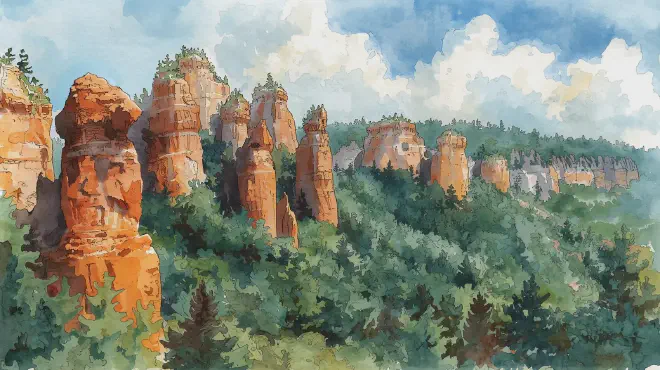
The Jan Žižka viewpoint was a small wooden platform set atop a rock. Named after the 15th-century Bohemian hero who led the Hussite Wars, the view from this place was truly spectacular. A 360-degree panorama spread out, allowing me to survey the entire landscape of Bohemian Switzerland. Sandstone pillars scattered through the green forest showed their mystical forms like ancient ruins.
I ate lunch at the viewpoint while taking in this landscape. The wind caressed my cheeks. Cloud shadows moved across the forest, and patterns of light and shadow changed moment by moment. My sense of time disappeared, and I felt as though I’d become part of this scenery.
For the descent, I chose a different route. A path through what’s called a gorge—a narrow canyon flanked by high rock walls on both sides, creating a mystical space. Ivy entwined the rock walls, and water droplets occasionally fell. My footsteps echoed off the rock walls, creating the sensation of walking through an underground palace. At the deepest part of the gorge was a small waterfall, where I took off my shoes and dipped my feet. The water was cold as ice, and the day’s fatigue seemed to dissolve away.
In the evening, when I returned to the pension, Jana greeted me with a worried expression.
“You were late today, so I was concerned. How was it?”
“It was wonderful. Like spending a day in another world.”
For dinner, I decided to eat at a local restaurant. At a small establishment in the village center, the menu was written in Czech and German. The elderly owner spoke to me in fluent German. I ordered roast pork with knedlíky and locally brewed beer. The meat was tender, and the beer had a pleasantly balanced bitterness.
“This beer is made at a small brewery in the village. The recipe hasn’t changed for over a hundred years.”
Savoring the owner’s pride and joy, I reflected on the day’s events. The silence I’d felt in the forest, the spectacular view from the viewpoint, the mystical atmosphere of the gorge. All were precious experiences impossible to have in a city.
That night, I went out to the garden again to gaze at the starry sky. Tonight was perfectly clear without a single cloud, and the Milky Way was clearly visible. Tomorrow would already be the final day. Thinking that my parting from this land was approaching made me feel a bit lonely. But at the same time, I was aware of the magnitude of what I’d gained from this journey. Dialogue with nature, the value of silence, and the warmth of local people. These might be truly important things for humans that are easily forgotten in urban life.
Day 3: A Small Miracle Found on the Morning of Departure
The final morning was the most beautiful yet. Opening the window, I saw mist settling in the valley, with distant rock peaks appearing like islands floating in a sea of clouds. I stood by the window for a while, trying to etch this fantastical landscape into my memory.
I savored breakfast slowly. The combination of dark bread and honey I’d grown familiar with over these three days tasted especially delicious knowing this would be the last time. Jana was busy preparing for the next guests, but she occasionally glanced my way and smiled.
Using the time before checkout, I decided to explore the village center. Hřensko is a tiny village with a population of just a few hundred, but you could feel the strong bonds among residents. In the village square stood a small church, in front of which an elderly woman walked hand in hand with a child who appeared to be her grandchild.
The church door was open, so I decided to go inside. The interior was simple, but I was captivated by the beauty of the stained glass. Colors based on blue and green harmonized with the hues of the forest. Several candles burned before the altar, creating a quiet space for prayer.
I sat on a wooden bench for a while, reflecting on these three days. The majesty of the stone arch I’d felt on the first day, the complete silence experienced deep in the forest on the second day, and this morning’s mystical landscape shrouded in mist. Each was carved deep into my heart, memories I would never forget for the rest of my life.
Leaving the church, I found the village bakery opening for business. Drawn by the aroma of freshly baked bread visible through the window, I entered to find the shopkeeper greeting me with a smile.
“You’re a traveler, aren’t you? Where are you from?”
“From Japan.”
“Oh my, from so far away! Thank you for coming to our small village.”
Her warm words touched my heart. As a souvenir, I purchased special cookies made with local wheat. The wrapping paper had a hand-drawn illustration of Pravčická brána.
Returning to the pension, Jana had prepared to see me off.
“It was a short stay, but did you enjoy yourself?”
“It was a wonderful experience. I’ll never forget the beauty of this land and everyone’s warmth.”
“Please come back again. Next time, stay longer and see the landscape in different seasons too.”
As I loaded my luggage into the car, Jana handed me a small package.
“This is herbal tea my grandmother used to make. It’s dried herbs gathered from this forest. When you drink it at home, I hope you’ll remember this place.”
Her thoughtfulness made my chest grow warm. The kindness of people met in foreign lands often becomes the most precious memory of a journey, and this trip was no exception.
Before departing, I decided to see Pravčická brána one last time. The stone arch in the morning light showed yet another expression, different from the first day. The mist had cleared, and I could confirm its shape more clearly. The emotion I’d felt here three days ago came flooding back.
I took a deep breath in front of the arch. The fragrance of the forest, the scent of rock, and the sensation of humid air. All of these would be preserved in memory, someday resurfacing as nostalgic recollections.
I set off on the return journey to Prague. As the scenery visible through the car window gradually became more urban, the extraordinary nature of these three days became more vivid. Bohemian Switzerland had truly been a special place. Making me feel simultaneously the grandeur of nature and the smallness of human endeavor, it reminded me of important things easily forgotten in city life.
As Prague’s cityscape came into view, I picked up the package of herbal tea Jana had given me. The forest’s fragrance faintly wafted from within. Each time I drink this, I’ll probably remember this journey. The trip has ended, but its memories and experiences will continue to remain in my heart perpetually.
An Imaginary Journey That Felt Undeniably Real
This journey was an imaginary trip I never actually experienced. Yet the landscapes I drew in my mind while following the words, the emotions I felt, and the exchanges with people I met were strangely real and vivid.
The emotion of passing through Bohemian Switzerland National Park’s stone arch, the complete silence experienced deep in the forest, the warm hospitality of local people. All of these are etched in my heart as if I’d truly experienced them. The mysterious power of imagination carries us to distant lands, transcending time and space.
Perhaps the essence of travel doesn’t necessarily lie in physical movement. Meeting new landscapes, touching different cultures, stepping away from daily life to face oneself. And above all, having experiences that move the heart. All of these can be fully experienced even within imagination.
There’s also a freedom unavailable in real travel. Without being bound by time, unaffected by weather, able to enjoy scenery at one’s own pace. And above all, able to preserve perfect moments perpetually in one’s heart.
Through this imaginary journey, my interest in Czech Republic’s beautiful nature and culture has deepened. If I ever actually visit Bohemian Switzerland someday, it will be fascinating to see how the memories of this imagined journey overlap with real experience.
Three days that felt undeniably real despite being imaginary. It was a precious travel experience that taught me the infinite possibilities of imagination.