
A Diver’s Paradise Floating in the Caribbean Sea
Bonaire Island. Those who have heard its name are likely in the minority. Located in the southern Caribbean Sea, approximately 80 kilometers off the coast of Venezuela, this small island continues to preserve its unique culture and nature as part of the former Netherlands Antilles.
The island covers about 288 square kilometers—roughly half the size of Tokyo’s 23 wards—with a population of only around 20,000. Trade winds blow through year-round, rainfall is scarce, and temperatures remain between 27 and 30 degrees Celsius. Arid land dotted with cacti and waters with visibility exceeding 50 meters. This contrasting landscape forms Bonaire’s first impression.
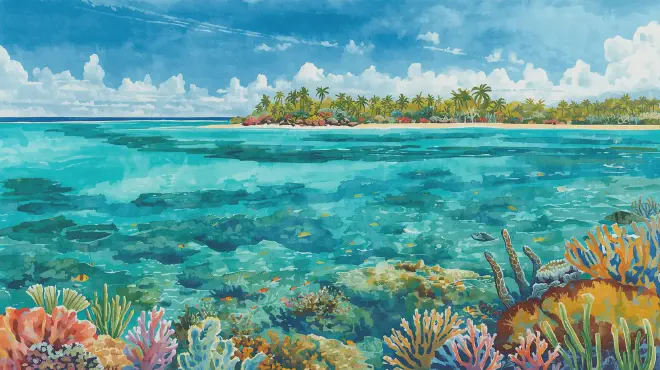
The western coast faces the calm Caribbean Sea, protected as a marine park that divers worldwide dream of visiting. The eastern shore, meanwhile, reveals a wild character where Atlantic swells crash against the rocks. At the southern tip, salt pans stretch out where flamingos gather in flocks. Dutch, African, and South American cultures blend together, and Papiamento, a unique language, melts into daily life.
I chose Bonaire for its “nothingness.” Not a flashy tourist destination, but simply a place where sea, wind, and sun exist. I felt that spending two nights and three days there might quietly organize something within me.
Day 1: Welcomed by the Wind
When I stepped off the plane at Flamingo International Airport, the Caribbean sun struck my skin mercilessly. Outside the small terminal, a cheerful man holding a rental car company sign was waiting. Since public transportation is virtually nonexistent on Bonaire, a car is essential for getting around the island. After completing the paperwork, I climbed into a right-hand-drive pickup truck.
My accommodation was a small dive resort on the west coast, slightly south of downtown Kralendijk. Pastel yellow walls with blue window frames. Palm trees and bougainvillea swayed on the grounds, and a pier stretched into the sea right in front. After checking in and entering my room, I found the Caribbean Sea spread out before the window. The sound of waves reached my ears with the regularity of breathing.
Though tired from the morning’s travel, sitting still in my room with the sea before me felt wasteful. I changed into my swimsuit and entered the water directly from the resort’s pier. Even in the shallow waters where my feet could touch bottom, colorful fish were already swimming. When I put on my snorkel mask and dipped my face into the water, another world unfolded. Yellow-striped sergeant majors, brilliant blue tangs, lobsters lurking in rocky crevices. Even before reaching any serious diving spots, this richness. The reason Bonaire’s waters are called a “Diver’s Paradise” became clear that first afternoon, in just a few meters of shallows.
In the evening, I drove into downtown Kralendijk. Along the main street, Kaya Grandi, colorful buildings housed souvenir shops, dive shops, and small restaurants. The architectural style preserving traces of Dutch colonial times harmonized with the vibrant colors characteristic of the Caribbean.
For dinner, I chose a restaurant called “The Rose Inn” facing the harbor. Sitting on the terrace, I looked over the menu. Dutch, Papiamento, and English mixed together in the listings. Following the waiter’s recommendation, I ordered a local fish dish called “Pisca Krokodeko.” About fifteen minutes later, what arrived was a whole snapper simmered with tomatoes, peppers, and onions. It came with fried plantains and a side of funchi, a cornmeal accompaniment.
One bite and the acidity of the tomatoes melted together with the umami of the fish in my mouth. The spices were modest, letting the ingredients’ flavors take the lead. As I enjoyed my meal slowly, cheerful laughter rang out from the neighboring table. A local family, perhaps. Children chattering in Papiamento while adults laughed. Watching that scene, I truly felt I had come somewhere far away.
As the sun set and the sky turned deep purple, I returned to my lodging. Sitting on the room’s balcony, I drank beer while listening to the waves. A canopy of stars spread overhead, the Milky Way clearly visible. Bonaire has few streetlights and almost no light pollution. This quietness and darkness felt like a luxury impossible to experience in the city.
Day 2: Time Beneath the Sea, Time Upon the Land
I woke to the sound of birds singing. Opening the window, the air still held a coolness. Breakfast was a simple buffet on the resort’s outdoor terrace—bread, fruit, and Dutch-style cheese and ham. Drinking strong coffee, I considered the day’s plans. Morning would be Washington Slagbaai National Park, afternoon dedicated to proper diving.
I drove north. Washington Slagbaai National Park, spreading across the island’s northern section, is a nature reserve covering about 20 percent of Bonaire. After paying the entrance fee at the visitor center, I proceeded onto the park’s unpaved roads.
On the arid land, tall cacti dotted the landscape. Divi-divi trees bent in one direction from the wind, their shape striking. These trees tell the story of the trade winds’ strength. Along both sides of the road, iguanas plodded about. Some in vivid yellow and orange looked almost like toys.
Climbing to an observation point within the park, I could see the island’s entire panorama. To the west, the calm Caribbean; to the east, rough waves crashing from the Atlantic. In the distance, Bonaire’s symbolic twin hills, Brandaris and Seru Largu, were visible. The wind blew strong, nearly snatching away my hat. On this island, I understood, wind is always the protagonist.
I also stopped at caves within the park. In caves once inhabited by indigenous peoples, wall paintings remained. Geometric patterns and human-shaped figures drawn in red pigment. Thinking that hundreds of years ago, people lived here, caught fish from the sea, and felt this same wind filled me with a strange sensation.
Past noon, I returned to the resort to prepare for the afternoon’s diving. Along Bonaire’s coastline are over 60 diving sites, most accessible via beach entry. Today I chose a spot called “1000 Steps.” True to its name, you descend stairs to reach the shore, though there are actually only 67 steps. However, climbing back up carrying heavy gear makes it feel like 1000—that’s the joke behind the name.
Descending the stairs, I arrived at the beach. The coral reef wall pressed close to the shore. I donned my gear and slowly entered the water. The moment my face broke the surface, a deep blue spread before me. Descending along the wall, the coral continued down 5 meters, 10 meters, 20 meters.
The wall bore colorful sponges and soft corals, between which countless fish swam. Large barracuda crossed majestically, rays glided slowly across the sandy bottom. Occasionally, I spotted sea turtles swimming gracefully away. My sense of time dissolved. Underwater, only the sound of breathing and my own heartbeat were audible. A space where I was permitted to simply exist, thinking nothing.
After about 50 minutes of diving, I ascended slowly. When my face emerged at the surface, the real world returned. Climbing the stairs, I certainly understood the meaning of the name.
In the evening, I headed to Pekelmeer, the salt pans at the island’s southern tip. Salt production has occurred on Bonaire since the 17th century, and large-scale salt pans still operate today. Pure white mountains of salt glowed pink in the sunset. And in the salt pans, hundreds of flamingos had gathered.
Pink-bodied flamingos foraged in the shallow water. The carotenoids in the algae and plankton they eat create that beautiful pink color, I’d learned. Sunset, flamingos, and pink salt pans. This landscape felt surreal.
For dinner, I ate at a small eatery serving a traditional dish called kabritu stoba. This is a home-style dish popular in Bonaire and Curaçao, born during the era of slavery. Goat meat stewed with flavoring from orange peel, with sweetness and acidity perfectly balanced. It came with tutu, rice cooked with black beans, and was quite filling.
The woman at the eatery asked in broken English, “Delicious?” When I nodded with a smile, she smiled happily too. Though words didn’t fully connect, there was an exchange through food.
Day 3: Morning of Farewell, Weight of Memory
The final morning, I woke with a sense of reluctance. Though only two nights, the time on this island felt strangely long. Perhaps because I’d spent each day carefully.
After breakfast, I decided to enter the sea one last time. In front of the resort, I enjoyed snorkeling slowly. The familiar fish were swimming unchanged. To them, my stay was merely a momentary event. Still, I felt certain that for these few days, we’d truly shared the same sea.
During the morning, I strolled through Kralendijk. I stopped at a small museum and learned about Bonaire’s history. Dutch colonization, the slave trade, the salt industry, and the shift to tourism today. The complex history this small island had walked was carefully displayed.
I also visited the local market. Fresh fish, tropical fruits, handmade hot sauce. In this market where locals shopped daily, there was a different face of the island than in tourist areas. I bought papaya and had it cut there with a knife. Squeezing lime over it, sweetness spread with a hint of acidity.
For lunch, at a casual bar along the shore, I ate a fried fish sandwich. Freshly fried mahi-mahi with cabbage slaw, pickles, and special sauce heaped on top. Drinking beer while gazing at the sea. This view too would be my last today.
In the afternoon, before heading to the airport, I stopped once more at Pekelmeer. Unlike yesterday evening, the salt pans gleamed in strong sunlight. Fewer flamingos, but still dozens stood gracefully.
I tried to capture this scene in a photograph, but the moment I raised my camera, I suddenly thought: How much meaning is there in capturing this landscape in a photo? The temperature of the wind, the scent of the tide, the sound of distant waves. The flamingos’ calls, the texture of sand underfoot. Perhaps what cannot be photographed is more important. Still, I pressed the shutter because I wanted to take home at least these colors.
On the road to the airport, I ruminated on my time on this island. Not a flashy tourist destination. Nothing particularly special happened. Yet the time spent here had certainly left something within me.
After checking in, I waited for boarding in the small waiting area. Outside the window, the island I was about to leave spread out. Arid land, scattered cacti, and blue sea. Perhaps because the landscape was simple, it engraved itself on my heart.
As the plane took off and gained altitude, all of Bonaire became visible. The boomerang-shaped island. The calm western coastline and the rough eastern shore. The salt pans at the southern tip and the national park in the north. This small island contained diverse expressions.
Above the clouds, Bonaire disappeared from view. But its memory remained vivid. The sound of waves, the strength of wind, the water’s clarity, the flamingos’ pink, the taste of kabritu stoba, the market’s bustle, and above all, that quietness.
Certainty Within Imagination
To be honest, I have never actually visited Bonaire Island. This travel essay is an imaginary journey woven from research and imagination.
Yet while writing this piece, I experienced a strange sensation. As if I had truly walked that island, dived in that sea, felt that wind. By putting it into words, memories of experiences I never had became engraved in my heart as something certain.
What is travel? Is moving one’s physical body the only form of travel? Might touring foreign lands in imagination, envisioning their culture and nature, also be a kind of journey?
Bonaire Island exists. There truly are waters with 50-meter visibility, dancing flamingos, and trade winds blowing through. Perhaps one day I will actually visit that island. When that happens, how will these imagined memories overlap with, or diverge from, the actual experience? That too would be fascinating.
A journey that, while imaginary, feels as if it truly happened. Perhaps this is another form of travel that human imagination brings forth.
And if anyone reading this becomes interested in Bonaire Island, please do visit. With your own eyes, that ocean’s blue. With your own skin, that wind’s strength. With your own tongue, that cuisine’s taste.
Hoping that this imagined journey might someday connect to someone’s real journey, I close this travel essay.