
A Tranquil Ancient City Nurtured by the Rhine
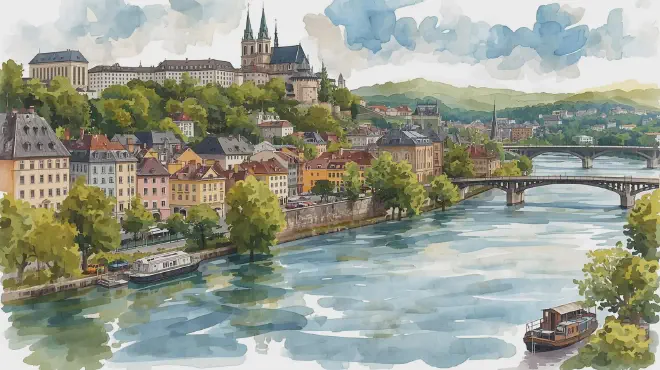
When most people hear the name Bonn, the first thing that comes to mind is probably Beethoven’s birthplace. But this city’s charm extends far beyond that single association. Stretching along the gentle flow of the Rhine River, Bonn is a place of depth and layers—where vestiges of its time as West Germany’s capital overlap with its two-thousand-year history as a fortress city founded by the Romans.
About thirty kilometers south of Cologne, this city maintains a quiet dignity, removed from the clamor of larger metropolises. The Siebengebirge hills rising on the right bank of the Rhine are lined with ancient vineyards, their beautiful ridgelines visible from the old town across the river. In spring, the cherry blossom avenue at Alter Zoll draws admirers from afar, while autumn transforms the ginkgo-lined streets into corridors of gold.
Centered around the University of Bonn, the city also functions as an academic hub, with young people opening books and engaged in discussion at cafes throughout the town. Former government facilities have been transformed into international organizations and museums, where old and new coexist in quiet harmony. Music, art, scholarship, and the gentle flow of the river—Bonn embraces all of these elements, welcoming those who visit with open arms.
Day 1: Into Beethoven’s City
After an hour and a half on the train from Frankfurt Airport, I arrived at Bonn Hauptbahnhof just past one in the afternoon. Stepping out of the station, I was greeted by sunlight softer than I’d anticipated. Despite being late October, the air wasn’t too cold—it carried only the pleasant essence of autumn.
I boarded a tram from the station square toward the old town. The scenery flowing past the window was characteristically orderly for a German provincial city. Stone buildings lined up in neat rows, with people cycling between them. Inside the tram, elderly women clutched shopping bags while students with large backpacks stood nearby, all wearing expressions of calm contentment.
After checking into a small hotel near Münsterplatz in the heart of the old town, I immediately set out to explore. My first destination was Beethoven’s birthplace. The building facing the small street called Bonngasse was more modest than I’d imagined—a three-story house with yellow walls, now open to the public as a museum. Inside, I found the piano and trumpet the composer actually used, along with handwritten scores. In the music room, his masterpieces played softly.
By the time I emerged, dusk had settled. Returning to Münsterplatz, I found the Baroque Bonn Minster illuminated by the evening sun, standing in solemn majesty. Market stalls had appeared in the square, and the savory aroma of roasted chestnuts wafted through the air. I bought a small paper bag of chestnuts and sat on a bench, peeling and eating them one by one. They were warm, with a subtle sweetness.
For dinner, I went to a Brauhaus tucked away in one of the old town’s alleys. When I ordered the local beer “Bönnsch,” a golden liquid arrived in a hefty mug. The foam was fine-textured, and the first sip filled my mouth with the rich flavor of malt. For my meal, I chose Sauerbraten, a Rhineland regional specialty—beef marinated in wine and vinegar for several days before being slow-cooked. The dish offered a complex interplay of subtle acidity and sweetness. The accompanying red cabbage salad and Knödel (potato dumplings) absorbed the rich sauce perfectly.
The restaurant bustled with local regulars. At the neighboring table, a group of middle-aged men raised their beer mugs in celebration of something. The elderly man who appeared to be the owner exchanged jokes with customers across the counter. I didn’t understand the German, but the warmth of the atmosphere transcended language.
On my way back to the hotel, I walked along the Rhine promenade. Lights from the opposite shore shimmered on the water’s surface. A ship’s horn sounded in the distance. It was quiet—truly, deeply quiet. Lying in bed back in my room, fatigue from the day mingled with anticipation for the journey ahead, and I drifted naturally into sleep.
Day 2: Hills and Museums in the Afternoon
Morning began with the hotel’s breakfast buffet. True to German style, various types of Brot (bread), ham, and cheese were laid out. I spread rich butter on rye bread, topped it with smoked salmon, and took a bite. As I washed it down with hot coffee, I could feel my body awakening.
For the morning, I decided to head to Drachenfels on the right bank of the Rhine. From the small town of Königswinter, I would take a cogwheel railway to the summit. After transferring between tram and bus to reach Königswinter, I found myself in a distinctly tourist-oriented atmosphere. Souvenir shops lined the streets, and tourists relaxed at outdoor café tables.
The cogwheel train climbed slowly up the steep slope. Through the windows, the Rhine River and the townscape spreading along both banks gradually came into view. Along the way, I spotted the ruins of an ancient castle and terraced vineyards. After about twenty minutes, we reached the summit, where a breathtaking panorama unfolded before me.
The Rhine River flowed gently in an S-curve, with the city of Bonn spreading across the opposite shore. Looking further north, I could even make out Cologne Cathedral in the distance. The wind was strong, tousling my hair, but its refreshing force felt invigorating. I ordered apple cake and coffee at the viewing platform restaurant and savored the scenery at leisure. An elderly couple seated nearby struck up a conversation in English: “We come here every year at this time. The autumn colors are the most beautiful.”
In the afternoon, I returned to Bonn’s center and headed to the Museum District, where several art museums are concentrated. The Kunstmuseum Bonn in particular is renowned for its contemporary art collection. Entering the building with its striking white exterior, I found exhibition spaces flooded with natural light.
The collection ranged from German Expressionist works to contemporary installations. What left the deepest impression was the vibrantly colored paintings of August Macke. Born in Bonn, Macke’s depicted world was bright and brimming with vitality. The fact that he died young in war made the radiance of his works feel all the more poignant.
When I left the museum, it was already approaching evening. I stopped at a nearby café and ordered Käsekuchen, a German-style cheesecake. It was rich yet not heavy, with a subtle hint of lemon. Through the large windows, I could see the street trees glowing golden.
That night, I explored the Poppelsdorfer Allee district, a student quarter lined with bars and restaurants. I entered a small Italian restaurant and ordered risotto, a green salad, and white wine. Jazz played inside, where young couples and groups of friends enjoyed their meals in animated conversation.
Eating Italian food while in Germany felt somewhat odd, but within the larger cultural sphere of Europe, such blending must be part of daily life. The risotto was perfectly al dente, with the flavor of Parmesan cheese coming through distinctly.
On my way back to the hotel, I walked along the Rhine again. Unlike last night, the moon was out this evening. Its light reflected on the water’s surface, fragmenting and reconnecting with the waves. Laughter echoed from somewhere. Someone’s life was being lived in this city. Thinking this, I felt both the strangeness of walking here as a traveler and, simultaneously, something of the universal nature of human existence.
Day 3: A Morning of Farewells and What I Carry Home
On my final morning, I woke a bit early. Checkout was at eleven, but I wanted to walk through this city just a little more. After packing my belongings and leaving them at the front desk, I went out with only my camera.
I headed to the cherry blossom avenue at Alter Zoll, which I’d heard about. This street, famous for its cherry blossoms in spring, was said to reveal a different beauty in autumn. Getting off the tram and walking a short distance, a magnificent tree-lined avenue appeared. The cherry leaves had already fallen, and the ginkgos blazed golden. Walking through the tunnel of trees standing on both sides of the street, I found yellow leaves carpeting the ground beneath my feet.
People took their morning walks, walked their dogs, went jogging—each enjoying this tree-lined path in their own way. I took several photos, though I knew the softness of this light, the quality of this air, could never be fully captured. Still, I pressed the shutter, wanting some aid to memory, some trigger to help me recall this moment someday.
At the end of the avenue stood a small café, where I drank a cappuccino. A young woman working there asked in English, “Are you traveling?” When I said yes, she smiled and asked, “Did you like Bonn?” Of course, I replied, and she nodded happily. These small exchanges are what make travel memories warm.
I returned to the hotel to collect my luggage, then made one final visit to Münsterplatz. The Minster still stood there as always, and the square held the gentle air of a weekday afternoon. People shopping at the market, an old man reading a newspaper on a bench, children playing around the fountain.
Bonn is not a flashy city. It doesn’t offer dramatic vistas or stimulation filled with dizzying change. But there is genuine life here, history, culture. It’s the city that gave birth to the genius Beethoven, once served as a nation’s capital, and now quietly nurtures scholarship and the arts. All of this exists without excessive assertion, simply being there.
On the tram toward the station, I gazed absently at the scenery flowing past the window. Would I come again? I couldn’t say. But if I did return, I’d want to visit the places I’d missed this time—the former West German government buildings in the suburbs, a Rhine River cruise, perhaps the small villages nearby.
Standing on the platform at Bonn Hauptbahnhof waiting for the train to Frankfurt Airport, I watched as a train on the adjacent platform slowly began to move. A child pressed their face against the window, waving. I couldn’t tell who they were waving to, but I waved back. The child smiled happily and disappeared from view with the departing train.
My train arrived on schedule, and I took my seat. As it pulled away, the city of Bonn slowly receded from the window. I saw the Rhine River, saw the hills, and gradually everything grew smaller.
What Felt Real Despite Being Imaginary
The two nights and three days I spent in Bonn were far from a long journey. Yet within that brief time, there was something tangible. The weight of history felt at Beethoven’s birthplace, the grandeur of the Rhine viewed from Drachenfels, the radiance of colors encountered at the museum, and above all, the peaceful expressions on the faces of people walking through the streets.
Travel is not merely about visiting new places. It’s about breathing there, eating there, sharing the same air with the people. Only then does the true face of a place begin to reveal itself.
Bonn taught me this quietly. Precisely because it’s not a flashy tourist destination, the texture of everyday life remains vivid. And for a traveler, that everyday quality is the most fresh and irreplaceable thing of all.
This journey is a product of imagination. I did not actually visit Bonn. Yet the image of this city that I came to know through literature, photographs, and videos formed a clear picture within me. And that picture may not be so far from the sensations I would feel if I actually visited.
Travel is not completed through physical movement alone. When the heart moves, when imagination works, when curiosity about the unknown is satisfied—that’s when a person can truly say they have “traveled.”
If the day comes when I actually visit Bonn, there will be a moment when this imaginary memory overlaps with real experience. At that moment, I’m sure I’ll smile—embracing both the parts that match what I imagined and the completely unexpected discoveries.
The journey continues—in imagination, and in whatever reality may someday come.