
In a City of Red Brick and Cobblestones
When I hear the name Boston, I feel a certain nostalgia in its sound. Perhaps it’s because of the old streetscapes where America’s founding history still breathes—scenes depicted countless times in films and novels. This city, the capital of Massachusetts, was established by Puritans in 1630 and still retains strong traces of the 17th and 18th centuries.
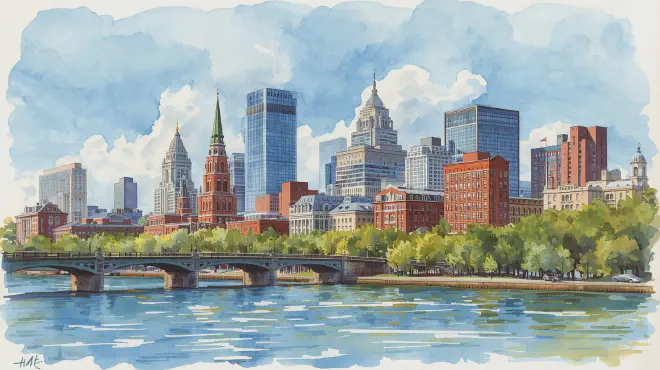
The Charles River flows gently, embracing the city, while prestigious institutions like Harvard University and MIT infuse the air with intellectual energy. Meanwhile, a historical path called the Freedom Trail weaves through the city like a thread. In this city of red brick buildings and cobblestone streets, wrapped in fiery autumn foliage, I decided to spend a brief two nights and three days.
The climate of New England is known for its distinct four seasons, with autumn beauty said to be particularly exceptional. This is also the homeland of clam chowder and lobster rolls, and the harbor—the stage for the Boston Tea Party—still carries memories of history. What encounters and discoveries would I make in such a city?
Day 1: Footsteps on Cobblestones and Doors to History
The moment I stepped off the plane at Logan International Airport, the scent of the tide brushed past my nose. This airport, close to Boston Harbor, must have welcomed countless travelers as the gateway to the city. I transferred to the Blue Line subway, rattling along toward downtown. The scenery passing by the windows had a familiar quality that somehow reminded me of regional cities in Japan.
I got off at Downtown Crossing and walked to my pre-booked hotel. The aromatic smell of coffee drifted from a café facing the street, and already I felt myself dissolving into the daily life of this city. After checking in at the hotel, I immediately set out to explore.
In the morning, I began my wandering from Boston Common. America’s oldest park, created in 1634, was bustling with people despite being a weekday. Joggers, students reading on benches, locals walking their dogs—everyone spending time in their own way. I could feel how deeply rooted this park was in the lives of the city’s people.
As I rested by the pond, an elderly gentleman nearby struck up a conversation. “Visiting?” he asked, and when I told him I’d come from Japan, he smiled warmly. “My son works in Tokyo,” he said, then kindly shared several of Boston’s must-see spots. These casual encounters are surely one of travel’s greatest charms.
In the afternoon, I decided to walk the Freedom Trail. A red brick line is drawn on the ground, and following it leads you past major historical sites. First, I headed to the Massachusetts State House. Its golden dome gleamed beautifully against the blue sky. Stepping inside, I was overwhelmed by the solemn atmosphere. Listening to the guide’s explanations, I imagined how many important decisions had been made in this place.
Next, I went to Faneuil Hall. This building, called the “Cradle of Liberty,” was where important speeches were delivered before the Revolutionary War. The stone exterior exuded dignity, and inside, you could feel the weight of history on your skin. Standing in the second-floor hall, I felt as though I could hear the heated debates of historical figures like Samuel Adams and John Hancock.
As evening approached, I decided to rest at Quincy Market. Built in the 19th century, this marketplace has become a food court-like space bustling with tourists and locals alike. I ordered clam chowder, the local specialty. The rich cream soup was filled with chunks of clams and tender potatoes. With one sip, the ocean’s bounty and earth’s gifts melted together in my mouth, and I felt my travel fatigue melting away.
In the evening, I wandered through the Italian neighborhood of the North End. Family-run small restaurants and cafés lined the narrow cobblestone streets. Delicious smells wafted from every establishment, making my stomach growl. I ended up having dinner at a small ristorante recommended by a local.
The owner-like man greeted me cheerfully with “Buonasera!” Listening to his explanation mixing English and Italian, I ordered the recommended fish dish. Fresh white fish simmered with tomatoes and basil was simple yet excellent, bringing out the ingredients’ natural flavors. At the next table, a large family ate noisily together, seeming to symbolize the warm atmosphere of this neighborhood.
Leaving the restaurant, the cobblestones gleamed beautifully under the streetlights. I passed by St. Leonard’s Church and slowly made my way back to the hotel. At the end of my first day, I had felt the multifaceted charm of Boston. The weight of history and the vitality of the present, various cultures blending to create a unique atmosphere. What discoveries would tomorrow bring?
Day 2: Quietude of the Scholarly City and Riverside Melodies
For breakfast, I went to a small café near the hotel. Mixing with the locals, I read the Boston Globe while enjoying coffee and a bagel. At the next table, students were discussing exams, reminding me once again of this city’s academic atmosphere.
In the morning, I took the Red Line to Harvard Square. Stepping off the subway, I found myself in a completely different world. Old brick buildings lined up, and wherever I walked, an intellectual air permeated everything. Harvard University’s campus is open to the public and free to explore.
Entering Harvard Yard, I gasped at its serene beauty. The green lawn and old red brick buildings harmonized like a painting come to life. Watching students studying and debating in various spots, I realized this was truly one of the world’s premier centers of learning.
In front of the library, a tour for visitors was being conducted. A student guide explained the university’s history and notable alumni. John Adams, John Quincy Adams, Theodore Roosevelt, and John F. Kennedy. Thinking that so many figures who shaped American history studied here filled me with deep emotion.
At the campus bookstore, I bought a mug with the university logo as a souvenir. The kind saleswoman asked, “How do you like Harvard?” I replied, “It’s wonderful. I wish Japan had such beautiful campuses,” and she responded warmly, “But Japan has cherry blossoms, doesn’t it?” My heart felt warm.
In the afternoon, I decided to walk along the Charles River. The promenade called the Esplanade is a gathering place for locals. The cityscape reflected on the river’s surface was beautiful, with several bridges connecting Cambridge and Boston across the water.
As I sat on a bench gazing at the river, an elderly woman sat beside me. She’d lived in this area for many years and told me about the river’s expressions through the seasons. “In spring, cherry blossoms bloom; in summer, boat races are popular; in autumn, the foliage is beautiful; and in winter, it sometimes freezes.” Listening to her talk, I understood how deeply this river is connected to the lives of Boston’s people.
As evening approached, I moved to the Back Bay district. This area was created through landfill in the 19th century and is characterized by orderly streets. Newbury Street is famous as a shopping district, lined with stylish cafés and boutiques.
For dinner, I went to a well-regarded seafood restaurant. Having come to Boston, I had to try an authentic lobster roll. When the dish arrived, I was amazed by its generosity. A fluffy hot dog bun was stuffed with an abundance of lobster meat. The butter-sautéed lobster was sweet and springy, and with one bite, the ocean’s bounty filled my mouth.
After dinner, I attended a classical concert at Boston Symphony Hall. Built in the late 19th century, this hall is world-famous for its acoustics. Listening to the Boston Symphony Orchestra perform Beethoven’s Ninth Symphony, I reflected on music’s universal power. Beyond nationality or language, beautiful melodies move the human heart.
When the concert ended and I stepped outside, nighttime Boston showed a different face. The stone buildings illuminated by streetlights appeared more mysterious and beautiful than during the day. Walking slowly, I mentally organized what I’d felt during this day. In this city where learning and art, history and present harmonize so beautifully, I felt as though I’d discovered something precious.
Day 3: Wrapped in Sea Breeze, Etching Memories
On the final morning, I woke up a bit early and gazed at the city from my hotel window. The Boston streetscape illuminated by the morning sun was beautiful like an old postcard. Thinking that today I’d say goodbye to this city filled me with indescribable loneliness.
After breakfast, I left my luggage at the hotel and set out for one last exploration. Today I decided to spend my time centered on Boston Harbor. I took the subway to Aquarium station and walked from there to the Harborwalk.
Boston Harbor is an important place in American independence history. This port, the stage for the Boston Tea Party in 1773, has now been reborn as a beautiful waterfront. The sea breeze caressed my cheeks, and the scent of the tide etched itself deep into my memory.
I visited the Boston Tea Party Ships & Museum. On a reconstructed sailing ship, performances reenacting the historical event were taking place. Actors in 18th-century costumes engaged in heated debates. The participatory event allowed audience members to actually throw tea chests into the harbor at the end. By reliving a moment in history, I felt I could understand a little of what people felt back then.
In the afternoon, I took a ferry to Spectacle Island. One of the Boston Harbor Islands, this island was once used as a fort but is now maintained as a nature park. The Boston skyline viewed from the boat was magnificent, with skyscrapers and historical buildings harmonizing beautifully.
Landing on the island, I found a quiet world completely different from the city’s hustle and bustle. Walking through the grassy hills while gazing at Boston across the water. The wind was cool, with only birdsong audible. I sat on a bench near the island’s summit and ate a late lunch with the sandwich I’d brought.
On the return ferry, standing on deck feeling the sea breeze, I reflected on these three days. The first day feeling history’s weight, the second day touching learning and art, and the final day savoring nature’s beauty. Though it was a brief stay, I’d fully experienced Boston’s multifaceted charm.
In the evening, I strolled around Faneuil Hall again. Unlike my first visit, this time I felt a familiarity, as if I’d become part of the city. I greeted familiar shop clerks and bought maple syrup and cranberry sauce as souvenirs.
For my final dinner, I returned to Quincy Market where I’d stopped on the first day. This time I ordered a New England clambake. Steamed lobster, clams, corn, and potatoes piled on one plate—a magnificent dish. Eating it, I realized anew how deeply Boston’s food culture is connected to the ocean’s bounty.
Finishing the meal and stepping outside, the sky had already grown dim. The time to head to the airport was approaching. One last time, I walked through Boston Common. As night fell, the park’s trees illuminated by streetlights created a fantastical atmosphere.
Sitting on a bench, I carefully tucked away the time I’d spent in this city in my heart. The smiles of people I’d met, memories of food I’d tasted, the weight of history I’d felt, and beautiful natural scenery. All of it became one story within me, remaining as memories that would never fade.
On the subway ride to Logan Airport, the city lights visible from the window were beautiful. Thank you, Boston. I will definitely return—murmuring this in my heart, I headed home.
What Felt Real Despite Being Imaginary
This travel account is an imaginary story I never actually experienced. Yet, as I wrote these words, I felt as though I truly walked Boston’s cobblestones, gazed at the Charles River’s surface, and felt the warmth of clam chowder.
Perhaps this is the mysterious power born from longing for travel. Landscapes and encounters envisioned in the mind can sometimes be more vivid than reality, etching themselves deeply into the heart. Boston’s historical weight, cultural richness, and people’s warmth—even within imagination—certainly moved my heart.
If the day ever comes when I truly visit Boston, surely these imaginary memories and real experiences will overlap, creating even deeper emotion. Travel is not just about walking with your feet, but also feeling with your heart.
A journey that felt real despite being imaginary. Perhaps this is another reality drawn by our imagination.