
A Small Jewel of the Adriatic
When people hear the name Montenegro, many may not be able to pinpoint its exact location on a map. This small country on the Balkan Peninsula, with its beautiful Adriatic coastline and rugged mountainous interior, is truly a microcosm of nature’s grandeur.
Budva is one of Montenegro’s most representative ancient cities. With over 2,500 years of history, this town offers a breathtaking contrast between its old quarter, densely packed with medieval stone buildings, and the emerald-green Adriatic Sea. The townscape, which retains strong vestiges of its time under Venetian rule, possesses a unique blend of solidity and elegance unlike other cities along the Mediterranean coast.
The people of Montenegro are proud yet warm. They speak Montenegrin, which is close to Serbian, though English is also understood in tourist areas. The Orthodox Church has a strong influence, and small churches and monasteries dot the street corners. The cuisine is a unique fusion of Mediterranean and Balkan cooking, exquisitely combining fresh seafood with mountain delicacies.
Three days spent in this small town in this small country—it promised to be a special experience where time itself seemed to flow more slowly.
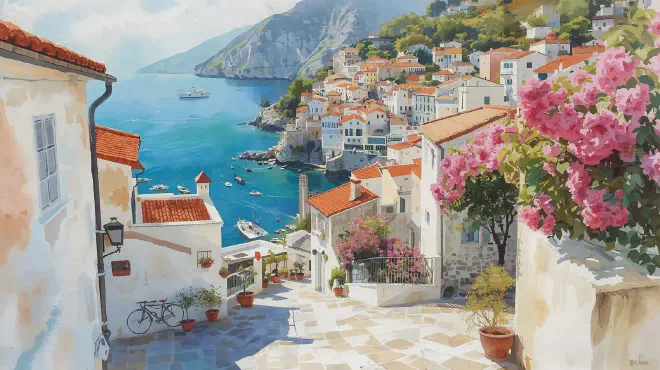
Day 1: Gateway to the Stone-Paved City
About thirty minutes by taxi from Tivat Airport. The Adriatic Sea visible through the car window was more transparent than I had imagined, as if it had directly captured the blueness of the sky itself. The driver, Miloš, spoke fluent English and told me about Montenegro’s history. His words were memorable: “Budva is our pride. It’s an old city, but it’s a living city.”
I arrived in Budva around 11 a.m. My accommodation was a small guesthouse called “Villa Mediterran,” about a five-minute walk from the old town. The owner, Marina, welcomed me warmly. While the building itself was new, the interior was unified in traditional Montenegrin style, with wooden furniture and handwoven carpets creating a comfortable atmosphere.
After leaving my luggage in the room, I immediately set out to explore the old town. The entrance to the walled old quarter was like a time tunnel into the medieval world. The stone pavement was worn smooth, countless footsteps carved into it over the long years. I first headed to the Church of St. Ivan, the symbol of the city. Built in the 12th century, this church had a simple exterior, but the frescoes inside were breathtakingly beautiful. Afternoon light streamed through the colorful stained glass, drawing rainbow patterns on the stone floor.
I had lunch at “Restoran Stari Grad” in the center of the old town. The terrace seating in the courtyard of the stone building had exactly the atmosphere befitting an ancient European city. Looking at the menu, I found dishes featuring fresh Adriatic seafood. On the waiter’s recommendation, I ordered salt-baked branzino (sea bass) and local white wine. The fish was surprisingly fresh, and the simple cooking method with lemon, olive oil, and local herbs brought out the flavor of the ingredients to the fullest. The white wine “Vranac” had a light and refreshing taste, perfect for dining on a terrace overlooking the sea.
In the afternoon, I strolled along the coast. Budva’s coastline consists of intricately indented coves and small bays, each showing a different expression. While Mogren Beach was crowded with tourists, at a small cove I reached after walking a bit further, locals were quietly enjoying their sea bathing. The color of the sea changed subtly depending on the location, from the emerald green of the shallows to the cobalt blue of the depths—like viewing a natural gradient.
In the evening, I walked along the top of the old town’s walls. These walls were built by the Venetians in the 15th century and still surround the city today. From atop the walls, I could see both the Adriatic Sea and Budva’s townscape at a glance. As the sun began to set over the sea, the stone buildings were dyed a warm orange, as if the entire town were wrapped in gold. In that moment, I was truly glad I had made this journey.
I spent the night at “Wine Bar Casper,” a wine bar in the old town. The small underground establishment created a medieval atmosphere with its stone walls and candlelight. The bartender, Aleksandar, taught me in detail about Montenegrin wines. The deep flavor of the red wine “Vranac” showed a completely different character from the white wine I’d had during the day. His words stayed with me: “This wine is the taste of our land.” While slowly savoring the wine along with a platter of cheese and prošut (prosciutto), I reflected on the day’s events. The sound of my own footsteps echoing on the stone pavement already felt nostalgic.
Day 2: Nature’s Symphony Where Sea and Mountain Meet
I woke around 7 a.m. When I opened the window, a refreshing breeze from the Adriatic Sea flowed into the room. The scent of last night’s rain still lingered in the air, and the stone pavement glistened wetly. I could have breakfast on the guesthouse terrace. The traditional Montenegrin breakfast consisted of kajmak (dairy product), honey, homemade bread, and local cheese. The kajmak in particular was a taste I’d never experienced before, with a richness somewhere between butter and cream cheese, and it paired perfectly with honey. The Turkish coffee Marina brewed was rich and aromatic, perfect for a morning awakening.
In the morning, I decided to visit Sveti Stefan island, located about thirty minutes by car from Budva. The taxi driver, Petar, talked the entire way about Montenegro’s nature. “This country is small, but it has sea, mountains, and lakes. It’s like a museum of nature,” he said, and true to his words, the scenery from the car window changed constantly.
Sveti Stefan island was a small island built as a fortress in the 15th century, now a luxury resort hotel. While the island itself was off-limits, the view from the observation point on the opposite shore was spectacular. Red-roofed stone buildings crowded onto the small island, like a medieval town floating on the sea. The sand bar connecting the island to the mainland formed naturally, changing its appearance with the tides. Under the morning light, the island looked exactly as it does in photographs, but seeing it in person left me speechless at its beauty.
Beautiful beaches dotted the area around the island. Miločer Beach in particular was a luxury beach known for having housed Queen Marija’s villa. I decided to swim here. The seawater was warmer than expected, and the transparency was outstanding. I could see clearly even to the pebbles on the seabed, beautiful as a swimming pool. While swimming, I could see schools of small fish swimming past my feet. When I came out of the water and lay down on the beach, the warmth of the sun and the coolness of the sea breeze maintained an exquisite balance.
I had lunch at “Restaurant Milocer” near the beach. From the terrace seating, I had a panoramic view of Sveti Stefan island—a perfect location. From the menu, I ordered the local specialty “ćevapi.” This is a dish like small sausages made from ground meat, eaten wrapped in a flatbread called “lepinja.” Though a simple dish, the umami of the meat was concentrated, and the combination with local onions and yogurt sauce was exquisite. For dessert, I ordered “baklava.” This pastry of thin dough layered with honey and nuts had a sweetness that evoked Turkish influence.
In the afternoon, I decided to visit a small village in the interior. At Petar’s suggestion, I participated in “ecotourism” where I could experience traditional Montenegrin village life. After driving up mountain roads for about an hour from Budva, there was a small village on a plateau at about 800 meters elevation. There, traditional stone houses were scattered about, and a pastoral scene unfolded with shepherds walking with their flocks of sheep.
At one farmhouse in the village, I was allowed to observe traditional cheese-making. An elderly couple, Dragan and Milica, were making cheese using methods passed down through generations. The cheese made from goat’s milk had a richness and natural sweetness you couldn’t taste in urban areas. “It’s because the milk comes from goats that eat the grass of these mountains,” Milica explained with a smile. Around their house was a small vegetable garden growing seasonal vegetables and fruits, and it was clear they were living a completely self-sufficient life.
On the way down from the village in the evening, I stopped at a small monastery. It was a small building like a branch of Ostrog Monastery, but beautiful icons (religious paintings) were displayed inside. One of the monks explained the history of this monastery. Built in the 17th century, this monastery was one of the centers of Orthodox faith in Montenegro even during the Ottoman Empire era. The monastery walls illuminated by the setting sun seemed to glow golden.
I returned to Budva around 8 p.m. I was tired but filled with a sense of fulfillment. For dinner, I went to “Konoba Stari Mlini” in the old town. This restaurant was converted from an old water mill, with impressive stone walls and wooden beams. From the menu, I ordered the traditional Montenegrin dish “jagnjećina” (roasted lamb). The lamb was tender, and the aroma of rosemary and garlic stimulated the appetite. The grilled vegetables that came as a side dish were also sweet and delicious, pairing well with the local red wine.
After the meal, I strolled through the old town. The stone-paved city at night showed a completely different face from daytime. The warm light of the street lamps illuminated the stone walls, creating a fantastical atmosphere like a movie set. In a small square, local young people were playing guitar and singing, their voices echoing off the stone walls. The fulfillment of touching nature all day and interacting with local people seeped into my body along with a pleasant fatigue.
Day 3: A Morning of Farewell and Gifts for the Heart
On the last morning, I woke earlier than usual. Around 6 a.m., when the city was still wrapped in silence, I walked alone through the old town. The stone-paved city in the early morning without tourists was filled with a stillness as if time had stopped. Only the sound of my own footsteps echoing on the stone pavement seemed to be adding a new sound to the city’s long history.
The Adriatic Sea seen from atop the walls in the morning showed a different hue from the previous days. The sunrise slowly ascended from the horizon, creating a glittering path of light on the sea surface. In this moment, I realized that in the short time of three days, this city had become a part of my heart. It wasn’t the temporary emotion characteristic of travelers, but rather a feeling of connection at a deeper level.
After breakfast, I said goodbye to Marina. She said, “Montenegro will always be waiting for you,” and gave me a small handmade amulet. It was a small cloth bag with traditional embroidery, containing a small stone blessed at a local church. Her words resonated in my heart: “If you carry this, you’ll surely come back.”
Since I had a little time before departure, I decided to visit the market one more time. The morning market bustling with locals showed a life-sized Budva different from tourist attractions. Fresh seafood, colorful vegetables and fruits, and handmade cheese and bread were lined up. I purchased some dried fruit and nuts being sold by an elderly woman. In broken English, she asked, “Trip, fun?” and waved, saying, “Come again.”
Around 10 a.m., I headed to Tivat Airport by taxi. The driver was Miloš, the same as on the first day. When he asked, “How was Montenegro?” I was momentarily at a loss for words. Beautiful, wonderful—such simple adjectives couldn’t fully express it. When I answered, “It was a place that stays in the heart,” he smiled with satisfaction.
The scenery visible through the car window looked completely different from when I first saw it three days ago. The same sea, the same mountains, the same townscape—yet there was a familiarity of known land. Though it was a short stay, I felt like I had become part of this place. It was an experience that went beyond merely “seeing” a tourist destination—something much deeper.
After completing airport procedures, while waiting to board, I reflected on these three days. The time spent in the small town of Budva was certainly short. However, its density was very rich. The ancient stone townscape, the transparent Adriatic Sea, the simple life in the mountain village, and above all, the encounters with warm people. All of these remained in my memory as one complete story.
Montenegro’s land, seen from the airplane window, looked small. But now that I knew how much abundant nature, culture, and history was packed into that small territory, I understood that its smallness was by no means poverty. Rather, it might be called condensed beauty. Gripping the amulet Marina gave me, I vowed in my heart to return someday.
What Felt Real Though It Was Imaginary
This travel account is a product of imagination. I have never actually visited Budva, Montenegro. Yet, while following the words, a sensation arises as if I truly walked those stone-paved streets, swam in that emerald-green sea, and tasted cheese in that mountain village.
Imaginary journeys have a freedom that real travel does not. One is not affected by weather, not troubled by language barriers, and need not worry about budget. But at the same time, one cannot experience the coolness of sea breezes felt on the skin, the fatigue of feet walking on stone pavement, or the joy of unexpected encounters with local people.
Still, these fictional three days certainly give us something. Perhaps it’s a longing for new places, or a thirst for travel. Or perhaps it’s the pleasure of expanding imagination toward a world not yet seen. An imaginary journey is both preparation for real travel and, at the same time, a complete experience in itself.
Three days and two nights in Budva, Montenegro. It was a journey that, though imaginary, felt as if it truly happened. And that sensation may be the true value of travel. Traveling with the heart is just as important as actually setting foot in a place.