
A City Where Five Thousand Years Still Breathe
When I think of Cairo, the first image that comes to mind is undoubtedly the grandeur of the pyramids. Yet the real Cairo is far more than the glory of ancient Egypt alone—it is a city where the fragrant traces of medieval Islamic culture and the vibrant chaos of the modern Arab world intertwine in intricate layers. It is, in the truest sense, a crossroads of civilizations.
Built upon the fertile soil carried by the Nile, this city has flourished as a vital junction connecting Africa, Asia, and the Mediterranean world from the age of the pharaohs to the present day. Walking through its streets, one finds ancient Coptic churches standing beside Ottoman-era mosques, with modern cafés crowding in just across the way. It feels as though time itself has accumulated here in visible strata.
In the district known as Old Cairo, narrow alleyways carry the scent of spices, and the rhythmic hammering of goldsmiths echoes off ancient walls. Meanwhile, along the modern Nile-side districts, traditional feluccas glide gracefully across the water between towering high-rises. Perhaps this very contrast lies at the heart of Cairo’s enduring charm.
The dry desert wind mingling with the river’s humid breath, the beautiful call of the adhan, the sweet fragrance of fresh sugarcane juice sold on street corners—all of this promises an experience that can only be found here, in this singular city.
Day 1: Welcomed by a Golden Sunset
I landed at Cairo International Airport while the afternoon sun still blazed overhead. The landscape passing by the taxi window was far greener than I had imagined—a testament to the blessings of the Nile Delta. My driver, Ahmed, asked in fluent English, “Is this your first time in Cairo?” His warm smile only heightened my anticipation for the journey ahead.
After checking into my hotel, I ventured out in search of a meal. I chose a small restaurant bustling with locals. The menu was entirely in Arabic script I couldn’t decipher, so I simply pointed at what the neighboring table was eating. What arrived was koshari—a humble dish of rice, lentils, and macaroni all mixed together. I topped it with tomato sauce, garlic sauce, and fiery shatta chili sauce, then stirred it all together. The unexpectedly complex, layered flavors surprised me. The owner proudly explained that this was Egypt’s national dish.
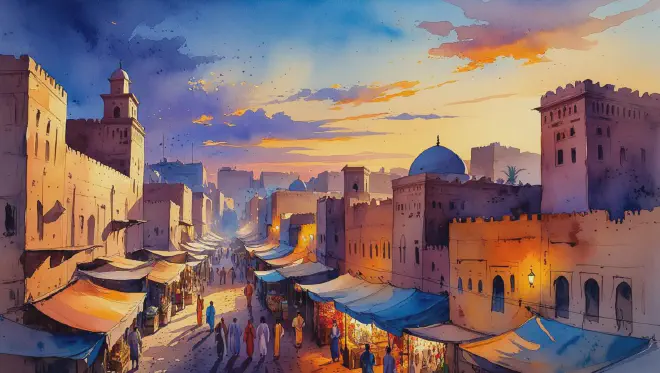
As the afternoon light began to soften, I walked toward the Islamic Quarter. Standing at the entrance to Khan el-Khalili Bazaar felt like stepping through a portal into the medieval past. On both sides of the cobblestone pathways lay colorful carpets, gleaming brassware, and intricately crafted inlaid wooden boxes. Merchants called out their wares, incense smoke curled into the air, and simply walking through stimulated every sense at once.
I stopped before a spice shop. Saffron, cumin, coriander, dukkah—spices I had never seen before were arranged in beautiful pyramids. At the shopkeeper’s urging, I bought small bags of several varieties. He taught me that dukkah, in particular, is exquisite when you dip bread in olive oil and then coat it with this blend of nuts and spices.
Emerging from the bazaar, I made my way to Al-Azhar Mosque. Built in 970 CE, this mosque is also home to one of the oldest universities in the Islamic world. Stepping into the courtyard, I was captivated by the beautiful geometric patterns adorning the walls. As the evening prayer time approached, worshippers began gathering quietly. Though merely a tourist, I removed my shoes and observed from a respectful distance. As the adhan resonated through the space and the faithful bowed in orderly rows, I felt a profound sense of devotion filling the air.
For dinner, I chose a restaurant along the Nile. The sunset reflected off the water’s surface, turning everything to gold—a sight that took my breath away. I ordered molokhia, a soup made from finely chopped jute leaves, and roz bi laban, a dessert of rice cooked in milk. The molokhia, simmered with chicken and fragrant with garlic and coriander, was deeply satisfying. The waiter explained that for Egyptians, this dish is something like soul food.
Walking back to my hotel along the riverbank, I savored Cairo’s nighttime face. The silhouettes of minarets illuminated by streetlamps, the cool breeze drifting off the river, the distant strains of Arabic music—I was already beginning to feel this city’s unique allure settling into my skin.
Day 2: Where Eternity and the Present Intersect
Breakfast was at a venerable old café near my hotel. I ordered the Egyptian morning staples: ful medames, a stew of slow-cooked fava beans, and ta’ameya, crispy fava bean fritters, along with freshly baked baladi bread. The ful medames, simply seasoned with cumin and garlic, proved deeply nourishing when scooped up with torn pieces of bread. Eating breakfast among the locals felt like one of travel’s most precious pleasures.
The morning was devoted to the Great Pyramids of Giza. About thirty minutes by taxi from the city center, the pyramids rise suddenly from the desert—a sight that overwhelms no matter how prepared you think you are. Standing before the Pyramid of Khufu, built some 4,500 years ago, I felt a surge of awe at human imagination and ingenuity. How those massive limestone blocks were lifted and stacked remains shrouded in mystery even today.
Sitting before the Sphinx, gazing into its weathered face, I was overcome by a strange sensation. Though erosion has claimed its nose and part of its beard, that enigmatic half-smile endures. A lion’s body with a pharaoh’s visage—it embodies the ancient Egyptians’ understanding of the cosmos and their beliefs about life and death.
I also ventured inside the pyramid to the King’s Chamber. Crouching through narrow passages, I finally reached the room containing the granite sarcophagus. Knowing that ancient kings once lay here in eternal repose filled me with deep emotion. The pyramid was not merely a tomb but a sacred vessel for the pharaoh’s journey to the afterlife.
The afternoon brought me to the Egyptian Museum of Antiquities. The golden mask of Tutankhamun was stunning not only for its beauty but for the extraordinary craftsmanship achieved over 3,300 years ago. The mask’s serene expression still conveys the likeness of the young king who died too soon. In the Mummy Room, I stood before the actual preserved remains of pharaohs—Ramesses II, Hatshepsut, rulers I had only known from textbooks, their physical reality now confirmed before my eyes.
What moved me most in the museum were the wall paintings and grave goods depicting everyday life. Ancient Egyptians’ meals, clothing, musical instruments—all rendered in vivid colors. The earnest hope that life in the afterworld would mirror life on earth came through with touching clarity.
In the late afternoon, I wandered through the Coptic Quarter of Old Cairo. Here stand some of the earliest churches from Christianity’s arrival in Egypt. The Hanging Church, Sts. Sergius and Bacchus Church—the latter built over a site where the Holy Family is said to have sheltered during their flight to Egypt. Descending into the crypt, the cool air carried an atmosphere of reverent prayer.
The Coptic Museum revealed the magnificence of Egypt’s Christian art. A distinctive style emerged here, blending pharaonic techniques with Christian iconography—testament to this land’s cultural richness. The wooden crosses and textiles were particularly beautiful, demonstrating the sophisticated craftsmanship that flourished from antiquity through the medieval period.
Dinner was at a homey restaurant in the Coptic Quarter. I savored molokhia once more, along with roz bi laban for dessert. Simple yet deeply satisfying, the meal spoke of Egyptian devotion to food and family.
That night, I boarded a felucca on the Nile. The evening breeze filled the sail as we drifted slowly downstream. Lights from both banks reflected on the water, creating an illusion of sailing through a star-scattered sky. The old boatman hummed an ancient Arabic melody, his voice carrying beautifully across the evening stillness.
Day 3: What I Found at Journey’s End
On my final morning, I rose early and climbed Cairo Tower. From 187 meters above, the cityscape spread before me in breathtaking panorama. The Nile bisected the city, ancient buildings and modern towers mingling on either bank. In the distance, I could make out the silhouettes of yesterday’s pyramids. The entire city seemed to glow gold in the morning light.
I had breakfast in the tower’s restaurant. Sipping mint tea while gazing out over the city felt like a special luxury. Egyptian mint tea is traditionally served very sweet, its honeyed fragrance somehow embodying the warmth of the people here.
I spent the morning walking once more through Islamic Cairo, this time exploring small alleys I had missed the day before. I visited artisan workshops—a goldsmith spinning gold thread, weavers at their looms crafting carpets by hand, a glassblower demonstrating his craft. The traditional arts continue here, passed down through generations.
Most memorable was meeting Ahmed, a young goldsmith. He had inherited his skills from his father and created beautiful bracelets and pendants featuring Islamic geometric patterns. “This technique has remained virtually unchanged for seven hundred years,” he said with quiet pride. Watching him work—manipulating gold wire as fine as human hair into intricate geometric designs—I could only marvel at his concentration and skill.
Lunch was at a hidden restaurant recommended by locals. I tried fatta, a dish of crispy fried bread topped with tomato sauce and meat, and baklava, a pastry of layered phyllo dough filled with nuts and drenched in honey. The fatta looked humble but was elevated by its expertly spiced sauce—a revelation of Egyptian home cooking’s depth. The baklava flooded my mouth with honey’s sweetness and the warm fragrance of toasted nuts.
In the afternoon, I made a final visit to the National Library of Egypt. The modern building houses Egypt’s intellectual heritage, from ancient papyri to contemporary texts. The hieroglyph exhibition room particularly captivated me. The writing system devised by ancient Egyptians transcends mere record-keeping—it possesses the beauty of art itself.
In the library’s courtyard, I enjoyed my last cup of tea in Cairo. As the jasmine-scented steam rose, memories of these three days returned vividly. The majesty of the pyramids, the Sphinx’s mysterious smile, the bazaar’s clamor, the Coptic church’s silence, the gentle flow of the Nile, and above all, the warm smiles of everyone I met. Each moment was something that could only be experienced here.
In the taxi heading to the airport, Ahmed the driver said something I will not forget: “Cairo is not a city you can understand in one visit. But you will always want to return. That is Cairo’s magic.” Indeed, three days barely scratched the surface of this city’s depths. Yet even that glimpse left a profound impression on my heart.
From the airplane window, Cairo’s nightscape sparkled like jewels scattered across the earth. The Nile threaded through the city, countless lights twinkling on either shore. This city, inhabited continuously for five thousand years, remains the stage for countless lives even now.
What Felt Real Despite Being Imagined
This journey took place entirely in imagination. Yet the charm of Cairo, the warmth of its people, the cultural richness accumulated from antiquity to the present—these are realities that genuinely exist.
The cobblestones of Khan el-Khalili that I walked in my mind, the complex flavors of koshari, the sunset sinking behind the pyramids, the starlit sky from the felucca, the beautiful call of the adhan, the smiles of everyone I encountered—all remain vivid in my memory, as if they happened only yesterday.
Perhaps travel does not always require physical movement. Through imagination, we can touch different cultures, encounter new perspectives, and expand our inner worlds. This, too, may be a form of journey.
Cairo’s magic can be felt even without setting foot on its soil. The continuous human endeavor from ancient Egypt to the present, the rich tapestry woven from diverse cultures, and above all, the human warmth of those who live there—these are universal qualities that leave deep impressions however we encounter them.
When the day comes that I truly walk the streets of Cairo, these memories of imagined travel will surely enrich the real experience. And reality will undoubtedly surpass imagination in its power to move. Perhaps that is the true magic of Cairo—and of travel itself.