
The Port Town of Calais
Calais is a port town situated in the Pas-de-Calais department of northern France. Facing the English town of Dover across the Strait of Dover, the two are separated by a mere 34 kilometers at their closest point. Since ancient times, Calais has flourished as a gateway connecting both nations, and even today, countless travelers pass through via the Eurotunnel and ferries.
The town’s history runs deep. It developed as a fortified city throughout the medieval period, and during the Hundred Years’ War, it was fiercely contested between England and France. The siege of 1347 remains particularly famous, and Auguste Rodin’s sculpture “The Burghers of Calais” preserves the tragic story of that era for posterity.
Facing the sea, this town is blessed with fresh seafood carried in on the salt winds. Mussels, crabs, sole—the bounty of the North Sea is abundant, and the local people have long cultivated simple yet deeply flavorful dishes using these ingredients. The influence of Flemish culture also remains strong here, and the brick buildings and canal-side scenery evoke a certain nostalgia.
Modern Calais, while bearing the weight of history, shows new signs of life as a gateway to Europe. Walking the cobblestones of the old town, one feels the vestiges of the Middle Ages; heading toward the port, one encounters the vitality of a modern transportation hub. In this town of two faces, I decided to spend a quiet journey of two nights and three days.
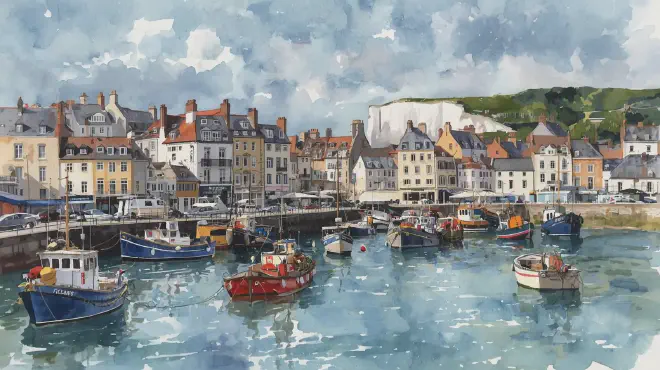
Day 1: Welcomed by the Sea Breeze
At eight in the morning, I boarded the TGV at Paris Gare du Nord. Watching the pastoral landscapes flow past the window, I traveled for about three hours. Arriving at Calais-Ville station via Lille just past eleven, I stepped out and immediately caught the scent of the tide tickling my nose—a moment when I truly felt the proximity of the sea.
After leaving my suitcase at the Hôtel Maurice, I headed first toward the town center. Walking along the cobblestone streets, a beautiful building decorated with red brick and white stone caught my eye. This was the Hôtel de Ville, Calais’s town hall. Constructed between the 15th and 16th centuries, this building is celebrated as a masterpiece of Flemish Gothic architecture. Its 75-meter belfry stands as the town’s symbol, and in 2005, it was inscribed as a UNESCO World Heritage Site.
At the end of the morning, I came face to face with Rodin’s “The Burghers of Calais” in the square before the town hall. This group of sculptures, depicting six citizens in different expressions and postures, represents those courageous souls who offered their own lives to save the town during the siege of 1347. The bronze figures seemed so vivid, as if they might begin walking at any moment, quietly conveying the weight of history.
For lunch, I visited a small bistro called “Chez Pierre,” recommended by a local. The owner, Pierre, was a gentle man in his sixties who told me he was born and raised in Calais. “Today’s special is moules marinière,” he said proudly. When a large pot piled high with mussels arrived, the aroma was unforgettable. The scent of white wine, parsley, and garlic mingled together, and the taste of the sea came through powerfully. The accompanying frites were crispy on the outside and fluffy inside—a perfect match with beer.
In the afternoon, I leisurely explored the old town. The Église Notre-Dame, built in the 13th century, is a beautiful example of Gothic architecture, and its stained glass windows sparkled like jewels in the afternoon light. In the silence of the church, I took a moment for prayer—giving thanks for safe travels and for the encounters yet to come.
Leaving the church, I happened to meet an elderly woman named Madame Dubois at a nearby antique market. She shared stories of Calais during the war years. “This town has been caught up in war many times, but each time, it has risen again. Being close to the sea, a new wind always blows in. That’s what gives us hope.” Her words carried the deep weight of someone who had lived her life in this town.
In the evening, I headed to the port. The Port of Calais is a large, modern facility where ferries connecting to England depart and arrive frequently. As the sunset painted the Dover Strait in gold, many people set off on journeys while others returned home. The view of the sunset from the port’s observation deck was truly breathtaking. The faint outline of the English coast visible beyond the horizon reminded me once again of this town’s unique geographical position.
For dinner, I chose “La Plaisance,” a restaurant near the port. This establishment, frequented by local fishermen, takes pride in dishes made from seafood caught that very morning. The owner recommended sole meunière. The sole, browned beautifully in butter, had tender, fluffy flesh, and a squeeze of lemon enhanced its deliciousness even further. It paired wonderfully with the local white wine, Côtes de Blanc Fossé.
After dinner, I walked through the nighttime streets. The cobblestone paths, illuminated by streetlamps, showed a different expression than during the day, and the medieval atmosphere felt even more pronounced. Before returning to the hotel, I passed through the square in front of the town hall once more. “The Burghers of Calais,” lit up against the night, appeared even more divine than in daylight, and the weight of history pressed upon my heart. The first night deepened as I was enveloped by the multifaceted charms of this seaside town.
Day 2: Stories of Fortresses and Shores
On the second morning, after a simple breakfast at the hotel café, I headed to Fort Risban. This fortress, built in the 16th century, played a vital role in guarding the entrance to Calais harbor. Today it serves as a museum, where visitors can learn in detail about Calais’s military and maritime history.
The view from the fort was magnificent, offering a panoramic vista of the entire port. Bathed in morning light, the harbor bustled with activity as ferry whistles echoed and people began a new day. My guide, Monsieur Leroy, was a local historian who explained Calais’s strategic importance in depth. “Calais has always been at the center of European history. Many peoples have passed through this land, and cultures have intersected here. That’s what has created the richness of Calais today.”
Later in the morning, I visited the Musée des Beaux-Arts et de la Dentelle. Calais is also famous for its lace industry, and its machine-made lace techniques are globally renowned. The museum displays lace works from the 18th century to the present, and I was left breathless by their delicate beauty. I was able to watch an actual lace artisan at work, and seeing how thread after thread intertwined to create beautiful patterns was truly artistic.
For lunch, I stopped at a small crêperie in the old town called “La Galette Bretonne.” The owner, Madame Legrand from Brittany, makes galettes that are beloved by locals. I ordered a complète—a buckwheat galette topped with ham, cheese, and egg. Simple yet deeply flavorful, it was perfect paired with cider. Madame Legrand told me with a warm smile, “Cooking is something you make with your heart. Especially for travelers, a meal becomes a special memory.”
In the afternoon, I ventured a bit further to Boulogne-sur-Mer, near Calais. About thirty minutes by train, this small port town is beautiful with its medieval walled old town. The fish market here is the largest in northern France, bustling from early morning with fresh seafood brought in by local fishermen. Even in the afternoon, the market retained its energy, and watching locals shopping for their evening meals was heartwarming.
The Notre-Dame Basilica, perched on Boulogne’s hilltop, is a 19th-century neoclassical building with an impressive interior dome. From the basilica, I could see the sea spread out before me, and in the distance, even the town of Calais was visible. A local guide I met there, Monsieur Durand, said, “This sea holds many stories. Stories of fishermen, stories of merchants, and the everyday stories of ordinary people. Looking at the sea, I feel that everything is connected.”
Returning to Calais in the evening, I took a walk along the beach. Calais’s beach is shallow, and at low tide, a vast expanse of sand appears. Against the backdrop of the setting sun, local families enjoyed their strolls. An elderly couple with their dog, children flying kites, young people jogging. Everyone watched the same sunset while spending their own time. I too walked along the water’s edge, listening to the sound of waves washing in and retreating at my feet.
For dinner that night, I went to “Auberge du Phare,” a homey restaurant recommended by a local friend. The specialty here is carbonnade flamande—a Flemish-style beef stew. The beef, braised in beer, was tender, with subtle bitterness and sweetness in perfect balance. This regional dish showed the Nordic influence distinct from traditional French cuisine. The dessert, tarte au sucre, had a simple, gentle sweetness.
At the restaurant, I had the chance to speak with a local couple at the neighboring table, Monsieur and Madame Morin. They were teachers in their fifties who spoke passionately about Calais’s charms. “Many tourists just pass through, but if you take a little time to walk around the town, you’ll discover its true appeal. History, culture, the warmth of the people—it’s all here.” Madame Morin’s words were filled with deep love for her hometown.
Before returning to the hotel, I went to see the nighttime port once more. In contrast to the daytime bustle, the port was wrapped in silence. The masts of moored yachts clinked in the wind, and in the distance, a ferry whistle sounded. Under the starry sky, listening to the sound of the waves, I etched this town’s special atmosphere into my heart.
Day 3: A Morning of Farewell and Memories to Keep
On the final day, I woke early and decided to take a morning walk through the town. At six in the morning, still in the dim light, I walked toward the port. In the early morning harbor, fishermen were preparing for the day ahead. The sound of boat engines, the sound of waves, and the voices of fishermen calling to each other composed the morning symphony of a port town.
At the café “Le Marin,” I had breakfast of café au lait and a croissant, sitting among the local fishermen. Regulars lined the counter, discussing the day’s weather and sea conditions. The owner, Monsieur Dupont, called out to me, “A traveler, are you? How did you find Calais?” When I answered, “It’s a wonderful town. The people are so warm,” he laughed heartily and said, “Of course, of course. People from seaside towns have open hearts. The sea teaches them that.”
After breakfast, I went to see the market. Calais’s central market is held every Wednesday and Saturday, with local farmers, fishermen, and artisans bringing fresh produce and handmade goods. The cheese seller, Madame Bernard, let me sample Maroilles cheese made locally. “This is a recipe from my grandfather’s generation. We don’t use machines—everything is done by hand. It takes time, but that’s what creates the true flavor.” The creamy, deeply complex cheese felt like a fitting gift at the end of my journey.
For my final morning, I visited “The Burghers of Calais” once more. Having come to understand this town a little over two days, I felt more deeply what the sculpture was trying to say. Courage, sacrifice, and hope. The spirit that Calais has cultivated through its long history seemed condensed in this place.
After checking out, I decided to have one last lunch before heading to the station. I chose “La Gare,” a small bistro near the station. Their plat du jour was a simple yet heartfelt dish using abundant local ingredients. Sautéed white fish with local vegetables on the side, and homemade bread. The cooking method, which brought out the best in the ingredients, was truly the essence of northern French home cooking.
As I ate, I reflected on these three days. Calais is indeed a town that many people pass through. But if you take a little time to walk its streets, talk with the locals, feel its history, and let the sea breeze touch your skin, the town’s true charm reveals itself. It was not the glamorous appeal of a famous tourist destination, but something quieter and deeper.
At two in the afternoon, I waited for the Paris-bound TGV at Calais-Ville station. On the platform, I met an elderly local man, Monsieur Leblanc, who said, “Come back again. Calais always welcomes travelers,” and extended his hand for a handshake. Through the warmth of his palm, I felt the warmth of heart that defines the people of this town.
As the train began to move, the town of Calais gradually grew smaller outside the window. The cranes of the port, the belfry of the town hall, and the sea visible in the distance. Though it was only three days, this town had surely carved out a special place in my heart.
When changing trains at Lille, I spoke with a middle-aged French woman, Madame Lefèvre, who had been in the same carriage. She lived in Paris but was originally from Calais. When I asked, “How was your hometown?” she answered with a nostalgic expression, “What I love about Calais is that it never changes. Whenever I return, the same scent of the sea welcomes me. That’s what makes me feel at peace.”
I arrived at Paris Gare du Nord around six in the evening. Returning to the bustle of the great city, the quiet hours of Calais felt all the more precious. Amidst the station’s crowds, I suddenly recalled the scent of the tide. It was surely engraved in my memory—a treasure I could recall at any time.
What Felt Real Despite Being Imaginary
This journey is a product of imagination. I did not actually walk the cobblestones of Calais, nor did I feel the steam of moules marinière on my face. I did not truly touch “The Burghers of Calais,” nor did I hear the voices of fishermen at the port.
And yet, the experiences of these three days exist with certainty in my heart. The silence of the morning port, Pierre’s friendly smile, Madame Dubois’s wartime stories, the beauty of the Dover Strait dyed in sunset colors, the farewell handshake with Monsieur Leblanc. All of these remain in my memory.
What is travel? Is it simply moving from place to place, or is it discovering something within one’s heart? What I felt through this imaginary journey is that true travel happens within the heart. Even without physically visiting, with imagination and knowledge, one can feel the air of a place, experience the warmth of its people, and sense the weight of its history.
The charm of Calais lies not in glamour but in quiet depth. Precisely because it is a port town that many pass through, diverse cultures have accumulated in layers here. Memories of war, coexistence with the sea, the warmth of the people, and hope for the future. All of these combine to create the unique charm of Calais.
Though imaginary, the emotions and discoveries from this journey were real. Encounters with people, delicious meals, beautiful landscapes, dialogue with history. All of these were truly experienced within my heart and became part of who I am.
Even when real travel is not possible, journeys of the heart can continue. If we spread the wings of imagination, we can go anywhere. And what we experience there may hold value no less than that of actual travel.
The sea breeze of Calais still blows within my heart. That is proof that this imaginary journey truly took place within me.