
Introduction
Cao Bang Province lies in the northeastern reaches of Vietnam, pressed against the Chinese border. This is a land where majestic limestone karst mountains stretch in succession, and emerald-green rivers wind through valleys—a natural treasury that deserves to be called a hidden paradise.
The region is renowned for Ban Gioc Falls, a magnificent waterfall straddling the border between Vietnam and China along the Quay Son River. This area is also a cultural mosaic where diverse ethnic minorities—the Tay, Nung, and Hmong peoples—have lived for generations. French colonial influences mingle with the subtle fragrance of Chinese culture, creating a distinctive cultural landscape found nowhere else.
The sound of water echoing through limestone gorges, bamboo groves swaying in the green shade of terraced rice paddies, and smoke rising from villages scattered among the mountains. In Cao Bang, time seems to flow more gently. Here, the grandeur of nature and the simple lives of its people exist in harmony, quietly stirring the hearts of those who visit.
Day 1: The Road to a Border Town
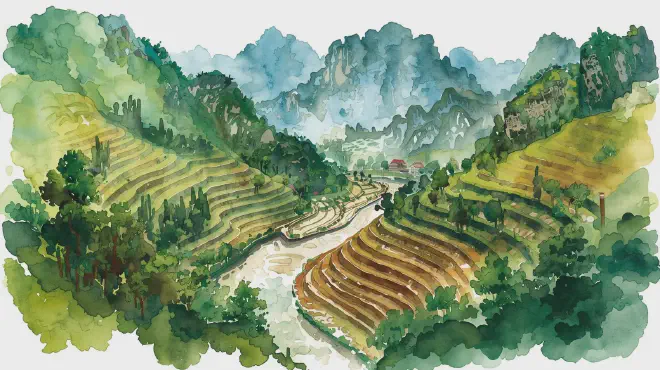
The bus journey from Hanoi took approximately six hours. I departed in the cool morning air, leaving behind the capital’s clamor and heading toward Cao Bang. The scenery outside the window gradually became more mountainous, with terraced rice paddies covering the slopes like green staircases. Passing through small villages along the way, I caught glimpses of water buffalo lazily grazing in the fields and farmers in conical hats transplanting rice seedlings.
Around two in the afternoon, I finally arrived in Cao Bang town. Nestled in a valley basin surrounded by mountains, the town was quieter than I had expected—a place where old French colonial buildings stood alongside more modern structures. My accommodation was a small family-run guesthouse near the town center. The woman at the reception welcomed me warmly with broken English and expressive gestures.
After dropping my bags in the room, I set out to explore the town. Walking along the main street, motorbikes weaved through traffic while phở stalls and fruit vendors lined the roadside. What struck me most were the displays of tropical fruits piled high at the open-air stalls—dragon fruit, rambutan, and others in brilliant colors. The shopkeeper, an older man with kind eyes, offered me a sample. The sweet-tart flavor of dragon fruit spread across my tongue.
In the evening, I visited a small local market. Here, townspeople were doing their daily shopping among tightly packed stalls of fish, vegetables, and spices, each contributing its own aroma to the air. I spotted a woman dressed in traditional Tay ethnic clothing selling handwoven textiles. The vivid blue and red geometric patterns were so beautiful I found myself standing there, transfixed.
For dinner, I followed a local’s recommendation to a modest restaurant. I ordered “bún chả Cao Bằng,” a noodle dish unique to this region. Rice noodles came swimming in a broth made from river fish, accompanied by generous amounts of fresh vegetables. The soup was light yet deeply flavorful, gently soothing my tired body. At the next table, a local family was gathered happily around their evening meal. Watching them, I felt a quiet warmth settle in my chest.
Back at the guesthouse, I took a shower and reflected on the day. My first impression of Cao Bang was of a gentle, unpretentious town. The kindness of its people and the tranquility of its mountain setting lingered in my mind. Tomorrow, I would visit Ban Gioc Falls—the region’s most celebrated natural wonder.
Day 2: The Majesty of Ban Gioc Falls
I woke at six to birdsong. Opening the window, I was greeted by the beautiful sight of mountains wrapped in morning mist. After a simple breakfast at the guesthouse, I boarded a tour bus bound for Ban Gioc Falls.
The drive from Cao Bang town to the falls took about an hour and a half. The road gradually wound deeper into the mountains, and the landscape grew increasingly wild. Limestone pinnacles stood like sentinels, the road threading between them. On the bus, the guide shared stories about the region’s history and culture—how this area had been an important stronghold during the Vietnam War, how numerous ethnic minorities continue to live here. It was all fascinating.
Around ten o’clock, we arrived at Ban Gioc Falls. First, I made my way to a viewing platform where the full panorama of the falls could be seen from a distance. The view was simply breathtaking. The massive waterfall, roughly three hundred meters wide and thirty meters high, cascaded down in three tiers. The water was a clear emerald green, and fine mist danced above the plunge pool. The border line between Vietnam and China runs through the center of the falls, making this an international waterfall shared by two nations—a fact that became viscerally real standing there.
Descending closer to the falls, the sound of water grew louder until it became a thunderous roar. I breathed deeply of the air, rich with negative ions, and felt as though I were being cleansed to my very core. Small bamboo rafts waited near the falls, and local boatmen ferried tourists closer to the cascade. Boarding one of these rafts and approaching the falls, spray misted my face—its coolness refreshing.
Lunch was at a restaurant near the falls, where I enjoyed local dishes. The “chả cá lá vọng”—river fish grilled with herbs—was particularly delicious. The fish flesh was tender, and the fragrance of lemongrass and coriander awakened my appetite. Eating while listening to the sound of the falls, I felt deeply grateful to be surrounded by nature.
In the afternoon, I explored the area around the falls. There were several limestone caves nearby, and I visited one called Nguom Ngao Cave. The interior was cool, and stalactites and stalagmites created a fantastical landscape. Illuminated by the guide’s flashlight, the rock walls looked like sculpted art. From deep within the cave came the sound of underground water trickling—a reminder of nature’s mystery that I could not ignore.
On the way back to Cao Bang town in the evening, we stopped at a Tay ethnic village. Wooden stilt houses dotted the landscape, and chickens wandered freely in the yards. One of the villagers showed me the process of creating traditional woven textiles. The skill required to weave intricate patterns using threads of various colors was remarkable—each piece taking weeks to complete. I was moved by both the patience and the artistry.
Back in town, I had dinner at a different restaurant. This time I tried “nem nướng”—pork wrapped with herbs and grilled. The outside was crispy, the inside juicy, and it paired perfectly with the nước mắm-based dipping sauce. I exchanged simple conversation with locals in a mixture of broken English and Vietnamese, receiving their warm hospitality.
Returning to the guesthouse, I reflected on the day. The grandeur of Ban Gioc Falls, the mystery of the cave, the encounters with villagers. It had been a day when I truly felt the richness of Cao Bang’s nature and culture.
Day 3: A Farewell Morning and Lasting Impressions
On my final morning, I rose early to visit the town’s morning market. Around six o’clock, the market was bustling with energy as farmers brought fresh vegetables and fruits to sell. Tomatoes, cucumbers, water spinach—vegetables familiar from Japan—alongside tropical produce I had never seen before, all displayed in a riot of color.
I discovered embroidery made by an elderly Hmong woman. Birds and flowers were rendered in vivid colors, the work as beautiful as a painting. Though we could not communicate in words, she smiled as she told me the price and carefully wrapped my purchase. This embroidery, I knew, would remind me of Cao Bang long after I returned home.
For breakfast, I stopped at a small eatery near the market for a bowl of phở bò. Eating warm phở in the fresh morning air was exquisite—the rich flavor of the beef bone broth warming me to my core. Adding generous amounts of herbs, their fragrance tickling my nose, I knew this would be etched in memory as the taste of a Vietnamese morning.
During the morning, I visited a small museum in the town center, learning about the region’s history, culture, and the various lifestyles of its ethnic groups. Particularly interesting were the exhibits about how this area had long been an important trading hub with China, the French colonial period’s influence, and events during the Vietnam War.
Before lunch, while walking near my guesthouse, I discovered a small temple. It was a Buddhist temple, but its architecture blended Chinese style with local traditions in a distinctive way. The grounds were quiet, filled with the fragrance of incense. Watching locals pray devotedly, I sensed the depth of faith in this land.
Lunch brought the most memorable dish of my trip: “chả lá lốt”—beef wrapped in lá lốt leaves and grilled. The leaves had a slight bitterness that matched perfectly with the savory beef. Wrapping it in rice paper to eat, various textures and flavors danced in my mouth. This dish, I felt, embodied the rich nature and food culture of Cao Bang.
In the afternoon, with time before my bus to Hanoi, I wandered slowly through the town. At a small shop, I purchased tea produced locally. According to the shopkeeper, it was made from wild tea leaves gathered in the nearby mountains, characterized by a gentle sweetness and deep aroma. Taking a sip, an elegant sweetness indeed spread across my palate, evoking the pure mountain air.
As departure time approached, I picked up my luggage from the guesthouse. The woman at the front desk called out in halting English, “Please come again.” Though my stay had been brief, I was filled with gratitude for being welcomed so warmly, as though by family.
Boarding the bus, I left Cao Bang behind. The mountain scenery outside the window, the green terraced fields, smoke rising from farmhouse roofs. Each of these scenes was being etched deep into my heart.
On the road to Hanoi, the thundering of Ban Gioc Falls, the silence of the cave, the warm smiles of villagers, the flavors of various dishes—all of it circled through my mind. It had been only a short trip of two nights and three days, but Cao Bang had left a profound impression on my heart. In this place where the grandeur of nature and human life exist in harmony, I felt as though I had discovered something precious.
What Felt Real, Though Imagined
This journey was not one where my feet actually touched the soil of Cao Bang, where I breathed its air or truly met its people. Yet by imagining the landscapes through words and experiencing them as though I were there, I gained something that felt genuinely real.
The coolness of Ban Gioc Falls’ spray, the warm smiles of people at the market, the complex and rich flavors of local cuisine, the silence of the mountains and the songs of birds. All of this exists as products of imagination, yet within my heart, they exist as experiences that were certainly lived.
Perhaps travel does not only mean physical movement. By engaging our imagination and contemplating a place’s culture, nature, and the lives of its people, we can experience a genuine journey within our hearts. With affection and respect for this land called Cao Bang, I feel deep satisfaction in having walked this imaginary path.
Will the day come when I truly visit this place? Just imagining how these remembered imaginings might overlap with actual experience makes my heart race. Until that day, I will treasure these memories of a journey taken in the mind.