
Introduction
Cappadocia. Just speaking the name leaves a strange resonance deep in the heart. This land spreading across central Anatolia in Turkey is known for its bizarre rock formations born from volcanic activity millions of years ago, and the underground cities and cave churches carved into those rocks.
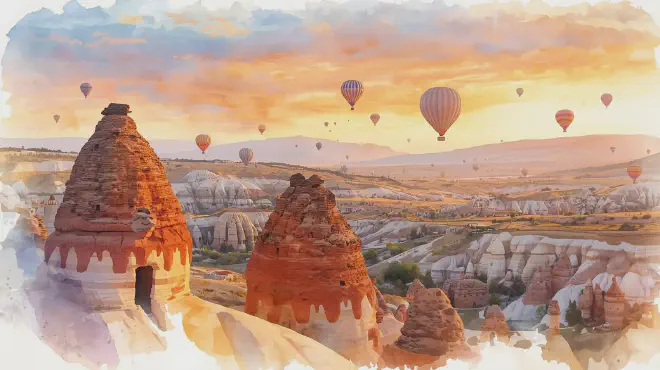
The cone-shaped rocks made of tuff are called “fairy chimneys,” and the forms created by wind and rain produce a dreamlike landscape, as if the earth itself were dreaming. People have lived in this land since ancient times—first the Hittites, then during the Byzantine era, when Christians fled persecution and hid in caves, building churches and monasteries within the rock. The frescoes they left behind still tell of the depth of their faith in vivid colors.
Even today, people can stay in cave hotels carved from rock, dance through the sky in hot air balloons, and experience this land’s unique culture. Cappadocia is a place unlike anywhere else in the world, where the mysteries of nature and human endeavor have melted together.
Day 1: An Encounter with Time Carved in Stone
The domestic flight from Istanbul landed at Kayseri Airport, which was more modest than I had anticipated. On this November afternoon, the dry air of the Anatolian plateau stung my skin. The drive from the airport to Göreme, the heart of Cappadocia, would take about an hour. As I watched the landscape gradually transform outside the window, I contemplated why I had been drawn to this land.
The driver, Mehmet, said “Welcome to Cappadocia” in broken English while pointing to the strange rocks beginning to appear along the roadside. At first they were small protrusions, but as we approached Göreme, their scale became overwhelming. The rock faces illuminated by the setting sun took on a reddish hue, making the earth seem to breathe.
The cave hotel where I would stay was literally carved into rock. As I descended the stone steps toward my room, I touched the wall. The cool rock face made me feel the weight of centuries it had spent watching over this land. From the room’s window, I could see the Göreme Valley at dusk. The sight of countless cone-shaped rocks standing in rows created the illusion of wandering into another world.
After dropping off my luggage, I decided to venture into town. While tourist shops lined Göreme’s center, it retained a rustic atmosphere. A rug shop owner called out, “Would you like some tea?” I didn’t hesitate to accept. The tea poured into a small glass was surprisingly rich, and when I added sugar, a gentle sweetness spread through my mouth.
“How long have people lived in this land?” I asked. He looked into the distance and answered, “Since long, long ago. My grandfather’s grandfather, and his grandfather too—they all lived here. Together with these rocks.” His words carried the pride of living rooted in this land.
Dinner was at an old restaurant called “Sofra.” The interior, converted from a cave, was dimly lit, with candlelight illuminating the stone walls. Starting with a mixed meze appetizer platter, I savored the meal slowly over local wine. Particularly impressive was “testi kebab,” a dish of meat and vegetables simmered in an earthenware pot. The performance of breaking the pot in front of me to retrieve the contents was magnificent. The deep flavor of the lamb and the sweetness of the tomatoes and onions were exquisitely harmonized.
When I stepped outside after the meal, night had completely fallen. The fairy chimneys illuminated by street lamps showed a completely different expression from daytime. The outlines of rocks emerging in the moonlight looked like ancient giants who had fallen asleep. As I walked back to the hotel, I thought about tomorrow’s hot air balloon flight. What kind of wonder would await me when I saw this land from the sky? I fell asleep in my cave bedroom with anticipation swelling in my chest.
Day 2: Memories of Wind Connecting Sky and Earth
At 4:30 AM, I gathered in the hotel lobby before dawn had fully broken. Staff from the balloon company came to pick us up and took us to the launch site with other guests. Everyone was quiet in the car, gazing at the rock silhouettes floating in the darkness outside the windows.
When we arrived at the launch site, dozens of balloons were already being prepared. The flames from enormous burners illuminated the night sky, and watching the colorful balloons inflate was spectacular. Our pilot, Ertan, was a fifteen-year veteran. “The wind is calm today—perfect conditions,” he greeted us with a smile.
As we climbed into the balloon’s basket, we gradually lifted off the ground. At first it was a slow floating sensation, but as we gained altitude, the view beneath our feet transformed completely. With sunrise, all of Cappadocia was dyed golden. The sight of the fairy chimneys standing like a massive sculpture garden was beautiful beyond words.
From the air, I could clearly see how complex and beautiful this land’s topography was. Greenery flourished in the deep valleys, and small villages dotted the tops of rocks. Other balloons also floated in the air, each flying at different altitudes—the scene resembled a city in the sky. The approximately one-hour flight passed in what felt like an instant.
After landing, we held a modest celebration on the grassland, as champagne toasts were customary. I exchanged contact information with other passengers and shared the joy of this wonderful experience.
In the late morning, I visited the Göreme Open Air Museum. This is a place where churches carved from rock by Christian monks between the 4th and 11th centuries are preserved. When I stepped inside the cave churches, each with distinctive names like “Dark Church,” “Snake Church,” and “St. Barbara Church,” I could feel the depth of faith from those times.
The Dark Church’s frescoes were particularly impressive. Because no external light enters, the color preservation is excellent, and the vivid colors remain surprisingly fresh despite being painted over a thousand years ago. I felt the soul of the creator poured into each scene depicting Christ’s life.
Lunch was at a homey restaurant near the museum. I ordered “dolma,” rice wrapped in grape leaves, and “gözleme,” a thin flatbread filled with cheese and spinach and baked. Both were simple but had a gentle flavor that made the most of the ingredients. I was surprised when the female owner asked in broken Japanese, “Does it suit your taste?” Apparently many Japanese tourists visit.
In the afternoon, I visited the underground city of Kaymakli. This enormous underground city, eight floors above ground and eight below, was built by early Christians to protect themselves from Arab invasions. Descending deep underground through narrow passages, I found an underground world complete with churches, residences, storage rooms, and even stables. I was amazed by the scale and sophistication of this city, which could house up to 20,000 people.
The underground city’s passages are extremely narrow, designed to prevent large invaders from advancing easily. Additionally, the massive stone doors separating each level are designed to open only from the inside. The guide, Ahmet, said, “I really admire the wisdom and courage of people from the past,” and I thought exactly that.
In the evening, I returned to Göreme and headed to a sunset point. The evening view of Cappadocia from the top of a small hill had a different beauty from the view from the morning’s hot air balloon. The contrast between the gradually darkening sky and the fairy chimneys emerging as silhouettes was fantastical. I exchanged words with an elderly German couple beside me: “It’s beautiful, isn’t it?” I felt again that before beautiful things, language barriers don’t exist.
That night I had dinner at a restaurant with a folk dance show. The dance called “sema,” a whirling dance of the Sufi order, was mystical—a man in white robes spinning endlessly. The dancer’s expression was meditative, as if in dialogue with God. The meal was also a luxurious course centered on local dishes, with “hanım göbeği,” a thin pastry filled with cheese, being particularly exquisite.
Day 3: Finding Eternity at Journey’s End
On the final morning, I woke a little earlier than usual. Outside the window, I could see early morning hot air balloons slowly ascending into the sky. Thinking that I had been inside one of those yesterday gave me a strange feeling.
After breakfast, I decided to visit the “Love Valley” as my last tourist destination. This oddly named valley is lined with rocks shaped suggestively like male symbols. Though these are natural formations, I couldn’t help but smile at their sculptural beauty. Here too, ancient people had carved caves and used them as living spaces. Looking at the traces of life remaining in the rocks, I couldn’t help but feel the continuity of human life that had been carried on in this land.
Afterward, I visited Avanos, a town famous for pottery. This town is known for ceramics made from red clay, and at the workshop I could watch artisans hand-working their pottery wheels. Master Mustafa told me, “This clay hasn’t changed for thousands of years. The technique has been passed down from grandfather to father, father to me.” I tried making pottery myself, but it was much harder than it looked, and I was reminded once again of the magnificence of craftsmanship.
Lunch was at a riverside restaurant where I savored kebab, a Turkish staple. The Adana kebab I ate here—spiced ground meat wrapped around a skewer and grilled—was among the most memorable kebabs I’ve ever had. The dessert “baklava,” thin pastry layered with nuts and soaked in syrup, had elegance within its sweetness.
In the afternoon came my last shopping time. At a souvenir shop in Göreme, I purchased Cappadocian wine, dried fruit, and a small ceramic figurine. The shop owner, Ali, said in Japanese, “Please come back again.” As I answered “I definitely will,” I found myself truly meaning it.
On the road to the airport, I tried to burn the Cappadocian landscape into my eyes once more. Unlike when I first saw it two days ago, now I felt affection for each individual rock. Mehmet asked, “How was this land?” I answered, “It was very beautiful, a place that will remain deep in my heart,” and he smiled happily. His words, “Thank you for loving this land,” resonated in my chest.
After checking in at Kayseri Airport, while waiting for boarding in the lounge, I reflected on these three days. The sunrise from the hot air balloon, the ancient frescoes in the cave churches, the complex structure of the underground city, the fairy chimneys dyed by sunset, and the warmth of the people I met—all have been engraved in my heart as unforgettable memories.
When I looked down at Cappadocia for the last time from the plane to Istanbul, those fairy chimneys appeared only as small dots. But in my heart, that fantastical landscape will certainly remain forever. Cappadocia is not merely a tourist destination, but living history itself—woven from time, nature, and human endeavor.
Conclusion
The two nights and three days in Cappadocia, though spent in imagination, are etched in my heart as vivid memories that feel as if they truly existed. The beauty of the sunrise from the hot air balloon, the sacred atmosphere felt in the cave churches, the grandeur of the underground city, and above all, the warmth of the local people—all of these remain deep in my heart as if I had actually experienced them.
Travel may not simply be about moving from place to place, but about building a new world within one’s heart. The mysterious charm of the land called Cappadocia blurs the boundary between reality and imagination, allowing one to feel its beauty and mystique sufficiently even within the imagination.
While I hope that one day this imaginary journey will become reality, in the heart’s Cappadocia, hot air balloons continue to dance slowly among the fairy chimneys swaying in the wind.