
The Caribbean Jewel
Cartagena de Indias. Just speaking this name aloud feels like opening a door to a distant world. This port city on Colombia’s northern Caribbean coast is a place where time folds over itself in layers—the walled old town built by the Spanish in the 16th century coexists with the modern new city that spreads beyond it.
Once thriving as the gateway to South America, this port saw galleons laden with gold and silver come and go. At the same time, it was a target for pirates and marauders. Sturdy walls and fortresses were built to protect the city, and they still stand today, bathing in the strong Caribbean sun, etched with memories of that era.
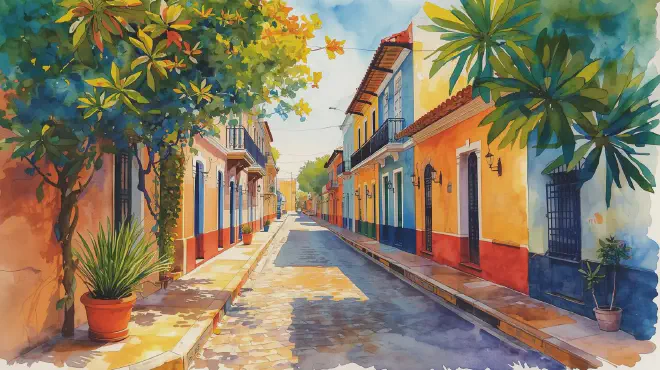
The alleyways of the old town, lined with colonial-style buildings, are adorned with vibrant bougainvillea, and colorful flowers cascade from balconies. As dusk falls, warm orange lights illuminate the cobblestone streets, and the sounds of cumbia and vallenato music drift from somewhere unseen. The atmosphere of this city—born from the blending of African, Spanish, and indigenous cultures—possesses a unique sweetness and strength found nowhere else.
I decided to take a three-day, two-night journey to this Cartagena. I wanted to feel the Caribbean breeze, walk through alleyways where history and present intersect, and surrender myself to the multilayered time this city holds.
Day 1: An Afternoon Dissolving into the Walled City
As the plane from Bogotá began its descent, the blue of the Caribbean Sea spread out beyond the window. Deep, rich blue gradating into the translucent aquamarine of shallow waters. Along the coastline, I could see a cluster of white buildings packed together—that must be Cartagena’s old town.
Stepping off at Rafael Núñez International Airport, I was enveloped by thick heat and humidity. This is Caribbean climate, I realized. During the taxi ride to the city center, modern high-rise hotels of the Bocagrande district passed by the window, and soon the ancient walls came into view.
Passing through the Clock Tower (Torre del Reloj) at the entrance to the old town, a scene unfolded as if I had traveled back in time. Cobblestone alleys, colonial buildings painted in vivid colors, heavy wooden doors and iron-barred windows. The building walls were yellow, pink, blue, green—as colorful as an overturned palette.
I had booked a small boutique hotel near Santo Domingo Square in the heart of the old town. The rooms were arranged around a central courtyard with a small fountain. After checking in, I entered my room to find white walls, wooden furniture, and aged beams crossing the ceiling. Opening the window, I could look down from the balcony onto the cobblestone alley below.
Dropping my luggage, I immediately set out to explore. It was just past 3 p.m. The sun was strong, but when I stepped into the shade of buildings, the Caribbean breeze felt pleasant. Walking through the alleys, I encountered palenqueras—women in traditional dress carrying baskets of fruit on their heads. These Afro-Colombian women are iconic symbols of Cartagena. Their colorful dresses and the balance of baskets atop their heads created perfect pictures.
In Santo Domingo Square, street vendors sold accessories and artists painted. Around Botero’s sculpture “Reclining Woman” in one corner of the square, tourists and locals sat, spending time as they pleased. I sat beside them, watching people pass by. Children ran across the cobblestones, elderly people chatted on benches, and couples walked arm in arm. This square was the everyday life of the city itself.
As dusk approached, I decided to walk along the city walls. You can access the walls from Las Bóvedas, a former weapons storehouse. Climbing the stone steps and standing atop the walls, my view suddenly opened up. On one side, the old town with its orange-tiled roofs; on the other, the blue Caribbean Sea stretching endlessly. The sound of waves reached me quietly.
Walking along the walls, I found a section where local young people had gathered, playing music and dancing. They approached tourists with easygoing friendliness. “Want to dance with us?” I was invited, but I smiled and shook my head. Still, their cheerful atmosphere lightened my heart.
The sun approached the horizon, the sky changing from pale purple to orange. Many people gathered on the walls to watch this dusk. Everyone silently, yet with certain joy, welcomed the end of the day. The sun setting into the Caribbean Sea disappeared surprisingly slowly yet inevitably into the water.
For dinner, I ate at a small restaurant in the old town, ordering Caribbean fish. Pescado frito (fried fish) came with coconut rice and patacones (fried plantains)—a simple dish. The fish was crispy outside and tender inside; squeezing lime over it released a refreshing acidity. The subtle sweetness of the coconut rice paired well with the saltiness of the fish.
Walking back to the hotel after dinner, the alleys glowed with warm orange light, and music leaked from restaurants and bars. Cartagena’s night reveals a different face from daytime. Light reflecting on cobblestones, distant laughter, the sweet scent of flowers somewhere—this city’s night never sleeps.
Day 2: The Sea, Fortress, and Time in Hidden Alleys
In the morning, when I opened the window, the city was already in motion. The sound of sweeping cobblestones, distant voices calling to each other, church bells. I had breakfast in the courtyard: arepas (grilled corn cakes) with cheese, fresh tropical fruit, and strong Colombian coffee. Simple, yet a breakfast that seeped into my body.
That morning, I decided to visit Castillo San Felipe de Barajas. This fortress on a hill outside the old town is the largest military fortification built by Spain in South America in the 17th century. On the taxi ride there, the driver told me, “You’ll see the best view in Cartagena.”
Standing at the fortress entrance, I was overwhelmed by its massive scale. Thick stone walls, intricately maze-like passages, strategically positioned watchtowers. Thinking that pirates and enemy fleets were once watched from here, I felt the weight of history. The interior was labyrinthine, and walking through underground passages, I could almost hear the breathing of soldiers from that era.
Climbing to the top, I found the view the driver promised. Below stretched the entire city of Cartagena: the old town dense with red roofs, the walls encircling it, and the endless Caribbean Sea. A strong wind blew through, cooling my sweaty skin.
Leaving the fortress, I spent the afternoon slowly wandering the old town’s alleys. Turning away from the main streets crowded with tourists, I entered narrow side streets. There was local people’s daily life. Laundry hung on ropes strung from window to window, and an old man sat in a doorway reading the newspaper. Children kicked a soccer ball in the alley while a dog ambled past.
I ventured into the Getsemaní district, an area adjacent to the old town that was once a working-class neighborhood. In recent years, young people and artists have gathered here, and cafés, galleries, and street art murals have multiplied. Colorful murals covering entire building walls expressed Cartagena’s history, culture, and Afro-Colombian identity.
I entered a small café and ordered limonada de coco (coconut lemonade). The combination of coconut milk and lemon seemed odd at first, but tasting it, I found it both refreshing and rich. Inside the café, young people worked on laptops or chatted with friends. Local artists’ paintings hung on the walls, and quiet music played from somewhere in the back.
Leaving the café, I continued through the alleys. In Plaza de la Trinidad, vendors were setting up for the evening, preparing to grill arepas, empanadas, and chorizo. In one corner of the square, elderly men played dominoes. Their movements were practiced, the rhythmic clack-clack of tiles creating a pleasant beat.
At dusk, I climbed the walls again, this time near Café del Mar. Here, a bar sits atop the walls, and many people gather with cocktails to await the sunset. I ordered a mojito and leaned against the stone parapet.
The sky slowly changed colors. Blue to purple, purple to pink, pink to orange. The sea’s color shifted in response. During this time, everyone on the walls faced the same direction, watching the same sunset. Regardless of nationality or age, we simply shared a moment of finding something beautiful, beautiful. It was a quiet yet certain solidarity.
For dinner, I went to a ceviche restaurant recommended by a local. Ceviche is a dish of raw fish cured in lime, widely eaten along Latin America’s coasts. Cartagena’s ceviche contained fresh white fish with tomatoes, red onions, cilantro, and a touch of jalapeño. One bite brought together the lime’s acidity and the fish’s sweetness, vegetables’ crisp texture mingling in my mouth. Eaten with patacones, it was even more delicious.
On my way back to the hotel, passing through Santo Domingo Square, live music had begun. Local musicians played vallenato and cumbia. Several people began dancing around them, and before long it became an impromptu dance party. I sat at the edge of the square, watching the scene for a while. Music and dance, laughter and applause—Cartagena’s night is filled with people’s joy.
Day 3: A Morning of Farewell and What I Carry Home
On the final morning, I woke earlier than usual. Perhaps my body unconsciously rose, knowing I would soon have to leave this city. Looking out the window, the city was still quiet, soft morning light illuminating the cobblestones.
Before breakfast, I went for one last walk. The early morning alleys with few passersby showed a different face. People sweeping, preparing bakeries, children heading to school. This wasn’t Cartagena as a tourist destination but Cartagena as a city where people live their lives.
I passed by the Church of San Pedro Claver, named after a Spanish missionary who worked for the rights of people brought from Africa as slaves. Cartagena was once the largest slave-trading center in South America. This history is far from entirely beautiful. Behind this city’s vibrant colors and cheerful music lies a history of hardship. The quiet church seemed to whisper that this must not be forgotten.
Returning to the hotel, I had breakfast. Arepas and coffee again today—flavors I’d grown familiar with over these three days. Until checkout time, I sat on a bench in the courtyard, trying to read the book I’d brought. But the words wouldn’t register. The sounds, colors, smells of this city, and the faces of people I’d met kept flooding back.
The time came to head to the airport. The taxi arrived in front of the Clock Tower, and I loaded my luggage. As the car started moving, the walls, colorful buildings, flowers blooming on balconies flowed past the window. Everything slowly receded behind me.
“Did you like Cartagena?” the driver asked.
“Very much,” I answered, and he smiled with satisfaction.
“This city—once you come, you can’t forget it. There’s the sea, history, and music. And people’s hearts are warm. Come back again.”
On the road to the airport, the Caribbean Sea was visible through the window. That blue sea I’d gazed at yesterday and the day before. The waves quietly but ceaselessly caressed the shore. For hundreds of years, this sea has remained unchanged, watching over people’s lives.
After checking in, while waiting in the departure lounge, I reflected on these three days. The sunset seen from the walls, the smiling faces of people met in back alleys, the sweet aroma of coconut rice, music echoing on cobblestones—all of it I could recall vividly, as if it were yesterday. Yet at the same time, these memories already felt distant.
The plane took off, and Cartagena grew smaller outside the window. The old town enclosed by walls looks truly small from above, yet the density of time and stories contained within is immeasurable.
A Certain Memory Within Imagination
Thus ended my three days and two nights in Cartagena. Or rather, to be precise, this journey never actually happened. This is an imaginary journey, and my feet have never once touched Cartagena’s cobblestones. I’ve never felt the Caribbean breeze on my skin, never actually tasted coconut rice.
Yet strangely, this journey exists certainly within me. The color of the sunset seen from the walls, the music heard in back alleys, the acidity of ceviche, the vivid clothing of palenqueras—though assembled in imagination, they’re etched in me as memories.
What is travel? Is travel only physically going to a place? Of course, nothing surpasses actually visiting, feeling with all five senses. But isn’t imagining also a form of travel? Reading books, viewing photographs, listening to music, and letting imagination wander—through this process, we encounter unknown worlds and expand the maps within ourselves.
The city of Cartagena exists. The walls, San Felipe fortress, colorful buildings, vallenato music—all truly there. This imaginary journey is an imagined story set in a real place. If someday I truly visit this city, how will this imagination and reality overlap or diverge? When that time comes, I’ll surely experience two journeys simultaneously.
A journey that, though imaginary, feels as if it truly happened. This seems contradictory, yet it may be the essence of travel. Because even when we actually visit a place, what we bring back are memories—a kind of “story.” And stories, through the power of imagination, can be reconstructed and continue living again and again.
On Cartagena’s cobblestones, I’m still walking. Feeling the Caribbean breeze, about to turn the next corner. This journey has ended, yet at the same time, it continues.