
Introduction
The scent of salt carried on Atlantic breezes, the mingling sounds of Arabic and French in the streets. Casablanca is Morocco’s largest city, yet it possesses a peculiar charm where ancient medinas coexist with modern high-rises.
This city, whose name means “white house,” began as a small Berber fishing village called Anfa, later named Casa Branca by the Portuguese. After the French protectorate era, it evolved into the economic heart of modern Morocco. Walking through its streets, one finds beautiful Islamic mosques standing beside Art Deco buildings, layers of history overlapping at every turn.
The magnificent minaret of the Hassan II Mosque stretching toward the sea has become the symbol of this city. In the old medina, the steam rising from tagine pots mingles with the fragrance of mint tea, and one can watch artisans at their craft up close. Casablanca is a special stage where Moroccan tradition and modernity interweave, awaiting travelers who seek something beyond the ordinary.
Day 1: First Steps into the White City
The moment I stepped off the plane at Mohammed V International Airport in the late morning, the dry air and the distant call to prayer made me acutely aware that I had arrived on the African continent. Through the taxi window on the way to the city center, I watched palm trees and white buildings pass by, with the blue horizon of the Atlantic Ocean visible in the distance.
My driver, Mohammed, offered a warm smile and said “Welcome to Casablanca” in broken English. As we approached the city, the density of buildings increased, and colorful signs and the sound of motorbikes grew livelier. The streetscape, where Art Deco architecture from the French protectorate era stood alongside traditional Moroccan buildings, was quintessentially Casablanca.
After checking into my hotel, I headed to a nearby restaurant to satisfy my hunger. At a place called Restaurant Al Mounia, bustling with locals, I attempted my first Moroccan meal. The menu was written in Arabic and French, but a waiter named Omar kindly explained everything in English.
I ordered tagine, the quintessential Moroccan dish — lamb with prunes and almonds. When the conical-lidded tagine pot arrived and the cover was lifted, the aroma of spices immediately stirred my appetite. The flavors of cinnamon, ginger, and saffron harmonized exquisitely, sweetness and saltiness intertwining with the warmth of spices in ways I had never experienced before. The couscous served alongside had fine, fluffy grains that paired perfectly with the tagine’s sauce.
In the afternoon, I decided to explore the city center. My first destination was Mohammed V Square. Built during French rule, this plaza is surrounded by white buildings with a beautiful fountain at its center. Pigeons crossed the square while elderly men relaxed on benches. In one corner, a flower seller displayed roses of every color, their vivid hues creating a striking contrast against the white buildings.
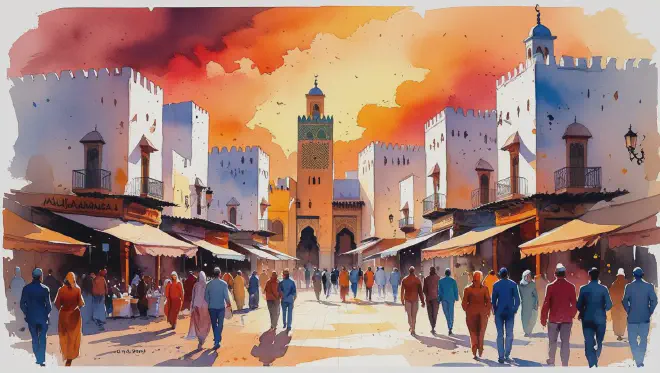
From there, I walked to the old medina. The moment I entered its narrow alleys, I stepped into another world. Stone-paved streets were lined on both sides with small shops selling spices, carpets, ceramics, and leather goods. At a shop where saffron, cumin, and paprika were piled high, the owner Ahmed called out to me in surprisingly good English, “Please, come see — good smell, yes?” The saffron he let me hold did indeed have a deep, rich fragrance.
At a leather shop, I watched an artisan crafting babouches — traditional Moroccan slippers — by hand. The skill with which he stitched together colorful leather was truly artistic. The shop owner’s son, a young man who spoke English, explained that making a single pair takes three days. Moved by such careful craftsmanship, I decided to purchase a pair as a memento.
As evening approached, I walked along the Corniche, the seaside promenade facing the Atlantic. From the waterfront walkway, I could watch the sunset sinking into the horizon. The sky turned orange, and the boundary between sky and sea blurred into something like a painting. Families strolling and people enjoying fishing gave me a glimpse into the everyday life of locals.
That night, at a café near my hotel called Café de France, I sipped mint tea while reflecting on the day. The green tea poured into a small glass balanced the freshness of mint with just the right amount of sweetness. Outside the café, the city’s bustle continued into the night — car horns and voices blending together to create the nighttime sounds of Casablanca.
My first night in a foreign land. Even when words failed, I was embraced by the warmth of people and the deliciousness of food. I fell asleep with my heart full of anticipation for tomorrow.
Day 2: Sacred Waters and the Artisan’s Touch
I awoke to see the Atlantic horizon through my hotel window, tinted a pale pink. Today I planned to visit the Hassan II Mosque, Casablanca’s most famous landmark.
For breakfast, I joined locals at a nearby bakery, enjoying freshly baked khobz — traditional Moroccan bread — with café au lait. The bread was crisp on the outside and soft within, simple yet perfect with smooth butter. The constant aroma of baking bread drifted from the back of the shop, filling the morning quiet with gentle warmth.
When I arrived at the Hassan II Mosque in the late morning, I was rendered speechless by its grandeur. The minaret, rising 200 meters high, stood majestically facing the Atlantic, as if offering prayers toward the heavens. Completed in 1993, this mosque is the third largest in the world and the only mosque built over the sea.
I toured the interior with a guide named Fatima. The prayer hall, capable of accommodating 25,000 worshippers at once, was breathtakingly beautiful. The massive chandelier hanging from the ceiling weighs 50 tons, and the floor is covered in geometric mosaics of marble and onyx. The walls are adorned with Arabic calligraphy and traditional Moroccan decoration, their calculated beauty a work of art in itself.
What struck me most was that part of the prayer hall floor is made of glass, revealing the sea below. To pray while sensing the ocean beneath — this was a mystical space unlike any other. Fatima explained, “The sea is a gift from God. That is why the mosque was built near it.”
In the afternoon, I visited a pottery workshop deep in the medina to experience traditional craftsmanship. The artisan Youssef, over sixty years old, handled the potter’s wheel with the strength of a much younger man. Watching clay transform before my eyes into a beautiful vessel seemed like magic.
“Pottery is patience. You must not rush,” Youssef said as he let me try my hand at it. At first I struggled, but under his guidance, I managed to create something resembling a small bowl. “Well done. You have talent,” he praised, though the smiles of the other artisans watching made it clear this was generous flattery. Still, the time spent working with clay was calming, allowing me to forget the rush of daily life.
I had a late lunch at a small café next to the workshop. I ordered harira soup and chebakia, a traditional Moroccan fried pastry. Harira is a tomato-based soup with chickpeas, lentils, and finely cut meat that warms you from within. A squeeze of lemon adds acidity that makes it even better. Chebakia is thin dough shaped like a rose, fried and drizzled with honey — a sweet treat that perfectly cleansed the palate after the harira.
The café owner, Abdoul, was over seventy but knew surprisingly much about Japan. “I once had a Japanese friend. Very kind and polite,” he told me. His words conveyed the richness of years spent meeting travelers from around the world.
In the late afternoon, I strolled through the Habous Quarter. This newer district, built during French rule, features orderly streets and beautiful tree-lined boulevards. Walking along avenues lined with Art Deco buildings, I almost felt I was in a corner of Paris. Yet the buildings incorporated Moroccan geometric patterns in their decoration, creating a unique beauty born from the fusion of East and West.
The central market was bustling with locals shopping for dinner. The fish section displayed catches brought in that very morning — sardines, sea bream, octopus, and varieties I had never seen. The vegetable section overflowed with vibrant tomatoes, cucumbers, eggplants, and olives. The variety of olives was astonishing — green, black, brown — each with its own distinct flavor.
That evening, I dined at La Sqala, a seaside restaurant. This establishment, converted from an 18th-century fortress, allows guests to eat in a courtyard surrounded by ancient stone walls. I ordered pastilla, a pie made with chicken and eggs, and seafood tagine. Pastilla consists of thin pastry filled with spiced chicken and egg, topped with powdered sugar and cinnamon. At first I was uncertain whether it was meant to be sweet or savory, but as I continued eating, I became enchanted by its exquisite balance.
The seafood tagine was filled with shrimp, squid, and fish, the tomato-based sauce enhancing the ocean’s flavors. The Moroccan wine served alongside was fruity with a clean finish, pairing wonderfully with the food.
After dinner, as I sat in the courtyard drinking mint tea and feeling the night breeze, the sound of an oud drifted from somewhere nearby. Local musicians were playing traditional music in a corner of the restaurant. The melody, characteristic of Arabic music, resonated deep within my heart, making this night something special.
On my way back to the hotel, I gazed once more at the Hassan II Mosque, now illuminated against the night sky. It wore an entirely different expression from what I had seen during the day, seeming to offer quiet prayers toward the darkened sea. This single day had allowed me to fully savor Casablanca’s diverse charms. Tradition and modernity, East and West, sea and land — all in harmony. I felt anew what a remarkable city this was.
Day 3: A Morning of Farewell and Memories to Keep
On my final morning, I woke early to walk along the Corniche. I wanted to watch the sunrise over the Atlantic. Around six o’clock, walking while it was still dim, I found several locals already jogging along the waterfront. When I greeted them, they all responded with warm smiles.
As the sun slowly rose from beyond the horizon, the sea surface glowed orange, like a carpet of gold. The silhouette of the Hassan II Mosque emerging against the morning light was one of the most beautiful moments of my journey. The sea breeze was slightly cool, but its freshness felt pleasant, heralding the beginning of a new day.
During my walk, I spoke briefly with a local fisherman named Ali. He said he fishes here every morning at this hour. “The sea shows a different face every day. I never tire of it,” he told me in fluent English. On the end of his fishing rod, a small sardine danced. “Today is a good day. I have a gift for my family,” he said with a happy smile, giving me a glimpse into the lives of people who live alongside the sea.
For breakfast, I returned to the bakery I had enjoyed the day before. This time, I asked the owner, Mustafa, to tell me more about the different types of bread baked in the back. Morocco has various breads that differ by region, each with its own method of preparation and way of eating. He proudly explained that the khobz commonly eaten in Casablanca is relatively simple but has a flavor that never grows tiresome, even when eaten every day.
In the late morning, I returned to the medina to buy souvenirs. I consulted Ahmed at the spice shop I had visited the day before about a set of spices I could take back to Japan. “You absolutely need these,” he said, preparing small bags of saffron, ras el hanout — Morocco’s all-purpose spice blend — and cumin. “With these, you can enjoy Moroccan flavors at home,” he said, kindly teaching me cooking methods as well.
At the carpet shop next door, I was shown beautiful Berber rugs. An elderly man, the shop owner’s father, explained the meanings woven into the carpets. Each pattern carries significance — wishes for family happiness, health, and abundance. Hand-woven carpets take months to complete, and I came to appreciate their true value. In the end, I decided to purchase a small cushion cover.
For lunch, wanting to try something I hadn’t yet tasted, I entered a small eatery crowded with locals. I couldn’t make sense of the menu, but the dish a family at the next table was eating looked delicious, so I ordered the same. What arrived was a slow-cooked dish that looked unfamiliar at first, but the taste was surprisingly gentle — meat that had been simmered for hours until tender, with spices that were present but not overpowering, a deeply nourishing flavor that seemed to seep into my body.
The proprietress, Aisha, became very concerned when she learned I was traveling alone. “Are you all right by yourself?” “Is there anything troubling you?” She fussed over me like a mother. Though the language barrier remained, her warm care came through clearly, warming my heart.
In the afternoon, I enjoyed one last stroll through the city before my flight. I watched children feeding pigeons in Mohammed V Square, savored one more mint tea at a street-corner café — nothing extraordinary, but I tried to imprint Casablanca’s everyday scenes deeply in my heart.
While walking, I happened to run into Youssef, the potter I had met at the workshop the day before. “Leaving already? So soon,” he said with apparent regret. He had fired the small bowl I had made in his kiln. “Please take this home as a memento,” he said, handing it to me. Though misshapen, this piece I had made with my own hands became a special keepsake.
In the late afternoon, before heading to the airport, I went to see the Hassan II Mosque one last time. Over three days, I had visited this place many times, yet each visit brought new discoveries. This time, the minaret bathed in the setting sun created a path of light stretching across the Atlantic. I burned this beautiful scene into my memory, reluctant to part from Casablanca.
On the way to the airport, my driver was Mohammed — the same man from my first day. “How was Casablanca?” he asked. When I replied, “It was wonderful. I will definitely come back,” he smiled and said, “I’m glad. Next time, please stay longer.”
While waiting at the departure gate, I reflected on these three days. Delicious food, beautiful architecture, encounters with warm people, and the magnificent scenery of the Atlantic. Though my stay was brief, I had fully savored Casablanca’s charms. What remained most vivid were the kindnesses of the people I met. Even when words failed, hearts could connect — I felt this truth anew.
At the moment of takeoff, Casablanca’s cityscape grew smaller through the window. The beautiful city of white buildings, its warm people, and countless memories etched in my heart. What I gained from this journey, I will surely never forget.
In Closing
This three-day journey to Casablanca exists only in imagination. Yet while writing these words, I felt as though I had truly visited that place, breathed its scents, tasted its flavors, and met its people.
The solemnity of the Hassan II Mosque, the vitality of the medina, the aroma of tagine, the sweetness of mint tea, the Atlantic sea breeze, and above all, the warm smiles of the people I encountered. All of these arose vividly in my mind as clear images.
Perhaps travel is not only about physical movement. To exercise imagination, to contemplate a land’s culture and history, to think about the lives of those who live there — this too may be a form of journey.
I hope this imaginary travel essay will serve as a prelude to the day I truly visit Casablanca. With longing for the “white city” in my heart, I return to everyday life. Though imaginary, the memories of Casablanca etched in my heart feel undeniably real.