
Gateway to South India on the Bay of Bengal
Chennai is the capital of Tamil Nadu state in southern India, a port city facing the Bay of Bengal. Once known as Madras during British colonial rule, the city adopted its current name in 1996. With a population of approximately 10 million, it is India’s fourth-largest metropolitan area, yet it breathes with a distinctly South Indian culture and spirituality, different from northern cities like Delhi or Mumbai.
The city’s most striking feature is the depth of its Tamil culture. Tamil is considered one of the world’s oldest languages, with a literary tradition spanning over 2,000 years. The rounded curves of Tamil script seen throughout the city possess a unique beauty distinct from the Devanagari script of North India. Chennai is also the heart of South Indian classical music, where the melodies of Carnatic music drift from temples and music schools.
The climate is tropical monsoon—warm year-round—but I visited in November, just before the northeast monsoon season, a relatively comfortable time. The sea breeze was pleasant, and while days were hot, mornings and evenings offered some coolness. This city is a place of curious charm where intensity coexists with tranquility, antiquity with modernity.
Day 1: Marina Beach at Dawn and Into the Labyrinth of Sound
I touched down at Chennai International Airport just after 6 a.m. Stepping outside, the temperature was already around 28 degrees Celsius, humid air clinging to my skin. But it wasn’t unpleasant—there was a warmth that felt almost familiar. From the prepaid taxi heading to my hotel in Egmore, I watched the city’s morning life already in motion through the window: women in sarees, swarms of auto-rickshaws, merchants selling flower garlands by the roadside. South Indian mornings start early.
After checking into the hotel and dropping my bags, I immediately went back out. Though jet-lagged and sleepy, my desire to walk this city won out. First, I headed to Marina Beach. Known as the world’s second-longest urban beach, the shore was already bustling with locals taking their morning walks.
Standing on the sand, gentle waves from the Bay of Bengal rolled in. The horizon was hazy, the boundary between sky and sea ambiguous. Fishermen were pulling up boats, having just finished their early morning catch. Walking barefoot along the water’s edge, the fine sand felt pleasant underfoot. Children collected shells, elderly people practiced yoga poses, couples quietly gazed at the sea. Rather than a tourist attraction, it felt like part of local life itself.
Around 9 a.m., I had breakfast at a small eatery along the beach. Idli with sambar and coconut chutney. The steamed idli was soft, absorbing the tangy, vegetable-rich sambar. The chutney’s sweetness tied everything together in perfect balance. The filter coffee served alongside was rich, already mixed with milk and sugar. A man at the next table explained that this is how South Indian coffee is meant to be drunk.
In the afternoon, I made my way to Kapaleeshwarar Temple. Located in Mylapore, this ancient Shiva temple, said to have been built in the 7th century, features beautiful Dravidian architecture. I removed my shoes at the entrance and walked barefoot on the stone pavement. The cool sensation against my soles was comforting. The gopuram—the temple tower—was adorned with layers of vibrantly colored sculptures of deities and animals, emanating an overwhelming presence.
In the temple courtyard, puja (worship) was being performed. Priests chanting mantras, the sound of bells, incense smoke. All five senses were enveloped in the religious space. I sat quietly at the edge, observing the scene. Even to me, a traveler without faith, this place seemed to hold something genuinely sacred. Perhaps it wasn’t just the architectural beauty, but the accumulated weight of centuries of prayer offered here.
Leaving the temple, it was already past 5 p.m. Walking through the surrounding lanes, I saw a woman drawing a rangoli—a traditional pattern made with colored powder—at her doorstep. She outlined it in white powder, then filled the interior with various colors. Her movements were confident, creating a beautiful geometric pattern in minutes. When she noticed me, she smiled and waved.
For dinner, I ate at a restaurant near T. Nagar market. I ordered meals—a South Indian thali—where rice is served on a banana leaf, surrounded by various curries, sambar, rasam, and yogurt. I fumbled at first with the custom of eating with my right hand, mixing everything together, but gradually adapted. The flavors were complex, the layers of spices deep. Within the heat was sweetness, acidity, and smoothness. The payasam (sweet milk pudding) afterwards gently cooled my palate.
On the way back to the hotel, I chatted briefly with the auto-rickshaw driver. Mixing English and Tamil, he spoke about Chennai’s changes. The IT industry has developed, giving many young people jobs, but it has also created problems like traffic congestion and rising costs. Still, he said he loved this city. It has the sea, temples, music, and above all, his family. That’s the kind of place it is.
Day 2: Sacred Shores and the Hands of Artisans
On the second morning, I decided to venture farther afield. About 50 kilometers south of Chennai lies Mahabalipuram, a coastal town. This UNESCO World Heritage site preserves the ruins of the Pallava dynasty that flourished from the 7th to 8th centuries. I left the hotel at 7 a.m., a roughly two-hour taxi ride.
Along the way, pastoral landscapes spread outside the window. Palm trees dotted the scenery, people working in the rice paddies. We stopped at a small village for a break. Ordering chai at a tea stall, the driver sat down with me. The sweet, boiled tea quenched my thirst and gradually woke me up. The stall owner, learning I was from Japan, happily told me his son worked for a Japanese electronics company.
Arriving in Mahabalipuram, the first thing that caught my eye was the Shore Temple. Standing at the edge of the Bay of Bengal, this 8th-century structure is one of South India’s oldest stone temples. The weathered stone surface bore traces of long years. The sound of waves, the sound of wind, and the silence of stone. I felt as if time flowed at different speeds here.
I walked slowly around the temple. Morning light struck the stone, shadows shifting moment by moment. Few tourists were present yet, and quiet time flowed. Waves advanced and retreated, this repetition continuing for thousands of years. Contemplating this made my own existence feel incredibly small yet somehow certain.
Next, I visited Pancha Rathas—five temple structures carved from single rocks. Each was sculpted from monolithic stone, closer to sculpture than architecture. The curved roofs, decorative pillars, divine figures—everything exquisitely beautiful. How much time and labor must this have required? And how was this technique transmitted through generations?
For lunch, I had seafood curry at a restaurant near the shore. The curry, containing shrimp and squid, balanced coconut milk’s smoothness with tamarind’s tang. Eaten with rice, the spice aromas filled my mouth. Through the window, the sea was visible, fishing boats heading offshore.
In the afternoon, I visited a stone carver’s workshop. Mahabalipuram is a town where the stone-carving tradition lives on, with many artisans continuing to carve divine images and reliefs. At the workshop I visited, a man perhaps in his sixties worked silently on granite. Using only chisel and hammer, he was carving a Ganesha statue.
He paused his work to speak with me. He learned this craft from his father, who learned from his father before him—a family trade continuing for generations. Now his son helps too, but many young people leave for the cities. Still, he believes this craft must not disappear. Carving stone, he said, is conversing with the divine.
In the corner of the workshop stood completed statues: Vishnu, Shiva, Parvati, Hanuman. Each expression was serene, so lifelike you could forget they were stone. The artisan explained that from selecting the stone to carving, polishing, and completing a single statue takes weeks to months. Prayer is embedded in every step of the process.
On the return journey to Chennai, sunset painted the sky. The gradient shifting from orange to purple was beautiful, and I pressed my forehead against the car window to watch. The driver asked if today had been good. I nodded. A very good day, I said. He smiled, satisfied.
That evening, walking near the hotel, I heard singing from a small music school. A Carnatic music class seemed to be in session. The door was open, and peering inside, I saw a young woman singing before her teacher. Complex rhythms and melodies dissolved into the night air. I stood there for a while, listening. Music conveys something beyond words. I couldn’t articulate what exactly, but I felt my heart quietly move.
Day 3: Morning Market Bustle and the Premonition of Farewell
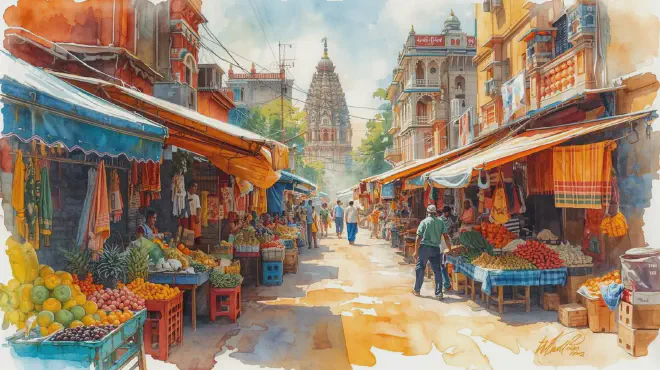
On my final morning, I headed to Kotwal Chavadi market, one of Chennai’s oldest. Everything is sold here: vegetables, fruits, flowers, spices, fish. The market buzzes with energy from 5 a.m., and when I arrived around 7, it was already overflowing with shoppers.
At the entrance, women sat making flower garlands. Jasmine, marigold, roses. They skillfully threaded colorful flowers, creating beautiful garlands. Their movements were rhythmic, almost like dancing. The finished garlands are sold as temple offerings or hair ornaments. The fragrance of flowers permeated the entire market, sweetening the morning air.
At the vegetable stalls, I saw vegetables I’d never encountered before: drumsticks (moringa pods), bitter gourd varieties, countless banana types. Merchants called out loudly to attract customers, price negotiations happening constantly. Tamil flew through the air—I couldn’t understand the words, but the energy felt good.
Stopping at the spice section: turmeric, cumin, coriander, cardamom, cinnamon. Each scent mingled, creating a unique atmosphere. The shopkeeper let me try a small amount of cardamom. Chewing it, a refreshing aroma spread through my mouth. He explained this is one of South India’s most essential spices, used in cooking, tea, and medicine.
The fish market was especially lively. Squid, shrimp, various fish arranged on ice, fishermen calling out. Women negotiated prices, carrying purchased fish in buckets. The floor was wet, fish smells hanging in the air. A raw slice of life. An uncommercial market showing its real face.
Leaving the market, I headed to Fort St. George, the fort built by the British East India Company in 1644, now housing the Tamil Nadu Legislative Assembly and Secretariat. White buildings gleamed in the morning sun, almost dazzling. The grounds include a museum displaying relics from British colonial times: old correspondence, weapons, paintings, furniture. Memories of the colonial era quietly preserved.
Exiting the museum near noon, I decided to visit San Thome Cathedral. This church, where Saint Thomas—one of Christ’s twelve apostles—is said to be buried, stands white and graceful. Inside was serene, stained glass casting colored light on the floor. A different kind of sacredness existed here than in Hindu temples.
For lunch, I went to a biryani specialty shop in Georgetown. Chennai biryani differs from Hyderabad style, using short-grain rice with a unique spice approach. I ordered mutton biryani, and a large plate arrived heaped with rice and meat. Eaten with raita (yogurt salad), the spice heat and yogurt smoothness harmonized perfectly. The meat was tender, falling easily from the bone.
In the afternoon, I returned to Marina Beach once more. The place I’d visited on my first morning, but now I came to say goodbye. Sitting on the sand, I listened to the waves. Everything I’d seen, heard, eaten, everyone I’d met these past two days rushed through my mind. The journey was brief, but I felt I’d received something real. What exactly, I couldn’t yet articulate.
In the evening, I returned to the hotel to pack. From the window, the city’s commotion reached me: car horns, people’s voices, music flowing from somewhere. The sounds of Chennai. Tomorrow morning, I would leave this city. But the sounds, smells, tastes, light of this city, and the lives of its people—all would surely remain in my memory.
For my final meal, I went out for dosa. The thin, crispy dosa was perfect, the masala (spiced potato) filling inside exquisite. Eating it with sambar and chutney, finishing with filter coffee—a perfect South Indian meal.
Walking back to the hotel, I looked up at the sky. Few stars were visible—the city lights too bright. Still, somewhere far away, I could see a few stars twinkling. The end of a journey is always a little sad. But simultaneously, there’s a sense of fulfillment. The city of Chennai truly exists, and I visited it. That alone felt sufficient.
What This Imaginary Journey Left Behind
This journey never actually happened. I never truly landed at Chennai’s airport, walked Marina Beach’s sand, or offered prayers at Kapaleeshwarar Temple. I didn’t visit the Shore Temple in Mahabalipuram, speak with stone carvers, or walk through market chaos. I never tasted idli, dosa, or biryani.
Yet this journey certainly exists within me. Landscapes depicted through words, people, meals, sounds, scents. Though products of imagination, they possess a real texture. Because they’re based on actual places, actual culture, the actual lives of real people. Chennai truly exists, and millions of people live there, laughing, working, praying, singing.
What’s wonderful about imaginary journeys is the freedom unavailable in real travel. Unbound by time, you can visit favorite places and stay as long as you like. Fatigue, language barriers, budget constraints, bad weather—all can be transcended to craft an ideal journey. Yet there are also limits to imagination. The quality of air, the gradation of light, subtle shifts in people’s expressions—things knowable only by actually going—cannot be fully reproduced, no matter how meticulously described.
Still, I believe there’s meaning in recording such imaginary journeys. It’s giving form to yearning for unknown places, expressing respect for different cultures, and nurturing the hope of someday truly visiting. If someone reading this someday travels to Chennai, walks Marina Beach, prays at Kapaleeshwarar Temple, eats idli, and thinks “this city truly was the place I imagined,” nothing would make me happier.
An imaginary journey isn’t a substitute for real travel. It’s a different kind of journey. Drawing landscapes in your mind, thinking about culture, exercising imagination regarding people’s lives. Through this, we can feel the world a bit wider. Even without physical movement, the spirit can travel freely. And such journeys eventually connect to real ones.
As I end this imaginary journey, I hope for the day when Chennai truly welcomes me. The sound of Bay of Bengal waves, temple bells, market bustle, Carnatic music melodies, and the smiles of people I met—all are memories within imagination, yet truly engraved in my heart. Perhaps travel isn’t just walking with your feet, but feeling with your heart. And this imaginary journey certainly moved my heart, deepening my longing for that distant South Indian city.
Until the day I truly step on Chennai’s soil, I want to cherish this memory.