
A Forest of Stone in Apache Land
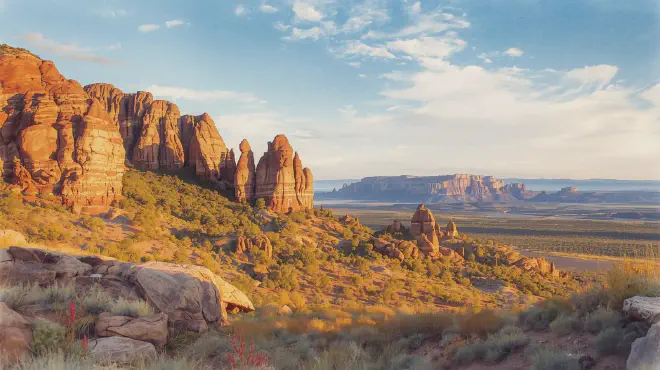
In the southeastern corner of Arizona, near the New Mexico border, lies Chiricahua National Monument—a place where geological wonder intersects with indigenous history. Twenty-seven million years ago, a volcanic eruption deposited vast layers of ash and pumice across this land. Over eons, wind and rain carved the compressed rock into countless stone pillars and spires. Some formations balance impossibly, with massive boulders perched atop slender pedestals. Others thrust skyward like ancient sentinels. Their presence inspires awe in all who see them.
This land once served as the stronghold of Cochise, the great Apache leader. In the late 19th century, he knew every crevice and passage in this labyrinth of rock, using the complex terrain to outmaneuver the U.S. Army. The name Chiricahua comes from the Apache language, meaning “great mountain.” Rising over 5,000 feet above sea level, this area nurtures an ecosystem distinct from the surrounding desert. Forests of oak, pine, and juniper provide habitat for over 350 species of birds, making it a pilgrimage site for birdwatchers.
In this remote silence, one learns to hear the conversation between stone, sky, and wind. I didn’t yet know that this would be the meaning of my visit here.
Day 1: Crossing the Desert into the Stone Maze
Two and a half hours from Tucson by car. I left at 8 AM, heading east on Interstate 10. Outside the window stretched the endless expanse of the Sonoran Desert—a brown landscape dotted with cacti, forming a sharp contrast against the blue sky. After exiting at Willcox, I took State Route 186, and the road began to climb steadily in elevation.
Just after 11 AM, I arrived at the Visitor Center. Only a few cars sat in the parking lot. The weekday quietness felt welcoming. The ranger at the desk, a woman in her sixties, greeted me with a warm smile.
“First time?” she asked.
“Yes,” I replied, and she spread out a map to explain the main trails. “I’d recommend the Echo Canyon Loop. It’s 3.5 miles, takes about three hours, but it captures everything special about this park.”
To warm up my legs, I first headed to Mushroom Rock behind the Visitor Center. Just a ten-minute walk on a paved trail, but already the park’s strange world began to reveal itself. A massive rock shaped like a mushroom balanced on a thin column. How does such a form come to be? The compressed volcanic ash—called tuff—is strong vertically but erodes easily horizontally. The result: these peculiar sculptures.
At 1 PM, I ate a simple lunch at a picnic area near the Visitor Center. Turkey, lettuce, tomato, mustard on sandwich bread. Simple fare, but in the thin, dry air at this elevation, it tasted exceptional. A Steller’s jay perched in a nearby tree, watching me. Its brilliant blue plumage and black crest were striking.
At 2 PM, I began the Echo Canyon Loop in earnest. The trail started with a gentle uphill slope. Passing through pines, the view opened suddenly, and I found myself speechless. Hundreds, perhaps thousands of stone pillars lined both sides of the canyon. Some stood sharp as spears, others thick and squat, still others stacked in precarious towers. Sunlight struck the rock faces, creating shadows in shades of orange and pink.
The trail wound between the rocks, sometimes passing through narrow gaps between walls, sometimes ducking beneath massive boulders. Echo Canyon earned its name from the way sound reverberates in these enclosed spaces. I tried calling out “Hello!” and the rocks returned my voice again and again.
Resting on a boulder, I encountered a young couple passing by. “Incredible views,” I said, and they told me they’d come from Germany. “There’s nowhere else like this in the world,” the man said. I had to agree.
At 5 PM, I finished the trail and returned to the parking lot. My legs were tired, but my spirit felt full. Tonight’s lodging was a small motel in Willcox, twenty minutes from the park. Not a chain, but family-run. The room was modest but clean, the bed comfortable.
For dinner, I went to a Mexican restaurant in town called La Unica. The place bustled with locals. I ordered carne asada tacos—charred beef, fresh cilantro, onions, and lime. The tortillas were handmade, warm and soft. The salsa verde had just the right amount of heat. I drank a Dos Equis, and it penetrated my tired body like medicine.
Back at the motel, I showered and lay down on the bed. Outside the window, stars filled the sky. This area has little light pollution, and the Milky Way stretched clearly visible. Tomorrow I would go deeper into this forest of stone. With that thought, I drifted into sleep.
Day 2: The Labyrinth and Memories in the Wind
I woke at 6 AM. Outside, darkness still lingered, but the eastern sky had begun to pale. I quickly dressed, grabbed complimentary coffee and a banana from the motel lobby, and headed back to the park. The early morning park wrapped itself in silence. Mine was the only car in the lot.
At 7 AM, I started on the Heart of Rocks Loop Trail, one of the park’s most popular routes—seven miles total. Walking during the cool morning hours was wise. The trail climbed steadily, eventually reaching the area called the “heart of rocks.”
Here the rock formations grew even more complex, like a vast sculpture garden. Two rocks named “Punch and Judy” faced each other like characters from a puppet show. “Totem Pole” stood thin and tall, piercing the sky. “Big Balanced Rock” looked so precariously perched it seemed ready to tumble, yet it had stood there for thousands of years.
Around 9 AM, I reached the trail’s highest point, about 6,900 feet. Below me, the entire park spread out in view. The forest of stone pillars rolled like waves, and in the distance, the peaks of the Chiricahua Mountains formed a jagged line. Wind swept through. This same wind had been sculpting these rocks for millions of years.
I thought suddenly of the Apache. Cochise and his warriors rode horses through these rocks, evading pursuing troops. For them, this land wasn’t merely scenery—it was a fortress for survival, a sacred place. Did they feel the same awe I felt now?
On the descent, I spotted a chipmunk foraging in the shadow of a rock. It showed no fear, regarding me with curious eyes. It held a nut in its tiny paws, eating with surprising dexterity.
At 11:30 AM, I returned to the trailhead. Nearly six hours of walking. My water bottle was almost empty. I refilled at the Visitor Center and took a break. In the exhibit room, I watched a video about the geological formation of this landscape. The massive eruption of Turkey Creek Caldera 27 million years ago. Over 2,000 feet of deposited ash and pumice. Compressed into rock, eroded, shaped into what exists today. I tried to grasp the incomprehensible span of time.
At 1 PM, I returned to Willcox for a late lunch at a place recommended by a local: Rodney’s BBQ. The menu was simple—brisket, ribs, pulled pork. I ordered the brisket plate. The meat had been smoked for over twelve hours and fell apart at the touch of a fork. Smoky aroma and the meat’s natural richness. Sides of coleslaw, baked beans, and cornbread. The taste of the American South.
At 3 PM, I drove back to the park and took the Bonita Canyon Drive slowly. This eight-mile paved road allows you to enjoy the park’s scenery from your car. I stopped at several viewpoints to take photographs. The view from Massai Point was especially magnificent—supposedly the best spot for sunset photography.
At 5 PM, I returned to Massai Point to wait for sunset. A few other visitors had arrived with the same intention. Everyone waited quietly. At 6:15 PM, the sun began approaching the western horizon. The sky shifted from orange to red to purple. The stone pillars became silhouettes against the fading light, their forms growing more mysterious. When the sun disappeared completely, applause rose around me. A simple human appreciation for natural beauty.
For dinner, I tried a different place: The Apple Pie, a small diner. True to its name, the place was famous for homemade apple pie. I ordered meatloaf with mashed potatoes, and apple pie for dessert. The warm pie came topped with vanilla ice cream. Simple, gentle flavors.
I returned to the motel after 8 PM. Tonight’s stars were equally brilliant. I sat on the room’s small porch, savoring the quiet night. In the distance, a coyote howled. The sound of this land at night. Tomorrow would be my final day. I would visit that stone forest one more time.
Day 3: A Morning of Farewell, Into Memory
I woke early on the last morning too. Today I would return to Tucson, but my afternoon flight left me with time. I wanted to visit the park once more.
At 7 AM, I arrived at the park. This morning I chose a shorter trail: Natural Bridge Trail. About 2.5 miles round trip, relatively flat. As the name suggests, it leads to a natural rock arch.
Walking in the morning light felt refreshing. The air carried a pleasant chill. Bird songs echoed through the forest. A red-tailed hawk circled overhead. I watched its graceful flight as I walked.
After thirty minutes, Natural Bridge came into view. The lower portion of a massive rock had eroded away, forming a bridge-like structure. You could walk beneath it. Looking up at the rock ceiling, I saw complex layering—volcanic ash, pumice, and other minerals compressed between them. Earth’s memory, inscribed in stone.
Beyond the bridge, a small canyon opened up. I rested here and ate a granola bar I’d brought. In the silence, only the sound of wind. I reflected on these past two days—the trails walked, the views seen, the people met. And this land’s deep history, its incomprehensible span of time.
A human life is so brief. My three days here barely registered as a blink in geological time. Yet during this short stay, I felt I had become part of this land, and it had become part of me.
At 9 AM, I returned to the trailhead. I stopped at the Visitor Center to thank the woman at the desk. “Come back again,” she said. “This park shows a different face each time you visit.”
On the road back to Willcox, I gazed once more at the distant Chiricahua Mountains. The rock spires gleamed in the morning sun.
I had my last breakfast at a café in town called Desert Rose. Pancakes, bacon, scrambled eggs. I refilled my coffee and took my time. At the next table, local elderly men gathered for conversation. These everyday scenes add warmth to travel memories.
At 11 AM, I departed for Tucson, retracing my route. The desert landscape flowed past the window once more. Leaving Willcox, heading west on Route 186. Cactus shadows grew shorter. Past noon, the sun climbed nearly overhead, its light relentless.
At 1:30 PM, I reached Tucson. I returned the rental car near the airport and arrived early at the terminal. While waiting, I sat in an airport café, reflecting on this journey. I jotted notes—scenes witnessed, feelings experienced, people encountered.
At 4 PM, boarding began. I settled into my window seat and fastened my seatbelt. The plane taxied down the runway, then lifted into the sky. Below, Tucson grew smaller. To the east, far in the distance, the Chiricahua Mountains must have stood. Though hidden by clouds, in my mind’s eye, those stone pillars continued their eternal vigil.
What This Imagined Journey Left Behind
Gazing at clouds outside the window, I thought: this journey was indeed a product of imagination. I haven’t actually visited Chiricahua National Monument. I didn’t eat in Willcox restaurants. I didn’t walk through that forest of stone.
Yet strangely, this journey remains in me as genuine memory. The echo when I called out in Echo Canyon. The colors of sunset at Massai Point. The taste of tacos at that Mexican restaurant. The silence beneath Natural Bridge. All of it experienced in imagination, yet none of it feels false.
Human imagination is a curious thing. Even places we’ve never visited can become vivid experiences when we combine information, knowledge, and sensitivity. And these experiences can move us, change us, as powerfully as reality itself.
Chiricahua National Monument is real. Its rock formations, Apache history, rich ecosystem—all genuine. Perhaps someday I’ll truly visit that place. When that day comes, how will these imagined memories intersect with reality? Surely some things will differ from what I imagined. But the essential feelings—the wonder, the awe, the silence, the sound of wind—those will likely remain unchanged.
Travel isn’t only about moving through space. It’s about the heart’s movement, gaining new perspectives, stepping away from the everyday to face oneself. Considered this way, perhaps this imagined journey deserves to be called real travel too.
The forest of stone continues to be sculpted by wind. Millions of years from now, it will look different again. But in my mind, those pillars stand forever in the form I saw them. That, I think, is another magic that imagined journeys possess.