
Where Waves Meet Land
Cianjur. Located at the southern edge of West Java Province, between the Java Sea and the Indian Ocean, this region preserves a special kind of quietude within Indonesia. It lacks the glamour of Bali or Yogyakarta. Yet here, ancient Sundanese culture breathes on, and landscapes woven from black sand beaches and deeply green hills welcome travelers.
About three hours by car from Jakarta. Once you leave the urban clamor behind, rice paddies and palm trees appear along the roadside. Cianjur has long prospered through agriculture and fishing, and people live within a leisurely flow of time. Traces of the Banten Sultanate era remain, a place where history and nature coexist quietly.
Particularly famous is the beautiful coastline including Sawarna Beach. The volcanic black sand stretches endlessly, and the sight of rough waves crashing in from the Indian Ocean evokes something of primal power. Inland, traditional villages dot the landscape, where Sundanese cultural traditions like the angklung (bamboo musical instrument) and wayang golek (wooden puppet theater) are still passed down today.
What made me want to visit Cianjur was a photograph I saw by chance. White waves breaking on black sand, the sunset beyond. There was an image of Indonesia unaltered by tourism, still simple and raw. Though only two nights and three days, I wanted to breathe this land’s air and touch the lives of its people.
Day 1: Standing on the Black Sand Coast
I departed Jakarta’s Soekarno-Hatta Airport early in the morning, heading west in an arranged driver’s car. After leaving the highway, as rural scenery gradually unfolded, the wind through the window began carrying hints of the sea. Along the way, I stopped for breakfast in a small town. Nasi uduk (rice cooked in coconut milk) and ayam goreng (fried chicken) from a roadside stall. The sweetness of coconut soaked into the warm rice, combined with spicy chicken, gave me the perfect energy to begin this journey.
Just after 10 a.m., I arrived in the town of Cianjur. My accommodation was a small guesthouse along the coast. A building with white walls and blue window frames, where the owner, Ibu Sri, welcomed me with a warm smile. The room was simple but clean, and when I opened the window, sea breeze and the sound of waves filled the entire space. I set down my luggage and immediately went outside.
Stretching before me was Pantai Cianjur, the region’s representative beach. The sand was indeed black. Volcanic ash deposited over long ages, I was told. Walking barefoot, the fine, soft texture felt pleasant. The waves were rougher than I’d expected, constantly surging forward with white foam. I’d heard from locals it was too dangerous to swim, but just watching their powerful presence, I was overwhelmed by nature’s force.
Walking along the coast, I saw fishermen mending their nets. Sun-darkened skin, practiced hands. When they noticed me, they waved lightly and smiled. I speak almost no Indonesian, but when I called out “Apa kabar?” (How are you?), they replied “Baik, baik” (Good, good). That was enough. Even without shared language, smiles are a universal tongue.
Lunch was at a warung (small restaurant) near the beach. Ikan bakar (grilled fish) with nasi putih (white rice) and sambal (chili paste). The fish, caught that very morning, had plump flesh and just the right saltiness. The sambal’s heat brought sweat, which in turn stimulated my appetite. Cold es teh manis (sweet iced tea) quenched my thirst.
In the afternoon, I ventured slightly inland. I asked a motorcycle taxi driver to take me to a nearby traditional village. At the village entrance stood a gate made of bamboo, beyond which thatched-roof houses lined the way. Children played in the road, chickens wandered freely. A place where time flows slowly.
At the village center was a small square, where women happened to be gathered. They were making batik (wax-resist dyed fabric), they said. Colorful cloths hung drying in the tree shade, swaying in the breeze. One woman beckoned me over and showed me their work. Using a thin tool, she dripped heated wax onto cloth, drawing patterns. I found myself captivated by her concentrated expression and delicate hand movements. When she let me touch a finished cloth, the gentle texture of hand-woven fabric transmitted through my fingertips.
On my way back to the guesthouse in the evening, I stopped at a small market. Vegetables, fruits, spices, fish. Everything fresh and vibrant. I bought rambutan (the hairy fruit) and ate it right there. Sweet-tart juice filled my mouth. The market’s vitality, people’s laughter, the sounds of price negotiation. Daily life was simply there.
That night I spent on the guesthouse terrace. Nasi goreng (Indonesian fried rice) and kerupuk (shrimp crackers) that Ibu Sri made for me. A simple dinner, but more than feast enough for my tired body after the first day of travel. Listening to the distant sound of waves, I slowly drank my coffee. The sky was full of stars. A number of stars you could never see in the city.
Coming here was the right choice. With that thought, I returned to my room and fell asleep. The sound of waves became a comfortable lullaby.
Day 2: Touching Earth and Human Warmth
In the morning, I woke to roosters crowing. Outside the window it was still dim, but the sky was gradually brightening. I went out to walk the beach before breakfast, and fishermen were already preparing to launch their boats. One by one, boats rowed out to sea through the morning mist. A quiet, sacred time.
When I returned, Ibu Sri had prepared breakfast. Nasi kuning (turmeric rice), tempe goreng (fried tempeh), and a fried egg. Nasi kuning is often eaten at celebrations, and its vivid yellow brightened the morning table. Tempeh is a traditional fermented soybean food, crispy outside, chewy inside. Simple yet deeply nourishing in flavor.
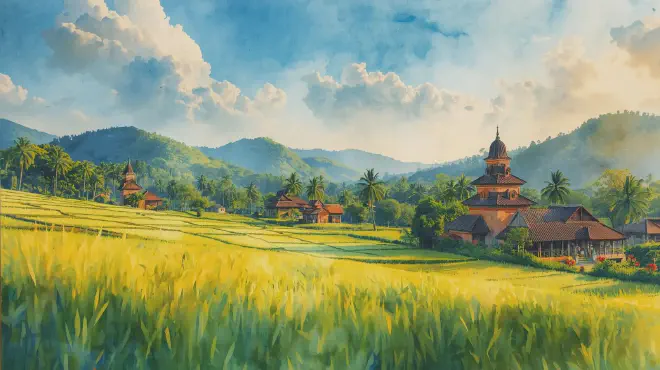
Today I planned to fully enjoy Cianjur’s nature. First I headed to the upper Citarum River region inland. I’d heard beautiful rice terraces spread there. After climbing a mountain road for about thirty minutes by motorcycle taxi, the moment the view opened up, I gasped. Green carpets stretched in steps, continuing to distant mountains. When wind blew, the rice ears swayed like waves.
Beside the terraces ran a small irrigation channel with cold, clear water flowing. A farmer was plowing a rice paddy with a water buffalo. The buffalo moving slowly through the mud, the farmer patting its back and calling out. A scene unchanged for hundreds of years exists here.
A woman from a nearby farmhouse called out asking if I’d like to rest. I sat on a mat spread before her house and drank the tea she offered. Sweetly brewed Javanese tea. In broken English, she taught me about rice cultivation in this land. Three harvests per year, how they’ve protected this land for generations. The way she faced this land with pride and affection left an impression.
Before noon, going deeper still, I reached a small settlement called Cisolok Village. This is a place where traditional Sundanese culture remains strong, I was told. A boy I met at the village entrance agreed to guide me. His name was Adi. He said he was ten years old. When I expressed surprise at his fluent English, he said proudly that he learned it at school.
Adi took me to the village elder’s house. The elder played a bamboo instrument called an angklung for me. Each time the bamboo tubes swayed, a gentle, clear tone rang out. Though simple in structure, multiple pitches layered into beautiful harmony. The elder let me hold one too, and we played together. My performance was clumsy, but the elder’s kindness in teaching me with laughter made me happy.
Lunch was home-cooked village food. Soto ayam (chicken soup), perkedel (potato croquettes), and sayur asam (tamarind sour soup). All had the taste of home, warm and gentle. The soto ayam especially, with its turmeric and lemongrass fragrance, warmed me from the core. After the meal they even brought out pisang goreng (fried banana).
In the afternoon I explored the village. Adi showed me his school, his friends’ houses, the village’s small temple. Though called a temple, it was more like a small shrine with flowers offered. Whenever villagers saw me, they always greeted me with smiles. Foreigners must be rare, but more than that, a culture of welcoming people is rooted here.
In the evening when I left the village, Adi and the villagers waved goodbye. Though it was a short time, I was most happy to have had this warm exchange. When I gave Adi some candy from my pocket, he received it with great joy.
On my way back to the guesthouse, I stopped at the beach again to watch the sunset. The western sky dyed crimson, beautiful in contrast with the black sand. The sound of waves and the sunset. Thinking nothing, just surrendering to that moment. I think such time is necessary in travel.
That night I splurged a little at a nearby restaurant. Gulai ikan (fish curry) and udang bakar (grilled shrimp). Sundanese curry has coconut milk and spices in exquisite harmony, sweetness within the heat. The shrimp were large, the flesh springy. When I finished eating and went outside, a full moon illuminated the sea. Under moonlight, the black sand appeared to shine silver.
Back in my room, I reflected on the day. Meeting people, natural beauty, the warmth of meals. Everything was a memorable day.
Day 3: Farewell, Until We Meet Again
On the final morning, I woke with slightly reluctant feelings. This afternoon I must return to Jakarta. But before that, I wanted to breathe in Cianjur’s air one more time.
After breakfast, I said goodbye to Ibu Sri and headed to the beach. This morning the waves were relatively calm, a quieter sea than usual. I sat down on the sand and gazed at the waves. Scooping up black sand in my hand, I watched it stream through my fingers. In each grain of this sand, long time is carved.
As I walked, one of the fishermen I’d met yesterday called out to me. “Going home already?” he asked, and I nodded. “Come back again,” he said with a smile. Simple words, but that kindness sank into my chest.
Before returning to the guesthouse, I stopped once more at the market. I wanted to buy a few souvenirs. A handmade batik stole, coffee beans, and sambal paste. Each item carrying this land’s fragrance. The market lady gave me a small bamboo-woven basket as an extra. When I tried to refuse, she laughed and said, “It’s a gesture.” I couldn’t resist that smile and gratefully accepted.
In the morning, there was one more place I wanted to visit. A small hill a bit away from the guesthouse. From there you could see the entire town of Cianjur and coastline, I was told. I went by motorcycle taxi and climbed the slope a bit. At the hilltop the wind was strong, palm trees swaying greatly.
Spreading below was the scenery I’d grown familiar with these past days. Black sand beach, blue sea, green countryside. The small townscape. Not glamorous by any means, but certainly people’s lives exist here, history exists, culture exists. The quietude and warmth of this land sank into my heart anew.
Descending the hill and returning to the guesthouse, Ibu Sri had prepared a final lunch. Mie goreng (fried noodles) and es cendol (coconut milk dessert). The mie goreng had sweet-spicy sauce coating the noodles, quite filling. Es cendol is green rice flour noodles with coconut milk and palm sugar poured over, cold and sweet, the perfect dessert for a hot afternoon.
After finishing the meal, I packed my luggage. Before leaving the room, I gazed at the sea from the window one more time. The sound of waves, sea breeze, children’s voices heard in the distance. I wanted to burn everything into memory.
When I said goodbye to Ibu Sri, she grasped my hand and said, “Come back again.” When I answered, “I definitely will,” she smiled happily.
The driver came to pick me up, and I got in the car. As I left the guesthouse, I turned back and waved once more. Ibu Sri waved back from the doorway.
On the road back to Jakarta, watching scenery flow past the window, I ruminated on this journey. Only two nights and three days. But within that brief time, there were so many encounters and discoveries. The black sand beach, green terraces, villagers’ smiles, warmth of home cooking, the angklung’s tones.
Cianjur may be unknown as a tourist destination. But precisely because of that, something remains. Unchanging daily life, simple kindness, culture rooted in the land. Being able to touch such things was this journey’s greatest harvest.
The scenery visible from the car window gradually became more urban. Entering the highway, buildings increased, traffic grew heavier. But in my heart, Cianjur’s wave sounds still echoed.
Certain Memories Within Imagination
This journey is an imaginary trip I never actually took. Yet the land called Cianjur certainly exists, and the black sand beaches, Sundanese culture, rice terraces, and warm people are all there. While writing this, I was enveloped in a sensation as if I’d truly visited.
Travel is a mysterious thing. Actually setting foot there isn’t the only form of travel. Walking a land in imagination, feeling its air, meeting its people. That too may be one form of journey. And I hope that someday this imaginary journey will transform into a real one.
Cianjur’s waves are still breaking now. Village people are still plowing paddies today, catching fish, living with smiles. That ongoing life continues unchanged. Even if imaginary, that fact remains unshaken.
Therefore, this journey certainly existed. In my heart, in memory, I certainly traveled Cianjur. I stepped on black sand, ate nasi goreng, heard the angklung’s tones. And I want to visit again. Next time not in imagination, but with real feet.
Cianjur, Indonesia. A quiet, warm, beautiful land. I hope you too will visit this place someday. Because surely you’ll find something that remains in your heart.