Introduction
Cradled by the flow of the Rhine, Cologne is an ancient city that has witnessed two millennia of history, yet pulses with contemporary vitality. On cobblestone streets that have existed since Roman times, the Gothic masterpiece of the cathedral rises in majestic dignity. Throughout the city, the fragrances of perfume laboratories and breweries drift through the air, while museums showcase avant-garde contemporary art alongside classical paintings in harmonious coexistence.
To visit Cologne is to peel back the layers of European culture one by one. Roman ruins, medieval churches, traces of the Industrial Revolution, and modern creativity all shimmer like light dancing on the Rhine’s surface. These three days in this city would surely become a journey through time itself.
Day 1: Guided by the Cathedral’s Shadow
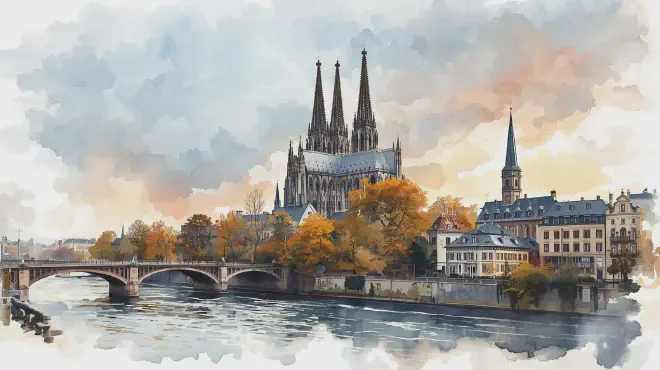
The ICE train from Frankfurt Airport glided into the platform at Cologne Central Station just past eleven in the morning. As I dragged my heavy suitcase through the station concourse, the space suddenly opened up, and the magnificent form of Cologne Cathedral burst into view. Looking up from the station exit at that moment, the twin towers soaring 157 meters seemed to pierce the clouds, and I stopped in my tracks involuntarily.
After checking into my hotel, I naturally headed first to the cathedral. Standing before its facade, I was struck speechless by its overwhelming presence. This building, which took 632 years to complete, was truly the crystallization of human faith and technical skill. Opening the door and stepping inside, I found stained glass in myriad colors glowing in the afternoon light, while stone pillars stretching deep into the nave reached toward the ceiling.
The silence inside the cathedral existed in another world from the bustle outside. Even tourists’ footsteps seemed to be absorbed and vanish into the high ceiling. Before the golden shrine holding the relics of the Three Wise Men, I felt the same emotions as medieval pilgrims must have felt. In a sensation where time seemed to stop, I could feel the thoughts of countless craftsmen who had worked on the construction carved into the stone.
For lunch, I went to “Hansa Stube,” a long-established restaurant near the cathedral. I ordered Sauerbraten, the Rhineland’s vinegar-marinated roast beef. The meat was tender with a subtle sourness that was distinctive, and its pairing with the accompanying Rotkohl (stewed red cabbage) was exquisite. Drinking Kölsch beer while gazing at the cathedral visible through the window, I realized how this great structure had melted into the daily lives of the local people.
In the afternoon, I wandered through the old town. Walking south from the cathedral, Roman ruins were scattered throughout. At the Romano-Germanic Museum, I could see mosaics and sculptures from ancient Roman times. Particularly impressive was the intricate craftsmanship of the Dionysus Mosaic—I marveled at the skill level of artisans from two thousand years ago.
Walking along the cobblestones of the old town, I noticed restoration work being carried out here and there. The effort to preserve old buildings while giving them modern functionality spoke to the city’s deep respect for culture. When I found the bronze statue of the Heinzelmännchen (the little people of legend), I couldn’t help but smile. The imagination and playfulness of Cologne’s people lived on in street corners.
As evening came, I walked along the Rhine promenade. The silhouette of the cathedral reflected on the river’s surface glowed golden in the sunset. Viewing Cologne’s cityscape from the opposite bank revealed a beautiful landscape where old and new architecture harmonized. I felt deeply how this river had continued to support the city’s life from Roman times to the present day.
For dinner, I ate at “Haus zur Deutsch,” a long-established Brauhaus. I savored Himmel un Äd (Heaven and Earth), a traditional Cologne dish. This combination of mashed potatoes, apple puree, and blood sausage struck an exquisite balance between sweetness and saltiness. Surrounded by the voices of locals conversing, tilting my glass of Kölsch beer, the warmth of this city seeped into my heart.
On the way back to the hotel, I looked up at the cathedral one more time in the night. The illuminated twin towers floated against the night sky, radiating a mystical beauty different from the daytime. As a first-day impression, I felt that Cologne was a generous city where past and present naturally coexisted.
Day 2: Wrapped in Fragrance and Art
In the morning, the flow of the Rhine visible from my hotel window glittered in the morning sun. The cobblestones, washed by last night’s rain, gleamed wetly, and the entire city was wrapped in fresh air.
In the morning, I visited Cologne’s proud sanctuary of fragrance. The main store of “4711” on Glockengasse was truly a treasure trove of scents. The birthplace of eau de cologne, continuing since the 18th century—entering the store, I was greeted by a refreshing citrus fragrance. While hearing the story of founder Johann Maria Farina, I toured the perfume blending process. The chemical reaction at the moment bergamot and lemon essential oils mixed together seemed almost magical.
At the Fragrance Museum, I learned about the history and manufacturing process of perfumes. I could trace the evolution of the sentiments people have placed in fragrances from ancient Egypt to the present. Particularly interesting was the display of herbal fragrances made in medieval monasteries, allowing me to understand how scents had melted into people’s lives at that time.
For lunch, I went to “Rhein Garten,” a café along the Rhine. I enjoyed a light meal of Schnitzel (thin fried meat cutlet) and Cologne’s local beer. The flow of the Rhine, viewed from the terrace seating, was gentle, and time passed just watching the ships go by. The voices of a couple quietly conversing at the next table mixed pleasantly with the murmur of the river.
In the afternoon, I visited Museum Ludwig, a temple of modern art. Works by artists representing the 20th century—Picasso, Warhol, Lichtenstein—were on display. Particularly impressive was Gerhard Richter’s abstract painting series; I found myself staring at the depth of color created by layers of paint overlapping.
What moved me most in the museum was the collection of contemporary German art. The works conveyed how German artists had confronted society and history from the postwar reconstruction period to the present. While dealing with heavy themes, their attitude of trying to find hope and beauty within them made me feel the depth of German culture.
Leaving the museum, I stopped by the adjacent Great St. Martin Church. A Romanesque masterpiece built in the 12th century, it possessed a simple beauty in contrast to the cathedral. The capital carvings and murals inside expressed the simple faith of medieval craftsmen, and precisely because I had just seen modern art, that purity stood out all the more.
In the evening, I took a Rhine River cruise. Cologne’s cityscape viewed from the boat showed yet another expression. The twin towers of the cathedral reflected on the water’s surface, and the setting sun beautifully illuminated the facades of buildings. With the wind caressing my cheeks, I felt the greatness of the Rhine that had supported this city’s two-thousand-year history.
Disembarking from the boat, I walked through the back alleys of the old town. Unlike the main streets crowded with tourists, here the lives of local people breathed. The aroma of fresh-baked bread drifting from a small bakery, colorful flowers lined up in front of a flower shop, children’s voices at play—perhaps the true charm of Cologne as a city lay in these everyday scenes.
For dinner, I ate at “Rhein Terrasse,” a restaurant along the Rhine. I savored fish dishes caught fresh from the Rhine. The white fish meunière had a delicate flavor, and its pairing with the lemon and herb sauce was superb. For wine, I chose a white from the Mosel region. Its fruity, refreshing taste enhanced the delicate flavor of the fish dish.
While eating and gazing at the river’s surface, night began to fall. Lights from the opposite bank reflected on the water, creating a fantastical scene. In this moment, I once again felt the multifaceted nature of Cologne as a city. Ancient history, medieval faith, early modern commerce, and contemporary art—all of these harmonized to create this city’s unique charm.
Day 3: A Farewell Morning Etched in Memory
On the final morning, I woke earlier than usual and walked through the city in the morning stillness. The square in front of the cathedral during a time when tourists were still few showed morning dew glittering on the cobblestones, making the cathedral’s majesty stand out even more.
For breakfast, I went to “Alt Köln,” a long-established café near the station. I ordered a German-style breakfast set: fresh-baked rye bread, various hams, cheese, boiled eggs, and rich coffee. The simple yet high-quality taste of the ingredients soothed my travel fatigue. The sight of an elderly man who seemed to be a regular, reading the newspaper while drinking coffee, was a slice of the calm daily life of Cologne’s people.
In the morning, I toured places I hadn’t yet visited. First, I headed to Cologne City Hall. A Gothic-style building constructed in the 14th century, it told of the prosperity of a commercial city during the Hanseatic League era. Climbing the city hall tower, I could overlook Cologne’s downtown. The orderly rows of houses with red tiled roofs with the cathedral towering at their center—the scene was like an ideal image of a medieval city.
Afterward, I visited St. Ursula’s Church in the northern part of the old town. This church is famous for relics related to the legend of St. Ursula and the martyrdom of eleven thousand virgins. The interior “Golden Chamber,” decorated with countless skulls and bones, offered a glimpse into medieval people’s views on life and death. While solemn, an atmosphere filled with compassion somehow pervaded the space.
Before lunch, I strolled through the riverside park along the Rhine. Being a weekday morning, I encountered scenes of local people’s daily lives—joggers, dog walkers, people reading on benches. Sitting on a bench along the river and gazing at the flow for a while, I felt deeply how this river had served as a bloodline for European civilization.
For lunch, I went to Bistro “Zum Kölner” in the old town. As my final meal, I ordered “Kölner Himmel,” a traditional Cologne dish. This combination of pork, mashed potatoes, and apple compote struck an exquisite balance between sweetness and saltiness. While eating, I recalled the faces of the people I had met over these three days.
In the afternoon, as my last bit of sightseeing, I visited the Wallraf-Richartz Museum. This museum is known for its collection of European paintings from the Middle Ages to the 19th century. Viewing masterpieces by Rubens, Rembrandt, Monet, and others, I could trace the flow of European art. Particularly impressive were the altarpiece panels of the Cologne School, where medieval devout faith was expressed in rich colors.
Leaving the museum, I realized my departure time was approaching. Returning to the hotel and packing my luggage, I organized the memories of these three days. The cathedral’s majesty, the Rhine’s leisurely flow, the fragrant scent of perfume, the stimulation of contemporary art, and the warmth of the people I met—each experience wove together as one story in my heart.
On the way to Cologne Central Station, I looked up at the cathedral once more. From the same place, at the same angle as when I first saw it three days ago. But this time, completely different emotions welled up than when I first saw it. This building was no longer merely a tourist site but had become a special place deeply carved into my memory.
While waiting for the train on the station platform, I gazed until the last moment at the cathedral’s form reflected in the window glass. As the departure bell rang and the train slowly began to move, Cologne’s cityscape gradually receded into the distance. Yet the warmth of this city certainly remained in my heart.
What Was Felt Despite Being Imaginary
This three-day experience in Cologne is entirely a story woven in my imagination. I never actually trod those cobblestones, never felt the Rhine’s wind on my skin. I never tasted the bitterness of Kölsch beer on my tongue, never heard the cathedral’s bells with my ears.
Yet, in tracing this fictional journey, I truly felt the breathing of the city called Cologne. The weight of two thousand years of history, the eternal flow of the Rhine, the rich fragrance of perfume, the creativity of contemporary art, and the warmth of its people—all of these reached my heart through a bridge called imagination.
Perhaps travel doesn’t necessarily require physical movement. Perhaps the true destination of travel is where the heart goes, where imagination takes flight. By imagining the multifaceted charm of the city called Cologne, I truly visited there and lived through time spent there.
Hoping that this imaginary journey might someday lead to a real one, I close this record. Believing that the people I met in my imagination, the food I tasted, and the scenery I felt will continue to shine forever in my heart.