
Fragments of Time Carried by the Río de la Plata
Colonia del Sacramento sits at the southwestern edge of Uruguay, a small historic town gazing across the Río de la Plata toward the lights of Buenos Aires on the opposite shore. Founded by the Portuguese in 1680, this city has witnessed sovereignty change hands between Portugal and Spain time and again, with that complex history quietly etched into its cobblestone alleys and ancient buildings.
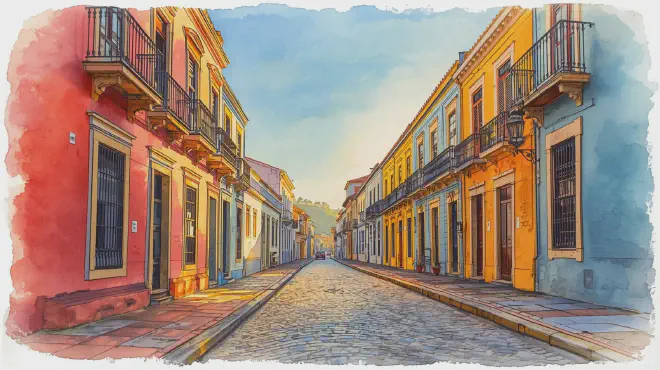
The Old Quarter, registered as a UNESCO World Heritage site, presents an appearance as if time itself has stood still. Colonial-era houses painted in pale pink, soft yellow, and blue are adorned with cascading bougainvillea. The cobblestones are laid irregularly, and after rain, puddles mirror the sky, gently echoing the footsteps of passersby. Beyond the town stretches the vast Río de la Plata, its surface turning golden at dusk, evoking the unique nostalgia this land possesses.
The people are gentle, and time flows leisurely. Though less than an hour by ferry from Argentina, Colonia maintains a tranquility that stands in stark contrast to urban clamor. People strolling along the riverbank with mate in hand, an elderly man reading the newspaper on a plaza bench, friends chatting while sitting on stone steps—such fragments of daily life bring deep peace to the hearts of visitors.
Day 1: Footsteps on Cobblestones and an Evening Wrapped in River Breeze
At 8 AM, I boarded a Seacat ferry from Buenos Aires’ Puerto Madero. The Río de la Plata was wider than I’d imagined, stretching to the horizon like an ocean. Perhaps it’s more accurate to call it a massive estuary than a river. As I sipped a cortado (espresso with a small amount of milk) in the cabin, watching the brownish water surface, the port of Colonia came into view after about an hour.
Stepping off at the port, I immediately felt the special atmosphere of this town. The urban bustle of Buenos Aires was absent here; instead, a gentle sea breeze and somehow nostalgic silence welcomed me. Even during the short taxi ride to the Old Quarter, the town’s compact scale and beautiful architecture left a strong impression.
My accommodation was a small boutique hotel in the heart of the Old Quarter, “Posada Plaza Mayor.” This hotel, converted from an 18th-century building, featured rooms with exposed stone walls and wooden beams, and from the window I could see a small cobblestone square. After dropping off my luggage, I immediately set out to explore.
I spent the morning slowly walking through the Old Quarter. My first destination was the “Portón de Campo,” a stone gateway that was once part of the city wall. This gate marks the entrance to the Old Quarter, and passing through it, a different world truly unfolds. The cobblestone street “Calle de los Suspiros” (Street of Sighs) is lined with colonial-style houses on both sides, their walls painted in beautiful shades of pale pink and soft blue.
Particularly impressive was the area around the “Portuguese Museum.” Here, buildings from the 17th-century Portuguese rule remain intact, with thick stone walls and small windows that invite imagination about the lives of people from that era. The museum’s exhibition rooms displayed colonial-era furniture, ceramics, and old maps, clearly illustrating that this town had been an important stronghold in the Río de la Plata basin.
I had lunch at a small restaurant facing the square, “El Bistró.” When I ordered the Uruguayan specialty asado (charcoal-grilled meat), tender beef arrived with the fragrant aroma of charcoal. The accompaniments—ensalada rusa (Russian salad) and papas bravas (spicy potatoes)—were simple yet delicious. Paired with a local Tannat wine, the deep flavors nurtured by Uruguay’s rich soil spread through my mouth.
In the afternoon, I walked along the riverside promenade, “La Rambla.” From here, the high-rise buildings of Buenos Aires are faintly visible across the Río de la Plata. Along the river stands an old lighthouse, “Faro de Colonia,” its white cylindrical structure one of the town’s symbols. Climbing the lighthouse, the red tile roofs of the Old Quarter appeared as a beautiful patchwork, and beyond them, the water surface seemed to stretch infinitely.
In the evening, I returned to the Old Quarter and sat on a bench in “Plaza Mayor,” a small square. This is the town’s center, surrounded by an old church and cafés. Watching local people chatting while drinking mate, I truly felt time flowing slowly. An elderly man sat next to me and spoke in Spanish. His name was Carlos, and he had been born and raised in this town. As we exchanged words in my broken Spanish, he spoke about the town’s charm. “Colonia is a small town, but it’s a place where hearts grow larger,” he said—words that left a deep impression.
For dinner, I went to a riverside restaurant, “La Costa.” When I ordered grilled dorado (a type of golden fish caught locally in the river), it was a wonderful dish where, though simple, the natural sweetness of the fish could be felt. The dessert, dulce de leche ice cream, had a rich flavor that spoke to Uruguay’s abundant dairy farming.
After the meal, I strolled through the Old Quarter at night. The cobblestones and old buildings illuminated by streetlights showed a different expression than during the day. Particularly “Calle de los Suspiros” had dim lights creating a mystical atmosphere, making me feel as if I’d time-slipped to the 18th century. The sound of tango carried on the night breeze from the distance, and feeling the romantic charm this town possesses, I returned to the hotel.
Day 2: A River Wrapped in Morning Mist and People in Patches of Sunlight
Around 6 AM, I woke to the sound of birds outside the window. Opening the curtains, I saw the cobblestone square wrapped in soft morning light. I decided to wake early and take a walk along the river.
The morning Rambla was quiet, with only a few joggers and dog walkers here and there. A thin mist hung over the Río de la Plata, and Buenos Aires on the opposite shore appeared hazy. The river at this time of day was especially beautiful, its surface mirroring the sky like glass, with occasional water birds creating ripples as they flew by. I sat on a riverside bench and gazed at this tranquil scene for a while.
I had breakfast at an old café near the hotel, “La Amistad.” This family-run café, operating since the 1920s, has old photographs and paintings decorating its interior. When I ordered medialunas (croissants) and café con leche, the fragrant aroma of butter and rich milk flavor elegantly opened the morning. The owner, María, was a friendly woman who told me in detail about the town’s history and attractions.
In the morning, I explored the “Bastión del Sur” district on the eastern side of the Old Quarter. This is an area not often visited by tourists, where you can catch glimpses of more local people’s daily lives. Laundry hangs in narrow cobblestone alleys, and small shops and workshops line the streets. At the workshop of Pedro, a leather craftsman, I was allowed to observe him making handmade wallets and belts. The leather goods crafted carefully by his hands were wonderful items that would gain character with use.
Lunch was at “Parrillada La Rueda,” popular with locals. Here I tasted the traditional Uruguayan dish “chivito.” Chivito is a sandwich with thin-sliced beef, lettuce, tomato, egg, cheese, and more—substantial in volume but surprisingly light. Enjoyed with the local beer “Patricia,” it became a simple yet satisfying meal.
In the afternoon, I ventured a bit further to visit the “El Real de San Carlos” district, about 3 kilometers from the Old Quarter. This is the ruins of a resort area built in the early 20th century, where a now-abandoned hotel and bullring remain. Particularly impressive was the ruins of the “Hotel Casino” built in 1910. Once flourishing as one of South America’s premier resort hotels, this building is now covered in ivy, with greenery peeking through the windows. In this place where the beauty of ruins and stories of rise and fall intersect, I was made to contemplate the passage of time.
In the evening, I returned to the Old Quarter and visited a small square called “Plaza de Armas.” Here stands the “Matriz Church” built in the 18th century, an impressive building with white walls and blue doors. The church interior is austere, but the wooden altar is beautiful, and the quiet space brings peace to the heart. Beams of light shining through the windows where the setting sun streamed in created a sacred atmosphere.
In front of the church, a local artist was painting. His name was Diego, a painter who depicted Colonia’s landscapes in watercolors. His works expressed the town’s beauty with delicate touches, and I was particularly impressed by a piece depicting cobblestones at dusk. When I purchased a small painting, he smiled happily and said, “May this become your memory of Colonia.”
For dinner, I went to “La Florinda,” a restaurant with an especially pleasant atmosphere in the Old Quarter. This restaurant, converted from an old mansion, has tables arranged in a courtyard. The Uruguayan-style paella “arroz con mariscos,” eaten under the stars, used abundant local seafood, filling my mouth with the aroma of the sea. While drinking cognac after the meal, I enjoyed conversation with other guests in the courtyard. An elderly couple from Argentina, a young couple from France, and a family from Uruguay. Time spent discussing Colonia’s charm across nationalities and ages was one of the trip’s great pleasures.
Day 3: A Morning of Farewell and Light on the Water That Remains in My Heart
On the final morning, I woke a bit early and walked along the river once more. Unlike yesterday, this morning was clear, and the Río de la Plata shone blue. Local fishermen were casting lines around the lighthouse, spending a leisurely morning. Talking with one fisherman, Juan, he taught me in detail about the river’s fish. This river is home to various fish like dorado, surubí, and pacú, and the fish you can catch change with the seasons.
Breakfast was again at “La Amistad.” This time I ordered tostadas (thick-sliced toast) spread with mermelada de durazno (peach jam) and fresh orange juice. Uruguay’s peach jam has modest sweetness, allowing the natural sweetness of the fruit to be felt. María said, “Please come back again,” seeing me off warmly.
In the morning, I visited the “Casa Nacarello” museum, which I hadn’t yet seen. This is the former residence of 19th-century Uruguayan politician Fructuoso Nacarello, converted into a museum where you can learn about the lifestyle of the upper class of that era. Particularly impressive were the beautiful tiled floors and furniture imported from Europe. The garden was also magnificent, with jasmine and roses in full bloom and a small fountain quietly making the sound of water.
Afterward, I browsed several souvenir shops in the Old Quarter. Handmade ceramics, leather goods, wool sweaters, and locally produced wine—items characteristic of Uruguay lined the shelves. I was especially taken with a small vase made by a local potter, whose irregular pattern was said to be inspired by Colonia’s cobblestones.
For lunch, I savored my last Uruguayan meal at the riverside “Restaurante El Faro.” Here I ordered “cordero al asador” (spit-roasted lamb). The lamb meat, slowly roasted over charcoal, was surprisingly tender, with the aroma of rosemary and garlic whetting the appetite. The side dish “puré a la provenzal” (potatoes seasoned with garlic and parsley) was also exquisite. Finally, when I had Uruguay’s representative dessert “chajá” (custard pudding), its gentle sweetness filled my heart, befitting the end of the journey.
In the afternoon, after packing and checking out of the hotel, I enjoyed a final walk until ferry time. I walked “Calle de los Suspiros” once more, confirming the texture of the cobblestones with my feet while looking back on these three days of memories. The beautiful buildings appearing at every turn, flowers decorating the windows, shadow patterns drawn on stone walls—everything was being etched into memory.
On the way to the port, I happened to meet Diego, the painter I’d encountered yesterday. He was painting a new work, this time a landscape of the lighthouse and river. “Colonia is always waiting for you,” he said—words that softened the sadness of parting.
At 4 PM, I boarded the ferry. The view of Colonia from the deck was beautiful like a postcard, especially the red tile roofs of the Old Quarter shining in the sunset. The lighthouse also grew smaller, eventually melting into the horizon. As the boat passed the middle of the river, looking back, Colonia had become just a small point, but its beautiful memories remain firmly in my heart.
As we approached Buenos Aires, I could feel the urban clamor returning, but the quiet, peaceful time spent in Colonia will surely remain deep in my heart for a long time. Drinking coffee in the cabin while gazing at the small painting I’d purchased, I felt as if I were still standing on those cobblestones.
What Felt Real Despite Being Imaginary
The two nights and three days in Colonia del Sacramento were a precious experience where time flowed slowly. It reminded me of the importance of simple beauty, warm human connections, and quiet time to face oneself—things easily forgotten in modern busy life.
With each step on the cobblestone alleys, I felt the weight of history this town carries, yet also its lightness that never feels oppressive. This town, where Portuguese and Spanish cultures mixed and sublimated into Uruguay’s unique culture, was like a small gem of South America.
What remains especially in my memory is the warmth of the people. María, Carlos, Pedro, Diego, Juan. Each encounter made this journey special. Being able to connect hearts beyond language barriers may have been thanks to the embracing power Colonia possesses.
The vastness of the Río de la Plata is also unforgettable. This body of water, more magnificent like an ocean than a river, is both part of daily life for Colonia’s people and an existence that evokes infinite possibilities. The river surface wrapped in morning mist, the horizon dyed by sunset, the night water reflecting the starry sky—each showed different expressions, enriching the hearts of those who see them.
Regarding the cuisine, I was impressed by the simple, deeply nourishing flavors that made the most of quality ingredients. Asado, dorado, chivito, cordero—every dish conveyed the blessings of the land and the love of those who prepared it. Especially the local Tannat wine was a masterpiece born from Uruguay’s rich soil and climate.
Though this journey is fictional, it remains in my heart as a vivid memory, as if I had actually visited that place, breathed that air, and walked that ground. This is probably because Colonia del Sacramento possesses universal beauty and something that resonates with the human heart. The sound of cobblestones, the scent of river breeze, people’s smiles, the color of sunset—all these combined to create a journey that, though imaginary, feels as if it truly happened.
Hoping that someday I will truly visit this town, I will carefully keep the memories of these three days in Colonia deep in my heart. And from time to time, I will take out those memories and recall that quiet, beautiful time.