
A White Town Standing on the Hill of Windmills
Consuegra is a small town of roughly ten thousand inhabitants, located in the Castilla-La Mancha region of central Spain. About ninety minutes by car southeast of Madrid, its white-walled houses huddle together on a hill overlooking the great plain of La Mancha.
What draws visitors from around the world to this town is the presence of twelve windmills standing along the ridge of the hill. Known as the windmills that appear in Cervantes’ Don Quixote, these white cylindrical structures crowned with reddish-brown roofs against a blue sky have become the iconic image of the La Mancha region. Once used to grind wheat, these windmills still preserve their original form, conveying the essence of medieval times to all who visit.
The town’s history runs deep. At the summit of the hill stand the ruins of a castle built in the twelfth century. During the era when Islamic and Christian forces clashed, this location served as a crucial defensive stronghold. The stone walls have endured centuries of wind and rain while standing firm, and the view of the plain from atop them remains unchanged from what the knights who once defended this land would have seen.
The name La Mancha is said to derive from an Arabic word meaning “dry land.” Indeed, this region receives little rainfall throughout the year, suffering scorching summers and harsh winters. Yet from this severity, a distinct culture has been nurtured—saffron cultivation, olive and grape farming, and the shepherding tradition. The simple yet resilient way of life of the La Mancha people continues to this day.
I decided to visit this town after seeing a photograph in a book—windmills silhouetted against an evening sky. The sky was burning orange, and the windmills rose as dark shapes against it. That serene beauty stirred in me a longing to escape to somewhere far removed from daily life. I chose late October, when tourists begin to thin out, and set off alone for Consuegra.
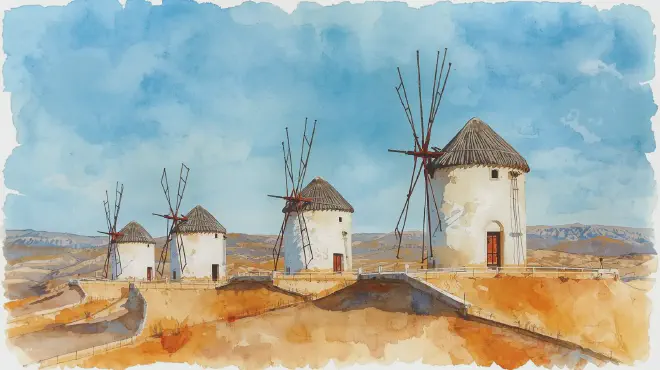
Day 1: Guided by the Wind
I arrived in Consuegra just after noon, having taken a train from Madrid’s Atocha Station and then transferred to a bus. Stepping off at the bus stop, the sunlight, still strong despite it being October, stung my skin. The air was dry, and taking a deep breath left a faint burning sensation at the back of my throat. Above stretched a cloudless blue sky. This, I realized, was the sky of La Mancha.
I walked up the cobblestone slope toward the town center. The white-walled houses had their window frames and doors painted blue or green, with potted geraniums adorning the walls. In the afternoon stillness, the distant sound of church bells reached my ears. With each turn of a narrow alley, the windmills appeared and disappeared from view ahead. It was as if they were calling to me.
My accommodation was a small hostal tucked in a corner of the old town, a modest family-run inn. After setting down my luggage and opening the window, I could hear a woman humming as she hung laundry in the neighboring courtyard. The sounds of everyday life. Hearing such sounds in a new place always gives me a sense of settling into the rhythm of that land.
After resting a while, I decided to head for the hill of windmills. From the town center, it was about a fifteen-minute walk. As I climbed the gentle slope, the view gradually opened up. Looking back, the white townscape spread out below me, and beyond it, the plain extended endlessly. Wheat fields and olive groves alternated across the vast land all the way to the horizon. The sheer expanse of it made me stop and catch my breath.
Each of the twelve windmills standing atop the hill has been given a name—Sancho, Rocinante, Chispero—names from Don Quixote’s story. Up close, the windmills were larger than I had imagined, their white walls weathered from years of wind and rain. Several had their interiors open to visitors, where millstones and wooden gears still remained. Stepping inside, I was met with cool air and the old scent of wood.
The most memorable was the windmill named Sancho. Here, an exhibit explained how the windmills worked, and old photographs hung on the walls. In one black-and-white image, a miller from the days when the windmills were still in operation gazed sternly at a millstone. In his profile, I seemed to see both the hardship and the pride of living on this land.
Stepping outside, the wind had grown stronger. The wind of La Mancha blows relentlessly, whipping hair and flapping clothes. It was this very wind that made the windmills function. The millers of old would read this wind, adjusting the angle of the blades to grind their wheat. The lives of people who conversed with nature seemed to come alive again in the sound of the wind.
I walked on to the castle ruins. Climbing the stone steps, crumbling walls and a tower came into view. Wild rosemary grew from cracks in the walls, bearing small purple flowers. Standing atop the walls, a three-hundred-sixty-degree panorama unfolded—windmills to the north, the town to the south, and the endless plain stretching east and west. What had the medieval knights seen from this place? Watching for approaching enemies, striving to protect this land—I felt as though I was tracing their gaze.
As evening approached, the western sky began to turn orange. The silhouettes of the windmills grew darker by degrees. Other visitors stood about, some with cameras raised, others simply gazing at the scene in silence. Though no words were exchanged, there was a strange sense of connection among those moved by the same beauty.
The moment the sun touched the horizon, the sky blazed crimson. The windmills became pure silhouettes, floating against the sky like shadow puppets. The scene was more magnificent, more fleeting, than any photograph could capture. Beautiful things always pass in an instant. Perhaps that is why we travel.
Descending the hill and returning to town, streetlamps were beginning to light. For dinner, I went to a small bar recommended by my innkeeper. Inside the stone building, the dim interior revealed local men seated at the counter. The menu was filled with dish names I couldn’t read, so I gestured to the owner, asking for “something from this land.” He nodded with a smile.
What arrived was pisto, a vegetable stew, along with Manchego cheese and a platter of Ibérico ham. Pisto is a humble dish of tomatoes, zucchini, and peppers stewed in olive oil—the sweetness of the vegetables filled my mouth. Manchego cheese, made from sheep’s milk, is a local specialty—rich yet with a clean finish. The ham was sliced thin and melted on the tongue.
When I ordered a glass of wine, local red wine was poured. La Mancha is also wine country. The wine had a robust character, conveying both the harshness and the abundance of this land. As I ate slowly, I listened to the conversations of the men at the counter. Though I couldn’t understand Spanish, the laughter and gestures told me they were enjoying talk of everyday matters.
Walking back to the inn, I looked up to find the sky filled with stars. With few streetlamps in this town, the stars shone remarkably bright. Even the Milky Way was clearly visible. Had Don Quixote and Sancho Panza looked up at this same sky? Beneath these stars, the world of the story and reality seemed to merge.
Day 2: A Morning Touching the Land and Its People
I woke the next morning to birdsong. Opening the window, cool air flowed in. The sky was still a pale purple, the eastern horizon slowly brightening. Breakfast in the small dining room downstairs consisted of fresh bread with olive oil and tomato spread—pan con tomate—and café con leche. Simple, but the quality of the ingredients made it deeply satisfying.
I had decided to spend the day walking leisurely through the town. In the early morning hours, before tourists appeared, I could glimpse the lives of the local people. In the central Plaza, a market was underway. Vegetables, fruits, cheese, olives, wine, honey—all spread out for sale. The women vendors called out loudly to customers, chatting warmly with regulars.
At one stall, I found saffron. La Mancha is famous for saffron cultivation. The deep red threads were displayed in small glass bottles. The elderly shopkeeper told me “Muy caro”—very expensive—but knowing that this precious spice is harvested by hand, I made the purchase. She beamed and said “Gracias,” then gave me a small bag of almonds as a gift.
Leaving the market, I headed for the town church. The Church of San Juan Bautista was built in the thirteenth century. Pushing open its heavy doors, light streaming through stained glass painted colorful patterns on the floor. In the silent, empty space, I sat on a wooden pew. Time flows slowly here. Those who come to pray, those who simply sit to savor the stillness—this place seemed to welcome all equally.
Leaving the church, I noticed an old man painting nearby. He had set up a small easel and was rendering the windmill-dotted landscape in watercolor. When I peered over, he smiled and said, “Bonito, no?"—Beautiful, isn’t it? I answered in halting Spanish, “Muy bonito.” He nodded, pleased. Even without shared language, the joy of appreciating beauty together can be understood.
For lunch, I went to a restaurant called El Alfolí, recommended by my innkeeper as known for carefully prepared local cuisine. Inside the stone building, the atmosphere was calm, with old farming tools displayed on the walls.
The menu featured traditional dishes of La Mancha. For a starter, I ordered migas manchegas—stale bread crumbled fine and fried with garlic and chorizo. A dish born of the shepherds’ wisdom, wasting nothing. The plate arrived fragrant with garlic and olive oil. The crisp texture mingled with the savory chorizo—humble yet deeply flavorful.
For the main course, cordero asado—roast lamb. La Mancha is shepherding country, and lamb dishes are traditional. Slowly roasted in the oven, the lamb was tender, infused with herbs. With each bite, the meat’s sweetness spread, and I felt the reality of receiving the life of a sheep raised on this land.
For dessert, I had flores manchegas, a traditional pastry of fried wheat and egg dough drizzled with honey. Simple, but the gentle sweetness was perfect after the meal. Sipping espresso, I gazed out the window. Afternoon light illuminated the white walls as a cat crossed the street. Everything moved slowly, peacefully.
In the afternoon, I ventured a bit farther, exploring the area around town. Borrowing a bicycle from the inn, I rode along narrow paths through the olive groves. The wind brushed my cheeks. On either side, low olive trees stood in orderly rows, their silvery leaves rustling. Occasionally a white farmhouse appeared in the distance, and I could hear dogs barking.
I stopped the bicycle beside the fields and rested under an olive tree. Sitting on the ground, I could smell the earth—dry soil, withered grass, and faintly, the scent of olives. I pulled a water bottle from my pocket and drank. No one was around. Only the sound of wind and distant birdsong. In this stillness, I felt myself growing smaller, yet simultaneously becoming one with the land—a strange sensation.
After a while, I spotted an elderly couple working in the fields. They appeared to be harvesting olives. When I greeted them, they paused their work and smiled back. The woman said something while plucking an olive and holding it out to me. I accepted it and put it in my mouth—an intense bitterness spread. I must have made a face, because both of them burst out laughing. Raw olives cannot be eaten as they are. This small exchange felt like communication beyond words.
Before returning to town in the evening, I climbed the windmill hill once more. A different time, a different light. The same place takes on new expressions depending on when you visit. Today the wind was gentle, and the windmill blades turned slowly. I sat on the grass of the hill and watched the sun sink into the plain.
A young couple sat nearby, gazing quietly at the view. A little farther off, an elderly man stood alone, leaning on his cane. Each of us was looking at this scene with our own thoughts. Some in the midst of a journey, some gazing at their homeland, some sensing the twilight of life. The hill seemed to welcome everyone equally.
For dinner, I went to a different bar from the night before—a livelier place where young locals gathered. I ordered several tapas and stood drinking at the counter. The man beside me struck up a conversation in English. He was home for the weekend from Madrid. “How do you like Consuegra?” he asked. When I replied, “It’s beautiful,” he smiled with pride. “It’s my hometown.”
At his suggestion, I visited a small bodega—a wine cellar—known only to locals. An old building at the end of a narrow alley. Inside, barrels lined the walls, and the rich aroma of wine filled the air. Most of the wine made here is consumed locally, he explained. Poured directly from the barrel, the wine had a rough yet powerful character, different from what I had drunk the night before.
The bodega’s owner was a taciturn old man who said little, yet his hands as he poured the wine conveyed pride and affection. Grapes grown on this land, water from this land, the hands of this land’s people—all distilled into a single glass of wine. Tilting my glass, I thought about what it means to travel. To visit unfamiliar places, to meet the people who live there, to taste the flavors of that land. It is not mere sightseeing, but feeling the world’s diversity with one’s own body.
Day 3: Farewell and What I Carry Home
On the final morning, I woke with a touch of sadness. Only two days had passed, yet I already felt nostalgic for this town. Such is the strange nature of travel. Even a short time, when deeply engaged, leaves its mark on the heart.
After breakfast, I went out for one last walk before checking out. I wandered the cobblestones still damp with morning dew, taking in the town once more. The familiar white walls, the potted flowers, the cat sunning itself in the plaza—all felt dear to me. I didn’t raise my camera, only tried to imprint it all in my eyes. What photographs cannot capture—the scent of the air, the temperature, the feel of the wind—these are the true essence of travel.
Back at the inn, the owner’s wife said wistfully, “Leaving already?” The warmth in her words, “Mata ven”—come again—was genuine. A small inn in a small town, yet here was true human warmth. As I stepped out with my luggage, I turned and said “Gracias.” She waved with a smile.
With some time before my bus, I headed once more to the windmill hill. In the morning light, the windmills wore a different expression from the days before. Standing atop the hill, I surveyed the land. This vast plain, this transparent sky, this relentless wind. All of it was La Mancha.
Don Quixote charged at these windmills, convinced they were giants. It might be called madness, but he lived in the world he believed in. The line between reality and imagination is always blurred. We all live our own stories. And standing on this hill, everyone can feel, for a moment, like a knight.
I touched one of the windmills. The rough white wall had weathered hundreds of years. What this wall had witnessed—war and peace, abundance and famine, joy and sorrow. All of human endeavor. That weight seemed to pass through my palm.
Descending the hill, I walked to the bus stop. At the edge of town, I passed the elderly woman from the market. She remembered me and called out, “Buen viaje”—safe travels. In a small town like this, such encounters are born.
I boarded the bus and took a seat by the window. The engine started, and the bus slowly began to move. Outside the window, the townscape of Consuegra flowed past—the white houses, the church tower, and the windmills on the hill. I watched them grow smaller until my vision blurred.
The bus traveled the road across the plain. Fields stretched on either side, farmhouses dotted the landscape, windmills stood in the distance. The horizon went on forever. Into this scenery, my memories of two days dissolved—what I ate, what I saw, the people I met, the wind I felt. All of it remained within me as a single story.
A Memory That Feels Real Within Imagination
This journey does not actually exist. I have never been to Consuegra. I have never taken a bus from Madrid, never stood on the windmill hill. I never met the elderly woman at the market, never drank wine in the bar. Everything happened only in imagination.
Yet strangely, this journey exists within me with certainty. The feel of touching the windmill, the aroma of migas manchegas, the force of the La Mancha wind, the color of the evening sky—all are vivid, as if truly experienced.
Humans are creatures of imagination. We envision places we have never been, imagine people we have never met, dream of flavors we have never tasted. And sometimes, that imagination becomes more real than reality itself. Just as Don Quixote believed windmills were giants, we can live in the worlds we create.
The essence of travel is not only in moving through space or visiting new places. It is the stirring of something within the heart, the broadening of perspective, the shift in our relationship with the world. And that can happen even without physical movement.
Even from an imaginary journey, there is something to be gained. Interest in lands unknown, understanding of different cultures, thoughts of people living far away. Perhaps someone reading this will want to visit Consuegra someday. Or perhaps they will begin a new journey within themselves.
The boundary between imagination and reality is not as clear as we might think. All our experiences exist only as “memories” reconstructed in the brain. What we actually traveled and what we imagined traveling are ultimately stored in the same realm of memory. What matters is what those memories bring to us.
The windmills of Consuegra stand on that hill today. They stand quietly, receiving the wind of La Mancha. Perhaps one day I will truly stand in that place. Or perhaps I never will. But this imaginary journey exists within me with certainty, and it will remain with me as a small treasure.
The journey has ended, but the story continues.