
A City Where Sea, Hills, and Historical Memories Converge
On a map, Dalian appears like a bird about to take flight into the sea, jutting out from the tip of the Liaodong Peninsula into the Yellow Sea. This port city carries a complex history—once leased by Russia, later governed by Japan, and finally returned to China. Layers of different eras are stacked upon one another here.
Walking through the streets, you encounter Russian stone architecture alongside red brick buildings from the Japanese colonial period and modern Chinese high-rises, all coexisting without discord. The hilly terrain evokes memories of Hakodate or Nagasaki, and the salt-tinged breeze carries a certain nostalgia. Despite being the gateway to Northeast China, Dalian enjoys a temperate climate—a summer resort when hot, and relatively mild even in winter.
I wanted to visit this city not merely to tour its sights, but to witness with my own eyes the overlapping histories and the lives of people who continue forward despite it all.
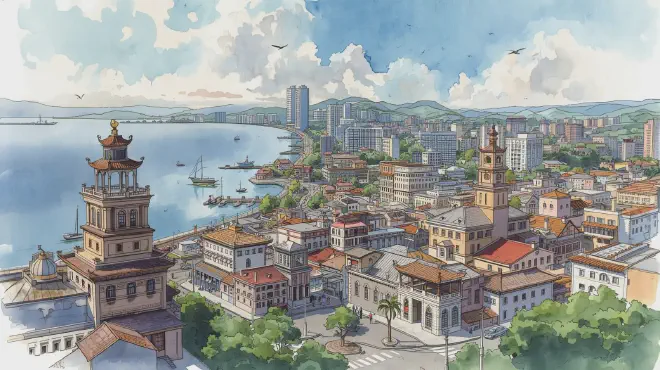
Day 1: Greeted by the Sea Breeze
I arrived at Dalian Zhoushuizi International Airport in the early afternoon. Stepping outside, the air was gentler than I had imagined. Late October in Dalian marks the deepening of autumn, yet the maritime wind, carrying its characteristic moisture, was neither too cold nor uncomfortable—just right.
The view from the airport bus window surprised me with its abundance of greenery. Street trees lined up in neat rows, with small parks dotting the landscape here and there. I would later learn that Dalian is called the “City of Acacias,” but at this moment, I simply found myself impressed by the clean, orderly cityscape.
I stayed at a small hotel near Zhongshan Square, housed in a renovated old building. After dropping off my luggage, I immediately set out to explore. The afternoon light still held, giving me ample time to wander.
Zhongshan Square is a circular plaza where radiating roads, constructed during the Russian lease period, converge. Standing at its center, ten streets extend in all directions. The surrounding buildings—the former South Manchuria Railway headquarters, the old Yokohama Specie Bank Dalian branch, and others over a century old—gradually took on a soft glow as twilight approached.
On a bench in the square, elderly men played Chinese chess while a small crowd gathered around them. Voices rose each time someone made a clever move. I stood at the edge of the circle, watching for a while. Though I couldn’t understand the words, the tension of the game and the intimacy among friends came through clearly.
For dinner, I entered a small dumpling restaurant near the square. The sign read “Laobian Jiaozi.” Dalian claims to be the birthplace of dumplings, with dumpling shops scattered throughout the city. Inside, the place bustled with locals.
Pointing at the menu, I ordered fennel dumplings (huixiang jiaozi), garlic chive and egg dumplings (jiucai jidan jiaozi), and hot and sour soup (suanla tang). The dumplings that arrived had thinner wrappers than I expected, the filling visible through the translucent skin. Taking a bite, the distinctive aroma of fennel filled my mouth. This herb, uncommon in Japan, strangely harmonized with the savory filling.
Leaving the restaurant, dusk had already fallen. Walking back toward Zhongshan Square, the illuminated buildings revealed a different expression than in daylight. This streetscape—a mixture of Russian, European, and Japanese influences—stands as witness to a complex history, yet now simply offers beautiful night scenery for people to enjoy.
On my way back to the hotel, I found a small bookstore and stopped in. I have a habit of visiting bookshops when traveling. I picked up a photo book about Dalian’s history and flipped through it. The black-and-white Dalian in those photographs felt somehow continuous with the city I had just walked through, yet simultaneously like a distant world.
Back in my room, I opened the window to catch the scent of the sea somewhere in the distance. Checking the map, the harbor was only about ten minutes on foot. I decided to walk along the waterfront tomorrow, and with that thought, I ended my first night.
Day 2: Walking the Coast, Touching Lives
In the morning, the hotel breakfast was simple but included warm soy milk (doujiang), fried dough sticks (youtiao), and xiaolongbao. Dipping the youtiao into the doujiang—a staple of northern Chinese breakfast, I’d heard—tasted simple yet satisfyingly delicious when I actually tried it.
Today, I planned to trace the coastline from Xinghai Square toward Laohutan Ocean Park. I left the hotel and took a tram to Xinghai Square. The cityscape visible through the windows differed from yesterday’s old district, with modern high-rises standing tall.
I reached Xinghai Square around ten in the morning. This plaza, said to be the largest in Asia, overwhelms with its sheer size. At the center stands a massive white marble huabiao (traditional Chinese pillar), surrounded by footprint reliefs symbolizing different eras embedded in the ground. Looking seaward, the blue ocean spreads out, with cargo ships passing in the distance.
In the square, families flew kites, elderly people practiced tai chi, and young people enjoyed roller skating—each absorbed in their own activities. I began walking along the coastal promenade. The sea breeze blew strong, tossing hair across my face. The blue of the sea and sky melted together, their boundary becoming ambiguous.
After walking the promenade for about an hour, I came upon an area resembling a small fishing village. Shops displayed dried fish, an old man mended nets, vendors sold freshly caught seafood from the harbor. Here was the scent of daily life, not yet touristified.
At one stall, a woman held up a large crab, saying something to another customer who seemed to be asking about the price. As I watched their exchange, the woman noticed me and beckoned with a smile. Though we shared no common language, she lifted up the crab to show me. A fine swimming crab (suozi xie). When I gestured to indicate I had no way to cook it, she nodded understandingly, yet continued chatting in a friendly manner. The warmth in her voice made me smile back.
I decided to have lunch at a small eatery I found in that fishing village. I ordered stir-fried seafood noodles (haixian chaomian) and garlic steamed scallops (suanrong zheng shanbei). The dishes that arrived looked unpretentious, but the umami of fresh seafood came through strongly. The steamed scallops especially, with their garlic-infused sauce enhancing the sweetness of the shellfish, kept my chopsticks moving.
After the meal, I resumed walking. The afternoon sun grew a bit stronger, bringing a light sweat to my forehead. Just before Laohutan Ocean Park, I found a road leading to Bangchui Island. The island, named because its shape resembles a washing stick, is actually a connected peninsula known for its rocky coastline and clear waters.
On the path to the island, I passed through a pine forest. The scent of pine mingled with the sea breeze. Emerging at a small beach, I saw several locals fishing from the rocks. I sat down on a boulder and gazed at the sea for a while. Waves crashed against the rocks, shattering white. Dalian’s cityscape, visible in the distance, felt like another world from this quiet place.
After spending an hour or so lost in thought here, I decided to return to the city center. In the evening, I visited Russian Street. This area, which recreates imperial Russian architectural styles, features colorful buildings lining cobblestone streets. Souvenir shops, cafes, and restaurants stand side by side, and at dusk, the street carries a nostalgic atmosphere.
For dinner, I entered a Russian restaurant. I ordered borscht, piroshki, and Russian black bread. Through the meal, I felt Dalian’s multilayered character. The deep red of the borscht and its subtle sourness. The meat juice spilling from the piroshki. Outside the window, illuminated Russian-style buildings created the illusion of wandering into a foreign land.
Walking back to the hotel, I reflected on the many faces of Dalian I had witnessed today. The modern square, the traditional fishing village, the quiet island, and streets filled with exotic charm—all coexisting within a single city. This depth of character deepened my fascination with the place.
Day 3: Morning of Departure and What Remains
On my final morning, I woke a bit early. There was a place I wanted to visit once more while the city still slept. Lüshunkou.
Located about forty kilometers southwest of Dalian, Lüshun is known as a fierce battleground of the Russo-Japanese War. I wanted to visit this place of historical weight before ending my journey.
After an early breakfast, I took a bus to Lüshun—about an hour’s ride. Through the window, the landscape gradually shifted to mountainous terrain.
Upon arriving in Lüshun, I first climbed Baiyu Mountain. At the top stands a memorial tower overlooking Lüshun Harbor. Climbing the stairs, I found myself short of breath. Looking back, the city of Lüshun and its harbor spread below. Knowing that many lives were lost here, this peaceful view somehow constricted my chest.
Descending the mountain, I visited Height 203. Now covered in greenery, a shell-shaped memorial tower stands on the hill. Here too, little remains to suggest the fierce battles once fought. Only the numbers on information boards and grass swaying in the wind quietly convey those memories.
I returned to downtown Dalian around noon. Before heading to the airport, I wanted to visit Zhongshan Square once more.
The square in early afternoon functioned as it had on my first day—a space for daily life. Elderly men played chess, a mother strolled with her child, young people chatted on benches. In these three days, I had merely traced the surface of this city. Yet I had certainly grasped something.
Time permitting, I walked slowly around the square’s perimeter. I looked up at each building’s windows, felt the texture of cobblestones through my shoe soles, breathed deeply the scent of sea breeze.
My final meal was simple zhajiang noodles at a small noodle shop near the square. Sweet and savory meat sauce clung to the noodles, while julienned cucumber added freshness. It was an unremarkable bowl of noodles, yet strangely memorable.
On the airport bus, I tried to burn the passing cityscape of Dalian into my memory. Hillside streets, roadside trees, old buildings, new towers—they all slipped past in succession.
Waiting at the boarding gate, I recalled fragments of the journey. The aroma of dumplings, the blue of the sea, elderly laughter, Russian-style buildings, the fishing village woman’s smile, Lüshun’s quietude. These were already beginning to transform in my memory, eventually coalescing into a single image called “Dalian.”
As the plane took off, Dalian grew smaller below the window. I could clearly see the peninsula jutting into the sea. I thought I would not forget this city’s complexity and yet embracing atmosphere.
Certain Memories Within Imagination
The journey to Dalian I have recounted here is not one I actually experienced. This is an “imaginary journey,” a story woven with the help of AI.
Yet curiously, as I wrote, these scenes began to take on a certain solidity within me. The texture of Zhongshan Square’s cobblestones, the distinctive aroma of fennel dumplings, the sea breeze at Xinghai Square, the quietude of Lüshun—though fictional, they feel somehow as if truly experienced.
Dalian exists as a real city, and many of the places, foods, and cultural elements described here are actual. I combined this information and reconstructed it from a single traveler’s perspective. What emerged from this process was a new kind of “memory”—one where fact and imagination intermingle.
Perhaps the essence of travel lies not in the experience itself, but in how we receive it and imprint it on our hearts. Even an imaginary landscape, when imagined with care, can carry the same weight as real memory.
If the day comes when I truly visit Dalian, I want to see how the scenes woven in this imaginary journey overlap with or differ from actual experience. And surely, that day will bring new discoveries and unexpected emotions.
Travel is not only about movement. Imagination, too, is a form of journey—this is what I have come to feel through this imaginary travel.