
Ancient Souls Breathing at the Northwestern Edge
County Donegal, located at the northwestern tip of the island of Ireland, is known as the land that retains the most wild beauty in this country. As the name Dún na nGall—meaning “fort of the foreigners” in Irish—suggests, this place has long nurtured its own unique culture, isolated from the outside world.
Sea cliffs carved out by the rough waves of the North Atlantic, boglands of peatland spreading inland, and small villages dotting the landscape. Donegal’s scenery is distinct from other regions of Ireland. Ancient Celtic legends still breathe here, and areas where Irish Gaelic is spoken daily remain.
This land is also a sacred place for traditional Irish music, where impromptu sessions starting in a corner of a pub often continue until dawn. The warm texture of Donegal tweed, fresh Atlantic salmon, and the simple kindness of the people. Something that tends to be lost in modern times certainly remains in this land.
Perhaps I chose Donegal because I wanted to touch that lost time.
Day 1: Encounters in the Mist
I took the first bus from Dublin in the morning and arrived in Donegal Town around noon after about four hours. Occasional rays of sun broke through the drizzly sky, and the stone buildings reflected beautifully on the wet pavement. Walking the short distance from the bus stop to my B&B, I imprinted my first impression of this town on my heart.
In the town center stands an old obelisk in a space called the Diamond. This is a monument honoring 17th-century abbots. The colorful buildings surrounding it showed the typical appearance of a small Irish town. Red, yellow, green, blue—bright colors like those in a child’s drawing radiated warmth even under the cloudy sky.
Mary, the landlady of the B&B, was a petite woman in her mid-sixties. “From Japan? How wonderful!” she greeted me with a beaming smile. As she showed me to my room, she rapidly told me about the sights in the area. “Donegal Castle is a must-see. And if you have time, the view from Blueberry Hill is also beautiful.”
I set out to explore the town around 2 p.m. after dropping off my luggage. First, I headed to Donegal Castle, which Mary had recommended. Built in the 15th century, this castle served as the seat of the O’Donnell clan that ruled this region for a long time. The impressive stone tower and interior exhibits told the story of life in those times.
When I came out after touring the castle, the mist had begun to clear a bit. Walking along the River Eske, I could see the vivid green of the forest on the opposite bank. I sat down on a bench by the river and wrote down my impressions of the day in my notebook.
For dinner, I decided to try The Reel Inn, a riverside pub Mary had recommended. The 200-year-old building had low ceilings and weathered wood everywhere. The walls were decorated with old photographs and farming tools—truly the essence of an Irish country pub.
I ordered a Guinness and fish and chips. The fresh white fish had a crispy batter, and the accompanying mushy peas were simple and delicious. A few locals sat at the counter, talking animatedly in Irish Gaelic. I enjoyed my meal slowly while listening to the musical sound of their language.
When I stepped outside after dinner, the evening was beginning to fall. The cobblestones, lit by streetlights, gleamed with rain. On my way back to the B&B, the sight of an old man playing a fiddle through a pub window left an impression. Though I couldn’t hear the melody, the movement of his fingers alone suggested how skilled a musician he was.
Even after returning to my room, I listened to the sounds of the town’s night through the window. Music from afar, the occasional passing car, and silence. My first night in Donegal passed slowly like this.
Day 2: To the Cliffs of Slieve League
The morning began with Mary’s homemade Irish breakfast. Bacon, sausages, black pudding, eggs, grilled tomato, and warm soda bread. Everything had a simple, homely taste. “You’re going to Slieve League today? Excellent choice. But it’s windy there, so dress warmly,” Mary advised.
I left Donegal Town at 9 a.m. and took a bus to Slieve League. The hour-long journey gradually transformed from inland pastureland to increasingly desolate scenery. After passing through green hills dotted with sheep, I began to see the blue horizon of the Atlantic Ocean in the distance.
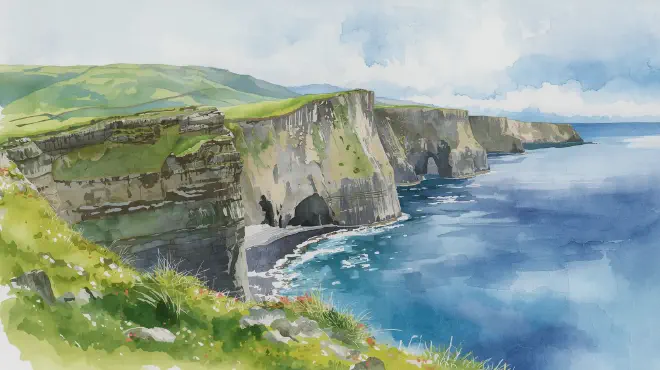
Upon arriving at the Slieve League car park, I immediately felt the scent of the sea and strong ocean winds. This is one of Europe’s highest sea cliffs, reaching nearly 600 meters above sea level at its highest point. On the way to the cliff edge, wildflowers bloomed in the grassland at my feet. The pale purple of heather, the blue of wild scabious, and small yellow flowers I couldn’t name.
The moment I stood at the cliff’s edge, I gasped. Spreading below was the deep blue of the endless North Atlantic. The cliff dropped vertically, and white waves crashed against the rocks below. The wind was strong, and while nearly losing my hat, I gazed at this magnificent view.
Here I met Paddy, a local guide in his seventies. “These cliffs have served as a landmark for sailors since ancient times,” he explained in fluent English. “On clear days, you can see the mountains of Sligo thirty kilometers away.”
Walking along the cliff trail with Paddy, I heard about the region’s history and legends. “There’s a story of lovers who threw themselves from this cliff long ago,” he told me. “But it’s not all sad tales. These cliffs have also saved the lives of many sailors.”
In the afternoon, I visited the small village of Kilcar. This place is famous as a production center for Donegal tweed. I toured Studio Donegal, a workshop where craftsman Seán demonstrated hand-weaving. “This technique has been passed down through generations,” he said proudly.
From spinning wool, making dyes from plants, to weaving on a hand loom—every step is done by hand, and completing a single piece of tweed takes several weeks. Attracted by the warm texture of the finished product and its natural colors reminiscent of earth and sea, I purchased a small scarf.
In the evening, I visited the Folk Village in Glencolmcille. This is an open-air museum recreating 18th and 19th-century Irish rural life. Thatched-roof farmhouses, traditional farming tools, and lifestyles of the time are faithfully reproduced.
Particularly impressive was the smell of burning peat in the fireplace. That sweet, slightly smoky scent is the iconic smell of the Irish countryside. The caretaker, Bridget, explained in detail how people in the past ingeniously lived in harsh environments.
Dinner was at a small restaurant in Glencolmcille called The Glen Tavern. I ordered a seafood platter with locally caught lobster and a Guinness. The sweetness of fresh shellfish and the simple taste of local vegetables were exquisite. Through the restaurant window, I could see the bay dyed in sunset colors, and the day’s fatigue felt pleasant.
I returned to Donegal Town around 9 p.m. When I arrived at the B&B, Mary greeted me with “How was your day?” When I told her about Slieve League, she said with narrowed eyes, “No matter how many times I go, that view still moves me.”
While recording the day’s events in my room, I listened to the night’s silence spreading outside the window. The grandeur of the cliffs I saw today, the warmth of the craftsman’s hands, and the kindness of the people. I felt Donegal’s charm being gradually etched into my heart.
Day 3: Music and a Morning of Farewell
On the final morning, I woke up a little earlier than usual. When I opened the window, the cloudy sky from the previous days had cleared as if it were a lie, and fresh air flowed into the room. The hills beyond the Diamond were beautifully illuminated by the morning sun.
At breakfast, Mary said with a smile, “It’s such lovely weather today. To see such blue skies on your last day—surely it’s blessing you.” Her homemade porridge with honey and berries was a taste that warmed both body and heart.
In the morning, I decided to visit the Donegal Craft Village. It’s a small craft village located a bit away from the town center, where various artisans have established workshops for pottery, woodworking, jewelry making, and more.
At potter Seán’s workshop, I could see works inspired by Donegal’s landscape. The blue of the sea, the brown of peatland, the purple of heather. His works directly reflected the colors of this land. “I use local clay. So my pieces truly contain the earth of Donegal,” he explained.
At woodworker Michael’s workshop, I was allowed to observe the traditional Irish flute-making process. “This flute is an instrument that has supported Irish music for generations,” he said, his hands demonstrating true craftsmanship. When I held the flute being carved, it couldn’t yet make sound, but I could feel the warmth and potential of the wood.
In the afternoon, after a walk along the River Eske, I visited a small bookshop in the town center called Four Masters Bookshop. This shop specializes in books about local history and culture, and the owner Patrick gave me a careful tour. I purchased a collection of Donegal folk tales, which would make a good souvenir to take to Japan.
For my final dinner, I decided to try a different pub, McGinley’s. Mary had told me this was a place where locals often gathered. When I arrived, a spontaneous session by local musicians had just begun.
Fiddle, accordion, bodhrán (a traditional Irish drum), and guitar. People with instruments naturally gathered, and the music began without any set program. “Whiskey in the Jar,” “Danny Boy,” and traditional tunes I couldn’t name were played one after another.
When they learned I was from Japan, an elderly fiddler said, “I know ‘Sukiyaki’ by Kyu Sakamoto,” and played an Irish-arranged version of the song. In that moment, feeling the universality of music transcending borders, my chest grew warm.
For dinner, I ordered Irish stew. A simple dish of lamb, potatoes, carrots, and onions slowly stewed together—a heartwarming taste appropriate for my last meal in Donegal.
The music continued late into the night, but considering my early bus the next morning, I left the pub around 10 p.m. On my way back, I turned to look at the pub’s lights. The smiling faces visible through the window and the music spilling out—I thought this was the true face of an Irish night.
While packing in my room, I reflected on the three days. The magnificent cliffs of Slieve League, the warm hands of the craftspeople, the natural friendliness of the people, and tonight’s music. Though it was a short stay, it was a journey in which I fully experienced Donegal’s charm.
When I said goodbye to Mary, she said, “Please come back again. Donegal will always be waiting for you,” and gave me homemade scones. At that warmth, my eyes unexpectedly grew hot.
Something Certain Felt in Imagination
The landscape of Donegal gradually recedes from the bus window. Though it was only three days, the people I met in this land, the culture I touched, and the scenery I saw all remain vividly in my heart.
Donegal may indeed be a remote place. It may lack modern conveniences or glamour. But here, something that tends to be lost definitely breathes. Connections between people, harmony with nature, respect for tradition, and the pure joy that music brings.
The coldness of the wind I felt at the cliffs of Slieve League, the warm texture of Donegal tweed, the sound of music heard in the pub, and the smiles of the people. All of these tell the story that this journey was something beyond mere imagination.
Travel may not necessarily involve physical movement. If the heart moves, imagination takes flight, and one can touch a new world, then that is surely travel. This imaginary journey to Donegal became an experience that felt more real than reality.
Someday I may actually set foot on the land of Donegal. At that time, I want to confirm how similar to—or different from—the landscapes and people I encountered in this imaginary journey. But even if that doesn’t happen, the memory of this journey will continue to live within me.
A journey that is imaginary yet feels as if it truly happened. Perhaps that is the most beautiful form of travel, woven by the power of imagination, respect for culture, and longing for journeys.