
A Town Where Dinosaurs and Earth’s Memory Sleep
In southeastern Alberta, Canada, about an hour and a half northeast of Calgary by car, beyond the vast prairie grasslands, the earth suddenly splits open to reveal the Badlands. At the heart of this strange terrain lies a small town called Drumheller.
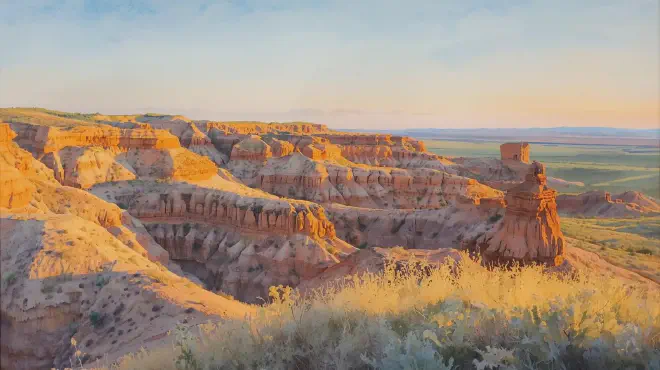
With a population of about 8,000, this town is known as one of the world’s premier sites for dinosaur fossils. About 75 million years ago in the Late Cretaceous period, this area was a temperate coastal plain where relatives of Tyrannosaurus and Hadrosaurs roamed. The land, carved by glacial periods, exposes layers of time itself, drawing stripes of reddish-brown and gray across the earth.
Summer temperatures exceed 30°C, while winter plunges to -30°C—a harsh climate. Yet this land holds a unique stillness, a flow of ancient time. Not only dinosaurs, but also the history of the Blackfoot First Nations and traces of the late 19th-century coal mining boom shape the memory of this town.
I visited in early September, when summer’s heat was subsiding and autumn’s first whispers began to drift through the air.
Day 1: Into the Earth’s Fracture
I rented a car at Calgary Airport. Highway 2 headed north, then turned east. Outside the window stretched endless grassland and blue sky—a vastness where the horizon truly appeared curved.
Gradually, the earth’s color began to change. The grassland broke apart, reddish rock faces emerged, and the landscape transformed into oddly shaped hills. This was the Badlands. The name comes from terrain unsuitable for agriculture, but the scenery was breathtakingly beautiful.
At the town’s entrance, the first thing I saw was a 26-meter-tall Tyrannosaurus statue. Called the “World’s Largest Dinosaur,” the structure has stairs inside leading up to its mouth. I pulled over immediately and climbed it. After ascending 106 steps, I could see the entire town and Badlands landscape. The reddish-brown earth carved into valleys, grasslands beyond, and blue sky above. The wind was strong; I held my hat while taking in the view.
For accommodation, I chose a small motel downtown. A single-story building with a retro atmosphere—simple but clean. After dropping my bags, I headed straight to the town center.
Main Street was short; you could walk from end to end in fifteen minutes. Old buildings lined the street, with dinosaur-themed signs and sculptures scattered everywhere. I entered a café and gift shop where local potters’ dinosaur figurines, fossil replicas, and First Nations beadwork were displayed.
I had lunch at Athens Greek Restaurant, a locally popular Greek place. Greek food in this town? I wondered, but learned the owner was a Greek-Canadian who’d immigrated to Alberta. I ordered lamb shawarma and Greek salad. The slow-cooked lamb was well-spiced, complemented perfectly by the saltiness of feta cheese and olives. Several regulars chatted familiarly with the owner.
In the afternoon, I drove to Horsethief Canyon on the east side of town, about fifteen minutes away. Walking from the parking lot, a large canyon appeared before me. Rock walls striped in reddish-brown and gray formed a deeply carved gorge. Descending the trail, I could clearly see the texture and color variations in the rock—geological layers from over 70 million years ago, exposed as they were.
Reaching the canyon floor, cool air surrounded me. I touched the rock wall—rough sandstone texture. Dinosaur bones might once have been buried in this rock. No one else was around; only the sound of wind and distant bird calls.
After leaving the canyon, I drove to the Royal Tyrrell Museum of Palaeontology before sunset just to see its exterior—I planned to visit properly tomorrow, but I was curious about its architecture. The museum sits northwest of town, within the Badlands. A modern building with curved design reminiscent of dinosaur vertebrae. In the desolate surroundings, the white structure seemed alien yet strangely harmonious.
For dinner, I ate lightly at a pub called The Last Chance Saloon—a name straight from a Western, with interior woodwork evoking frontier days. I ordered local Big Rock beer and a buffalo burger. My first time trying buffalo meat; it was leaner than beef, with a wild flavor. An elderly man at the next stool told me about the town’s coal mining era. In the 1930s, over thirty coal mines operated here, he said, and the town thrived. Now all closed, only traces remain.
Returning to the motel, it was pitch dark outside. Few streetlights; looking up, a sky full of stars spread overhead. The Milky Way clearly visible. Deep darkness impossible in cities, and countless lights shining within it. Did the dinosaurs see this same starry sky? I wondered vaguely before entering my room.
Day 2: Walking Through Time’s Strata
In the morning, I had a simple breakfast in my motel room—granola bars and coffee I’d brought. Outside the window was already bright, the dry air pleasant.
I headed to the Royal Tyrrell Museum after 9 AM. It opens at 9, but I’d heard weekends get crowded, so I went early. Several cars were already in the parking lot.
Entering, an enormous dinosaur skeleton greeted me immediately—Tyrannosaurus and Triceratops positioned as if facing off. Their size was overwhelming. Exhibits were arranged chronologically, allowing visitors to trace life’s evolution from Earth’s birth to the present.
Most impressive was the section on dinosaurs discovered in Alberta. Fossils of Albertosaurus, Edmontosaurus, Pachyrhinosaurus, and others found around Drumheller were displayed. Not just bones, but fossils with skin impressions and egg fossils too. Gazing at bones in glass cases, I tried imagining what this town looked like 75 million years ago.
The museum has a fossil preparation lab where, through glass, you can watch technicians actually cleaning fossils. Carefully removing rock with fine tools, exposing bone—work requiring painstaking precision and patience, I realized.
After spending about three hours at the museum, I had lunch at the attached café. A sandwich and soup set. Outside the window, the Badlands landscape stretched out.
In the afternoon, I drove to Dinosaur Provincial Park, about 45 minutes from town along the Red Deer River. This UNESCO World Heritage site is one of the world’s densest concentrations of dinosaur fossils—over 500 specimens from more than 40 species have been discovered here.
At the visitor center, I got a park map and began walking the nature trails. I chose the Badlands Trail, about four kilometers. The trail was rugged, climbing and descending rocky slopes. Walking carefully, I occasionally encountered oddly shaped rock formations—hoodoos, mushroom-shaped rocks. Hard rock sits atop softer layers; the bottom erodes, creating these shapes.
Along the way, I found small fossil fragments. Picking them up is prohibited, so I only took photos. Even these tiny pieces were once part of something alive.
Midway through the trail was a viewpoint with a spectacular view. Reddish-brown earth undulating like waves, the green Red Deer River winding between. Cloud shadows moved across the land, constantly changing the scenery’s expression. The wind was strong; my hat nearly blew away.
By the time I left the park, it was nearly evening. On the way back to town, I stopped at a small shop called Fossil Shop that sells real fossils and minerals. Ammonite fossils, dinosaur tooth replicas, trilobite fossils lined the shelves. The owner, knowledgeable about paleontology, enthusiastically explained each fossil. I bought a small ammonite fossil—palm-sized with a clearly visible spiral pattern.
For dinner, I went to Yavis Family Restaurant, a local family-run place. The menu had standard steaks and pasta, plus Alberta beef meatloaf, which I ordered. Sides were mashed potatoes and green beans. The meatloaf had an old-fashioned homemade taste, somehow nostalgic. Families and couples filled the restaurant with peaceful time flowing.
After dinner, I walked around town a bit. Before sunset, golden light enveloped everything. Old buildings on Main Street glowed beautifully in the evening sun. I sat on a park bench, watching. People walking dogs, children on bicycles, locals slowly driving past. More than a tourist destination, this was everyday life in an ordinary small town.
Back at the motel, stars filled the sky again. The Milky Way even clearer than the previous night. I stood outside my room, looking up for a while. This silence, this vastness. A flow of time unimaginable in urban noise existed here.
Day 3: Farewell and Memory
On my last morning, I slept in slightly. Checkout wasn’t until 11, so I had time. I carried my luggage from the motel room and loaded it into the car.
In the morning, I walked through town center once more. Details I’d missed yesterday caught my eye. Coal mining motifs painted on old building walls, dinosaur-shaped streetlights, a small museum displaying coal chunks. I felt anew that this town’s history existed not only with dinosaurs but with coal.
I had a late breakfast at Bernie & The Boys Bistro, a café. I ordered eggs Benedict and coffee. The eggs were perfectly poached, the hollandaise sauce rich. Local artists’ paintings decorated the walls, many watercolors of Badlands landscapes. A woman who seemed to be the owner asked about my trip. When I said it was a wonderful town, she smiled proudly.
As checkout time approached, I wanted to see the town from above one last time. I decided to climb the giant Tyrannosaurus statue again. The same 106 steps. The view from its mouth was magnificent as before.
The reddish-brown Badlands, that strange terrain. Distant green grasslands. Blue sky and white clouds. Though only a three-day, two-night stay, this town’s landscape was deeply etched in my heart. Here you can feel the weight of time. Seventy-five million-year-old strata exposed, hundred-year-old coal mine traces remaining, and people still living now. Past and present coexist in a strange balance.
Descending from the Tyrannosaurus statue, I took one last photo of the town. Then I got in the car and started driving toward Calgary.
The town’s landscape in the rearview mirror grew smaller and smaller. The Badlands’ reddish-brown gradually changed to grassland green. The horizon distant, the sky vast. Driving this straight road, I reflected on what I’d felt during this journey.
Earth’s memory. Time’s strata. Richness within silence. The smallness of human endeavor, yet the strength of life continuing nonetheless. This town isn’t a flashy tourist destination. But precisely because of that, I could spend time at my own pace.
Approaching Calgary, traffic increased. A sense of returning to the human world. But the silence of those three days in Drumheller remained firmly in my heart.
At the airport, I returned the rental car and waited for my flight. Sitting on a bench near the gate, I took out the ammonite fossil I’d bought. Tracing the spiral pattern with my finger, I remembered again—that vast sky, starry nights, reddish-brown earth, the town’s quiet streets.
Boarding time came, and I got on the plane. Sitting by the window, waiting for takeoff. As the plane rolled down the runway and lifted off, Alberta’s land spread below. Somewhere far away, those Badlands must exist. Invisible, but certainly there.
A Certain Memory Within Imagination
This journey is not one I actually experienced. The town of Drumheller in Canada, the Royal Tyrrell Museum of Palaeontology, Dinosaur Provincial Park—all are real places. The landscapes, meals, and people’s lives described are based on what actually exists there. But I myself never walked those paths. This is a record of an imaginary journey, woven by AI.
Still, while writing this, I had a strange feeling. There were moments when I felt as if I’d truly walked that town, felt those Badlands winds, gazed up at that starry sky. Words sometimes have the power to make us feel we’ve experienced what we haven’t.
What is travel? Is it only travel to actually go to a place, walk with your own feet, see with your own eyes? Isn’t traveling in your heart through reading books, watching films, or through writing like this also a form of journey?
For you reading this, the town of Drumheller now exists within you too. The reddish-brown Badlands, the giant Tyrannosaurus statue, the quiet night’s starry sky. These are things I described with words, but your imagination supplements them, creating your own unique Drumheller.
If someday you truly visit Drumheller, an experience different from this imaginary journey will await you. It may differ from what’s written here. But then, perhaps the memory of this imaginary journey will also remain faintly in your heart.