
Longing for a Sacred Lake
The Sea of Galilee. Just speaking this name awakens something deep within. Located in northern Israel, this lake is formally known as Lake Kinneret, a freshwater body lying about 200 meters below sea level. Stretching roughly 21 kilometers north to south and 13 kilometers east to west—about one-third the size of Japan’s Lake Biwa—its historical and religious significance is immeasurable.
For Christians, it is known as the holy site where Jesus Christ performed numerous miracles and spent time with his disciples. But the charm of this place extends far beyond that. Ancient fishing traditions, rich natural environment, and the lives of people who continue to live here today all breathe around this lake. While it sits at the crossroads of three religions—Judaism, Christianity, and Islam—there exists here a universal stillness that transcends religion.
I wanted to visit this place to touch that stillness. I wanted to step away from the noise of daily life and face myself in a place where time flows gently. The Sea of Galilee seemed to possess the depth to embrace such a wish.
Day 1: Sunset Reflections on Sacred Waters
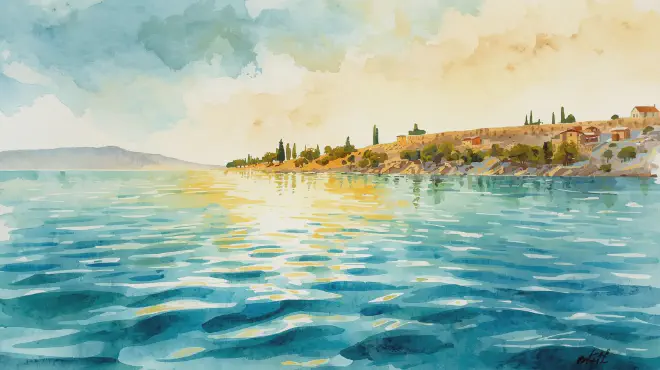
After a two-hour drive from Ben Gurion International Airport in Tel Aviv, the moment the Sea of Galilee came into view, I couldn’t help but pull over. Around 2 PM, the lake surface shimmered under the midsummer sun. It was much calmer than I had imagined, like a vast mirror. In the distance, the hills of the Golan Heights sketched a blue silhouette beyond the water.
I arrived at Kibbutz Ginosar, my accommodation, just after 3 PM. A kibbutz is a unique Israeli communal settlement, originally begun as socialist agricultural communities. Many kibbutzim today also engage in tourism, opening their doors to travelers. Ginosar sits on the northwestern shore of the lake and includes guest facilities.
After checking in and leaving my bags in a simple but clean room, I immediately headed toward the lakeshore. It’s about a five-minute walk from the kibbutz to the water. At 4 PM, the sun was still high, but the breeze crossing the lake surface gently caressed my cheeks. I felt again the reality of being about 200 meters below sea level. Perhaps due to the difference in air pressure, the atmosphere felt dense, deep.
Small piers line the shore, with fishing boats and tourist vessels moored alongside them. I sat down on one of these piers and gazed at the lake for a while. The water was clearer than I expected—in the shallows, I could see straight to the bottom. Small fish swam in schools. The fish from the Sea of Galilee are famous—tilapia, known as “St. Peter’s fish”—and watching them actually swimming was somehow endearing.
Around 6 PM, I had dinner in the kibbutz dining room. Israeli cuisine is strongly influenced by Mediterranean cooking, with heavy use of olive oil, tomatoes, and herbs. The menu that evening included hummus (chickpea paste), falafel (chickpea fritters), and grilled fish fresh from the lake. The preparation was simple, but the ingredients spoke for themselves—delicious. The fish especially had moist flesh, perfectly complemented by just lemon and olive oil.
After dinner, I headed back to the lakeshore. Around 7:30 PM, the western sky gradually began to turn orange. I had heard that sunsets over the Sea of Galilee were exceptional, and it was true. The lake surface mirrored the sky like glass, blurring the boundary between water and air. There was hardly any wind, and only the distant call of birds occasionally broke the silence.
After 8 PM, as the sun sank behind the western hills, the lake surface turned a deep purple. Lights from the town of Tiberias across the water began to flicker on, one by one. In this moment, I certainly felt something. Whether it was a religious experience or simply awe at natural beauty, I couldn’t say. But there was no doubt this was a special place.
Around 9 PM, I returned to my room. Opening the window, a faint breeze from the lake and the distant sound of waves entered. Wrapped in these sounds, I fell into a deep sleep.
Day 2: Following Sacred Footsteps Around the Lake
At 6 AM, I woke to birdsong. Looking out the window, a thin mist hung over the lake. My heart leapt at this morning face of the Sea of Galilee. After preparing for the day, I decided to walk the lakeshore before breakfast.
At 6:30 AM, stepping outside, the air was cool. The mist-wrapped lake was dreamlike, as if I had entered another world. Walking to the pier, I found a few locals enjoying their morning stroll. “Shalom,” we exchanged greetings. In Hebrew it means “hello,” but literally wishes “peace.”
At 7:30 AM, breakfast in the kibbutz cafeteria. Israeli breakfasts are famously substantial. Fresh vegetable salad, various cheeses, olives, freshly baked bread, and fried eggs. Simple, yet each item full of flavor. The sweetness of the tomatoes was particularly striking. I could taste the richness of this land from breakfast itself.
At 9 AM, I set out to visit holy sites around the lake. First destination: the ruins of Capernaum. Known as the base of Jesus Christ’s ministry, it’s about a 15-minute drive. Upon arrival, I found stone ruins of a synagogue built in the 2nd-3rd century CE. Pillars and partial walls of white limestone still stand after nearly 2,000 years.
Walking while reading the explanatory signs, I felt the reality that people once gathered here to pray and deepen their learning. The decorations carved into each stone were beautiful, and I marveled at the skill of ancient craftsmen.
At 11 AM, I visited Tabgha, known for the Church of the Multiplication of the Loaves and Fishes. This is considered the site of the miracle where five loaves and two fish fed 5,000 people. While the current church was built in the 20th century, 5th-century mosaics are preserved in the floor. The mosaic depicting fish and a basket of bread, though simple, was striking.
Outside the church lies a beautiful garden overlooking the lake. I rested here for a while, drinking from my water bottle. The morning sun felt pleasant, and the breeze from the lake coolly brushed my cheeks.
Just after noon, I headed to a lakeside restaurant for lunch. A small family-run place in Tiberias’s old town, proud of its lake fish dishes. I ordered “St. Peter’s fish” meunière. The skin was crisply grilled, the flesh tender and flaky. The vegetable accompaniments were fresh, and squeezing lemon over it brought out the delicate flavor of the fish.
At 2 PM, I took a post-lunch walk through Tiberias. This city was founded in the 1st century by Herod Antipas and named after the Roman Emperor Tiberius. Today it thrives as the center of a lakeside resort. The streetscape, where old stone buildings mix with modern hotels, speaks to the layered history of this region.
Around 4 PM, I went on a lake cruise. Boarding a tourist boat departing from Tiberias port for about an hour-long journey around the lake. Viewing the Sea of Galilee from the boat showed a completely different face than from land. I felt anew the beauty of this lake surrounded by hills on all sides.
The captain, Avi, was a local who had been fishing on this lake for over 40 years. In fluent English, he explained the lake’s history and nature. “This lake is alive,” he said. “Depending on the weather, the season, the time of day, it shows a different face every day. That’s why I haven’t tired of it in 40 years.”
At 5:30 PM, the boat quietly returned to port. The evening lake surface glowed golden. Disembarking at the port, Avi told me, “Come see the lake early tomorrow morning. The morning lake is special.”
I returned to the kibbutz for dinner. That evening’s menu was lamb kebab and couscous. Seasoned with Middle Eastern spices, it had a complex flavor you couldn’t find in Japan. After the meal, I returned to the lakeshore to watch the sunset again. Unlike yesterday, there were many clouds, and the way sunlight streamed through them was fantastical.
Around 8 PM, I returned to my room and wrote in my journal. It was difficult to put into words what I had seen and felt that day, but I certainly sensed something accumulating in my heart.
Day 3: Prayer in Stillness and Farewell
On the final morning, remembering Avi’s words, I woke at 5:30 AM. It was still dim outside, and deep mist covered the lake. Standing on the silent lakeshore, the world felt as if it had just begun.
At 6 AM, the sky gradually began to lighten. As the mist cleared, the lake surface became mirror-smooth, perfectly reflecting the mountains across the water. In this moment, I truly understood the “specialness” Avi spoke of. The morning Sea of Galilee possessed a sacredness absent at other times.
Standing on the lakeshore for a while, I saw a small boat approaching from the distance. A local fisherman heading out for the morning catch. Without engine noise, moving quietly across the lake surface with oars. The scene seemed like the very practice that had been repeated on this lake for 2,000 years.
At 7 AM, after breakfast, I headed to my final holy site visit. I chose the ruins of Bethsaida at the northern end of the lake. Considered the birthplace of the apostles Peter, Andrew, and Philip. Excavation continues today, with parts of the ancient town discovered.
The ruins sit atop a small hill, from which you can overlook the entire Sea of Galilee. Watching archaeologists carefully proceeding with excavation work, I thought about the depth of time carved into this land. Each stone, each pottery fragment, tells of the lives of people long ago.
At 10 AM, I visited the Church of the Lord’s Prayer, a modern Christian pilgrimage site a short distance from Bethsaida. Though a relatively new church, it’s famous for wall paintings inscribed with the Lord’s Prayer in various languages. Finding the Japanese text made me somehow happy.
Inside the church, wrapped in silence, pilgrims from around the world quietly offered prayers. Though I’m not a follower of any particular religion, I felt my heart naturally calming in this stillness. Perhaps it was less a religious experience than a fundamental human longing for silence.
Just before noon, I had my final lakeside lunch. Again at a Tiberias restaurant—simple pita bread and hummus, and the grilled lake fish that had become a favorite. I realized that in three days I had grown familiar with the tastes of this land. They say taste most vividly revives travel memories, and surely whenever I recall these flavors, the landscape of the Sea of Galilee will rise in my mind.
At 1 PM, as checkout time approached, I returned to the kibbutz to pack. From my room, I looked at the lake one last time. Under the strong afternoon sun, the lake surface gleamed white. Though the same lake I first saw three days ago, it looked completely different. Not because the lake had changed, but because something within me had.
At 2 PM, I said farewell to the kibbutz staff. The woman at the front desk smiled and said, “Please come back again. The Sea of Galilee will remember you.” Strangely, it didn’t feel like mere pleasantry.
Driving toward Tel Aviv, I looked back at the Sea of Galilee many times. The lake gradually grew smaller, eventually disappearing behind the hills. But its stillness and beauty were certainly etched into my heart.
Though Imagined, Somehow Real
Through this 2-night, 3-day journey at the Sea of Galilee, I felt and thought about many things. Rather than a religious experience, it seemed more like a fundamental human longing for stillness. I felt again the importance of stepping away from modern noise and facing oneself in a place where time feels slow.
The morning mist on the lake, the beauty of sunsets, the warmth of local people, the simple yet resonant cuisine, and above all, the deep stillness flowing through this land—all of this left a profound impression on my heart. Particularly Avi’s words that “the lake is alive” still resonate with me. Nature truly is alive, speaking to us in many ways.
This journey is fictional. I have never actually visited the Sea of Galilee. Yet by researching this place and letting my imagination roam, I was able to gain a feeling as if I had truly been there. Perhaps this shows that the essence of travel lies not necessarily in physical movement, but in the exploration of the heart.
Though imagined, the stillness, beauty, and encounters with people I felt on this journey certainly exist within my heart. This is the wonder of human imagination, and at the same time, the depth of our longing for beautiful places in the world. If the day comes when I truly visit the Sea of Galilee, surely the memories of this imagined journey will make the real experience richer.
Perhaps travel is, in the end, about discovering the inner world by seeing the outer one. Through this imagined journey to the Sea of Galilee—that distant, sacred lake—I feel this truth anew.