
The City Where Atlantic Winds Blow
Galway, in western Ireland. When you hear the name of this city, most people first imagine the Atlantic wind. This port town facing Galway Bay, with views of the Aran Islands, is Ireland’s third-largest city, yet somehow it never loses the warmth of a country town—a mysterious place indeed.
Cobblestone streets continuing from medieval times, Shop Street lined with colorfully painted buildings, traditional music sessions performed on the streets every weekend. Galway is called “Ireland’s Cultural Capital” and serves as the gateway to the Gaeltacht regions where Irish Gaelic is still spoken in daily life.
Around the city lie the lunar-like rocky landscape of the Burren, the rugged Atlantic coastal cliffs, and ruins of monasteries hundreds of years old. The limestone land and endless stone walls. The landscape of western Ireland is harsh yet beautiful.
In a short two-night, three-day stay, one cannot know everything about this city. But I felt certain I could take home the sound of the wind, the laughter spilling from pubs, and the sensation of rain-soaked cobblestones beneath my feet.
Day 1: Footsteps Echoing on Cobblestones
Two and a half hours by coach from Dublin. As I watched the landscape outside the window gradually change from rolling green hills to a desolate stony land, the bus glided into Galway’s coach station. Early November afternoon, the sky hung heavy with clouds, cold wind stinging my cheeks.
Walking toward my accommodation, my first impression of the city began to take shape. Through Eyre Square, across the Salmon Weir Bridge spanning the River Corrib. The river surface was gray, the current surprisingly swift. Looking down from the bridge, they say you can sometimes see salmon swimming upstream to spawn, but today there was no trace of them. Only the sound of water remained in my ears.
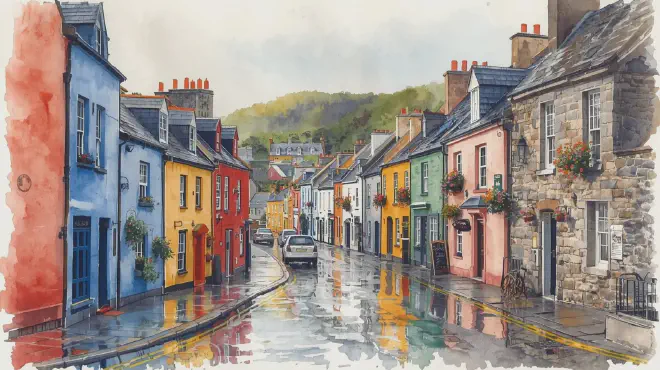
After checking in at my accommodation and dropping off my luggage, I headed into the city around three in the afternoon. First, to Shop Street. This street is pedestrianized, lined on both sides with stone buildings preserving their medieval character. Shops selling Aran sweaters for tourists, stores handling traditional crafts, and pubs everywhere. The signs all had a warm, hand-painted quality, and building walls were colored pink, yellow, green, blue—like something from a picture book.
Halfway down the street, a street musician was playing the fiddle. The melody of a traditional reel flowed on the wind between the cobblestones. A few euro coins glinted in his hat. As I stood listening, an elderly woman beside me said, “This tune is ‘The Wind That Shakes the Barley.’” The wind that shakes the barley. For the people of this land, wind must always be a familiar presence.
At dusk, though it was still early, I decided to have dinner. I chose a small seafood restaurant popular with locals. I’d heard oysters were their specialty, but I was more drawn to the fish and chips. Fresh white fish from the Atlantic, coated and fried. Crispy outside, fluffy and tender inside, squeezing lemon brought out the fish’s sweetness. The accompanying mushy peas, a simple bean paste, had a humble, warming flavor.
After dinner, while the sun hadn’t completely set, I walked to the Spanish Arch. An old arch built in the sixteenth century, a remnant of the era when the city prospered through trade with Spain. Now it stands quietly at the mouth of the River Corrib. Beyond the arch, the bay spreads out, the silhouette of the Aran Islands visible faintly in the distance.
That night, before returning to my accommodation, I stopped at a pub. Tigh Neachtain, one of Galway’s oldest pubs. Inside, tall shelves reaching almost to the ceiling were lined with whiskey bottles, old photographs and paintings hung on the walls. I ordered a Guinness at the counter and settled into a corner seat.
The Guinness tasted slightly different from what I’d had in Dublin. Smoother, creamier, the foam slowly dissolving on my tongue. Irish people say “Guinness tastes different in every pub,” and perhaps that’s really true.
At the back of the pub, several people with instruments were gathering. A traditional music session was about to begin. Fiddle, tin whistle, bodhrán (an Irish traditional drum), and accordion. Without any particular arrangement, when someone started playing a tune, others naturally joined in.
The music continued without pause, one tune ending and another beginning. From fast reels to melancholic airs. Occasionally, someone would start singing. Was it in Irish Gaelic? I couldn’t understand the words, but the melody had a power to evoke some distant memory.
I left the pub after ten. Outside, darkness had completely fallen, streetlights illuminating the cobblestones. Walking down Shop Street back to my accommodation, I heard laughter in the distance. Galway’s night had only just begun.
Day 2: Into the Land of Stone and Sea
In the morning, I had breakfast in the small dining room at my accommodation. A traditional Irish breakfast: bacon, sausages, fried egg, black pudding, white pudding, grilled tomato and mushrooms, and toast piled on the plate. I wondered if it was too much, but once I started eating, I surprisingly finished it all. On a cold morning, such a heavy meal warms the body.
Today, I had planned to join a tour of the Cliffs of Moher and the Burren. At nine in the morning, I boarded a minibus in the city center. About ten passengers. The driver-guide Sean, who appeared to be in his mid-fifties, was a cheerful man of the type who couldn’t stop talking once he had the microphone.
The bus left Galway and headed south along the coastal road. Outside the window, endless stone walls stretched on. A characteristic landscape of western Ireland. Stone walls built by stacking stones dug from the limestone land divide the land, enclose livestock, and break the wind. According to Sean, if you connected all these stone walls, they would be long enough to circle the Earth two and a half times.
We reached our first destination, the Cliffs of Moher, around ten-thirty. From the parking lot, through the visitor center, walking the path leading to the headland. And the moment the view opened up, I caught my breath.
Cliffs exceeding two hundred meters in height stand facing the Atlantic for eight kilometers. Black rock faces meet the waves, sending up white spray. The sea is deep gray, its boundary with the sky ambiguous. The wind—truly strong. Wind strong enough to feel like it might carry me away, blowing relentlessly.
There’s a fence at the cliff edge, but it still makes your legs weak. Looking down, far below you can see waves breaking. Seabirds fly on the wind, occasionally perching on the cliff’s rock ledges. Puffins, guillemots, gulls. According to Sean’s explanation, from spring to summer, even more seabirds come here to breed.
Walking along the path by the cliffs, O’Brien’s Tower, a stone tower, came into view. An observation deck built in the nineteenth century; climbing the narrow spiral staircase inside, you can see the cliffs and sea from an even higher vantage point. The wind was too strong to stand there long. But I thought this landscape would become unforgettable.
Leaving the Cliffs of Moher behind, the bus headed for the Burren. The landscape transformed completely. From green pastureland to a desolate land where gray limestone was exposed. The Burren, said to resemble a lunar surface, is a remnant of the Ice Age. Bedrock scraped by glaciers still lies exposed.
The bus stopped in front of Poulnabrone Dolmen, an ancient tomb. A massive flat stone supported by several stone pillars. Built more than three thousand years BCE. Who carried such large stones, stacked them, and for what purpose? Nothing surrounds it—only the stony land spreads endlessly. Only the wind blows, unchanged from five thousand years ago.
We had lunch at a pub in a small Burren village. Beef and Guinness stew. Beef slowly simmered in Guinness beer, the meat falling apart, rich sauce soaking into the bread. On a cold day, no dish could warm you better.
In the afternoon, the bus continued further inland, stopping at the ruins of Kilmacduagh Church. An old church built in the twelfth century, now without a roof, only walls remaining. Old gravestones line the cemetery, some carved with Celtic crosses. Weathered and unreadable, but here lie the memories of people who lived and died in this land for hundreds of years.
We returned to Galway after five in the afternoon. Getting off the bus, the city’s bustle felt oddly fresh. Perhaps because we’d returned from the desolate stony land, human voices and laughter seemed like proof of being alive.
For dinner, I went to a small bistro in an area called the Latin Quarter. I ordered roasted Irish lamb. The meat, seasoned with rosemary and garlic, was tender, the sweetness of its fat spreading in my mouth. The side dish of colcannon (mashed potatoes mixed with cabbage) was also simple yet deeply nourishing.
That night, I went to a pub again. I chose a different place from last night. Taaffes Bar, crowded with local people. A session was happening here too, with younger musicians playing than last night. An elderly man sitting next to me struck up a conversation.
“Are you traveling? Where are you from?”
When I answered that I was from Japan, he narrowed his eyes and said, “You’ve come from far away.” He himself was born and raised in Galway, never left.
“This city has everything. The sea, the mountains, music, and good company.”
He said this and raised his Guinness glass. I raised mine as well, lightly clinking them together.
“Sláinte (cheers).”
The music continued late into the night.
Day 3: A Morning of Farewell, and What Comes Next
On the last morning, I woke up a bit early. Outside the window it was still dim, the city still quiet. I packed my luggage and thought I’d walk through the city one more time before checkout.
Shop Street was eerily quiet, the previous night’s bustle seeming like a lie. Store workers cleaning, a van delivering bread, people jogging. Morning Galway showed its face not as a tourist destination but as a city where people actually live.
I walked along the River Corrib. Thin mist hung over the river surface, buildings on the opposite bank hazily blurred. Standing on the bridge, looking down at the flow. Something felt different from when I stood here two days ago. Was it because I now knew this city a little? Or because this city had accepted me a little?
I returned to my accommodation and checked out. The owner said, “Come back again.” I knew it was just courtesy, but it made me happy nonetheless.
There was still a bit of time before the bus. I decided to look at the market one more time. Saturday morning, the Galway Market was open. Local farmers selling vegetables and fruit, bakers displaying freshly baked bread, cheese vendors handing out samples.
At one stall, I bought brown bread. Traditional Irish wholemeal bread, heavy and dense, with a simple flavor. I thought I’d take this home. As a small memento of this city, of this journey.
On the way to the coach station, I turned back to look at Galway’s cityscape. Colorful buildings, spires, and the bay visible in the distance. The wind was blowing, as always.
I boarded the bus and sat in a window seat. The engine started, the bus slowly began to move. Galway gradually grew smaller.
It was a short stay of two nights and three days. But what I saw, heard, ate, and felt in this city remains certain within me. The Atlantic wind, the texture of cobblestones, pub music, people’s smiles. And the endless sky spreading over the desolate stony land.
Galway is not a glamorous city. It lacks the flashiness of a tourist destination. But there seemed to be something essential there. Wind, stone, and sea. And the fact that people have continued to live in this harsh nature for hundreds, thousands of years.
The bus ran again between green hills. I closed my eyes and ruminated on my memories of Galway.
Imaginary, Yet Somehow Certain
This journey doesn’t actually exist. I haven’t walked on Galway’s cobblestones, haven’t stood at the Cliffs of Moher. I’ve never drunk Guinness in a pub or listened to a traditional music session.
Yet, while writing, and while rereading, I’m enveloped in a strange sensation. As if I’d really been there, a certain memory. The coldness of the wind, the texture of Guinness foam, the sound of the fiddle, the smell of limestone. They seem to be etched in my heart not as data or information, but as experience.
Perhaps this is the power of imagination. Landscapes woven by words can sometimes feel more real than reality itself. Connecting with the reader’s memories and experiences, in each person’s heart, their own Galway rises up.
If this imaginary journey could become the beginning of someone’s real journey someday, that would be wonderful. Or if someone who has actually visited Galway reads this and thinks, “Yes, that landscape was just like that,” that too would be a happiness.
Travel doesn’t necessarily require physical movement. Through words, through imagination, we can go anywhere. And that journey, too, certainly becomes a part of us.
Galway. The city where Atlantic winds blow. Will a day come when I really visit? Or will it end with only this imaginary journey? Either is fine. Because in my heart, Galway already exists.