
Introduction
Giethoorn lies in the northeastern province of Overijssel in the Netherlands. Often called the “Venice of the Netherlands” or the “Venice of the North,” this small village is threaded with canals that emerged from peat excavation during the 18th and 19th centuries. With a population of only about 2,600, certain areas of the village have no roads at all—only canals, footpaths, and bicycle lanes serve as the means of transportation.
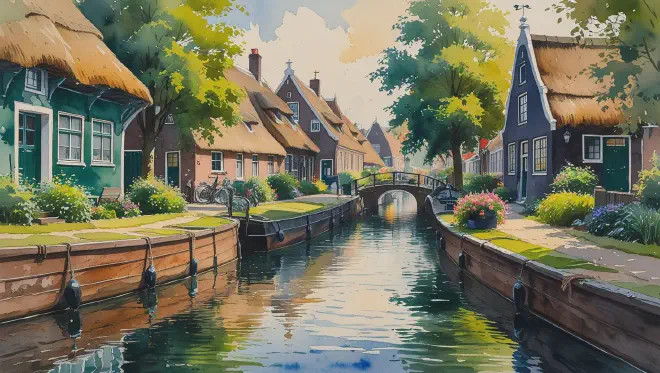
Thatched-roof farmhouses dot the canal banks, their gardens bursting with flowers of every color. From spring through summer, tourists arrive in numbers, yet the village remains untouched by urban clamor—a place where time seems to stand still. Here, people glide quietly along the canals in “whisper boats,” electric vessels that make almost no sound, leaving only birdsong and the gentle lapping of water to fill the air.
I decided to spend three short days in this place where traditional Dutch rural culture and nature exist in harmony. My hope was to forget the busyness of modern life and, within this slowly flowing time, find a moment to face myself.
Day 1: Arriving at the Door of Silence
From Amsterdam Centraal, the train to Zwolle takes about an hour. From there, a forty-minute bus ride brought me closer with each passing moment. Gazing out the window at the quintessential Dutch countryside, I felt my heart gradually settling into calm. Cows scattered across pastures, shadows of windmills, and an endless carpet of green stretching to the horizon.
Stepping off at the Giethoorn bus stop, the first thing I noticed was the absence of sound. Almost no engine noise. Instead, birdsong reached my ears, along with the sound of water from somewhere unseen. Walking toward my bed and breakfast, “De Rietstulp,” I immediately sensed what made this village extraordinary.
The sight of thatched-roof houses standing along the canals made me feel as though I had wandered into a storybook. The thick golden thatch glowed against white walls in beautiful contrast. Gardens overflowed with lavender, roses, and dahlias—each home expressing its own personality through its plantings.
The owner of the inn, Marta, was a gentle woman in her sixties. She welcomed me in fluent English and told me she had been born and raised in this village. “This is one of the quietest places in the world,” she said with a soft smile as she showed me to my room. From the second floor, I could see the canal below, and from a small balcony, the white roses in the neighboring garden were close enough to touch.
In the afternoon, I set out to explore the village. My first stop was Museum Giethoorn ’t Olde Maat Uus, a recreated 19th-century farmhouse where visitors can glimpse how people once lived. The lives of those who earned their living through peat excavation were modest yet rich, and there was a handmade warmth in the furniture and household items. What struck me most was the living room centered around an enormous hearth—imagining a family gathered there through long winter nights stirred an indescribable nostalgia.
As evening approached, the village sank deeper into silence. Walking along the canal path, I saw a whisper boat approaching slowly. An elderly couple sat inside, and they waved to me. These small, casual encounters spoke to the warmth of the people here.
For dinner, I went to De Lindenhof, a family-run restaurant near my lodging known for traditional Dutch cuisine. I ordered stamppot met rookworst—mashed potatoes with smoked sausage. Simple but slowly simmered, the dish warmed me from the inside out. An elderly gentleman at the neighboring table kindly explained the dish to me in English, which was a pleasant surprise.
Back in my room that night, the canal outside my window shimmered silver under moonlight. A sky full of stars—impossible to see in any city—stretched overhead. Lying in bed, I planned to explore the village by boat the next day. I drifted off to sleep wishing that time could simply stop.
Day 2: A Day Adrift on the Canals
I woke to birdsong. The clock read seven in the morning—unthinkably early in my usual life—but my body felt light. Opening the window, cool morning air brushed my cheeks. A thin mist hung over the canal’s surface, creating an almost dreamlike scene.
Marta’s homemade breakfast consisted of freshly baked bread, Dutch cheese, ham, and tomatoes and cucumbers picked from the garden. Simple, yet each ingredient’s flavor came through clearly—a meal made with care. “You’re going on the boats today?” she asked. When I nodded, she advised, “The wind is calmer in the afternoon.”
I spent the morning exploring the northern part of the village on foot. Moving away from the main tourist area, I encountered more everyday scenes of village life. Laundry hanging to dry, an elderly person tending a garden, a woman walking her dog. Everyone greeted me with “Goedemorgen.”
One encounter left a particular impression—an old man who must have been over eighty. Smoking a pipe in his garden, he told me the village’s history in fluent English. “My grandfather worked in peat excavation. Every one of these canals was dug by hand.” Listening to him, I thought about the labor of those who came before, hidden behind today’s beautiful scenery.
In the afternoon, I finally went boating. At Giethoorn Boat Rental, I rented a whisper boat. The electric vessel was remarkably quiet, with almost no engine sound. Gliding along the canals, I could view the thatched-roof houses from angles invisible from land.
The scenery from the boat was like a painting. Willow trees draped their branches over both banks, and the houses scattered among them each wore a different expression. In one garden, a woman sat reading—she waved back at me. At another home, a boy fished from a small dock. These glimpses of daily life seemed to embody Giethoorn’s charm: a tourist destination that still feels lived-in.
The canals crisscross the village, sometimes opening into lake-like expanses. In the area called Botermarkt, there was once a butter market. Now only ducks swim across the quiet water, but thinking of the merchants’ voices that once echoed here made me feel the passage of time.
Midway through my boat tour, I stopped at a small island-like spot to rest. A bench had been placed there, and I ate a simple lunch of Dutch stroopwafels and coffee I had brought along. Around me was nothing but water and green. Occasionally another tourist’s boat passed silently by, but mostly I had time and space entirely to myself.
After returning the boat in the evening, I headed to Café Restaurant Fanfare, the village’s most famous eatery. From a terrace seat along the canal, I sipped a Heineken and watched the sunset. The golden sky reflected on the water, and the silhouettes of thatched roofs created a beautiful contrast.
I stayed for dinner and ordered gebakken snoekbaars—pan-fried pike-perch caught from local lakes. The butter and herb aromas awakened my appetite, and the fresh vegetables on the side spoke to the richness of Dutch agriculture.
Before returning to my lodging, I walked along the canal once more. The nighttime silence differed from daytime’s; warm light spilling from windows trembled on the water’s surface. From somewhere came the sound of a piano—Chopin’s Nocturne. What a luxury, I thought, to hear classical music in a place like this.
Back in my room, I drank the herbal tea Marta had left for me and reflected on the day. From morning to night, time had flowed slowly. My mind and body felt completely relaxed, immersed in a sense of time utterly different from the busy pace of urban life.
Day 3: A Morning of Farewell and What Remains in the Heart
I woke on the final morning with a touch of sadness. As always, birdsong roused me, but knowing this quiet world and I would part today left my chest feeling both warm and wistful.
I shared my last breakfast with Marta. “How did you find Giethoorn?” she asked. “It was like a fairy tale,” I replied, and she smiled with satisfaction. “Many people say that. But for us, it’s simply home.” Her words reminded me that even as a tourist destination, this place remains where people live their cherished daily lives.
After checking out, I had about two hours before my bus, so I went for a final walk. This time I headed south to Zuiderpark, a small park that serves as a gathering spot for locals—quiet, with few tourists. I sat on a bench and wrote down my memories of these three days in a journal I had brought.
Children from the village were playing in the park. I couldn’t understand their Dutch conversation, but children’s laughter is universal. When a girl on a swing waved at me, I realized that hearts can connect without words.
Before leaving, I walked through the village center one more time. The scenery I had grown familiar with over three days looked different now that I was conscious of leaving. The thatched-roof houses, the boats moving along the canals, the flowers in every garden—all of it seemed to carve itself deeply into my heart.
My last stop was a small souvenir shop called Giethoorn Gifts. There I bought a tiny Dutch windmill figurine, small enough to fit in my palm—but it felt like a symbol of my memories here. When the shopkeeper said in English, “Please come again,” I silently promised myself I would return.
Walking toward the bus stop, I turned to look back at the village. Thatched-roof houses lined the far side of the canal. The same view I had seen three days ago—yet now it held special meaning. The people I had met, the silence I had experienced, the food I had tasted, the flow of time I had felt. All of it seemed to have become part of me.
The bus arrived, and I left Giethoorn behind. As the scenery outside the window gradually turned modern, those three days in that quiet village began to feel like a dream. But the windmill figurine in my hand assured me it had all been real.
At Zwolle Station, waiting for the train to Amsterdam, I realized something. For three days, I had not once looked at my smartphone. I hadn’t checked social media. And I had felt no anxiety about it. If anything, I felt I had remembered what truly matters.
Arriving at Amsterdam Centraal, the urban clamor rushed in all at once. People hurrying past, the sound of cars. A scene that had seemed ordinary three days ago now looked different. Having known the silence of Giethoorn, the city’s noise felt a little too loud.
In Closing
These three days in Giethoorn were an imaginary journey, yet they exist clearly within my heart. The thatched-roof houses, the quiet canals, the kind people I met, the slowly flowing time—all of it remains vivid in my memory, as though I had truly experienced it.
Sometimes a journey of imagination can become something purer and more beautiful than a real one. Freed from the constraints and inconveniences of reality, we can gather only the most beautiful moments of a place and live them. This imaginary trip to Giethoorn was exactly that kind of journey.
Yet through this imaginary journey, my longing for the real Giethoorn has only grown stronger. Someday I want to truly visit that quiet village, cruise its canals by boat, and stay in a thatched-roof cottage. When that day comes, these imagined memories and the real experience will overlap, surely creating a journey unlike any other.
A journey that feels real despite being imaginary—perhaps that is another kind of reality, one that exists only in the heart. Giethoorn continues to mark time quietly within my memory, even now.