Introduction: A Village Among Giants
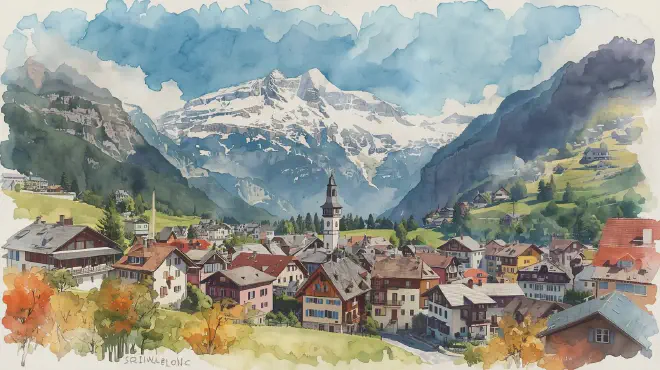
Grindelwald is a small mountain resort village nestled in the Bernese Oberland region of Switzerland, spreading across a plateau at approximately 1,000 meters above sea level. Situated at the foot of the Eiger North Face, its imposing presence can be seen from anywhere in the village. Developed as a base for mountaineers since the late 19th century, this village now welcomes travelers throughout all four seasons.
Traditional wooden chalets line the village center, their balconies adorned with red geraniums. Located in the German-speaking region, Swiss German is spoken in daily life, though English is widely understood in this tourist destination. Church bells echo through the valley, and the sound of cowbells from the pastures drifts on the mountain air. Against this pastoral backdrop rise three peaks over 3,000 meters: the Eiger, Mönch, and Jungfrau.
Grindelwald bustles with skiers in winter and serves as a hiking base in summer. I visited in early June, when the snow was melting and alpine flowers were beginning to bloom.
Day 1: Peaks Through Breaking Clouds
Three hours by train from Zurich Airport, changing connections at Interlaken Ost. When I boarded the yellow mountain railway, the scenery outside the window gradually deepened into mountain terrain. Lake Brienz’s blue surface receded in the distance as the train climbed, threading through the valley. I stepped off at Grindelwald station just after 2 PM. Unlike sunny Zurich, the village was shrouded in low-hanging clouds.
A five-minute walk from the station brought me to a chalet-style hotel. The room, with its warm wood tones, was simple but clean and functional. Opening the window, cold, clear air flowed in. The air at 1,000 meters was distinctly different from the flatlands—taking a deep breath brought an invigorating sensation that seemed to penetrate to the depths of my lungs. The Eiger should have been beyond those clouds, but its form remained hidden.
After leaving my luggage, I headed to the village center. Along the main street, sports shops, a supermarket, and restaurants lined up in succession. Though a tourist destination, there were no garish signs, and most buildings maintained traditional wooden architectural styles. I stopped at the Coop supermarket to buy water and chocolate for the next day’s hike. I had expected Switzerland’s high prices, but it still surprised me that a single bottle of mineral water cost 3 francs (about 450 yen).
Past 4 PM, the clouds began to shift. As I sipped coffee at a cafe, watching the sky, a rock wall emerged through a break in the clouds. The Eiger North Face. Its overwhelming presence took my breath away. The vertically rising gray rock wall, known as the “death wall” that has claimed many climbers’ lives, changed expression with each passing cloud. I continued gazing at that shifting rock face.
For dinner, I chose Restaurant Glacier in the village center. A solid stone building where a fireplace fire greeted me inside. The menu was written in German, French, and English. I ordered rösti, a Swiss regional specialty—a potato pancake with a crispy exterior and fluffy interior. The accompanying salad was simple, but the vegetables had a robust flavor. I also ordered the local Eiger Bier. Its refreshing bitterness eased the day’s fatigue.
Through the restaurant window, in this season of long days, I could see the Eiger at twilight. Even past 8 PM it remained bright, the mountain face gradually染められていく turning orange. At the next table, a family conversed cheerfully in Swiss German, children’s laughter filling the space. Here, time seemed to flow slowly.
Walking back to the hotel, I passed by the church. A small stone structure with a bell tower reaching toward the night sky. The church bulletin board displayed Sunday mass times and summer hiking information. True to a mountain resort, emergency contact numbers for rescue operations were prominently posted. For the people of this village, the mountains are part of daily life, an entity commanding constant respect.
Returning to my room, darkness had completely fallen outside the window. The clouds had departed, revealing a sky full of stars. The number of stars, impossible to see in any city, overwhelmed me. Even the Milky Way stood out clearly. Would tomorrow be clear? With such thoughts, the first day of my journey quietly drew to a close.
Day 2: To First, and the Memory of Glaciers
At 6 AM, I woke while it was still dim. Opening the curtains, the Eiger had begun to glow red in the morning sun. The phenomenon called Morgenrot. I stepped onto the balcony, determined not to miss this sight visible for only a few minutes. In the cold air, the mountain face transitioned from red to golden, then to white—as if the mountain itself were breathing.
Hotel breakfast began at 7 AM. A buffet spread of cheese, ham, bread, and muesli. The variety of cheeses particularly caught my eye: Emmental, Gruyère, Appenzeller—Switzerland’s representative cheeses all assembled. I paired the rich, flavorful cheese with fragrant bread for a substantial breakfast. Today would be a long hike.
At 8:30 AM, I headed to the First gondola station. Several climbers were already queuing. Germans, French, travelers from Asia—various languages filled the air. Boarding the six-person gondola, we slowly ascended. Below, green pastures spread out, cows grazing peacefully. As we gained altitude, the Eiger North Face appeared larger, closer. An elderly couple sharing the gondola seemed to have visited many times, confirming the names of visible peaks with each other.
After about 25 minutes, we arrived at First station (2,168 meters). Stepping off the gondola, cold wind brushed my cheeks. Though it was June, remnants of winter lingered at this altitude. From the observation deck, the Grindelwald valley spread below, with the Eiger, Mönch, and Jungfrau aligned beyond. Against a cloudless blue sky, the white peaks gleamed.
I chose the hiking trail to Bachalpsee Lake—about an hour one way, relatively flat terrain. The trail was well-maintained, though meltwater flowed across the path in places, requiring careful footing. Alpine flowers were beginning to bloom: yellow dandelion-like flowers, small blue blossoms emerging from rock crevices. As I walked, admiring the wind-blown flowers, hikers descending from ahead passed by. “Grüezi,” we exchanged—the Swiss German greeting. In the mountains, even strangers greet each other; it’s the custom here.
After about 40 minutes of walking, Bachalpsee Lake came into view. A small lake at 2,265 meters, reflecting the Schreckhorn peak on its surface. A mountain hut stood by the shore, busy with resting hikers. I sat down and ate the sandwich I’d brought—simple bread with cheese and ham, but it tasted exceptional in the mountains. The lake water was astonishingly transparent, stones on the bottom clearly visible. Dipping my hand in, it was ice-cold. Just weeks ago, this lake must have been frozen over.
After spending about an hour by the lake, I returned to First. The descent was easier than the climb, but required attention to footing—wet stones were slippery. I walked slowly, enjoying the scenery. Looking back, Bachalpsee Lake shone blue.
I returned to First station around 2 PM. Taking the gondola down, I headed back to the village. After resting briefly at the hotel, I decided to visit the Gletscherschlucht (Glacier Gorge) in the afternoon. Located on the village’s south side, this gorge is the trace left by glaciers that once covered this land. I purchased a ticket at the entrance and went inside.
The gorge was deep and narrow. Both rock walls were smoothly polished, testament to the glacier’s power. Wooden walkways were installed, allowing safe passage to the depths. Explanatory panels appeared at intervals, describing glacier mechanics and the region’s geological history. At the deepest point, a waterfall cascaded between the rock walls. The roaring, milky-white water must have melted from the glacier. Spray hit my face, refreshingly cool.
Leaving the gorge, it was already past 5 PM. Exploring the village, I searched for dinner. Tonight I wanted something more casual, so I entered Cafe 3692—a cafe-restaurant. The number in the name represents the Jungfrau’s elevation. I’d heard their fondue was famous.
When I ordered cheese fondue, a ceramic pot and a basket full of bread cubes arrived at the table. In the pot, cheese simmered in white wine and garlic, bubbling gently. I pierced a bread cube with the long fork and dipped it into the melted cheese. The piping hot cheese was rich, the wine flavor pronounced. One bite filled my mouth with cheese’s aromatic fragrance. I’d heard that for the Swiss, fondue is not merely food but a social occasion for gathering and conversation. Indeed, looking around, everyone at neighboring tables enjoyed lively conversation around their fondue.
Stepping outside after dinner, it was still too early for dusk. Swiss June days are long, remaining light until around 9 PM. I walked a quiet road slightly removed from the village center. In the pastures, cows grazed and a shepherd’s figure appeared in the distance. Cowbell sounds echoed through the valley—an irregular rhythm, yet somehow soothing.
I sat on a bench near the church, gazing at the mountains. The Eiger, illuminated by sunset, glowed golden. Completely different from yesterday’s cloud-shrouded appearance—a gentle, peaceful expression. Mountains change expression moment by moment. Perhaps that’s one reason people are drawn to this place. An elderly local sat on the neighboring bench, gazing at the same mountains. We exchanged no words, yet there was a sense of sharing this place’s beauty.
I returned to the hotel near 10 PM. Even then, dim light remained in the sky. After showering, I lay in bed. Outside the window, stars began to twinkle. Tomorrow would be the final day. The thought brought a touch of sadness.
Day 3: Morning Farewells and Until We Meet Again
The final morning dawned clear again. Today I had to catch an afternoon train to Interlaken, leaving only the morning hours. After breakfast, I packed my luggage and checked out. The front desk staff sent me off with a smile: “Have a good journey.”
I stored my suitcase in a coin locker at the station and set out for a final walk. I headed to Pfingstegg, a small observation point on the village’s north side. About 20 minutes from the village on a gentle uphill path. I walked through the crisp morning air. A local out jogging greeted me as we passed.
Reaching the observation point, I could see the entire Grindelwald valley. Green pastures, scattered chalets, and the three peaks rising behind them. The village I’d walked through for two days spread before me like a painting. I sat on a bench, burning the scene into my memory.
At 10 AM, I returned to the village center. With time still before departure, I decided to stop at a cafe one last time. At Cafe Glacier, a small cafe, I took a window seat. Ordering a cappuccino, I gazed outside. People passing on the street, climbers with ski poles, locals with shopping bags. The village’s daily life flowed slowly.
Sipping my cappuccino, I reflected on these two nights and three days. The Eiger’s majesty, Bachalpsee Lake’s tranquility, the glacier gorge’s mystery, and the warmth of the village people. Though a short stay, I had seen and felt much. What impressed me most was how the people of this village live with the mountains. For them, the mountains provide livelihood, command reverence, and inspire pride. That they’ve developed as a tourist destination while maintaining traditional lifestyles and architecture must be an expression of this respect for the mountains.
At noon, I headed to Grindelwald station. The yellow mountain railway already stood at the platform. Carrying my luggage, I boarded. The departure bell rang, and the train slowly began to move. Outside the window, Grindelwald’s scenery flowed backward. Pastures, church, and the Eiger. As the train descended the valley, the mountains gradually grew smaller.
Through the windows toward Interlaken, Lake Brienz’s blue surface appeared. We passed small villages along the lakeshore. A peaceful, gentle landscape contrasting with Grindelwald. But my heart remained with those mountains.
On the train, I reviewed photos from this journey. The Eiger dyed by morning sun, Bachalpsee Lake’s surface, the glacier gorge’s rock walls. Every photo was beautiful, yet couldn’t match the emotion of seeing them in person. Photos cannot capture the cold air, the sound of wind, the cowbell echoes, the fondue’s aroma. All of these form the memory of this journey.
I arrived at Interlaken Ost just after 1 PM. Here I would transfer to the train toward Zurich. Leaving Grindelwald brought genuine sadness. But simultaneously, a desire to return had taken root. Next time in a different season, walking different hiking trails. Winter skiing, autumn foliage, spring flowers. This village surely has many faces yet unseen.
As the train accelerated toward Zurich, I saw my face reflected in the window. Slightly sunburned cheeks, a satisfied expression. Certainly, I had visited this place, breathed this air, seen these sights in these two nights and three days. That realization felt genuine.
A Real Memory Within Imagination
This journey never actually took place. It’s a fictional travel narrative, spun before a keyboard and screen. Yet the Grindelwald landscape described here, the Alpine mountains, Swiss cuisine and culture—all of these truly exist. The Eiger North Face stands there still, Bachalpsee Lake shines quietly in the mountains today. Fondue’s aroma fills actual cafes, cowbell sounds echo across real pastures.
People need not physically visit a place to journey there in their hearts. Through writing, through images, or through someone’s stories. Such “imaginary travels” also become part of our experience, nurturing longing for the day we might actually visit.
If this imaginary journey to Grindelwald has planted a small seed in someone’s heart, I would be glad. And if someday that seed sprouts and brings them to actually walk that land, should this narrative be remembered then, that would bring the greatest joy.
The mountains are there. Waiting.