
The Butterfly of the Caribbean: Guadeloupe
Guadeloupe, a French overseas department floating in the Caribbean Sea, consists of two islands shaped like the wings of a butterfly. Grande-Terre to the east is a flat limestone land where white sandy beaches stretch endlessly, while Basse-Terre to the west rises with volcanic mountains cloaked in deep green. Twin islands of contrasting beauty.
Since becoming French territory in 1635, this land has nurtured a unique Creole culture born from the fusion of African, European, and indigenous Carib traditions. Though French is the official language, it is the soft melody of Creole that echoes through the streets. The aroma of spicy dishes—accras, boudin, colombo—drifts on the sea breeze, while the rhythms of zouk and gwo ka color the nights.
The majestic silhouette of La Soufrière volcano, waterfalls hidden in tropical rainforests, the green carpet of sugarcane fields. And above all, the warm smiles of the people who call this island home—these are the true treasures of this place. Though my stay would be brief, a journey to experience this rich culture and nature was about to begin.
Day 1: Blue of Sky, Blue of Sea, and the First Strains of Creole
Stepping off the plane at Pointe-à-Pitre International Airport, warm air laden with humidity brushed against my cheeks. Outside the terminal, the town spread out more modern than I had imagined, catching me slightly off guard. Yet when a taxi driver mumbled something in Creole while waving cheerfully, I realized—yes, this is indeed the Caribbean.
On the way to my accommodation in Sainte-Anne, sugarcane fields rolled past the car window in waves of green. In the distance, the peak of La Soufrière hid behind clouds. The driver, who introduced himself as Marcel, taught me about the island in broken English. “Here, morning is quiet, but evening is lively with zouk.” His smiling words swelled my anticipation for what lay ahead.
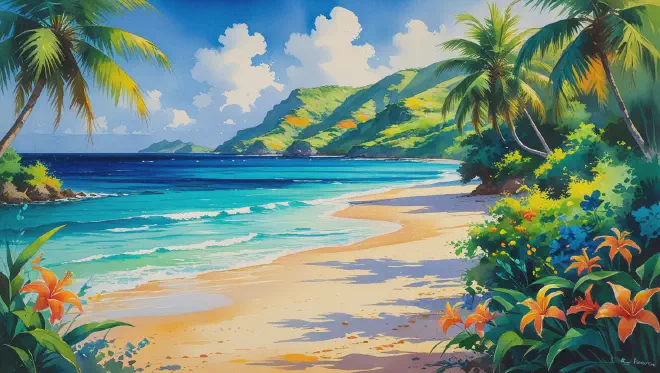
In the afternoon, I made my way to the beach at Sainte-Anne. This stretch along Grande-Terre’s southern coast was truly a picture-perfect white sand beach. Hammocks swayed in the shade of palm trees while local children splashed in the shallows. The color of the sea shifted from transparent emerald green near the shore to deep cobalt blue toward the horizon.
At a small café along the beach, I tried my first Creole cuisine. Accras—salt cod fritters—were crispy on the outside, fluffy within, and when squeezed with lime, freshness burst across my palate. When offered a Ti’ Punch, a rum-based cocktail, the alcohol was stronger than expected, but the sweet-sour blend of cane sugar and lime lingered deliciously on the tongue.
In the evening, while strolling near my lodging, the sound of drums drifted from somewhere nearby. Following the rhythm, I found locals dancing gwo ka in a small plaza. Men and women, young and old, formed a circle, moving to the simple yet powerful beat of the drums. Watching them made my heart dance too. When a woman took my hand and pulled me into the circle, joy overcame embarrassment, and before I knew it, I was moving my body with abandon.
That night, on the small balcony of my lodging, I gazed at the sea and reflected on the day. Only a few hours had passed since landing, yet I was already captivated by this island’s charm. The distant sound of zouk music, the murmur of waves, occasional laughter—all of it filled my heart with anticipation for tomorrow.
Day 2: Into the Deep Green Mountains, and the Fire of Spice
Morning began with a breakfast of mango and passion fruit freshly picked from the garden. The mango was exceptionally sweet, so juicy that its nectar dripped down my fingers. Madame Leclerc, the proprietress of my lodging, strongly recommended visiting the national park on Basse-Terre. “The mountain green and the sound of waterfalls will surely cleanse your soul.” Encouraged by her words, I set off by rental car toward Basse-Terre.
Winding up mountain roads that threaded through banana and coffee plantations, the scenery gradually transformed into deep tropical rainforest. At the entrance to Guadeloupe National Park, I parked the car and began hiking. Wrapped in humid air, I made my way through giant ferns and tree ferns. Occasionally, the calls of colorful birds echoed through the forest, making me feel as though I had wandered into another world.
After about thirty minutes of walking, I arrived at Chutes du Carbet. The waterfall, perhaps fifteen meters high, slid gracefully down the rock face, forming a small natural pool at its base. Watching a local couple enjoying the water, I removed my shoes and dipped my feet in. The cold mountain water soothed my heated feet. Time seemed to slow in this place.
In the afternoon, I visited the town of Basse-Terre. Colonial-era houses that preserved the memory of French rule stood surrounded by lush gardens. Most striking was an elegant former governor’s residence built in the eighteenth century. White walls, blue window frames, and red tile roofs stood vivid against the blue sky—the very image of a tropical paradise.
I decided to have lunch at the town market. The bustling market overflowed with unfamiliar vegetables, fruits, and spices. The scent of colombo, a yellow spice blend, was particularly memorable. At the vendor’s recommendation, I ordered colombo de porc. This dish of pork simmered in coconut milk and colombo spices began with a gentle sweetness, then gradually released a complex heat that tingled across my tongue. Eaten with plantain on the side, the spiciness was tempered to perfect balance.
In the evening, I wandered through the port town of Pointe-à-Pitre. This town, which flourished as a hub of Caribbean trade, holds a mix of French, African, and Indian cultures. At Marché de la Darse, madamas—Antillean market women—dressed in colorful fabrics sold spices and folk crafts. I spoke briefly with one of them, a woman named Maryse. She taught me how to wrap a colorful scarf in a style inherited from her grandmother, then laughed, “Now you are a woman of Guadeloupe.”
That evening, at a restaurant near the harbor, I savored grilled langouste. The fresh lobster was fragrant with garlic butter and herbes de Provence, pairing beautifully with white wine. From the terrace, I could see the night harbor, fishing boat lights shimmering on the water. From somewhere distant came the sound of zouk, and once again, the Guadeloupe night deepened with music.
Day 3: The Final Morning, and Farewells That Linger in the Heart
I greeted my last morning on the shore of Sainte-Anne. Walking the beach in the dim light before sunrise, a different silence enveloped me. Local fishermen were returning from their early morning catch, their boats laden with colorful fish. The golden body of dorado, the red eyes of snapper—they spoke of the Caribbean’s abundance.
One of the fishermen, Joseph, called out to me. He had been fishing these waters for over forty years. “This sea is fickle, but it always provides for us,” he said quietly, gazing at the water. In his profile was the serenity that belongs only to those who have spent a lifetime facing the sea. The fresh sea urchin he shared with me burst with oceanic saltiness and rich sweetness—a revelation of the sea’s generosity I had never before experienced.
That morning, Madame Leclerc offered to teach me some home cooking. Starting with sofrito, the aromatic vegetable paste at the heart of Creole cuisine, I then watched her prepare boudin créole, a blood sausage. “Cooking is love,” she said as she carefully blended spices. In her movements, I sensed the depth of wisdom and technique passed down through generations.
When I tasted the finished boudin, I felt hesitant at first, but with each bite, complex spice aromas and a surprisingly light flavor surprised me. “This is the taste of Guadeloupe,” Madame smiled. In those words, I glimpsed the pride of people born and raised on this island.
In the afternoon, I chose to spend my final hours at Pointe des Châteaux on the eastern tip of Grande-Terre. Here, the rough waves of the Atlantic crash against the cape—a powerful contrast to the gentle waters of Sainte-Anne. The view from the lighthouse was breathtaking: an endless expanse of blue sea and sky stretching in all directions.
At a café on the cape, I ordered my last Ti’ Punch. When I first tried it three days ago, it seemed too strong, but now it tasted like something familiar. The elderly café owner called out, “Come back again.” His kindness brought unexpected warmth to my chest.
Marcel drove me to the airport, just as he had on my arrival. “How was Guadeloupe?” he asked. A complex swell of emotions rose within me, too rich to capture in a single word. The beautiful nature, the rich culture, and above all, the warmth of the people I met—all of it was etched deep in my heart.
In the departure lounge, listening to the last strains of Creole around me, I reflected on these three days. Though brief, I felt I had touched, if only slightly, the soul of this island called Guadeloupe. As the boarding announcement echoed, I bid farewell to the island with a quiet certainty that I would return.
What Felt Real, Though Imagined
Watching Guadeloupe’s silhouette grow smaller through the airplane window, I tucked away the memories of these three days deep in my heart. The saltiness of accras, the sweet-sour tang of Ti’ Punch, the rhythm of gwo ka, the cold water of Chutes du Carbet, and the smiles of everyone I met—all remain vivid within me.
This journey is a product of imagination. Yet the rich nature and culture of the island called Guadeloupe, and the warmth of its people, exist in reality. Memories woven from words may not be actual experiences. Still, my longing and respect for this island, and my desire to visit again, are feelings that transcend imagination—real emotions etched into my heart.
Perhaps travel is about discovering a new self in a new land. These three days spent on the butterfly-shaped island of Guadeloupe, though imagined, have become a part of me as if they truly happened. I look forward to the day when these imagined memories become reality.