
A Medieval Town Embraced by Lakes and Forests
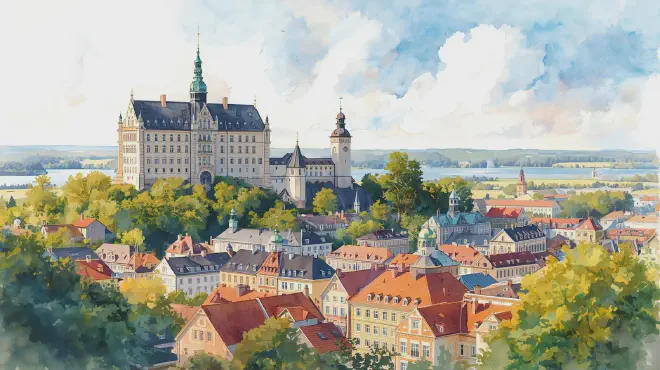
Hämeenlinna is a serene town located in the Häme region of southwestern Finland. With a population of approximately 67,000, it stands as one of Finland’s oldest cities, having developed around Häme Castle, built in the 13th century. The town’s name itself means “Castle of Häme.”
Nestled on the shores of Lake Vanajavesi, this town embodies an exquisite harmony between Finland’s characteristic natural abundance and centuries of continuous history. In summer, birch and pine forests turn deep green, while countless lakes mirror the sky like glass. Come winter, the world transforms into a snow-covered realm of silence, occasionally graced by the aurora borealis dancing across the night sky.
Hämeenlinna is also renowned as the birthplace of composer Jean Sibelius. In this land where Finland’s national composer spent his childhood, there dwells a beauty both serene and powerful, much like his music. Walking through the town, one can truly understand why the Nordic reverence for nature that permeates Sibelius’s symphonies was born from this very place.
Day 1: Arrival in a Town Watched Over by an Ancient Castle
An hour by train from Helsinki. As the scenery outside the window gradually shifts to farmland and scattered lakes glimmer in the sunlight, I arrived at Hämeenlinna station. The station building is modern yet retains a certain Finnish simplicity.
I took a taxi from the station to my accommodation, Hotel Vanajavesi. The driver, Matti, a gentle man in his sixties, spoke fluent English and shared stories about the town’s history. “Hämeenlinna is the heart of Finland,” he said. “This is where Finland as a nation began.”
The hotel was an elegant building on the lakeshore, with a view of Lake Vanajavesi’s calm waters from my room window. The afternoon sunlight danced on the lake surface while the forest on the opposite shore cast deep green shadows. After dropping off my luggage and catching my breath, I headed out to explore the town.
A ten-minute walk from the hotel brought me to Häme Castle. This red brick castle, built in the late 13th century, is considered one of the best-preserved medieval castles in Northern Europe. Stepping into the courtyard surrounded by thick walls, my footsteps echoed quietly on stone pavement that had endured centuries. Inside the castle museum, medieval weapons, ornaments, and everyday items were on display, offering glimpses into the lives of people from that era.
Climbing the castle tower, I could see the entire town of Hämeenlinna spread before me. Red-roofed houses dotted the lakeside, with forests beyond stretching to the horizon. The breeze was cool, carrying the scent of pine. The view from here evoked the love of homeland that Sibelius must have poured into “Finlandia.”
As evening approached, I decided to have dinner at Restaurant Kastelli near the castle. Inside the heavy stone building, warm lighting enveloped local residents and tourists quietly enjoying their meals. The menu centered on Finnish cuisine, and I ordered gravlax (salt-cured salmon) as an appetizer. The thinly sliced salmon melted on my tongue, with dill’s fragrance filling my senses.
For the main course, I chose poronkäristys (sautéed reindeer). The reindeer meat was lighter than I had imagined—gamey yet refined in flavor. The accompanying potatoes and puolukka (lingonberry jam) complemented the meat perfectly. Savoring local Karhu beer alongside my meal, I gazed out at the lake’s evening scenery through the window.
As night deepened, I walked along the lakeside before returning to the hotel. June in Finland is the season of white nights, and even past 10 PM, the sky remained dimly bright. The lake surface was mirror-still, reflecting the silhouette of the forest on the opposite shore. Occasionally, a water bird’s call broke the silence. Walking through this dreamlike scene, my sense of time grew hazy.
Back in my hotel room, lying in bed, I reflected on the day. Hämeenlinna is not a flashy town, but it certainly possesses something that resonates deep within the heart. Perhaps it’s the weight of history, the beauty of nature, or the gentleness of its people. Most likely, it’s all of these elements blended together, creating this land’s unique charm.
Day 2: Following Sibelius’s Footsteps and Forest Poetry
I woke to the chirping of birds. Opening the window, I saw mist rising from the lake, enveloping the forest in a fantastical scene. The hotel breakfast was simple yet delicious—open-faced sandwiches with rye bread, butter, ham, and cheese, accompanied by strong coffee that warmed my body.
In the morning, I decided to visit the Sibelius Birthplace Museum. A fifteen-minute walk from Häme Castle through a residential neighborhood brought me to a yellow wooden house—the birthplace of the composer Finland proudly claims as its own. Built in 1865, this house recreates middle-class life of that era, displaying the room where Sibelius spent his childhood, family photographs, and the piano he used.
Particularly striking were copies of musical scores Sibelius composed as a child. Beautiful melodies already showing glimpses of genius were written on staff paper in childlike handwriting. Anna, the museum guide, told me, “Sibelius spent much of his childhood in Hämeenlinna’s nature. His music carries the echoes of this land’s forests and lakes.”
Leaving the museum, I headed to Sibelius Park. Just a five-minute walk from the birthplace, this small park features a bust of the composer. Sitting on a park bench, I listened to Sibelius’s “Karelia Suite” through my earphones while gazing at scenery he must have seen. In that moment when music and landscape overlapped, I felt a strange sensation—as if conversing across time with young Sibelius himself.
Lunch was at Café Lauri in the town center. This small café beloved by locals prides itself on homemade cakes and coffee. I ordered korvapuusti (traditional Finnish bread) and mustikkakakku (blueberry cake). Korvapuusti—literally meaning “ear slap”—was soft and sweet as its name suggests, with cinnamon fragrance filling my mouth. The mustikkakakku had just the right tartness, pairing perfectly with strong coffee.
In the afternoon, to fully appreciate the nature around Hämeenlinna, I headed to Aulanko Nature Reserve. A 30-minute bus ride away, this park is one of Finland’s oldest nature reserves, known for its beautiful lakes and primeval forests. Upon arrival, the pristine beauty of Lake Aulanko immediately caught my eye. Walking paths along the lakeside were well-maintained, allowing forest bathing while strolling.
Walking the paths, I encountered small animals like squirrels and rabbits. They showed no fear of humans, as if asserting their natural rights as forest residents. Along the way, I found a hiking trail sign and decided to extend my walk to a rock cave called “Bear’s Cave.”
The one-hour hiking trail wound through forests of birch, pine, and spruce. Underfoot grew low shrubs of lingonberries and blueberries, with the sweet scent of wild strawberries occasionally tickling my nose. Deeper into the forest, urban noise completely vanished, leaving only birdsong and the sound of wind rustling through trees.
Bear’s Cave was a massive rock crevice formed during the Ice Age, indeed looking like it could house a large bear. Standing at the cave entrance, cool air brushed my cheeks. I wondered what this cave meant to ancient people who lived on this land.
On the bus ride back, the scenery outside the window was gilded by the setting sun. Sunset reflected on the lake surface shimmered like liquid gold. This beauty was beyond words—I could only gaze quietly.
That evening, back in Hämeenlinna, I had dinner at Pub Oluthuone, a gathering place for locals. Inside the warmly wooden interior, people chatted over local beers. Jukka, the cheerful bartender, laughed as he told me, “Finns are said to be introverted, but once we have beer, we suddenly become talkative.”
For dinner, I ordered makkara (Finnish sausage) and mustamakkara (blood sausage). The makkara had a strong smoky aroma, with meat’s umami flooding out with each bite. Mustamakkara looked dark and heavy but was surprisingly light in taste, creating an exquisite harmony when eaten with rye bread and lingonberry jam.
Late that night, returning to the hotel, I happened to meet Erika, a German woman also traveling alone. She’s an architect visiting Finland to study Nordic wooden architecture. As we discussed Hämeenlinna’s charms, it became clear she too was captivated by the town’s quiet beauty. “There’s something here that modern society has lost,” she said. I completely agreed.
Day 3: A Morning of Farewells and Memories Etched in the Heart
On the final morning, I woke early to walk along the lakeside. Morning mist drifted over the lake surface, with the forest on the opposite shore forming a hazy silhouette. The lakeside walking path was empty, allowing me luxurious time alone.
Sitting on a lakeside bench, I read from a poetry collection by Finnish poet Eino Leino that I had purchased the day before. Though I couldn’t understand Finnish, reading the English translation, I tried to sense the resonance of words born in this beautiful nature. One passage particularly stayed with me—praising forests and lakes, it seemed to sing of the very landscape spread before my eyes.
After breakfast, I checked out and decided to visit Hämeenlinna Art Museum one last time. Though a small museum in the town center, it boasts a high-quality collection focused on Finnish contemporary art. Particularly intriguing was a series by a local painter depicting Hämeenlinna’s four seasons—beautifully capturing the various expressions of the town I had experienced over these three days.
Leaving the museum, I visited Häme Castle once more. Viewing the castle from a different angle than yesterday, I quietly reflected on my time in this town. Though just a short two-night, three-day stay, Hämeenlinna had certainly left a deep impression on my heart.
Lunch was at a small café on the way to the station—Finnish-style open-faced sandwiches and coffee. The elderly shop owner said in broken English, “Please come again,” and gave me homemade cookies as a gift. This warm hospitality was another part of Hämeenlinna’s charm.
Waiting for the train on the platform, I thought about the people I had met in this town. Taxi driver Matti, museum guide Anna, pub bartender Jukka, and Erika, the German architect I met by chance. These brief encounters enriched my travel memories.
The Helsinki-bound train arrived, and sitting in my seat, I gazed out the window. The Hämeenlinna townscape gradually grew smaller, eventually transforming into scenery of forests and lakes. The view from the train window should have been the same as on arrival, yet somehow it looked different. Perhaps my understanding of Finland had deepened over these three days.
As the train accelerated, time spent in Hämeenlinna began to feel dreamlike. Yet the museum pamphlet in my pocket and the scent of cookies from the café proved it was indeed real.
What Was Felt, Though Imaginary
Reflecting on this journey, I feel that Hämeenlinna, though not flashy, is a place with charm that leaves a deep mark on visitors’ hearts. History spanning from the 13th century, cultural soil that nurtured the great musician Sibelius, and above all, beautiful nature and gentle people—all these elements harmonize to create a unique and irreplaceable appeal.
Finns often use the word “sisu”—a concept meaning perseverance and inner strength in facing difficulties. Through my time in Hämeenlinna, I felt I understood this word a little better. Quiet strength cultivated in harsh natural environments could be sensed throughout this town.
At journey’s end, I’m reminded to ask: what is true richness? Hämeenlinna lacks the glamour of big cities, yet values that modern society is losing—harmony with nature, respect for history, human connection—certainly live and breathe here.
The landscapes I saw, the cuisine I tasted, the people I met, and the silence and beauty I felt in this town will surely remain in my heart for a long time. Especially the deep peace felt in lakeside morning mist and the moment when music and landscape merged at Sibelius’s birthplace have become unforgettable treasures.