
A Town of History Sleeping at the Confluence
At the northeastern tip of West Virginia, where the Potomac and Shenandoah Rivers meet, lies a small town called Harpers Ferry. With a population of only about 300, this place is known as the site of one of the most significant events in American history—John Brown’s raid. In 1859, the radical abolitionist John Brown attacked the federal armory here, igniting the spark for the fight to end slavery. It was an event that would serve as a fuse for the Civil War that began just two years later.
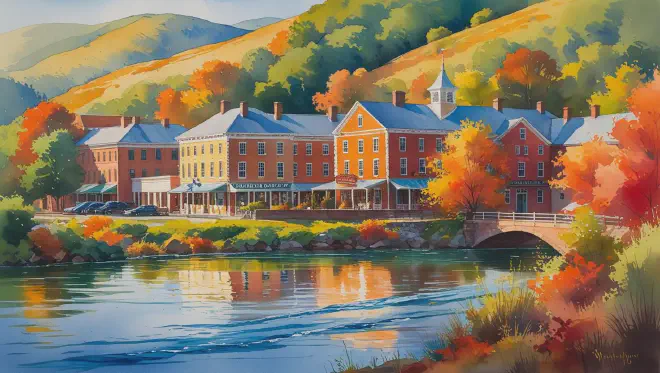
Today, the town is preserved as a National Historical Park, retaining the atmosphere of the nineteenth century. Cobblestone streets, brick buildings, and an old railroad bridge stretching along the river. Surrounded by the beautiful nature of the eastern United States, this is a place where one feels the deep weight of history. This region, part of the Blue Ridge Mountains, shows rich expressions through all four seasons, and the autumn foliage is said to be breathtakingly beautiful.
I decided to visit this town not only out of an interest in history but also because I was seeking a place away from the clamor of modern life, where I could quietly reflect. Wrapped in the sound of flowing rivers and birdsong, I thought I might sense something special in this place where past and present intersect.
Day 1: Through the Door to a Town Where Time Stands Still
At seven in the morning, I boarded the MARC (Maryland Area Rail Commuter) train from Union Station in Washington, D.C. I had deliberately chosen a weekend to avoid the weekday commuter rush. The scenery flowing past the window gradually changed from the bustle of urban areas to verdant countryside. The train journey of about an hour and twenty minutes was enough time to prepare my heart.
Stepping off at Harpers Ferry Station, the first thing I noticed was the crisp, refreshing air. It was late October, with temperatures around 59°F. A light fleece jacket was just right. The walk from the station to the historic district took about fifteen minutes. Along the way, passing through residential areas, I caught glimpses of how the townspeople lived. Autumn flowers bloomed in front yards, and every home was well-maintained. An elderly man walking his dog, a woman doing garden work—everyone wore peaceful expressions.
When I reached the entrance to the historic district, a scene unfolded as if time had stopped. Cobblestone slopes, clusters of brick buildings, and the Potomac River visible in the distance. Tourists were sparse, and I felt the luxurious sense of having the quiet streets all to myself.
My first stop was the John Brown Museum. Though a small building, the exhibits were substantial. Brown’s life, his convictions, and the details of the armory raid on the night of October 16, 1859, were displayed alongside photographs and documents from the era. What struck me most were the words Brown spoke in his final address: “I, John Brown, am now quite certain that the crimes of this guilty land will never be purged away but with blood.” I felt the weight of determination of a man who stood against the enormous evil of slavery.
For lunch, I stopped at The Anvil Restaurant on Main Street. The building, dating from the 1850s, had been renovated into a restaurant while retaining its period atmosphere. They prided themselves on dishes made with local ingredients. I ordered the Shenandoah Trout—a simple preparation of fresh trout rubbed with herbs and grilled. The refined taste characteristic of river fish was delightful. The accompanying roasted root vegetables were sweet and delicious. Dining while gazing at the river view through the window was a luxurious experience.
In the afternoon, I walked along the promenade by the Potomac River. A few anglers stood along the riverbank, leisurely casting their lines. The opposite shore was Maryland, where hills covered in beautiful autumn colors stretched on. As I walked, a local man struck up a conversation. He appeared to be in his seventies and said he had been born and raised in Harpers Ferry.
“The good thing about this town is that it doesn’t change,” he said. “It’s become a tourist destination, but its essence is the same as always. People help each other, and they take care of nature. John Brown’s spirit lives on too. The courage to stand up for justice—that’s this town’s pride.”
His words conveyed that the people of this town had inherited history not merely as events of the past but as values that continue to live in the present.
In the evening, I checked into Harpers Ferry Guest House. A B&B renovated from an 1800s building, the room was simple but clean and comfortable. From the window, I could see the Shenandoah River, its surface beautiful as it caught the colors of sunset.
At night, I strolled through town. The streetlights were modest, and moonlight and starlight softly illuminated the streets. The atmosphere was completely different from daytime—fantastical. Only the sound of the flowing river broke the silence, with occasional calls of night birds. Walking the cobblestone roads, I imagined that perhaps on that night 160 years ago, John Brown and his men had walked this very path. It was a strange sensation, where the weight of history and present-day peace intersected.
Back in my room, I fell asleep with the window open, listening to the river. To ears accustomed to urban noise, these sounds of nature felt fresh and soothing.
Day 2: A Beautiful Harmony Woven of Nature and History
At six in the morning, I woke to birdsong. Looking out the window, morning mist hung over the river surface, creating a dreamlike scene. Breakfast at the B&B wasn’t until seven, but thinking it would be a waste to spend such a beautiful morning indoors, I decided to head out early.
Walking along the riverside promenade, I encountered locals out for their morning jogs. We exchanged friendly “Good morning!” greetings—moments that captured the warmth of a small American town. After about thirty minutes of walking, I returned to find breakfast ready.
Breakfast was taken in the inn’s dining room with other guests. Our host Martha had prepared scrambled eggs made with locally sourced eggs, thick-cut bacon, homemade biscuits, and apple butter made from freshly picked apples. Simple fare, but the quality of the ingredients shone through. The American couple seated with me had come from Baltimore, and they too seemed charmed by the town’s tranquility and beauty.
After breakfast, I visited the Harpers Ferry National Historical Park visitor center. First, I watched a twenty-minute film about the area’s history. It covered not only John Brown’s raid but also how this land was originally home to Native Americans, how European settlers later established an iron industry, and how it became a battlefield multiple times during the Civil War—layers upon layers of history.
Afterward, I joined a ranger-guided tour. Sarah, a female ranger in her fifties, was our guide. Including myself, there were eight participants. We first headed to the firehouse where John Brown made his last stand (then part of the armory). It has been restored and is now known as John Brown’s Fort.
“A thirty-six-hour siege took place here,” Sarah explained. “Brown and twenty-one companions occupied the armory, but resistance from local residents and an attack by Marines led to their capture. Many of his companions lost their lives, and Brown himself would be executed two months later.”
Looking at the small stone building, I imagined the tense situation of that time. I felt the weight of determination of men who risked their lives for justice.
The final stop of the morning was the overlook above the Potomac River. From here, one can take in the view of the confluence and the beautiful scenery on both banks. The autumn foliage on the Maryland shore was especially magnificent—gradients of red, orange, and yellow reflected on the river’s surface. According to Sarah, “This view has hardly changed since the nineteenth century.” The thought that John Brown may have seen this same scenery moved me deeply.
For lunch, I ate at Coach House Grill in Lower Town. Built in the 1750s, it was originally a stagecoach rest stop. The interior had been comfortably renovated while retaining its period atmosphere. The menu included regional dishes from West Virginia. I ordered the West Virginia Pepperoni Roll—the state’s specialty, pepperoni rolled into bread dough and baked. Born as a lunch for coal miners, it was simple but filling—perfectly suited to a worker’s meal, I thought.
In the afternoon, I hiked along the C&O Canal (Chesapeake and Ohio Canal) towpath. This canal was built in the nineteenth century and stretches 384 kilometers from Washington, D.C., to Ohio. Though no longer in use, it has been maintained as a walking trail where one can enjoy nature.
I walked about three kilometers upstream from Harpers Ferry. Along the way, I could see remnants of canal locks and original stonework. A quiet path through the forest, where only birdsong and the sound of footsteps on leaves could be heard. Afternoon autumn sunlight filtered through the trees, turning fallen leaves to gold.
An elderly hiker I met along the way told me, “I’ve been walking this path for twenty years, and I never get tired of it.” According to him, spring brings beautiful wildflowers, summer dazzles with fresh greenery, autumn offers foliage, and winter presents snow-covered landscapes—each season has its charm. “It’s a rare place in America where you can enjoy history and nature at the same time,” he said.
Returning to town in the evening, I sampled local craft beer at Harpers Ferry Brewing on High Street. This brewery was started by a young local couple who make craft beers using regional ingredients. I ordered the Shenandoah Wheat, a wheat beer that was light and easy to drink, soothing my tired legs from the hike. The atmosphere was casual and comfortable, and locals seemed to drop by casually too.
At night, I strolled through town again. Unlike the previous night, tonight the moon was bright, bathing the entire town in silver light. I climbed to Jefferson Rock and gazed at the confluence illuminated by moonlight. This rock is where third president Thomas Jefferson famously declared, “This scene is worth a voyage across the Atlantic.”
Indeed, the sight of two rivers meeting under moonlight was mystical and beautiful. The water surface sparkled, and the silhouettes of distant hills emerged. Lost in the view, I eventually heard the whistle of a freight train in the distance. The railroad that has passed through this land unchanged since the nineteenth century. A moment when I felt the continuity of history.
Before returning to the inn, I passed in front of St. Peter’s Catholic Church. A small stone church built in 1833, said to be where many historical figures offered their prayers. Illuminated by moonlight, the church was solemn, and I sensed something sacred in the silence.
Back in my room, I reflected on the day while writing in my journal. A fulfilling day of walking the stage of history on my own feet, exchanging words with locals, and touching the beauty of nature. With the window open and the sound of the river in my ears, I fell into a deep sleep.
Day 3: Thoughts Carried in the Morning of Farewell
On the final morning, I woke earlier than usual. It was five-thirty by the clock. Outside was still dark, but wanting to see that beautiful sunrise once more, I got ready and went out.
The path to Jefferson Rock was dark, and I walked relying on my flashlight. When I reached the rock, the eastern sky had begun to brighten faintly. Morning mist hung over the river, creating an otherworldly atmosphere. Soon the sun peeked over the mountains, dyeing the river gold. The mist cleared, and the autumn-colored mountains on the opposite shore emerged vividly. The beauty took my breath away.
In that moment, I wondered if John Brown had seen such a morning. He raided the armory on an October night. Perhaps the following morning, seeing such a beautiful sunrise, he understood his fate. Imagining the state of mind of a man who stood up for justice made my heart swell.
When I returned to the inn, Martha had prepared a special early breakfast. “Since it’s your last morning, something special,” she said, serving pancakes made with locally grown blueberries and homemade maple syrup. I was filled with gratitude for her warm thoughtfulness.
“I’m so glad you liked this town,” Martha said. “Many people come just to see history, but you treasured the people and nature too. That’s the true charm of this town.”
Her words resonated with me. Indeed, what impressed me most on this journey may have been the warmth of the locals and the beauty of nature, more than the historic buildings or museums.
After breakfast, I took one last walk through town. There was still time before checkout, so I walked slowly along the cobblestone streets, savoring my memories. Small flower beds I hadn’t noticed before, fine architectural details on buildings, subtle changes in the sound of the river—new discoveries appeared.
At the Dry Goods Store, I purchased souvenirs. A small ceramic vase made by a local artisan and a book detailing the region’s history. The woman at the store said, “This vase is made from local clay. Every time you put flowers in it at home, remember Harpers Ferry.”
I checked out at eleven and headed for the station. Martha saw me off at the doorstep, calling out, “Come back when the seasons change. Spring wildflowers, summer greenery, winter snow—each is beautiful in its own way.”
On the walk to the station, I felt the town’s charm anew. While maintaining historical significance, there is the life of people living in the present. Though a tourist destination, it maintains a dignity that isn’t overly commercialized. Buildings arranged in harmony with nature, a well-kept environment, and above all, the warmth of its people. All of these combine to make it a special place.
Before boarding the noon train, I turned back once more to look at the town. The confluence of the Potomac and Shenandoah Rivers, the hills adorned with autumn colors, the cobblestone streets, the clusters of brick buildings. Though my stay was only two nights and three days, this scene was deeply etched in my heart.
As the train began to move, Harpers Ferry grew smaller through the window. But in my heart, memories of that beautiful town would surely remain vivid forever. The sound of flowing rivers, birdsong, footsteps on cobblestones, the warm voices of locals, and countless moments when I felt the weight of history.
On the train back to Washington, D.C., I continued to think about this journey. The meaning of learning history, the value of nature’s beauty, the importance of human connection. What I felt in Harpers Ferry will surely continue to influence my life going forward.
What Felt Real Despite Being Imaginary
This journey unfolded entirely within my imagination—an imaginary voyage. I never actually set foot on Harpers Ferry’s soil, nor did I meet an innkeeper named Martha. Yet, as I write these words now, vivid memories remain in my heart as though I truly visited that beautiful town.
The beauty of the sunrise viewed from the confluence, the sound of my footsteps on cobblestone streets, casual conversations with locals, and countless moments when I felt the weight of history. All of these, though imaginary, feel as though they truly happened. Perhaps this is because the essence of travel lies not in physical movement but in experiences within the heart.
True travel may be about discovering a new self in a new place. Within the setting of Harpers Ferry, I was able to face history, converse with nature, and touch the warmth of people. Whether a journey is real or imaginary, the value of impressions and insights that remain in the heart does not change.
Someday, I may have the opportunity to actually visit Harpers Ferry. I am deeply curious how memories of this imaginary journey will overlap with real experience then. I am certain it will be more beautiful than I imagined, and just as warm as I expected.
The journey continues. In my heart, in my imagination, and someday, in reality.