
The Quiet Heart of Yorkshire
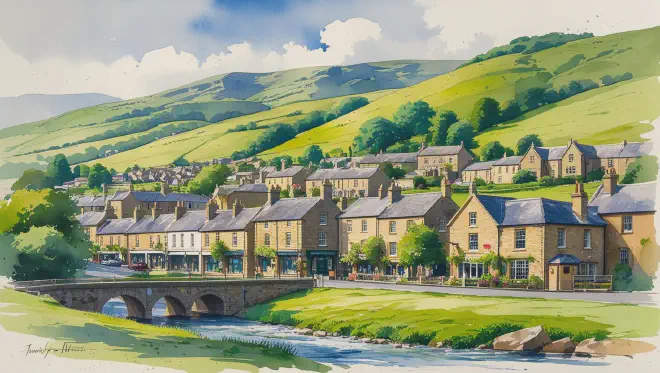
Deep within the Yorkshire Dales National Park in northern England lies a small town called Hawes. With a population of just over 1,100, this peaceful settlement sits in the beautiful Wensleydale valley, cradled by the Pennine hills. Stone-built houses line streets that seem untouched by time, preserving an atmosphere that feels lifted from the nineteenth century.
What has brought Hawes to the world’s attention is Wensleydale cheese, a tradition spanning a thousand years. French Cistercian monks who migrated from the Roquefort region are said to have first introduced cheesemaking to this valley. Even today, fresh milk from local family farms is transformed into cheese using time-honoured methods passed down through generations.
The hills surrounding Hawes form an endless carpet of green pastureland, divided by ancient dry stone walls into a beautiful patchwork that has come to symbolise the quintessential English countryside. Sheep grazing peacefully on the slopes, the distant sound of church bells—these simple pleasures offer a respite from the noise of modern life, a place where one can truly breathe.
Day 1: Stone Streets and the Beginning of a Journey
The train from Leeds took about two hours, the view from the window gradually transforming from urban sprawl to rolling countryside. At Garsdale station, the nearest rail stop, I transferred to a taxi for the final stretch to Hawes. The landscape passing by the car window was picture-postcard beautiful—gentle hills dotted with stone farmhouses, and occasionally, clusters of sheep appearing like white stones scattered across the green.
I arrived in the centre of Hawes around eleven in the morning. What immediately caught my eye were the honey-coloured stone buildings lining the main street. Most date from the seventeenth and eighteenth centuries, built from locally quarried Yorkshire stone. The warm tones seemed to welcome visitors with a gentle embrace.
For accommodation, I had chosen The White Hart Inn, a small pub with rooms above. The building was over two hundred years old, with low ceilings crossed by thick timber beams—a typical Yorkshire pub. My room on the first floor had a small window overlooking the main street. After dropping my bags and catching my breath, I set out to explore.
My first destination was the Wensleydale Creamery on Gayle Lane. This cheese factory and visitor centre is something of a local landmark. After purchasing my ticket, I wandered through the exhibition area. Through the viewing gallery, visitors can watch cheese being made from Monday to Friday. As it was Tuesday, I was fortunate to observe craftsmen in white coats warming milk in large copper vats and adding the curdling agents. The precision and care they brought to each movement spoke of generations of accumulated knowledge.
After the tour, I spent time in the shop sampling their wares. The ability to taste before buying was a welcome courtesy. I tried everything from classic Wensleydale to varieties studded with cranberries and apricots. What struck me most was how the flavour evolved with ageing—young cheese was fresh and light, while more mature versions had developed depth and complexity. In the end, I purchased both a traditional Wensleydale and a cranberry variety to bring home.
By the time I left the creamery, it was already past four. I strolled down the main street, peering into small antique shops and wool shops along the way. One shop selling hand-knitted sweaters made from local wool particularly caught my attention. The elderly woman who ran it spoke to me in her flowing Yorkshire accent about her craft. Her hands showed the slight distortions of decades spent knitting, yet the garments they produced were remarkably beautiful—true artisanship made visible.
Around six in the evening, I settled into the pub downstairs for dinner. The White Hart served as a gathering place for locals, and as evening fell, farmers and tradespeople drifted in for a pint after their day’s work. I ordered a local bitter at the bar and studied the menu. For tonight, I chose Yorkshire pudding with roast beef.
When the plate arrived, I was taken aback by the generous portions. A great mound of roast beef sat alongside an even larger Yorkshire pudding. This traditional batter dish, originally created to make use of leftover drippings, has become an essential part of the Sunday roast tradition. The pudding, soaked through with meat juices, was crisp on the outside and soft within—simple fare that delivered deep satisfaction.
During my meal, an elderly shepherd at the neighbouring table struck up a conversation. He had been raising sheep in these hills for over fifty years and shared fascinating stories about the seasons and the habits of his flock. What stayed with me was his description of lambing season in spring. “They call you out in the middle of the night,” he said with a rueful smile, his weathered face betraying a pride born of long experience.
By nine o’clock, as the pub grew more lively, I decided to retire to my room. Opening the window, I could hear the bleating of sheep from distant farms and the rustle of wind through trees—sounds that exist only in the deep quiet of rural places. Lying in bed, I reflected on my first day. Though I had been here less than a day, Hawes had already captured something in me.
Day 2: Walking the Hills, Touching History
I woke at six to birdsong. Pulling back the curtains, I found Hawes wrapped in morning mist, the stone buildings softened into something dreamlike, almost like a watercolour painting. I dressed lightly and stepped outside for a walk before breakfast.
On a small lane off the main street, I encountered the early morning routines of local life. A milk delivery man in an old van made his rounds, calling out “Morning!” as he passed. A woman walking her dog told me about nearby footpaths. Her Border Collie was friendly, lingering at my feet for some attention.
Back at the inn around eight, I ordered a full English breakfast. The plate arrived laden with bacon, sausages, fried eggs, grilled tomatoes, mushrooms, baked beans, and black pudding, accompanied by thick toast with butter and marmalade. The portions were substantial, but with a long walk ahead, I needed the fuel.
After breakfast, I visited the Dales Countryside Museum, which introduces the history and culture of the Yorkshire Dales. The exhibits on the region’s agricultural heritage and traditional crafts were particularly engaging. Most fascinating was the section on the knitting industry—this area once thrived on the production of hand-knitted sweaters and stockings during the nineteenth and early twentieth centuries. Looking at the old knitting frames and tools on display, I could almost see the lives of those who once used them.
Leaving the museum, I set off on the day’s main adventure—a hike to Hardraw Force. About ninety minutes’ walk from Hawes, this waterfall is known as England’s highest single-drop waterfall above ground. With a packed lunch prepared by the inn, I changed into sturdy walking shoes and began.
Once past the edge of town, classic Dales scenery opened up before me—pastureland divided by stone walls, scattered farmhouses, and distant hills rolling toward the horizon. The footpath was well-maintained, with waymarkers at regular intervals. After about thirty minutes of walking, I reached the first hilltop. Looking back, Hawes appeared small in the valley below. The morning mist had cleared entirely, leaving a bright blue sky.
Descending the hill, I followed a small stream. The dry stone walls in this area date mostly from the eighteenth century, standing intact after some two hundred years, still dividing the fields. The technique, called dry stone walling, uses no mortar whatsoever—just carefully placed stones supporting one another. The skill required is genuinely remarkable.
Around eleven, I reached the tiny hamlet of Hardraw. There was little here but a single pub called The Green Dragon Inn, which also serves as the gateway to the waterfall. After paying the entrance fee and walking through to the rear garden, I found what I had come for.
Hardraw Force drops roughly thirty metres in a single plunge. The force of the falling water was breathtaking. The surrounding rock face, made of limestone, has been sculpted by erosion over millennia into beautiful patterns. I was able to approach quite close to the base, and fine spray touched my face—cool and refreshing. I sat on a rock nearby, listening to the thunder of water while eating the sandwiches I had brought.
Around one o’clock, I started back. For the return journey, I chose a different route over higher ground. The climb was demanding, but the view from the top made every step worthwhile—the whole of Wensleydale spread out below. Green pastures through which a river wound lazily, villages scattered across the valley floor, and the Pennines fading into the distance. In that moment, I understood why so many people fall in love with this place.
Back in Hawes by three, I stopped at a tearoom on the main street to rest. At The Cockett’s Tea Room, I enjoyed afternoon tea. A three-tiered stand held cucumber sandwiches, scones, and small cakes, all beautifully arranged. The scones were exceptional, and I spread them generously with local clotted cream and strawberry jam. For the tea, I chose Earl Grey, which seemed to seep gently into my tired body.
After returning to the inn around five for a brief rest, I went out again for dinner—this time at The Golden Dragon, a Chinese restaurant in town. I was surprised at first to find such a place in a small English village, but the owner, Mr. Chen, explained that he had come from Hong Kong thirty years ago and made Hawes his home. The food was authentic, the sweet and sour pork and fried rice particularly good. The presence of local regulars spoke to a quiet example of multicultural coexistence in rural England.
By eight, I was back at the pub. Even more locals had gathered than the night before, and the atmosphere was lively. In one corner, someone had begun playing accordion and fiddle—traditional music night, held every Tuesday, when local musicians come together to perform old Yorkshire folk songs.
As I listened over a pint of ale, the shepherd I had met the previous evening reappeared, this time with his wife. Both were clearly enjoying themselves, clapping along with the music. He told me more about local history—how people had lived here since Roman times, how monasteries were built in the medieval period, how lead mining brought prosperity during the Industrial Revolution, and how tourism and farming now sustain the community.
Around ten, as the music wound down, an elderly man rose and began to sing. It was “On Ilkla Moor Baht ‘at,” the famous Yorkshire anthem. Within moments, others joined in, and the whole pub seemed to become one voice. In that moment, I felt less like a tourist and more like a temporary member of this community—a warmth I had not expected to find.
Even after returning to my room, I sat by the window for a while, listening to the night. The murmur of a distant stream, the occasional call of a night bird, the wind moving through branches. Sounds that city life makes us forget. It had been a full and deeply satisfying day.
Day 3: A Morning of Farewells and Gratitude
I woke on my final morning at half past five, earlier than usual. Perhaps it was reluctance to leave this beautiful place—some part of me wanting to hold onto every remaining moment. The view from the window looked different somehow. The same stone buildings, the same cobbled streets, the same distant hills—yet everything seemed more vivid, more precious than before.
Stepping outside in light clothes, I found the morning air crisp and clean. A deep breath seemed to fill me entirely. The main street was still quiet, only my footsteps echoing on the cobblestones. I passed an elderly local on his morning walk, and we exchanged silent nods—no words needed to share an appreciation for such a beautiful dawn.
I made my way to the small churchyard at the edge of town. St Margaret’s Church dates from the twelfth century and has been a spiritual anchor for the people of Hawes ever since. Many of the gravestones are from the eighteenth and nineteenth centuries, their inscriptions worn by weather and time. Yet even in their fading letters, I could sense the lives of those who were born, lived, and came to rest in this small town.
At seven, the church bell tolled, its sound spreading gently across Hawes to announce the new day. I sat on a bench and listened. This same sound had marked the mornings here for hundreds of years.
Back at the inn, I had breakfast and prepared to check out. As I tidied my room, I found myself reflecting on these two nights and three days. The faces I had encountered, the food I had tasted, the paths I had walked, the views I had seen—all of it etched deeply within me. What remained most vividly was the warmth of the people. They had welcomed a stranger naturally and kindly, and in their manner, I glimpsed something essential about human decency.
At ten o’clock, with my bags packed and ready to leave, I thanked the innkeepers. Mary pressed a packet of homemade shortbread into my hands as a parting gift, saying, “You must come back.” Tom said simply, “I hope Hawes has become one of your heart’s homes.” Their words stayed with me.
Before departing, I returned once more to the Wensleydale Creamery. In the production area, craftsmen were at work just as they had been the day before, quietly continuing the tradition. Watching them, I felt again the dignity of preserving something across generations. I bought more cheese—enough to bring the taste of Hawes back with me.
I walked through the centre of town one last time. The antique shops, the wool shops, the small cafés—places that had become familiar over just two days. The elderly woman at the wool shop waved from her window. The owner of the tearoom came outside to see me off. Such gentle farewells are the privilege of small towns.
At eleven, my taxi arrived to take me to Garsdale station. Through the car window, I watched Hawes grow smaller behind me. The last thing I saw was the church spire, the town’s quiet landmark. The driver, a local man, remarked, “Even after living here my whole life, this view still moves me every day.” His words made me realise that the true charm of Hawes lies not just in its scenery, but in the hearts of those who call it home.
On the station platform, waiting for my train, I jotted final notes in my journal. Numbers could sum up some of it—two nights and three days, roughly twenty kilometres walked, perhaps thirty people met. But what truly mattered could not be quantified. The way time moves here, the way people connect, the way one relates to nature—things I had forgotten in my city life, now remembered.
The train to Leeds arrived. From inside, I took one last look at Wensleydale. Green hills, stone walls, scattered sheep catching the afternoon light, everything gilded in gold. As the train pulled away, I whispered silently, “Thank you, Hawes. I will come back.”
As the scenery outside gradually shifted to something more urban, I was already feeling nostalgic for my time in that small town. What I had gained was more than memories. It was a new way of looking at life, and an understanding of what true richness might mean.
What Felt Real, Though Imagined
This journey of two nights and three days in Hawes was experienced entirely in imagination. I never actually set foot on that land, nor spoke with those who live there. Yet the sensation of walking on cobblestones, the taste of Wensleydale cheese, the sound of church bells, the warm smiles of strangers—all of these remain vivid within me.
Perhaps the essence of travel lies not only in physical movement. The longing for new places, curiosity about unfamiliar cultures, the wish to step outside daily routines—these feelings are themselves the true starting point of any journey. Even an imaginary voyage, when approached with sincerity, can yield genuine experience.
Through this small town, I caught a glimpse not only of the English countryside’s beauty, but of people who live by honouring tradition. The pride of the cheesemaker, the wisdom of the shepherd, the warmth of the innkeeper—these human qualities resonated deeply, even in imagination.
Now, as this imagined journey ends, I believe that what matters in travel is not arrival at a destination, but what one feels, learns, and how one changes along the way. These three days in Hawes were fictional, yet the wonder I experienced, the lessons I absorbed, and the perspectives I gained will surely sustain me in the days to come.
Every imagined journey must end. But the landscapes held in the heart, the faces remembered, the feelings stirred—these live on no differently than memories of places truly visited. They remain, and they will endure.