
Introduction
Hornstrandir lies in the far northwest of Iceland, a place that truly deserves to be called the edge of the world. Despite being the central town of the Westfjords region, it’s home to barely 2,600 people. Surrounded by sea on three sides, with desolate mountains rising at its back.
People first settled here in the 9th century. Vikings crossed the rough seas and established lives built on fishing and livestock in this harsh natural environment. Even today, Hornstrandir remains a fishing town, its harbor lined with colorful fishing boats. In the extreme environment of summer’s midnight sun and winter’s polar night, the people have learned the art of coexisting with nature.
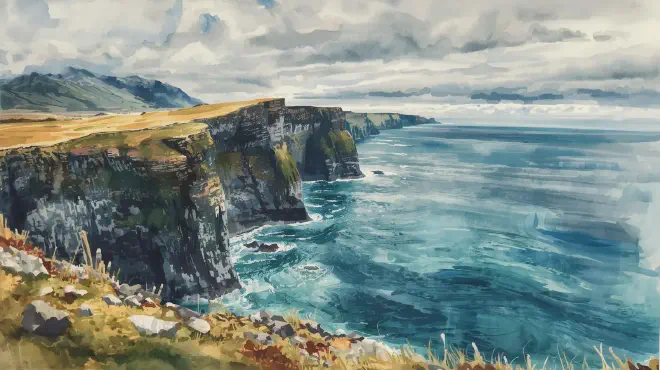
The town’s name, “Hornstrandir,” means “horn coast.” Indeed, the coastline visible from town features distinctive horn-like promontories jutting out, beyond which stretches the Arctic Ocean. This is one of Iceland’s most remote places. And perhaps for that very reason, it’s also a place where one can step away from urban noise and face oneself.
Day 1: Journey to the Horn Coast
The flight from Reykjavik to Hornstrandir takes about an hour and a half on a domestic route. Looking down from the small propeller plane’s window, Iceland’s landscape seemed like another planet. Lava plateaus stretched endlessly, punctuated by blue lakes weaving through them. As the aircraft headed west, the scenery gradually grew more rugged.
The moment I stepped off at Hornstrandir Airport, the cold wind against my cheeks made me catch my breath. It was a June morning, yet the temperature was below 10 degrees Celsius. The drive from the airport to the town center took about ten minutes. The taxi driver appeared to be local and shared the town’s history in broken English.
“This has always been a fishing town. My grandfather, my father, and I were all fishermen. Tourists are increasing these days, but the sea remains the center of our lives.”
My accommodation, the guesthouse “Hornbjarg,” sits on a hill overlooking the harbor. Converted from a 19th-century wooden building, its warm yellow exterior walls leave a lasting impression. From my room’s window, I could take in the beautiful view of Hornstrandir Fjord.
I spent the afternoon exploring the town. Along the main street, Höfnarstraeti, cafes, general stores, and a small supermarket lined up side by side. The buildings were all two or three stories, painted in vivid colors—red, blue, green. I’d heard this was meant to lift spirits during the long, oppressive winters.
I visited the Hornstrandir Maritime Museum near the harbor. Though small, it detailed the region’s fishing history extensively. What struck me most were the models of small wooden boats used by 19th-century fishermen. To think they fished these harsh seas in such small vessels filled me with respect for their courage.
Dinner was at a restaurant called “Viking” near the harbor. The interior was designed to resemble a ship’s hold, with old fishing equipment and ship parts decorating the walls. I ordered the local specialty, grilled lamb. Icelandic lamb, raised on herb-rich pastures, has a distinctive flavor. The accompanying potatoes, grown locally, spread a sweet, fluffy softness across my palate.
Stepping outside after dinner, though it was past eight in the evening, the sky remained dimly bright. This was the beginning of the midnight sun. In the harbor, fishermen prepared for the next day, the sound of boat engines echoing through the quiet night.
On my way back to the guesthouse, I looked down at the town from the hilltop. The scattering of small lights across the townscape resembled a scene from a picture book. In the distance beyond the horizon, clouds hung thinly, but sunlight filtered through the gaps.
Lying in bed, I reflected on the day. Though the journey had just begun, I already felt far removed from daily life. From outside the window came the sound of waves and occasional cries of seabirds, highlighting the quietude of this place.
Day 2: Walking Through Nature’s Sanctuary
I woke around six in the morning. Light streaming through gaps in the curtains told me it was already bright outside. During the midnight sun season, the boundary between sunrise and sunset becomes ambiguous.
Breakfast was in the guesthouse dining room. A traditional Icelandic breakfast consisted of dark bread with butter, cheese, and locally caught smoked fish. Accompanied by coffee, it seemed to warm me from my core.
In the morning, I took a short trip to the Hornstrandir Nature Reserve, about thirty minutes from town by car. I’d rented a car and set out alone. Along the way, I repeatedly encountered sheep crossing the road. Icelandic sheep are let out to pasture during summer, free to roam the grasslands and mountains. Their appearance spoke to the richness of this land’s nature.
Arriving at the nature reserve, vast grasslands spread before me. At this time in June, the grasslands were adorned with various wildflowers. Yellow Icelandic poppies, purple lupine flower spikes, and small white arctic cotton flowers. Their swaying in the wind seemed like silent music played by nature itself.
Following the trail deeper into the grasslands, I spotted mountains in the distance. Part of the Drangajökull massif, rising over 1,000 meters. Permanent snow remained on the peaks, their whiteness standing out against the blue sky.
After walking for about two hours, I came upon a small lake. The water’s surface was still as a mirror, perfectly reflecting the surrounding mountains. I sat on a large rock by the lakeside and had lunch with the sandwich I’d brought. Inside the bread was smoked trout I’d bought as a souvenir from last night’s restaurant. Its saltiness and the lake’s pristine air created a strange harmony.
In the afternoon, I returned to town and enjoyed interacting with locals. First, I visited a small yarn shop on the main street called “Wool World.” The owner, Sigríður, was a woman in her seventies who still practiced traditional Icelandic knitting techniques.
“This pattern has been passed down in my family for generations,” she said, showing me a hand-knitted sweater. The complex geometric pattern resembled snowflakes, conveying in a single glance the harshness and beauty of Icelandic winters.
“In the old days, each household would devise such patterns, and they served as family emblems. Nowadays, few people know these traditions, but I want to continue them as long as possible.”
Listening to Sigríður’s story, I thought about cultural preservation. In this small town, one elderly woman quietly maintained tradition. Though never proclaimed loudly, it would surely be passed to the next generation.
In the evening, I visited a small hot spring called “Pollurinn” on the town’s outskirts. Among Iceland’s many hot springs, this one was particularly small, serving as a gathering place for locals. The luxury of soaking in 42-degree water while gazing at the fjord scenery.
A man who appeared to be a local fisherman was already in the spring. He could speak English, and we exchanged a few words.
“My family has used this spring since my grandfather’s time. After fishing, coming here to soothe our fatigue has become a habit. Tourists come now too, but locals still outnumber them.”
He then told me about today’s catch. Cod, salmon, and sometimes lobster, he said. “The sea is harsh, but for us it’s also the source of life.” His words left a strong impression.
Dinner was at “Café Horn” in the town center. This establishment operated as a cafe during the day and a restaurant at night. I ordered “hangikjöt,” an Icelandic traditional dish. Lamb meat smoked using a special method, with a distinctive flavor. Though initially hesitant, as I continued eating, I became captivated by its deep taste.
For dessert, I had Iceland’s traditional yogurt called “skyr.” Rich yet refreshing, served with blueberry sauce.
After the meal, I walked through town again. Past ten o’clock at night, the sky remained bright, and in the harbor, anglers cast their lines. When I spoke to them, they turned out to be locals, not tourists.
“Night fishing is one of our pleasures. We work during the day, so at night we enjoy fishing leisurely. During the midnight sun season, our sense of time changes.”
Indeed, in this bright night, the flow of time felt different. There was a pleasant feeling of liberation from the usual time axis, surrendering to nature’s rhythm.
Day 3: A Morning of Departure and What Remains in the Heart
On the final morning, I woke a bit early and walked to the harbor. Though it was around five in the morning, fishermen were already at work. The sounds of preparing boats, engines, and seabirds colored this land’s morning.
I walked toward a small lighthouse at the harbor’s tip. The white cylindrical lighthouse, built in 1902, still actively protects ships’ safety. Around the lighthouse grew low grasses shaped by ocean winds, with small flowers blooming among them.
Sitting on a bench near the lighthouse, I gazed at the sea and reflected on this journey. Though a brief stay of only two nights and three days, I’d fully savored this land’s natural beauty, the warmth of its people, and the rich time within the silence.
In the morning, I returned to the yarn shop “Wool World” that I’d visited yesterday. I wanted to share my travel impressions with Sigríður. Entering the shop, she was knitting just as she had been yesterday.
“Thank you for coming again. How was your stay in our town?”
“I had a wonderful time. Especially at yesterday’s hot spring, speaking with a local helped me understand a bit about life here.”
“I’m glad. We’re not a people who speak much, but we hold many thoughts in our hearts. When travelers like you sense that, it makes us very happy.”
Moved by Sigríður’s words, I purchased a small hand-knitted hat as a memento. The hat, woven with traditional Icelandic patterns, became a treasured keepsake of this journey.
For lunch, Ástríður, the wife of the guesthouse owner Magnús, prepared a special meal. It was “fiskabúlla,” a homestyle Icelandic fish soup, with a gentle flavor of stewed cod, salmon, and vegetables.
“This recipe was taught to me by my mother. It’s been made throughout the long winters to warm the body. Every Icelandic woman can make this soup.”
Listening to Ástríður’s story while eating, I felt the importance of transmitting culture through food. Cuisine condenses a land’s history and the wisdom of its people.
In the afternoon, I took a final walk around the town. Fine details I hadn’t noticed when I arrived two days ago now felt precious. The old stone church, the colorful boats moored in the harbor, and the mountains visible in the distance.
I also visited a small cemetery on the town’s edge. Old gravestones bore dates from the 19th to early 20th centuries. People who lived in this harsh environment now rested quietly. Many gravestones featured carvings related to the sea, telling of this land’s people and their deep connection to it.
In the evening, before heading to the airport, I visited the harbor one last time. Boats returning from today’s fishing were coming in, fishermen putting away their nets. That everyday scene now seemed special to me.
“Come back again.”
The fisherman I’d met at the hot spring yesterday happened to pass by and called out.
“I’ll definitely return. Next time I want to stay longer.”
“We’re always here. As long as there’s the sea, this town will continue.”
His words brought me deep reassurance. This town, these people, this landscape would likely continue to exist, unaffected by the passage of time.
In the taxi heading to the airport, I looked back at the town. The small town’s lights glowed warmly in the twilight. That scene seemed like a picture engraved in my heart.
Waiting to board at the airport, I recalled the people I’d met over these three days. Sigríður’s gentle smile, Ástríður’s warm cooking, the fisherman’s powerful words. Each represented the rich humanity of this place.
As the plane took off and I looked down from the window, the town of Hornstrandir appeared small. And within the vast nature surrounding it, I felt how small human endeavors are, yet simultaneously how precious.
As the aircraft flew toward Reykjavik, the landscape of Hornstrandir remained vivid in my heart. The sound of wind at the harbor, the warmth of the hot spring, and the people’s smiles. These were irreplaceable treasures gained during this brief journey.
In Closing
The two nights and three days in Hornstrandir, though an imaginary journey, became a memory that exists tangibly in my heart. The cold wind of this place, the quiet lake, the warm smiles of the people, and the taste of simple cuisine. I can recall them as vividly as if I’d actually experienced them.
Perhaps travel isn’t solely about physical movement. The landscapes we picture in our minds, the conversations we imagine with people, the wind and scents we feel—these too are surely part of the journey.
The dawn light of Hornstrandir, the figures of people working in the harbor, and the ridgeline of distant mountains. These scenes continue to live on in my heart. And I hope that someday, this imagined journey will become reality.
A journey that, though imaginary, feels as if it truly happened. This speaks to the wonder of human imagination. We can travel anywhere in the world within our hearts.