
The Serene Seaside Beloved by Royalty
The name “Hua Hin” itself carries an air of elegance and tranquility. Located about 200 kilometers south of Bangkok on the Gulf of Thailand, this small coastal town has maintained its serenity and dignity since being established as a royal retreat by King Rama VI in the 1920s.
Situated at the southern tip of Phetchaburi Province, Hua Hin means “stone head” in Thai. True to its name, small rocky outcrops dot the coastline, against which gentle waves endlessly break. Here, there is none of the clamor found in Phuket or Pattaya. Instead, there are elegant buildings etched with royal history, humble markets run by local people, and sunsets that make you forget time itself.
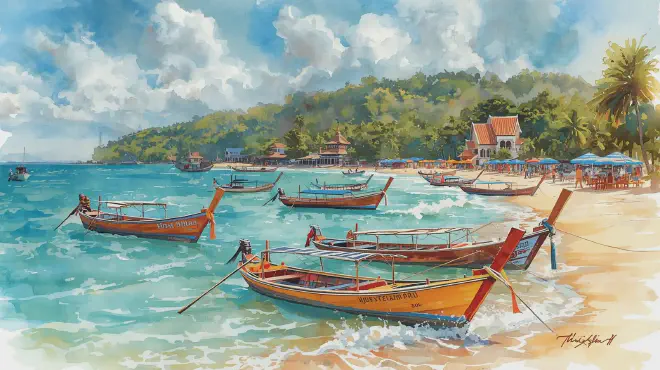
As a royal summer retreat, the town is still graced by the Klai Kangwon Palace, surrounded by lush green parks. Yet it also retains the unpretentious face of a fishing village, where colorful fishing boats return to port each morning.
What drew me to Hua Hin was precisely this duality. Royal dignity and common warmth coexist naturally; modern resort hotels harmonize with old wooden houses. I felt that by walking through this town, I might remember something important. With this premonition in my heart, I set out on a small journey of two nights and three days.
Day 1: Arrival Bathed in Afternoon Light
I boarded the morning train from Bangkok’s Hua Lamphong Station, and after a four-hour journey, stepped off at Hua Hin Station just after 2 PM. The station building was much smaller than I had imagined, its red roof gleaming in the strong tropical sun. Built in 1911, this station is said to be one of the most beautiful in Thailand, and indeed it was. The architecture, European in decoration yet somehow Thai in its softness, seemed to tell the story of this town’s history.
From the station to my hotel was about a 15-minute walk. Pulling my suitcase along, I strolled slowly through the town. The roads were wider than expected, traffic was moderate—a world apart from Bangkok’s chaos. On both sides of the street, old wooden shops mingled with new cafes, making the passage of time palpable.
My accommodation was a mid-sized hotel along the beach road. After checking in and entering my room, the blue sea spread out beyond the window. The sound of waves resonated pleasantly, and the humid sea breeze, different from Bangkok’s heat, caressed my cheeks. I dropped my luggage and immediately headed for the beach.
Hua Hin Beach was wider than I had imagined, its white sand forming a gentle arc. The afternoon sun was strong, but the sea breeze brought coolness. Some tourists sat in beach chairs, but without crowding, each enjoying their own time. I walked barefoot along the sand, picking up small shells. One small enough to fit in my palm was a pale pink color, as if holding the ocean’s memories.
As evening approached and hunger set in, I headed to a local eatery along the coast. Under a sign reading “Som Tam Hua Hin,” an auntie was running the shop alone. The menu was only in Thai, but through gestures, I ordered som tam (green papaya salad) and gai yang (grilled chicken).
The som tam offered the crisp texture of green papaya perfectly balanced with lime, fish sauce, and chilies. The spiciness was mild, gently cooling my body heated by the sea breeze. The gai yang was fragrantly grilled, its juices spreading deliciously through my mouth. Eaten together with khao niao (sticky rice), the combination was moving in its perfection.
The auntie occasionally spoke to me in broken English. “Hua Hin, first time?” “From Japan?” Such simple conversation, yet its warmth touched my heart. Her smile seemed to embody the kindness of the people in this land.
As the sun began to set, the sky gradually turned orange. I finished my meal and returned to the beach. Many people had gathered to watch the sunset, but all were quiet, absorbed in its beauty. As the sun approached the horizon, the sky’s color shifted from deep orange to purple, and a glittering path of light appeared on the sea’s surface.
When the sun completely disappeared, stars began to appear in the sky one by one. In Hua Hin, with its limited city lights, you could enjoy a starry sky invisible in urban areas. I returned to my hotel balcony and, listening to the sound of waves, reflected on the day.
Though I was tired from traveling, more than that, my heart had been soothed by this town’s unique atmosphere. Removed from the rush of daily life, time flowing slowly—this was a precious experience only travel could offer. What discoveries would tomorrow bring? Thinking such thoughts, I fell into a deep sleep.
Day 2: From Morning Market Bustle to Palace Serenity
I woke around 6 AM. It was still dim before sunrise, but I could already hear lively voices from outside the window. Opening the curtains, I saw fishing boats returning to port beyond the beach. The boats, having finished a night’s work, must surely be loaded with fresh seafood.
After showering and getting ready, I walked through the still-cool morning air toward the morning market. Chatchai Market, which could be called Hua Hin’s kitchen, was where locals gathered to buy daily necessities and groceries. At the market entrance, colorful tropical fruits were piled high. Mangoes, pineapples, dragon fruit, rambutans—all fruits that would be expensive in Japan, but here available at reasonable prices.
At the seafood section, fresh fish that the boats I’d seen last night must have brought were lined up on ice. Shrimp, crabs, squid, and various fish whose names I didn’t know. When the vendor noticed me looking with interest, he pointed to several fish and explained something. Though I couldn’t understand his words, his proud expression conveyed confidence in their freshness.
Deep in the market, food stalls lined up in rows. It was bustling with locals seeking breakfast, and I, a lone foreigner, felt naturally absorbed into the scene. I decided to have breakfast at a khao tom (rice porridge) stall. The elderly shopkeeper ladled white porridge into a bowl with practiced hands, topping it with finely chopped pork, ginger, and cilantro.
One sip revealed a gentle flavor spreading through my mouth. The ginger’s fragrance was pronounced, seeping kindly into my morning stomach. The cilantro’s aroma rose through my nose, making me feel Southeast Asia’s morning. Local people ordered the same dish one after another, eating quickly while standing before leaving. I felt as if I’d been allowed to participate, just a little, in their daily routine.
After breakfast, I left the market and headed for my next destination, Klai Kangwon Palace. It was about a 20-minute walk from the market. The morning sun was still gentle, making the walk pleasant. Passing through residential areas, I saw a lush park come into view. Beyond it stood beautiful palace architecture.
Klai Kangwon Palace was built in 1926 by King Rama VII as a summer retreat. Meaning “Palace of Distant Worries” or “Far from Worries,” this building is known for its unique design blending Spanish colonial style with traditional Thai architecture. Now open as a museum, it offers glimpses into royal history and the lifestyle of that era.
The palace interior was simpler and more practical than I had imagined. Rather than lavishly ornate, it was a space of dignified calm. Furniture and furnishings actually used by the royal family were on display, and from each piece, you could feel the breath of life from that time. Particularly striking were the large windows overlooking the sea. The view from here must still be as beautiful as ever.
After touring the palace, I strolled through the adjacent Ratchaphak Park. In the vast grounds, various plants, mainly Thai native species, were planted. Frangipani flowers wafted sweet fragrance, and bougainvillea added vivid color. Benches were scattered throughout the park where people read, meditated, or simply passed time, each in their own way.
I also sat on a bench for a while, gazing at the surrounding scenery. Beyond the park, the sea was visible, and occasionally I heard birds singing. There was a profound silence impossible to taste in urban areas. The concept of time became vague, and I felt a strange sensation as if past and present were gently merging.
I had lunch at a small restaurant near the park. Called “Krung Thai,” this establishment seemed to be a longtime favorite of locals, its walls decorated with many old photographs. Looking at the menu, I found hoi tod pla muek (squid omelet), a Hua Hin specialty. Without hesitation, I ordered it, along with tom yum goong.
Hoi tod pla muek is a Thai-style omelet using squid and eggs, offering a crispy exterior and fluffy interior. Topped with a slightly sweet sauce, it was a flavor easily palatable to Japanese tastes. The tom yum goong perfectly balanced the umami of shrimp with the fragrance of lemongrass and lime leaves, its spiciness and sourness revitalizing my weary body.
In the afternoon, I explored the area around Hua Hin Railway Station, a symbol of the town. Built in 1911, this station is known as the most beautiful in Thailand and still functions as an active station. The contrast of its red roof and white walls was beautiful, and its presence carried the weight of more than a century of history.
In the station waiting room, locals were leisurely waiting for trains. Looking at the timetable, I saw only a few trains to Bangkok each day, conveying a flow of time completely different from the rush of urban areas. I also sat on a waiting room bench, watching people come and go through this station. There were tourists, but mostly locals, and from their natural expressions, the tranquility of daily life was transmitted.
As evening approached, I headed to the beach again. Thinking I’d watch the sunset from a different spot than yesterday, I turned north. There were ponies carrying tourists on their backs along the beach. The peaceful scene warmed my heart. In the sea, local children were playing in the water, their innocent voices mixing with the sound of waves.
Today’s sunset was also beautiful. The sky’s color was subtly different from yesterday, a deeper orange. The clouds’ shapes were also different, as if viewing a different painting each day. While watching the sunset, I reflected on the day. The lively experience at the morning market, the tranquil time at the palace, the meditative moments in the park—all were memorable, deeply etched in my heart.
I had dinner at a seafood restaurant along the coast. Tables were placed directly on the sand, allowing meals accompanied by wave sounds. From the menu, I chose pla neung manao (steamed fish with lime) and goong pad phong karee (crab curry stir-fry). Both dishes made the most of fresh ingredients, letting me fully savor the ocean’s bounty.
After dinner, I stopped by the night market. Different from the daytime market, the evening market had many souvenir shops for tourists. Thai silk scarves, handmade accessories, local seasonings—colorful goods lined the stalls. I purchased a small wooden elephant carving. That palm-sized elephant would become a symbol of my Hua Hin memories.
On my way back to the hotel, I walked along the nighttime beach. The sea, showing a completely different expression from daytime, released a mysterious beauty illuminated by moonlight. The sound of waves resonated more quietly, more deeply, penetrating to the depths of my heart.
Returning to my room and gazing at the night view from the balcony, I ruminated on the day’s experiences. I was amazed that so many diverse expressions existed within this small town of Hua Hin. Royal dignity and common warmth, modern convenience and traditional beauty, lively mornings and silent nights—everything harmonized, gently embracing visitors. Tomorrow would already be the final day. Thinking that my parting with this town was approaching made me feel a little lonely.
Day 3: Morning of Farewell and the Silence of Khao Takiab Temple
On the last morning, I woke earlier than usual. At 5:30 AM, it was still dim outside, but a faint brightness had begun to appear in the distant sky. Wanting to see the sunrise on this journey’s final day, I hurriedly got ready and headed for the beach.
Several figures were already on the shore. A man who seemed to be a local, a woman jogging, and an elderly couple walking their dog. Everyone was cherishing their own morning time. I joined them, waiting for the sun to rise from beyond the horizon.
Gradually the sky brightened, and the horizon began to shine golden. Then, the moment the sun’s upper edge appeared, the entire sea surface glittered brilliantly. A completely different light from the previous days’ sunsets—a hopeful light, announcing the beginning of a new day with powerful radiance.
After witnessing the sunrise, I returned to the hotel for breakfast. Today’s plan included visiting Khao Takiab Temple and a final walk through town. I wanted to make good use of the time before checkout.
Khao Takiab Temple sits on a hill slightly removed from Hua Hin’s center. At about 120 meters elevation, from the summit you can overlook all of Hua Hin town and the sea. Hoping to go while the morning was still cool, I left the hotel around 8 AM.
The path to the temple starts flat but becomes a steep slope partway up. Stone steps are maintained, but still my breathing labored. Trees grew thickly on both sides of the path, and occasionally I spotted monkeys. After climbing for about 15 minutes, a beautiful stupa came into view.
The main hall of Khao Takiab Temple is built in traditional Thai architectural style, its golden decorations beautiful in the morning sun. The principal Buddha statue wore a peaceful expression, and as I placed my hands together before it, my heart naturally calmed. Including myself, there were only a few worshippers, allowing me to hold prayer time in silence.
After worship in the main hall, I headed to the summit observation deck. The view of Hua Hin from there was breathtakingly beautiful. Blue sea, white sandy beach, green hills, and red-roofed houses. I could see the entire small town at a glance, places I’d walked over two days visible as if in the palm of my hand. Beyond the coastline floated small islands, and beyond them, an infinitely spreading sea.
The observation deck had a bench, and I sat for a while, gazing at the scenery. The wind was pleasant, and I could hear birds chirping. In this silent time, I reflected on the journey so far. Though only three days, it had been intensely rich and fulfilling. New discoveries, beautiful scenery, encounters with warm people, delicious food—all deeply carved into my heart.
On the way down the mountain, I met a local grandmother at a small shop. She was selling handmade amulets and recommended one to me. A wooden amulet carved with a small Buddha figure that would surely protect my journey. Though we could barely communicate, her warm smile and her pleased reaction to my Thai “khop khun kha” (thank you) were memorable.
After descending from the temple, I used my remaining time to explore the town. I peeked into small alleys I hadn’t visited and checked out shops that had caught my interest. Nowhere was overly touristy; the daily lives of local people were palpable. Children heading to school, women chatting in front of shops, a young man making deliveries by motorbike—each wore natural expressions, living their daily lives.
For lunch, I decided to return to the same eatery I’d visited on the first day. The auntie seemed to remember me and greeted me with a beaming smile. Today I ordered pad thai and tom kha gai. The pad thai’s sweet-sour sauce clung well to the noodles, with bean sprouts providing a crisp accent. The tom kha gai perfectly balanced coconut milk’s mellowness with the fragrance of galangal and lemongrass—a gently flavored soup.
After finishing my meal, checkout time was approaching. As I packed my luggage in the hotel room, I gazed once more at the sea visible from the window. Thinking this was the last time I’d see this view, the last time I’d hear the sound of waves, something welled up in my chest.
After checking out, on my way to the station, I walked along the coast once more. The afternoon sun was strong, but the sea breeze brought coolness. On the beach, local children were playing just as they had yesterday. Watching that scene, I was struck by a strange sensation of time cycling. Even after I left here, this town’s daily life would continue. Though that was obvious, somehow it felt especially meaningful.
Arriving at Hua Hin Station, the Bangkok-bound train was already at the platform. The scenery visible from the train window flowed past in the opposite direction from my arrival. Green pastoral landscapes, small towns, and gradually appearing urban buildings. As the scenery changed, my time in Hua Hin was becoming the past.
Yet strangely, satisfaction outweighed loneliness. Though the time had been short, I had fully felt this town’s charm. And above all, being away from daily life and having time to face myself was a great harvest. Silent mornings, lively markets, gentle sunsets, kind people—all of these merged in my heart, becoming irreplaceable memories.
As the train approached Bangkok, urban clamor returned. High-rise buildings, traffic jams, countless people. That too was part of reality, but Hua Hin’s silence remained in my heart. Surely from now on, when I’m tired or lost, memories of this town will support me.
An Imaginary Journey That Felt Vividly Real
Looking back, this two-night, three-day journey to Hua Hin was precisely “an imaginary journey that felt vividly real.” Roads I didn’t actually walk, food I didn’t actually eat, people I didn’t actually meet. Yet each one remains vividly in my heart.
Why is that? Probably because longing for travel and imagination created experiences more real than reality itself. In our hearts constantly dwells yearning for unseen places, curiosity about unknown cultures, and anticipation of new encounters. Such emotions give imaginary journeys deep color and rich texture.
Through this journey, I also came to know the town of Hua Hin deeply. The unique atmosphere where royal dignity and common warmth coexist, the abundant nature and gentle sea, fresh ocean bounty and aromatic Thai cuisine, and above all, the luxury of slowly flowing time—all of these form this town’s charm.
Precisely because it was an imaginary journey, I could depict ideal experiences transcending real-world constraints. The weather always beautiful, everyone I met kind, every dish delicious. Such a perfect journey might not exist in reality, yet it certainly exists in our hearts.
And what this imaginary journey taught me was that the essence of travel doesn’t necessarily lie in physical movement. The silence, beauty, warmth, and newness that our hearts seek—if we can feel these, we can taste travel’s joy wherever we are. Small discoveries and emotions hide even in daily life. What matters might be the mental space and sensitivity to find them.
For those who read this travel journal, I hope the town of Hua Hin feels even a little closer. And if you ever have the chance to truly visit this place, surely a different yet equally beautiful experience from this imaginary journey awaits.
Imagination and reality, fantasy and experience, longing and realization—the boundaries between these sometimes become vague. And within that vagueness might dwell the magic of travel. Today again, a new journey begins in my heart.