
A Small Village in the Yorkshire Dales
Ingleton is a small village nestled in a corner of the Yorkshire Dales National Park in northern England. Its population is around 1,500. Located near the border between Lancashire and Yorkshire, about four hours by train from London with connections, this place is known for the distinctive landscape created by its limestone bedrock.
Most people who visit Ingleton are hikers. The “Ingleton Waterfalls Trail,” a roughly 7-kilometer circular route starting from the village that visits three waterfalls, has been beloved since the 19th century. Cave systems carved by rainwater eroding the limestone, the stark beauty spreading across the foothills of the Pennines, and green pastures dotted with sheep—here remains the rustic landscape of northern England that has continued since before the Industrial Revolution.
Many of the village buildings are constructed from locally quarried limestone. The grayish stone walls gleam dully when wet with rain and show a soft whiteness on sunny days. The village prospered in the 18th century with coal mines and quarries, but now it serves as a quiet tourist destination, offering visitors peaceful moments.
I chose this village because I wanted to escape the clamor. Not the bustle of the city, but a place where only natural sounds could be heard. And I wanted to surrender myself to landscapes that reveal themselves only through walking.
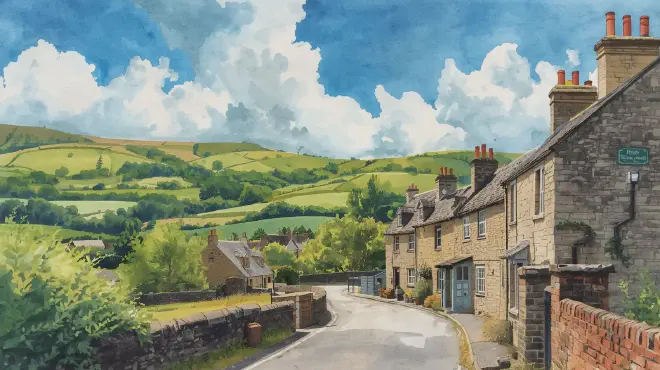
Day 1: Arriving in the Stone Village
The local train I boarded from Leeds station was a single-track line heading toward Carlisle. Through the window, I watched as plains gradually transformed into hills. Stone walls dotting green pastures, ridgelines of distant hills stretching across the horizon. I disembarked at Settle station, then took a bus for twenty minutes. Just after 2 p.m., I arrived in Ingleton.
The village center was surprisingly small. Along the main street stood stone buildings—two pubs, a few small shops, and that was all. I had reserved a room at a B&B called “Greystone House” on the village outskirts. It was an 18th-century farmhouse converted into an inn, run single-handedly by the proprietress, Margaret.
“Welcome. You’ve come a long way,” she greeted me with a gentle smile.
My room was a corner room on the second floor, with windows overlooking the hills beyond the village. The walls were thick, the window frames deep. The cool air characteristic of stone houses was pleasant. After setting down my luggage, I decided to explore the village right away.
In the afternoon light, the village lay utterly still. Occasionally, sheep bleating echoed from afar. Walking past the main street and by the parish church, I found 18th-century gravestones lined up in the cemetery. Names carved into moss-covered stones, some no longer legible. People born here, who lived here, who now sleep here. I felt the weight of lives rooted in this land.
After buying trail food for the next day at the village shop, I entered the pub “Wheatsheaf Inn.” Though it was just past 4 p.m., several apparent regulars were already quietly nursing their beers at the counter. I ordered a pint of local ale and the soup of the day.
What arrived was leek and potato soup. The cream-based warm soup had a rich depth of flavor—likely made with generous amounts of Yorkshire butter. The accompanying bread came from the village bakery, they said. Crusty on the outside, moist within.
Outside the window, the evening light gradually slanted. The pub was dim inside, the fireplace flames flickering gently. No one seemed in any hurry; time flowed slowly. An elderly man sitting next to me spoke up: “Where are you from?”
When I answered “Japan,” he widened his eyes in surprise.
“All the way from Japan to this little village with nothing in it. Come to see the waterfalls, have you?”
When I confirmed, he nodded with satisfaction.
“Weather should be fine tomorrow. If you’re walking the Waterfall Trail, best set out early. The waterfall sounds carry better when there aren’t many people about.”
Deciding to follow his advice, I slowly finished my beer. When I stepped outside, the sky was beginning to turn crimson. The ridgeline of the hills stood out sharply, and the entire village was enveloped in evening stillness.
Returning to the B&B, Margaret made me tea. By the fireplace in the living room, she told me about the village’s history. How it once prospered with slate quarrying and the wool industry. How, after the railway came, Victorians began visiting as a summer retreat. And how now it had become a village quietly visited by hikers.
“But you see, some things never change. These stone walls, those hills, the sound of the waterfalls. They’ve been here for hundreds of years.”
Her words were calm and certain. I returned to my room and gazed at the hills sinking into the night’s darkness from the window. Stars twinkled, more than could ever be seen in the city. Tomorrow I would walk this land. At the thought, my heart quickened with anticipation.
Day 2: Walking the Waterfall Trail
The next morning I woke at 6 a.m. Outside the window it was still dim, but birdsong filled the air. Breakfast was at 7:30. Margaret had prepared a traditional English breakfast: bacon, sausage, sautéed mushrooms, baked beans, tomato, and a fried egg. The eggs, delivered from a local farm, had deep orange yolks and a rich flavor.
“Going to see the waterfalls today, are you? I’ve made you some sandwiches to take along.”
The parcel she handed me contained cheddar cheese and pickle sandwiches, plus an apple. Wearing my waterproof jacket and hiking boots, I set off just after 8.
The entrance to the Ingleton Waterfalls Trail was about a ten-minute walk from the village. At a small reception hut, I paid the entrance fee, received a map, and began walking. The morning air was cold, my breath visible in white puffs.
The first thirty minutes followed a gentle ascent beside pastureland. Progressing along the small path enclosed by stone walls, I saw sheep grazing lazily in the distance. In places, limestone rock was exposed underfoot, etched with distinctive patterns from rain erosion.
As I entered the woods, the air changed. Morning light filtering through the trees illuminated moss-covered stones. The sound of water gradually grew louder, and the first waterfall, “Pecca Falls,” came into view.
About 9 meters high, the waterfall cascaded vigorously down the limestone cliff face. Spray flew on the wind. Drawing closer, cool mist-like droplets touched my face. The plunge pool water was a deep green.
I stood for a while before the empty waterfall. Only the sound of water echoed. The wind moving through trees, distant bird calls. Nothing else could be heard. The city’s clamor seemed like another world entirely.
The path to the next waterfall, “Holly Falls,” led deeper into the forest. The trail occasionally crossed rocky sections, forded small streams, and climbed steep slopes with exposed roots. This was less a tourist spot than a proper hiking course. But that’s precisely why nature remained in its unaltered state.
Holly Falls was a graceful waterfall that flowed down in curves between rocks. The water fell in several stages, each time creating white foam. The surrounding trees were dressed in fresh greenery, gleaming in the sunlight. I rested here briefly and ate the sandwiches Margaret had made. The saltiness of the cheese and the acidity of the pickles soaked into my tired body.
In the afternoon, I arrived at the third waterfall, “Thornton Force.” This was the trail’s highlight. Fourteen meters high, more than ten meters wide. Water thundered down from the limestone cliff. Behind the waterfall, geological strata from hundreds of millions of years ago lay exposed. Looking up from below, I was overwhelmed by its power.
A bench had been placed before the waterfall. I sat there and gazed at it for a while. As the sun began its western descent and the angle of light changed, the waterfall’s water shimmered with rainbow colors. I lost track of time, simply being there. Thinking nothing, only surrendering to the sound of water and wind.
The return route passed over the hilltop. Emerging from among the trees, my view opened, and the vast landscape of the Yorkshire Dales spread before me. Green hills layered upon one another, with barren mountain slopes beyond. Pastures dotted with sheep, meandering streams, the white walls of distant farmhouses.
I returned to the village around 4 p.m. About eight hours, seven kilometers. My feet were tired, but my heart was full. Returning to the B&B, Margaret greeted me with “Welcome back.” After showering and changing, I headed once more to the village pub.
The Wheatsheaf Inn at night was livelier than yesterday. Local people had gathered after work, and the counter was full. I ordered cottage pie and a beer. The cottage pie that arrived was so generous it nearly overflowed the dish. Minced meat and onion filling topped with abundant mashed potato, the surface toasted golden brown.
When I inserted my fork, steam rose with the aroma of meat. Rich gravy sauce mingled with fluffy potato. This was northern English pub food at its finest. Without pretense, yet warming body and soul.
At the next table, a young couple who had apparently walked the trail today were excitedly discussing the waterfalls. Beyond them, elderly men enjoyed a game of darts. I realized the pub was part of the village people’s lives.
On the walk home, the village was quiet. Few streetlights, only starlight to rely on. In the distance, an owl hooted. Returning to my room and lying in bed, the day’s journey floated through my mind. The sound of waterfalls, the forest’s fragrance, the touch of wind. All vividly resurfaced. With deep satisfaction, I drifted into sleep.
Day 3: A Morning of Farewell and Stone’s Memory
On my final morning, I woke slowly. Today I would leave the village in the afternoon. After finishing breakfast, I packed and decided to walk the village during my remaining time.
I chose a different route than the previous days. A small path on the village’s north side, continuing to Chapel-le-Dale. Following the narrow path between stone walls, a small chapel came into view. St. Leonard’s Church. Built in the 12th century, this church sat quietly with its surrounding cemetery.
Opening the door, cool air and the scent of old wood drifted out. Inside was dim, with light from stained glass windows drawing colorful patterns on the floor. Wooden pews, a simple altar, biblical verses carved into the walls.
How many people had offered prayers here? Wishing for the safety of newborn children, praying for safe journeys, mourning the departed. This place held hundreds of years of accumulated prayers. At the thought, my chest grew warm.
Leaving the church, I walked further inward. The path gradually narrowed, stone walls pressing in from both sides. Emerging into an open space, vast pastureland spread before me. In the distance rose the form of Pen-y-ghent. This 694-meter mountain is one of the Yorkshire Three Peaks.
In the middle of the pasture stood an old stone barn. Part of the roof had collapsed, grass growing from the walls. It had clearly been unused for a long time. Yet in its presence, I could sense traces of the life once lived here. Shepherds had sheltered from rain here, weathered winter’s cold. I could almost see that scene.
By the time I returned to the village, noon had passed. Bidding farewell to Margaret at the B&B, she smiled and waved, saying “Come again.” At the village shop, I bought Yorkshire tea as a souvenir. The elderly shopkeeper said, “Drink this tea in Japan and remember Ingleton.”
While waiting for the bus at the bus stop, I surveyed the village. Stone houses, the church steeple, distant hills. Though my stay had been only two nights and three days, this village had carved itself deep within me. Here, time flows slowly. People live alongside nature, and their way of life has continued across generations.
The bus arrived, and I left the village. The scenery from the window was the same as when I arrived. Green pastures, stone walls, distant hills. But now the landscape’s meaning appeared different to me. Here were people’s lives, history, and quiet pride.
I boarded the train from Settle station to Leeds. Sitting in my seat, gazing out the window, I reflected on my time in Ingleton. The sound of waterfalls, the forest’s fragrance, the pub’s warmth, people’s kindness. All of it became one story within me.
Travel is not merely about visiting places. It’s about breathing the land’s air, touching people’s lives, placing oneself within nature. Only then can you truly understand a place. Ingleton quietly taught me this.
The train picked up speed, leaving the Yorkshire hills behind. Looking at my face reflected in the window, I smiled. I’ll come back. Someday, certainly. I decided this in my heart.
What Felt Real Despite Being Imaginary
This journey never actually took place—it’s an imaginary trip. I haven’t walked Ingleton’s stone-paved streets, nor have I heard the waterfalls’ sound directly. The proprietress Margaret, the Wheatsheaf Inn’s cottage pie—these are not things I actually encountered.
Yet while writing this journey, I felt as though I had truly been there. Ingleton village exists, as does the Waterfalls Trail. The limestone bedrock of the Yorkshire Dales, the pastures dotted with sheep—they’ve been there unchanged for hundreds of years.
Even in imaginary travel, you can touch a place’s essence. Reading materials, viewing photographs, letting your thoughts drift to that place—in doing so, memories emerge in your heart as if you’d actually visited. Perhaps when I truly visit that land someday, these imaginary memories will enrich the real experience.
Travel is not only physical movement but also movement of the heart. By turning my thoughts to the small village of Ingleton, I certainly gained something. The value of stillness, the power of nature, and the dignity of lives accumulated over time.
I hope this imaginary journey might become the beginning of someone’s real journey someday.