
An Island Wrapped in Mist and Legend
The Isle of Skye is known as the largest and most mystical island among Scotland’s Hebrides archipelago in the northwest. Called “An t-Eilean Sgitheanach” in Gaelic, the name means “the winged isle,” and indeed, the island’s shape traces a distinctive outline like great wings spread wide.
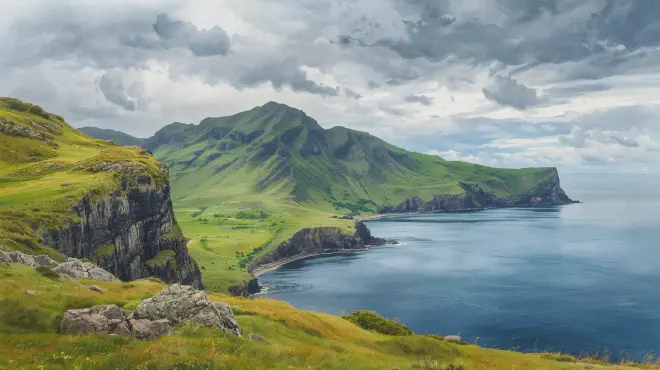
The island covers approximately 1,656 square kilometers with a population of only around 10,000. Yet this small island breathes with natural formations dating back to ancient times and the deep traditions of Celtic culture. The jagged peaks of the Cuillin mountain range, massive rock pillars like the Old Man of Storr, the basalt cliffs of Kilt Rock—landscapes carved by volcanic activity and glacial erosion truly deserve to be called works of natural art.
As a center of Highland culture, Gaelic is still spoken daily on the Isle of Skye, and the strains of bagpipes drift on the wind. As the historic stronghold of the MacLeod and MacDonald clans, ancient castles and ruins dot the landscape, telling the story of Scotland’s complex and turbulent history.
But what strikes you most is the unique light that envelops the island. Clouds and mist created by moist air from the Atlantic change their expression many times throughout the day, painting the landscape in fantastical hues. Just when a break in the clouds appears, the next moment fog rolls in, wrapping the mountains in a mystical veil. Perhaps this constant transformation is the Isle of Skye’s greatest charm.
Day 1: Gateway to a Mist-Wrapped Island
At 8 AM, after a roughly four-and-a-half-hour journey on the long-distance bus from Glasgow, I finally arrived at the port town of Mallaig. Cold sea wind caressed my cheeks, the scent of salt air filling my nostrils. Before me lay the silhouette of the Isle of Skye, veiled in mist. Though the Skye Bridge completed in 1995 allows car access, I wanted my first crossing to be by boat.
I boarded the ferry “Lord of the Isles.” The short thirty-minute voyage saw the island’s outline gradually sharpen as we left Mallaig harbor. The rugged peaks of the Cuillin range peeked through gaps in the clouds, their majestic presence taking my breath away. Seabirds wheeled around the boat, and occasionally pods of dolphins swam alongside us, keeping pace with our vessel.
Upon arrival at Armadale harbor, Mr. MacGregor, owner of my booked B&B, was waiting. He appeared to be in his early seventies, a gentle man born and raised on Skye. Riding in his old Land Rover toward our destination of Portree, he explained the island’s history and highlights in fluent English.
“Skye’s weather is fickle, you know. We say there are four seasons in one day. But that’s part of the island’s charm. You never see the same landscape twice.”
True to his words, during the hour-long drive to the guesthouse, the sky cycled rapidly through blue skies, clouds, light rain, and sunshine again. The scenery flowing past the window was beautiful as a painting. White sheep dotting green hillsides, small farmhouses surrounded by stone walls, and in the distance, the magnificent Cuillin range.
We arrived at “Hebridean House,” a B&B in central Portree, around midday. True to its character as a harbor town, colorful houses lined the port. My room was a corner on the second floor, with windows overlooking Portree Bay and the Cuillin mountains. After dropping my bags, I headed to a nearby pub, “The Islesmen,” to satisfy my hunger.
For lunch, I had Cullen skink (hot-smoked salmon), a Skye specialty, and a stew made with freshly caught mussels. The Cullen skink struck a perfect balance of salt and smoke, with an impressive texture that melted in the mouth. The mussel stew featured chunky shellfish in a creamy soup, letting me fully savor the ocean’s bounty. Paired with local “Skye Ale,” my travel fatigue vanished completely.
The afternoon was spent wandering Portree. Though a small harbor town of about 2,500 residents, it has flourished as Skye’s center since ancient times. The brightly colored houses along the harbor date from the 18th and 19th centuries, each painted in subtly different hues. Blue, green, yellow, pink—their reflections in the harbor waters looked like watercolors.
I also stopped at the Aros Heritage Centre, a small museum where you can learn about Skye’s history and culture. Particularly moving was the exhibit on the 19th-century Highland Clearances, when many islanders were forced to leave their homeland. Learning this sad history deepened my appreciation for the pride and local love of those who live on the island today.
Before returning to the guesthouse that evening, I climbed a small hill overlooking Portree Bay. As the sun set behind the Cuillin ridgeline, the sky turned deep orange and the bay’s surface glittered with light. From the distance came the sound of bagpipes on the wind, their melancholy melody resonating deep within my heart. Someone must be enjoying an evening performance.
That night, I had dinner in the guesthouse dining room, prepared by Mr. MacGregor’s wife, Elena. The main dish was roast Highland beef from a local ranch. The tender, flavorful meat paired exquisitely with a sauce of root vegetables and herbs. The dessert cranachan—a traditional Scottish dessert with raspberries, oatmeal, and whisky—had a simple yet profound taste.
After dinner, I sat by the fireplace with Mr. MacGregor, talking over whisky. He knew much about Skye’s folktales and legends, particularly stories of the giant Cuchullin associated with the Cuillin mountains, and tales of hidden valleys where fairies dwell. Outside, the wind grew stronger, and I could hear rain beating against the windows, but the fire and his gentle storytelling lulled me into pleasant drowsiness.
Returning to my room and looking out the window, I saw a star-filled sky peeking through breaks in the clouds. Thanks to the clear air, countless stars invisible in cities shone bright, and the Milky Way was clearly visible. With anticipation for tomorrow’s explorations in my heart, I fell into deep sleep with the sound of waves as my lullaby.
Day 2: Tracing Ancient Castles and Nature’s Mysteries
Around 6 AM, birdsong woke me. Opening the window, crisp air flowed into the room along with the fresh scent of sea and grass mingled together. Thanks to last night’s rain, the air was washed clean and the Cuillin mountains stood out sharply. Before breakfast, I decided to take a light walk around the harbor.
Early morning Portree harbor was wrapped in silence. Several fishing boats lay moored, and I could see fishermen tending their nets. Noticing me, they waved in a friendly manner. Walking to the end of the harbor jetty, I spotted a group of seals sunbathing on the rocks. Accustomed to human presence, they showed no signs of fleeing when they looked my way.
Returning to the guesthouse, a traditional Scottish breakfast prepared by Elena awaited me. Black pudding, haggis, grilled tomatoes and mushrooms, thick-cut bacon and sausages. Accompanied by homemade oatcakes and local jam. Though I was trying haggis for the first time, its distinctive spicy flavor was surprisingly palatable. The tea was, of course, a strong Scottish Breakfast blend that soaked into my morning body.
After breakfast, I set off on a bicycle Mr. MacGregor lent me toward Dunvegan Castle in the island’s northeast. The roughly 30-kilometer route had steep ups and downs, occasionally requiring me to stop and catch my breath, but the scenery along the way was so beautiful I forgot my fatigue.
Midway, resting near Waternish Bay, I met an elderly local shepherd. He was giving instructions to his sheep in fluent Gaelic, but noticed me and switched to English.
“This time of year, the sheep’s fleece is most beautiful. Next month comes shearing time.”
His sheep were Scottish Blackface, true to their name with black faces and white wool covering their bodies in fluffy clouds. Friendly creatures, they didn’t flee when approached, continuing to graze—an endearing sight.
I arrived at Dunvegan Castle before noon. As the seat of Clan MacLeod for over 800 years, it’s one of Scotland’s oldest continuously inhabited castles. The castle faces a small loch, its heavy stone exterior reflected in the water. I joined a guided tour inside, learning about clan history and treasured heirlooms passed down through generations.
Particularly striking was an ancient silk cloth called the “Fairy Flag.” According to legend, it was gifted when a MacLeod ancestor married a fairy woman and can be waved three times in the clan’s hour of need. Already used twice, only one use remains. Realistically, it’s likely 11th-century silk from the Middle East, but the fact that such legends are still carefully preserved speaks to the depth of Scottish culture.
The castle gardens were also beautiful, especially the formal gardens extending toward the loch, ablaze with colorful flowers. There I had lunch provided by the castle. The menu featured venison pie and soup made with local vegetables. The venison had less gaminess than expected, stewed with fragrant herbs and very easy to eat.
In the afternoon, I headed to Neist Point Lighthouse in the island’s northwest. Located at Skye’s westernmost point, this lighthouse was built in 1909 and stands atop cliffs about 60 meters high. The walking path to the lighthouse winds through green meadows, wild flowers blooming on both sides.
As I approached the lighthouse, the magnificent Atlantic vista opened up. On clear days, you can see other islands of the Hebrides, but today mist obscured the horizon in hazy softness. Yet perhaps this fantastical atmosphere is the true beauty of Skye.
While eating the remains of my picnic lunch near the lighthouse, the fog suddenly cleared and blue sky emerged. Then, faintly in the distance, I could make out the shadow of the Outer Hebrides. Below at the cliff base, waves crashed against rocks in white foam, their powerful sound carried on the wind.
On the return journey, I took a slightly inland route through Dunvegan village. A small village, but traditional cottages were scattered about, their gardens planted with colorful flowers. At the village pub “The Old School Restaurant,” I took a break with local beer and homemade shortbread. The shortbread had a rich buttery flavor that paired perfectly with tea.
On the way back to Portree that evening, I stopped at a viewpoint over Waternish Bay. From here, you can view the entire Cuillin range across the bay. Watching the setting sun illuminate the mountains, turning the rock faces red, was spectacular. I tried to photograph it, but capturing that beauty on camera seemed impossible.
Returning to the guesthouse, Elena had prepared a special dinner. The starter was grilled scallops, freshly caught locally. The plump texture and sweetness were impressive. The main course was roast lamb from Skye. The meat, flavored with rosemary and thyme, released deep tastes with each chew.
After dinner, Mr. MacGregor said “We have special guests tonight” and introduced local musicians. A duo with fiddle and accordion performed traditional Scottish music in the living room. The performance of “Flower of Scotland” particularly stirred my heart. When the music ended, applause arose naturally, sharing a warm moment.
Late that night, looking out my window, moonlight streamed through gaps in the clouds, illuminating the silhouette of the Cuillin range. Thinking that tomorrow I’d leave the island brought a touch of sadness. Listening to the sounds of waves and wind, I slowly fell asleep, etching these two days into my heart.
Day 3: A Morning of Farewell and Memories That Remain
On my final morning, I woke earlier than usual. The clock showed 5:30. Outside the window was still dim, but the eastern sky had begun to brighten faintly. Today I’d leave the Isle of Skye on the afternoon ferry.
Quietly leaving my room, I descended to the guesthouse garden. The scent of dew-dampened flowers tickled my nose. Sitting on a small bench at the garden’s edge, I gazed toward Portree Bay. The water surface was mirror-calm, lights from houses on the far shore reflected in it. From the distance came the sound of church bells, announcing the island’s quiet morning.
When I came down to the dining room at breakfast time, Elena smiled somewhat sadly and said, “Your last morning.” The final breakfast was a more lavish Scottish breakfast than usual. Fresh-baked scones with homemade marmalade and clotted cream. It tasted the most delicious yet.
Mr. MacGregor said, “There’s a place I want to show you before you leave,” and drove me to a hidden cove about ten minutes away. A small beach not on tourist maps, but beautiful with white sand and crystal-clear water, almost like a Caribbean resort.
“This is a secret place only locals know. We don’t usually tell tourists, but for you, it’s special.”
Grateful for his words, I walked the shoreline for a while. Colorful pebbles and shells scattered at my feet, some in beautiful shapes I’d never seen before. I picked up a few as mementos and slipped them into my pocket.
Afterward, returning to Portree town, I enjoyed my last stroll. I discovered a small art gallery I hadn’t noticed yesterday, viewing landscape paintings of Skye by local artists. One of them, a watercolor of the Cuillin mountains wrapped in morning mist, was exactly the scene I’d seen this morning.
Lunch was light at a small café near the harbor, “The Boathouse.” A simple menu of fish and chips with tea, but the freshly fried fish was crispy outside and fluffy inside—a fitting deliciousness for my final meal. Squeezing lemon and sprinkling a little salt, the ocean’s fragrance spread through my mouth.
At 1 PM, on the drive to Armadale harbor with Mr. MacGregor, he took a different route than when I arrived. Midway, he stopped the car near Elgol village to show me Loch Scavaig Beach with its black sand. The contrast between the black sand formed by volcanic activity and the Cuillin mountains towering behind was striking.
“I think the Cuillin range viewed from this beach is most beautiful,” Mr. MacGregor said. Indeed, the rugged mountains seen over the black sand had a completely different impact than from anywhere else.
Before reaching the harbor, I turned once more to survey the entire Isle of Skye. Under skies that repeatedly clouded over and cleared, the whole island changed expression as if alive. In these two nights and three days, I’d been able to see many of this island’s faces.
As ferry departure time approached, the moment came to part with Mr. MacGregor. When I promised “I’ll definitely come back,” he warmly replied, “The Isle of Skye will always be waiting for you.” Elena gave me homemade shortbread and Skye postcards as souvenirs.
Boarding the ferry “Lord of the Isles,” I stood on deck gazing at the Isle of Skye. As the boat left harbor, the island’s outline grew smaller. What remained visible to the last was the rugged ridgeline of the Cuillin mountains. When even that disappeared into clouds, my time on the Isle of Skye officially ended.
Inside the boat, I reflected on these three days. Beautiful nature, warm people, delicious food, and above all, the gentle island time that seemed to flow slowly. Precious time when I could forget the hurried daily life of the city and face myself.
Arriving at Mallaig harbor, I boarded the bus to Glasgow. Looking toward the Isle of Skye one last time from the bus window, I saw the island’s silhouette illuminated by sunset, floating beautifully like a painting. Gripping the pebbles in my pocket, I vowed in my heart to definitely return to this island someday.
As the bus started moving, the Isle of Skye slowly disappeared from view. But everything I’d experienced on this island was surely engraved deep in my heart. The mystical mountains wrapped in mist, the colorful harbor town, the smiling faces of warm people, and above all, the unique flow of time this island possesses. All of it lives on within me as a single story.
What Felt Real Despite Being Imaginary
This journey is an imaginary one I never actually took. Yet through words, visualizing Skye’s landscapes and contemplating its culture and history, the sensation of truly walking that land remains in my heart.
The essence of travel doesn’t necessarily lie only in physically standing in a place. Perhaps journeys experienced in the heart through longing, imagination, and knowledge are also one truth.
Mr. and Mrs. MacGregor’s warm hospitality, the mystical beauty of the Cuillin mountains wrapped in morning mist, the colorful houses of Portree harbor, and the gentle flow of time enveloping the entire island. These are all events from imagination, yet they exist certainly within my heart.
The beauty of imaginary journeys may lie in experiencing a place’s most beautiful moments without being bound by reality’s constraints. No worries about weather or transportation delays. One can purely face the place’s charm.
Yet simultaneously, through this imaginary journey, my longing for the actual Isle of Skye has only grown stronger. The desire to someday truly visit that island, feel the real wind on my skin, hear authentic wave sounds, and meet real people continues to burn deep in my heart.
An imaginary yet real-feeling journey. It’s proof of the wonderful power our imagination holds. Places visited in the heart are more beautiful than anywhere in reality and never fade.
Though my imaginary journey to the Isle of Skye has ended, my longing for this island and the dream of definitely visiting someday will continue living in my heart. And perhaps that dream itself is a precious treasure that enriches life.