
An Eternal City Straddling Two Continents
Istanbul spreads across both shores of the Bosphorus Strait. This city connecting Europe and Asia was once called Byzantium, then Constantinople, flourishing as the capital of the Roman Empire, the Byzantine Empire, and the Ottoman Empire. Having remained the center of empires for over 1,500 years, this city bears the layered imprints of both Christian and Islamic cultures.
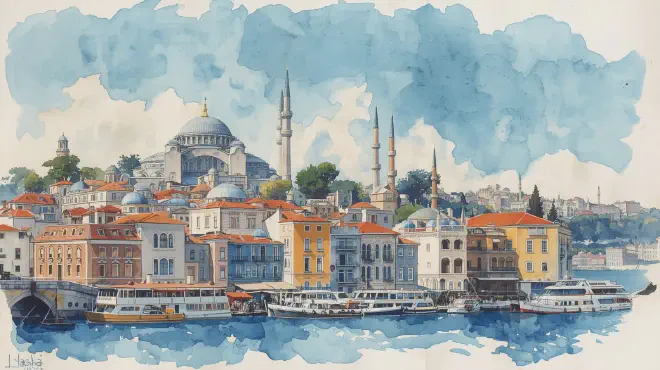
Walking through the streets, the magnificent dome of the 6th-century Hagia Sophia catches the eye, while beside it, the six minarets of the Blue Mosque stretch skyward. In the labyrinthine passages of the Grand Bazaar, the voices of merchants echo as they have for centuries, and beneath the Galata Bridge, ships crossing the Bosphorus carry the flow of time itself.
The richness of Turkish cuisine also speaks to the city’s diversity. Fresh seafood taking advantage of being surrounded by the Mediterranean, Black Sea, and Aegean Sea; fragrant spices that are gifts from the Anatolian plateau; dairy products breathing with the nomadic wisdom inherited from Central Asia. The complex and profound flavors born here exist precisely because this is a place where Eastern and Western cultures intersect.
I wanted to visit this city not merely as a tourist destination, but to see with my own eyes a place where different civilizations met, merged, and sometimes clashed, yet created a single beautiful harmony.
Day 1: A City Welcomed by Twilight Over the Bosphorus
I landed at Atatürk International Airport around 3 PM on an early autumn afternoon. In the bus from the airport to Taksim, as I gazed at the cityscape spreading outside the window, scenes that felt somehow nostalgic yet completely foreign continued to unfold. Buildings clustered on low hills, roads weaving between them, and in the distance, the silhouettes of minarets.
After checking into a small hotel in the Sultanahmet district, the atmosphere of evening was already drifting in. I dropped my luggage in the room and immediately set out to walk the streets. About five minutes from the hotel, my view suddenly opened up. What appeared before me was the massive dome of Hagia Sophia.
Its presence was overwhelming, hard to believe it was built 1,500 years ago. Stone walls dyed crimson by the setting sun, minarets reaching toward the heavens. As I approached, I kept looking up until my neck ached from its sheer size. Tourists from around the world visit constantly, yet strangely there’s no sense of noise. Perhaps in front of this sacred building, everyone naturally maintains silence.
I headed to the Blue Mosque, which stands facing Hagia Sophia. Officially called the Sultan Ahmed Mosque, this building was constructed in the early 17th century. Upon entering, the walls decorated with blue Iznik tiles glowed fantastically in the light of the setting sun. The world of blue created by over 20,000 tiles was beauty truly befitting the name “Blue Mosque.”
When prayer time came, the call to prayer began resonating from somewhere. Watching the people in the mosque quietly assume the posture of prayer, I could feel the depth of faith living in this city. As a tourist, I stood there for a while, enveloped in that solemn atmosphere.
After nightfall, I had dinner at a small restaurant near Hagia Sophia. Not understanding the menu, I asked the owner for his recommendation. In warm though not fluent English, he suggested “Istanbul Kebab.” The dish that arrived was completely different from the kebab I’d imagined. Thinly sliced lamb stewed in tomato sauce, placed on a bread called pide, with yogurt on top. One bite and the complex aroma of spices, the savory flavor of lamb, and the tartness of yogurt harmonized exquisitely in my mouth.
After the meal, on my way back to the hotel, I walked between the illuminated Hagia Sophia and Blue Mosque. Surrounded by these buildings showing completely different, mystical expressions from daytime, I felt the reality sink in that I had truly come to Istanbul. Even from my hotel room window, I could see the lights of the Bosphorus Strait in the distance, and I fell asleep with anticipation for tomorrow.
Day 2: Historical Melodies Echoing Across the Strait
I woke around 7 AM. The hotel breakfast was typically Turkish. Olives, cheese, tomatoes, cucumbers, boiled eggs, and freshly baked simit (Turkish version of a bagel). Simple, yet each item had a solid taste of its ingredients, with the saltiness of the olives and the mellowness of the cheese leaving a particular impression. While drinking çay, I thought about today’s schedule. First Topkapi Palace, then the Grand Bazaar, and a Bosphorus cruise in the afternoon—that’s the flow I decided on.
Topkapi Palace was where Ottoman emperors resided for 400 years. After buying a ticket at the entrance and entering the first courtyard, I found it more expansive than expected. Rather than a palace, it was more like a small town in scale, with numerous buildings scattered throughout. Proceeding to the second courtyard, there were displays that let me imagine what life in the palace was like.
Particularly impressive was the tour of the Harem. The place where the emperor’s mother and consorts lived, with beautiful rooms decorated with Iznik tiles continuing one after another. Narrow corridors and small rooms arranged in a maze-like fashion told the story of the confined lives of the women of that era. Still, the wall decorations and ceiling craftsmanship were breathtakingly beautiful, making me think that perhaps within this narrow world, they pursued their own form of beauty.
From the fourth courtyard of the palace, I could see a spectacular view of the Bosphorus Strait. Ships of all sizes cross the strait separating the European and Asian sides. Cargo ships, ferries, fishing boats, and tourist vessels. Did the sultans of the past also gaze upon this scene? We’re looking at the same landscape, yet surely they saw a completely different world.
Before lunch, I stopped by the Grand Bazaar, which was truly another world. This market, continuing since the 15th century, is a massive indoor market where 4,000 shops line up. The moment I crossed the entrance, I was enveloped in colorful goods, shopkeepers’ calls, and the murmur of tourists. Turkish carpets, ceramics, spices, accessories, lamps. Every shop displayed beautiful goods like works of art, and just looking made me lose track of time.
At the spice stalls, I stopped, drawn by the aroma of spices I’d never encountered in Japan. The elderly shopkeeper scooped various spices onto small plates for me to try. Saffron, sumac, za’atar. Each had a completely different aroma, and while I couldn’t imagine how to use them in cooking, they all somehow stimulated the appetite. In the end, I purchased several types of spices as souvenirs for cooking-enthusiast friends.
I ate lunch at a small eatery inside the bazaar. Döner kebab and pilaf, along with ayran, a yogurt drink. The döner kebab was completely different from what I’d eaten in Japan. The balance of meat fat and spices was exquisite, and it paired perfectly with the pita bread. While ayran initially puzzled me, drinking it with spicy food refreshed my palate, and I felt I understood why Turks favor it.
In the afternoon, I departed on a Bosphorus Strait cruise from Eminönü port. The boat slowly headed north along the strait. On the right hand, the European side cityscape, on the left hand, the Asian side. On both shores, Ottoman-era wooden houses called “yalı,” modern buildings, mosques, and palaces coexisted, allowing me to feel the layered history of this city even from the sea.
As the boat passed Rumeli Fortress, the guide explained. In the 15th century, this fortress was built by the Ottoman Empire to capture Constantinople, and by cutting off the Byzantine Empire’s supply routes, it began the end of the thousand-year empire. Thinking that this stone fortress, now quietly standing, was once a major turning point in history filled me with a strange emotion.
The boat went near the Black Sea and then turned back. The return voyage was bathed in the setting sun. The cityscape of Istanbul dyed by the sunset was like a scene from a dream. The silhouette of Galata Tower, the dome of Hagia Sophia, countless minarets. The tourists from various countries on board were all quietly absorbed in that beauty.
For dinner, I ate balık ekmek (fish sandwich) at a restaurant under the Galata Bridge. Fresh fish caught in the Bosphorus, grilled on the boat and placed in bread. Simple, but with the savory flavor of the fish and the tartness of lemon, combined with the atmosphere of eating on a boat, it tasted exceptional. On the bridge, fishermen enjoyed night fishing, showing me a completely different face of the bridge from daytime.
Before returning to the hotel, I strolled through Sultanahmet Square at night. The contrast of light and shadow woven by the illuminated buildings showed expressions completely different from daytime. Sitting on a bench in the square and reflecting on this day, I couldn’t help but feel the depth of this city called Istanbul.
Day 3: The City’s True Face Revealed at Journey’s End
On the final morning, I got up a bit early to see the morning market in the Eminönü district. Walking out around 6 AM while it was still dim, I found the market already full of life. At the fish stalls, fish landed the previous night were lined up on ice for sale. At the vegetable stands, colorful tomatoes, eggplants, and peppers were piled high. At the fruit stands, enormous pomegranates and figs were displayed, all sizes I’d never seen in Japan.
At a bakery, they were selling freshly baked simit. I bought one and tried eating it while walking—crispy on the outside, chewy inside, with the fragrant aroma of sesame spreading in my mouth. Walking through the city eating the same things as the locals, I felt less like a tourist and more like I’d become part of the city’s daily life.
After breakfast, still having time, I decided to climb Galata Tower. Built by the Genoese in the 13th century, this tower stands on a hill overlooking the Golden Horn. Taking the elevator to the top of the tower, I could see all of Istanbul.
Spread below was the cityscape divided into the new city and old city across the Golden Horn. In the foreground, the Galata district with modern buildings lined up; across the Golden Horn, the historic district with Hagia Sophia and the Blue Mosque. And in the distance, the Bosphorus Strait and the cityscape of the Asian side. From this height, I could clearly see how Istanbul is surrounded by water. The Golden Horn, the Bosphorus Strait, the Sea of Marmara. The city is divided by water and connected by water.
Descending the tower, I walked across the Galata Bridge back to the old city. On the bridge, fishermen dropped their lines just as they had the previous night. Below the bridge, the morning fish market was open, showing a completely different face from the night. Walking across the bridge, I reflected on the various expressions of Istanbul I’d seen over these two days.
For lunch, as my final meal in Istanbul, I splurged a bit at an established Ottoman cuisine restaurant. The dishes recreating Ottoman imperial court cuisine were all elaborate. What particularly remained in my memory was “Hünkar Beğendi,” a dish of lamb stew over eggplant purée. The creamy texture of the eggplant and the rich flavor of the lamb harmonized exquisitely—a complex, deep taste I’d never experienced before.
For dessert, I had “muhallebi,” a milk pudding. Sprinkled with pistachios on the surface, with a faint aroma of rose water, it had an elegant sweetness. The coffee was, of course, Turkish coffee. The rich coffee made by boiling finely ground beans was initially puzzling, but once accustomed, seemed like a taste I could become addicted to.
In the afternoon, I decided to visit Hagia Sophia once more. Having only seen it from outside on the first day, this time I wanted to observe the interior carefully. Entering inside, I was overwhelmed by the height of the ceiling. A massive dome 31 meters in diameter floats 55 meters high. When constructed in the 6th century, this was the world’s largest dome.
On the walls, Byzantine-era mosaics and Ottoman-era calligraphy coexisted. Next to a mosaic of the Virgin and Child from the Christian era hung Islamic verses written in Arabic script. I felt that this building represented the very essence of Istanbul as a city. Different religions, different cultures, not fighting but coexisting. They might not be in complete harmony, but they continue to exist in the same space.
As evening approached, the time to head to the airport drew near. I picked up my luggage at the hotel and took the airport bus from Taksim. Looking at Istanbul’s cityscape for the last time through the bus window, these three days felt very short. A desire welled up to stay longer in this city, to know more.
Arriving at the airport and completing check-in, I organized my thoughts about this trip. Istanbul was a far more complex and multifaceted city than I’d imagined. Old and new, East and West, Islam and Christianity, tradition and modernity. These opposing elements somehow coexist naturally here. It’s not superficial coexistence, but a deep-level fusion cultivated through a long history—that’s what I felt.
While drinking çay at an airport café until boarding time, I looked outside the window. Beyond the runway, the lights of Istanbul were visible. Tomorrow I return to daily life, but the sense of this strange harmony I felt in this city will surely remain somewhere in my heart.
Something Felt Vividly Real Though Imaginary
This 2-night, 3-day Istanbul trip is remembered as an event that truly occurred in my heart. Though I’ve never actually stood there, I remember the neck pain from looking up at Hagia Sophia’s massive dome, and it feels like the aroma of spices from the Grand Bazaar lingers in my nose. The beauty of the Bosphorus sunset and the rich taste of Turkish coffee all remain as vivid memories.
Perhaps this is due to the special charm that Istanbul possesses. This city is not merely a tourist destination, but a place where human history itself is condensed. Here, time exists in layers, with the past breathing within the present. Because it’s such a city, perhaps it can be felt as a genuine experience in one’s heart even without actually going there.
And above all, “the beauty of coexistence among different things” that I felt in this city is a message needed in today’s world. In an era when conflict and division occur throughout the world, perhaps we should learn from Istanbul’s tolerance that accepts diversity, the wisdom that fuses rather than excludes the foreign.
This journey was a product of imagination, but the emotions and lessons felt there were certainly real. If I ever have the opportunity to actually visit Istanbul, I want to see how these imaginary memories overlap with real experiences. Surely at that time, along with new discoveries, this imaginary journey will become even more meaningful.