
A Hidden Gem of the Alps
The Julian Alps mountain range stretching across northwestern Slovenia was truly a work of art woven by nature itself. The mountains centered around Triglav (2,864m), the highest peak of this small country wedged between Austria and Italy, possess white limestone peaks, deep green forests, and beautiful valleys carved by glaciers.
This region has long been inhabited by Slavic peoples who, while influenced by the Austro-Hungarian Empire, nurtured their own unique culture. Along the hiking trails, mountain huts called “planinska koča” are scattered about, carefully maintained by local mountaineering enthusiasts. These huts welcome travelers with traditional Slovenian cuisine and warm hospitality.
What characterizes the Julian Alps is the ability to enjoy dramatic changes in scenery over relatively short distances. Beyond the tree line appear karst formations of bizarre rocks, and from near the summit, a grand panorama stretching to the Adriatic Sea. This mountain region is also a national symbol for Slovenians, with Triglav’s three peaks depicted on the national flag.
I chose this place because I wanted to experience the tranquility away from Western Europe’s hustle and bustle, and to touch the simple mountain culture not yet commercialized by tourism.
Day 1: Embraced by Forest Silence
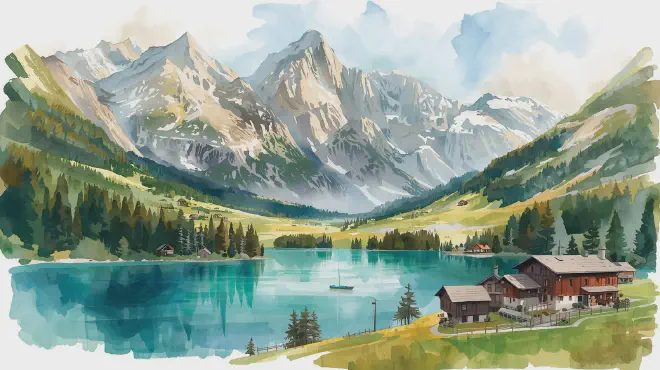
An hour and a half by car from Ljubljana, I arrived at a small village on the shores of Lake Bohinj around 10 a.m. The lake surface was mirror-still, reflecting the surrounding mountains in perfect inversion. The air was cold and crystal clear, and with each deep breath, a refreshing sensation spread to the depths of my lungs.
At the Vogel Cable Car station, the starting point for the trek, I organized my gear and the journey truly began. The cable car swiftly ascended to 1,540m, revealing the full expanse of Lake Bohinj below. The deep blue of the lake, the surrounding forest’s green, and the distant white peak of Triglav wove together a scene worthy of a painting.
The morning brought relatively gentle ridge trails. Small Alpine rose flowers bloomed at my feet, and occasionally squirrels darted between the trees. The local hikers I encountered along the way were all friendly, offering “Dobro jutro” (good morning) greetings along with advice about the mountain hut I was heading toward.
I had a simple lunch at a viewpoint. While munching on the sandwiches I’d brought, I gazed at the glittering horizon of the Adriatic Sea visible far to the south. The fact that the sea could be seen from this height spoke to the geographical character of Slovenia as a country.
The afternoon brought a steeper trail. In the limestone outcrop areas, I carefully selected footholds while gaining elevation. Looking back, the morning’s path appeared tiny below, and I truly felt how far I had climbed.
I arrived at tonight’s lodging, the “Dom na Komni” mountain hut, just after 4 p.m. Built at 1,520m elevation, this warm wooden structure offered panoramic views of the Julian Alps’ main peaks from its windows. The hut keeper, Marko, a gentle man in his fifties, explained the hut’s history in fluent English.
“This hut was built in the 1920s. My family has managed it since my grandfather’s time. Many people now climb these mountains, but it remains as quiet and beautiful as ever.”
Dinner was shared with other guests in the hut’s dining room. The menu began with “Julian Alps-style soup,” followed by a main course of “kranjska klobasa,” traditional Slovenian sausage with braised sauerkraut. Simple yet allowing the ingredients’ flavors to shine, the meal permeated my hiking-weary body. Dessert was “potica,” a sweet bread rolled with walnuts and honey, perfectly paired with coffee.
My dining companions included a local Slovenian family and an elderly couple from Austria. Despite language barriers, love for the mountains and respect for nature were universal, and we enjoyed pleasant conversation through gestures and smiles.
At night, stepping outside revealed a sky full of stars. With no city lights, the Milky Way was clearly visible. In this silence, I recalled nature’s rhythm, so easily forgotten in urban life. A world where only the sound of wind, distant bird calls, and my own breathing could be heard. With anticipation for tomorrow, I retired early.
Day 2: Ascending to the World Above Clouds
At 5:30 a.m., the mountain hut’s morning began early. Outside the window it was still dim, but the eastern sky was beginning to brighten faintly. After a simple breakfast, I departed the hut at 6:30. Today’s goal was to summit Mangart Peak at 2,547m.
The morning trail was wrapped in fog. With the rocks underfoot wet, I proceeded cautiously. As elevation increased, vegetation changed, transitioning from coniferous forests to the world of alpine plants. When I spotted a small white edelweiss flower, I couldn’t help but stop. Seeing this flower blooming in the harsh Alpine environment, I couldn’t help but feel both the strength and beauty of life.
Around 9 a.m., as the fog began to clear, the view suddenly opened up. What spread before me was a magnificent landscape beyond imagination. The main peaks of the Julian Alps glowed golden in the morning sun, with the Italian Alps visible beyond, and even the Dolomites in the far distance. In this moment, all hiking fatigue vanished instantly.
Entering the rocky ridge section, the trail became more technical. There were several sections with chains, requiring careful route finding. Here, I rarely passed other climbers, truly feeling like I was in my own world. Underfoot were traces of glacier-carved rock, telling stories of tens of thousands of years.
Just past noon, I finally reached the summit of Mangart Peak. A 360-degree panorama spread out: Austrian mountains to the north, the Adriatic Sea to the south, and even Mont Blanc faintly visible to the west. At the summit stood a small cross and a climbers’ registry where I inscribed my name. The emotion of this moment defies verbal expression.
Lunch was taken at the summit, sheltered from the wind. The soup and bread I’d brought tasted better than any meal I’d ever eaten. After about thirty minutes of rest, I began the descent.
On the descent, I had an interesting encounter. Ana, a local botanist, was conducting alpine plant research. She taught me in detail about plants endemic to the Julian Alps. Particularly impressive was her story about “Juliana caulescens,” a small blue flower found only in this region.
“This flower is a survivor from the Ice Age. We continue conservation efforts because climate change is narrowing its habitat.”
Listening to her passionate explanation, I felt anew the importance of protecting this beautiful natural environment.
Around 4 p.m., I arrived at another mountain hut, “Dom Planika.” Located at 2,400m elevation, this would be tonight’s lodging. The stone building was constructed sturdily to withstand the harsh alpine climate. The hut keeper, Tomaš, a former mountain guide, spoke in detail about the climbing history of the Julian Alps.
Before dinner, I explored the hut’s surroundings. At this altitude, there were no trees, only a world of rock and alpine plants. I witnessed the “alpenglow” phenomenon, where the evening sun dyes the Alpine peaks red. The sight of mountains burning like flames spoke to nature’s mystical beauty.
Dinner was simple, befitting the high altitude, but “juh,” a traditional Slovenian stew, warmed my body. In the dining room, mountain talk blossomed among other climbers. An Italian climber said he would attempt Triglav tomorrow, while a German couple was planning a week-long Alpine traverse.
At night, stepping outside revealed an unbelievable starry sky. At this altitude, the thin air made the stars feel close enough to touch. I saw two shooting stars and felt a premonition that something good might happen. Tomorrow was the final day, and I fell asleep with somewhat wistful feelings.
Day 3: Farewell and a Promise to Return
The final morning was enveloped in a sea of clouds. Looking down from the hut’s terrace, the world below 2,000m was submerged in a sea of clouds. The sight of mountain peaks alone floating like islands above the clouds was truly a celestial world.
After breakfast, I departed the hut at 8 a.m. Today was descent day, but simply going down seemed wasteful, so I decided to take a detour via another mountain hut called “Zasavska koča.” This hut is located in a beautiful highland area known as the “Valley of the Seven Lakes.”
Descending through the sea of clouds, the green world gradually returned. Below 2,000m, coniferous forests appeared and birdsong became audible. Enjoying this process of change while walking is one of the pleasures of Alpine hiking.
Around 10 a.m., I arrived at the Valley of the Seven Lakes. In a beautiful cirque carved by glaciers, seven lakes of various sizes were scattered. Each lake displayed a different shade of blue, reflecting the surrounding mountains like mirrors. I rested here for a while, reflecting on these three days of mountain travel.
What remained most memorable were the encounters with people. The mountain hut keepers, the climbers and researchers met along the way—all held deep affection for the Julian Alps. Despite differences in language and nationality, I realized the love for mountains was the same.
Around 11 a.m., I arrived at the Zasavska koča mountain hut. Here I enjoyed a final coffee break. From the hut’s terrace, I could see the high mountains I’d departed this morning, truly feeling how far I had walked. The “kremšnita,” a traditional cake served with coffee, with its exquisite layers of cream and custard, soothed the journey’s fatigue.
From here, the descent route was relatively gentle, and I walked leisurely through the forest in the afternoon. In the beech forest, the dappled sunlight was beautiful, and I found wild blueberries here and there to taste. The sweetness of nature’s bounty was exceptional.
Along the way, I met a local elderly man. Ivan, an octogenarian, had been walking this mountain range since his youth. In fluent German, he told stories of the Julian Alps of old.
“There used to be more snow, and the glaciers were larger. But the mountains’ beauty hasn’t changed. The mountains must be pleased that young people like you come to visit.”
His words held the deep insight that only someone who has lived with the mountains for many years possesses.
Around 3 p.m., I returned to the parking lot by Lake Bohinj. It was the same lake I’d seen three days earlier, but now it looked completely different. Perhaps the time spent in the mountains had changed something within me.
Before departing, I had a final meal at a lakeside restaurant. “Bohinjska postrv,” a local trout dish, had a gentle flavor that conveyed the lake’s bounty. The wine, a local white “Rhine Riesling,” had a refreshing taste that seemed to express the Alps’ clarity.
While eating, I organized the experiences of these three days. Physically, it hadn’t been particularly demanding, but spiritually, it was an extremely fulfilling mountain journey. The silence unavailable in city life, nature’s grandeur, and heartfelt connections with people—all these became precious treasures for me.
From the restaurant’s terrace, I gazed one last time at the Julian Alps mountains. The peaks illuminated by the setting sun seemed to smile gently, as if regretting our parting. Promising in my heart to “surely return,” I left this beautiful land behind.
What Felt Real Despite Being Imaginary
On the flight home to Japan from Ljubljana Airport, I looked down at Slovenia’s mountains growing smaller below. These three days of experience, though an imaginary journey, are indelibly etched in my heart.
The silence of the Julian Alps, the warm hospitality at mountain huts, the breathtaking views from summits, and the smiling faces of people I met—all these live on within me as treasures called memories. Particularly impressive was the presence of people who love and continue to protect this land. Perhaps their passion and pride made Slovenia’s mountains appear even more beautiful.
Though a place I haven’t actually visited, by imagining its culture, nature, and people’s lives, I could recognize anew the world’s diversity and beauty. Travel is not necessarily only physical movement; it can also be an adventure experienced within the heart.
The two-night, three-day journey through Slovenia’s Julian Alps mountain range has become a special place in my heart, feeling as though it truly happened despite being imaginary. Until the day I actually visit this land, I want to carefully preserve this memory.