
Monasteries in the Sky and the Timeless Spirit of Greece
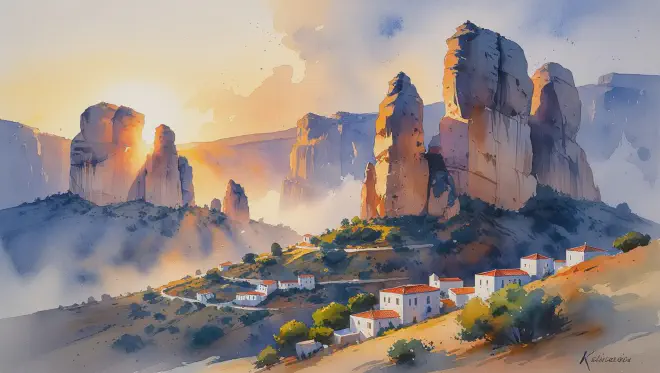
At the northwestern edge of the Thessalian Plain, nestled at the foot of the Pindos Mountains, the small town of Kalambaka embraces one of the most extraordinary landscapes on Earth. The name itself derives from Turkish, meaning “beautiful rock”—and beautiful it is. Looking up from the town, massive stone pillars thrust toward the heavens, the rock formations of Meteora standing in the same magnificent presence they have held since the age of myths.
Beginning in the sixth century, monks sought refuge atop these seemingly impossible pinnacles, eventually establishing as many as twenty-four monasteries suspended between earth and sky. Today, six remain active, quietly preserving the traditions of the Eastern Orthodox faith. Kalambaka itself is a modest place, home to only around two thousand residents, yet it serves as the gateway to this celestial sanctuary, welcoming pilgrims and travelers from across the globe.
Situated in central mainland Greece, this region has long been part of Thessaly, nurturing a distinct culture over the millennia. Mount Olympus lies not far to the northeast, and the land carries that peculiar quality where mythology and reality seem to dissolve into one another. In spring, wildflowers blanket the meadows; in autumn, the rock faces are painted with warm hues; and in winter, Meteora cloaked in snow becomes something otherworldly, a glimpse of the divine.
I chose this destination because I longed to step away from the noise of modern life and quietly contemplate the greatness of nature alongside the depths of human spirituality.
Day 1: Arrival Beneath the Watchful Pillars
The bus journey from Athens took roughly five hours. As the landscape outside my window shifted from open plains to mountainous terrain, Meteora suddenly appeared before me, and I caught my breath. Photographs cannot capture what I saw—the sheer, overwhelming presence of those rock towers. They rose one after another in irregular, powerful shapes, as if giants had hurled stones down from the heavens and left them standing where they fell.
I arrived at Kalambaka’s bus terminal around two in the afternoon. The town was smaller than I had imagined. The main street could be walked end to end in perhaps ten minutes. Traditional stone houses lined the roads, bougainvillea spilling purple blossoms from their eaves. My guesthouse, “Meteora View,” lived up to its name—the window of my simple room opened directly onto the rock pillars rising in the distance.
After dropping off my bags, I stepped outside into the afternoon light. The sun bathed the rock faces in warm shades of orange and amber. I wandered through the town center, gathering information for the next day’s monastery visits. At the tourist information office, a kind woman handed me a map and explained the opening hours and visiting tips for each monastery in fluent English. “Meteora is most beautiful at sunrise and sunset,” she told me. I made a mental note.
By five o’clock, the rhythms of local life became more apparent. The scent of fresh bread drifted from a bakery. At a café terrace, elderly men sat drinking coffee, their conversations unhurried and animated. I found my way to a small taverna called “Agapi” and settled in for my first dinner in Kalambaka.
The owner, Yannis, was a warm-hearted man in his sixties. He recommended the homemade moussaka and horiatiki salad. The moussaka arrived golden-brown from the oven, its layers of eggplant, minced meat, and béchamel sauce perfectly melded together. The first bite filled my mouth with Mediterranean herbs, and something in my chest loosened. The horiatiki was simple—ripe tomatoes, feta cheese, olives, cucumber—but each ingredient tasted vivid and alive.
As we talked, Yannis shared that his grandfather had been a stonemason who worked on the monasteries. “The stone of Meteora is special,” he said, pride evident in his voice. “Nature spent millions of years creating this art. And then humans built places of prayer upon it. There is no more beautiful harmony than this.”
By eight o’clock, dusk had settled over the town. Leaving the taverna, I looked up to see a crescent moon rising between the rock pillars. The monastery lights flickered on, one by one, like a constellation arranged across the cliffs. Anticipation for the days ahead stirred in my chest, yet the quiet of this evening wrapped around me and slowed my heartbeat.
Back at the guesthouse, I sat on the terrace bench and watched the night unfold. A church bell sounded somewhere in the distance, marking the hour with slow, deliberate strokes. A dog howled faintly, the sound echoing through the valley. This depth of silence—impossible to find in cities—felt like a luxury I had forgotten existed. With that thought, I ended my first long day.
Day 2: A Sacred Day Among the Monasteries in the Sky
I woke at six and opened the window to find the eastern sky beginning to lighten. Remembering Yannis’s advice, I decided to watch the sunrise over Meteora. A fifteen-minute walk brought me to a small hill above the town. From there, I watched as the sun slowly lifted above the horizon and gilded the rock pillars one by one in shades of gold.
The silhouettes of the monasteries emerged through the morning mist, and the sound of bells broke the stillness, ringing across the valley. How many centuries had monks witnessed this same scene each morning? Time seemed to stand still. I felt, all at once, the immensity of nature and the power of human faith.
Breakfast at the guesthouse consisted of thick Greek yogurt drizzled with honey and walnuts, accompanied by a strong Greek coffee. The yogurt was nothing like what I knew from home—rich and dense, perfectly balanced by the natural sweetness of the honey.
Around nine o’clock, I set off to visit the monasteries. My first destination was the most famous of them all: Great Meteoron. Reaching the entrance required climbing steep stone steps for about twenty minutes. I paused often to look back. Each time, Kalambaka appeared smaller below, and the Thessalian Plain stretched farther toward the horizon in a sweeping panorama.
Arriving at the monastery, I was struck by the solemnity of the fourteenth-century structure. Inside, the light was dim, and Byzantine frescoes covered the walls. The serene faces of saints, the delicate rendering of angels’ wings, the compassionate gaze of Christ—all of it spoke across centuries, the colors still vivid, the stories still alive.
From the courtyard, the view was truly of the heavens. A deep valley yawned beneath my feet. On a neighboring pillar, another monastery perched like a distant apparition. The only sounds were the wind passing through and, somewhere, the faint murmur of prayer.
For lunch, I descended to the town and found a small taverna called “Topanaki.” An elderly woman there prepared fasolada—a white bean soup—and tiropita, a cheese pie. The fasolada was humble in appearance but comforting, flavored with tomato, olive oil, and a hint of dill. When I bit into the tiropita, the crisp phyllo gave way to warm, melting feta, and I couldn’t help but smile.
In the afternoon, I visited Varlaam Monastery and Roussanou Monastery. Varlaam, built in the sixteenth century, felt smaller and more intimate. Its treasury displayed hand-copied scriptures and silver crosses, artifacts of the monks’ devoted labor over centuries.
Roussanou is the only convent among the monasteries, and a few nuns still reside there. In the garden, they grow vegetables and herbs—rosemary and thyme, their fragrance carried on the breeze. I encountered Sister Maria there. She greeted me with a quiet smile. We shared no common language, yet her gentle expression conveyed the peace of a life devoted to prayer.
Around six in the evening, I made my final stop at Holy Trinity Monastery. Relatively accessible compared to the others, it is renowned as a place to watch the sunset. Standing on the monastery terrace, I faced west as the sun sank slowly behind the mountains. The sky shifted from pale violet to orange to deepening indigo, and the rock faces changed color in response, as if breathing with the light.
In that moment, I felt as though I had slipped into a different dimension of time. Monks had watched this same sunset from this same place for hundreds of years. The thought stirred something strange and moving—a sense of becoming, however briefly, part of history.
That evening, I returned to Yannis’s taverna for dinner. When I described the day’s experiences, he nodded thoughtfully. “Meteora is a mirror that reflects the heart of the one who looks upon it,” he said. “What you felt today was something already inside you.” For dinner, I had souvlaki—lamb skewers grilled over charcoal—with tzatziki, the cool yogurt sauce, and a glass of local red wine. The lamb was fragrant and tender; the tzatziki bright and refreshing. The wine was full-bodied, deep, and seemed to ease the weariness from my limbs.
Day 3: A Morning of Farewell and Lasting Memory
On my final morning, I rose early once more to see the sunrise. This time I chose a different vantage point, and Meteora revealed yet another face. The way light fell upon the rocks transformed their expression entirely. Over these two days, Meteora had ceased to be merely a destination. It had become part of me.
After breakfast, I packed my things and checked out, but several hours remained before my bus departed. I decided to walk through the town one last time.
At a small souvenir shop on the main street, I bought local honey and olive oil produced by the monasteries. The elderly shopkeeper spoke to me in halting English: “Every time you taste this, remember Meteora.” The jar bore a simple label—“METEORA HONEY”—and something warm spread through my chest just looking at it.
I also stopped at the Church of the Assumption of the Virgin Mary, a twelfth-century structure tucked away from the tourist paths. Inside, a few elderly women knelt in quiet prayer. I lit a candle, offered silent thanks for this journey, and made a small wish for the life awaiting me back home.
For lunch, I tried a taverna I hadn’t yet visited: “O Platanos,” named for the plane tree—over a hundred years old—that spread its branches before the entrance. Sitting in the shade, I ordered pastitsio, a Greek-style lasagna, and a village salad. The pastitsio was layers of macaroni, minced meat, and béchamel, baked until golden—creamy and warm, the kind of dish that tastes like comfort, like home.
As I ate, a cat appeared at my feet, meowing sweetly. White and brown, with a friendly disposition. The owner told me his name was Philos—“friend” in Greek—and that he had been loved by many travelers over the years. Philos curled up beneath my chair and dozed, and watching his peaceful face, I thought he somehow embodied the warmth of this town and its people.
Around two in the afternoon, before heading to the bus terminal, I stopped to look up at Meteora one last time. My feelings had changed completely since that first moment of arrival. Then, I had been overwhelmed by the sheer scale of nature’s artistry. Now, I gazed at the pillars with something closer to affection—the kind you feel when saying goodbye to an old friend.
Just before I boarded the bus, Yannis came running to see me off. “Come back someday,” he said, clasping my hand. “Meteora will always be waiting for you.” The warmth in those words brought unexpected tears to my eyes.
The bus pulled away, and Kalambaka grew smaller in the window. The rock pillars of Meteora receded gradually, but their towering presence remained clear until the very end. It had been only two nights and three days, yet what I experienced here would stay with me, I knew, for the rest of my life.
On the bus back to Athens, I watched the scenery pass in a kind of reverie. The beautiful farmland of the Thessalian Plain. The distant mountains. White clouds drifting across a blue sky. Everything looked fresh and luminous. I thought about how travel changes us in ways that are difficult to explain.
What Felt Real, Though Imagined
Looking back, those two nights and three days in Kalambaka were an experience of time itself transformed. In ordinary life, hours are sliced into minutes and seconds. Here, time flowed according to the rhythms of nature—the movement of the sun, the tolling of bells, the sound of wind through stone.
The monasteries of Meteora stand as a perfect harmony of human spirituality and the grandeur of the natural world. Physically remote atop their impossible pillars, they radiate a presence that feels like the center of existence. The life of prayer carried on within them quietly asks each visitor: What truly matters?
The people of Kalambaka became treasures of this journey as well. Yannis and his gentle wisdom. Sister Maria and her serene, wordless kindness. The shopkeeper and her simple blessing. And Philos the cat, dozing peacefully at my feet. All of them remain as warm memories etched into my heart.
Greek food, too, was essential to the journey. Moussaka, pastitsio, souvlaki—these traditional dishes offered more than sustenance. They were a way of tasting history and culture. The richness of local honey, olive oil, and feta cheese spoke of the Mediterranean’s enduring gifts.
But what moved me most was the power of silence. The sound of wind in a monastery courtyard. Church bells echoing through the night. The glow of rock faces bathed in morning light. All of it conveyed something beyond words. At first, ears accustomed to the noise of modern life found the quiet almost unsettling. Gradually, I came to recognize its richness.
Kalambaka, though a destination of global renown, has not surrendered to commercialism. It preserves the traditions of old Greece with quiet dignity. The rhythms of life here may not have changed much over the centuries. To spend time in such a place is to see one’s own life from a new angle.
Of course, this travel diary is the product of my imagination. I have not actually visited Kalambaka. And yet, in learning about Greek culture and history, about the monasteries of Meteora, and in imagining the lives of the people who call this place home, I have written something that feels, strangely, like memory.
Perhaps the essence of travel lies not only in arriving at new places, but in learning to see the world through different eyes. Through this imaginary journey, I truly feel as though I breathed the air of Kalambaka, watched the sunset over Meteora, and shared warm moments with the people there.
These three days reminded me of the richness that imagination can offer. And at the same time, they planted in me a strong desire to one day visit this place in reality—to see how imagination and truth might overlap. Perhaps the longing for travel, at times, nourishes the soul even more than the journey itself.