
Introduction
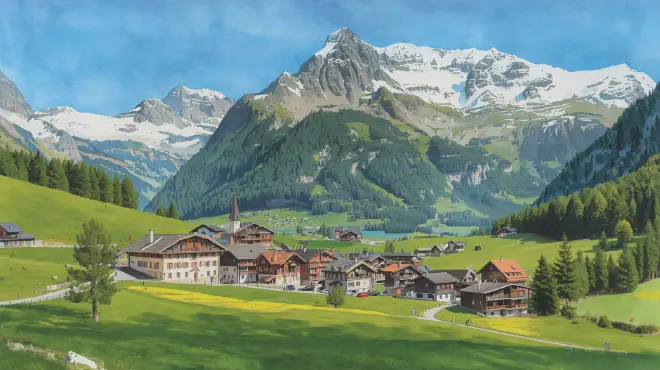
Kandersteg stands deep in the Bernese Oberland. This small mountain village sits on a plateau at 1,200 meters above sea level, a natural sanctuary encircled by peaks exceeding 3,000 meters. While its location offers views of famous summits like the Jungfrau, Eiger, and Mönch, it remains far removed from tourist commotion, preserving the simple, beautiful essence of the Swiss Alps.
Having flourished as a construction base for the Gotthard Railway in the late 19th century, the village now hosts approximately 1,200 residents in quiet mountain seclusion. Traditional wooden chalets dot the landscape, and the sound of cowbells echoes through the valley. Summer brings a network of hiking trails, while winter transforms it into a silver world of snow. What captivates visitors year-round is the harmony between untouched nature and mountain culture passed down through generations.
Kandersteg’s appeal also lies in its geographical uniqueness. Serving as the gateway to the Lötschberg Pass and as a base for glacier lakes like Oeschinen Lake and Blausee, the village itself maintains a serenity as if time has passed it by. Here, one can forget modern haste and find time for dialogue with the mountains, time to confront oneself.
Day 1: The Door to Stillness
After a two-and-a-half-hour journey from Zurich Airport via BLS RegioExpress connections, I stepped onto the platform at Kandersteg station. Cool mountain air brushed against my skin—a crisp coolness that made the altitude tangible. The station building was a simple wooden structure with red geraniums decorating the windowsills. It felt like stepping into the world of a postcard.
My accommodation, Pension Alpenrose, was about a five-minute walk from the station. Walking the narrow cobblestone path, I noticed traditional chalet-style houses. Flowers bloomed abundantly from deep eaves, and some buildings bore colorful frescoes on their walls. Marta, the pension owner, was a gentle woman in her sixties who welcomed me in fluent German. My room was a corner room on the second floor, with windows overlooking the clear Kander River and the mountain slopes beyond.
I decided to explore the village center in the afternoon. Even the main street was barely wide enough for one car. The shops were few—a small general store, a post office, and a restaurant called “Ruby” caught my eye. At the village center stood a small church, its spire striking against the blue sky. A cemetery surrounded the church, and reading the names carved on old gravestones, I felt the history of people who had lived rooted in this land.
I chose to have dinner at the pension. Marta prepared local specialties: rösti and fondue made with goat cheese. The rösti—shredded potatoes pan-fried until crispy outside and fluffy inside—paired perfectly with the fondue, which was rich yet finished with a refreshing aftertaste, complementing the white wine beautifully. Over dinner, I asked Marta about the village’s history. She spoke in quiet tones about her grandfather’s involvement in railway construction, the harsh winters, and recent changes as fewer tourists visit the village.
Night fell early. After 9 PM, the village descended into profound silence—only the murmur of the river and occasional lowing of cattle could be heard. Opening my window revealed a sky where stars seemed to fall. I caught my breath at the overwhelming number of stars, impossible to see in any city. Preparing for tomorrow’s mountain walking in earnest, I retired early that night.
Day 2: Pilgrimage to the Glacier Lake
Waking at 6 AM, I found the view outside wrapped in morning mist. Only the mountain peaks emerged from the sea of clouds—a fantastical sight. The pension’s breakfast featured homemade bread with berry jam and local honey. Along with the aroma of coffee, I felt the day truly beginning.
Today’s destination was Oeschinen Lake. I would walk the two-hour hiking course from the village. Departing at 8:30 AM, I began with a gentle uphill path. The forest trail was surrounded by spruce and fir trees, moss growing thick underfoot. After about thirty minutes, the view opened, revealing snow-capped mountains across the valley. Here the real climb began.
Midway, I took a break at a traditional alpine hut, an Alphütte. Several cows grazed in front, their cowbells swaying in the breeze, playing beautiful tones. The hut’s master, a man surely past seventy, had been ranching in these mountains for over fifty years. The herbal tea he brewed, made from alpine plants, soothed my fatigue.
Around 11 AM, I finally reached Oeschinen Lake. Situated at 1,674 meters above sea level, this lake possessed the beauty of a natural jewel. The emerald-green surface lay mirror-still, reflecting the surrounding jagged rock walls and glaciers. On the lakeshore stood the Berghotel Oeschinensee, a mountain hotel where I decided to have lunch.
The meal featured abundant mountain fare: grilled alpine salmon with a salad of locally harvested vegetables and white wine from Valais. Dining while gazing at the lake was extraordinary—I truly felt the luxury of being in nature. After the meal, I walked the lakeshore and dipped my feet in the stream flowing from the glacier. The water was ice-cold, and in that moment, it felt as though all the fatigue of city life washed away at once.
In the afternoon, I chose a different route back to Kandersteg. The descent path revealed various alpine plants. The vivid pink of alpine roses, the pure white of edelweiss, and countless small flowers whose names I didn’t know. Each plant conveyed the strength of having adapted to survive in this harsh environment.
Returning to the village around 5 PM, I purchased Swiss chocolate and herbal tea at the village store. The elderly shopkeeper, sensing I had returned from hiking, kindly asked, “How was Oeschinen Lake?” Though few words were exchanged, I felt her love for this land and her warm spirit toward visitors.
I chose to have dinner at the village restaurant, Ruby. This small establishment seemed beloved by locals—several village men sat at the counter. I took a window seat and ordered Wiener schnitzel with rösti. The veal cutlet was thin and large, refreshing when eaten with lemon. The local beer went down smoothly, healing the day’s weariness.
That night, returning to the pension, I found Marta had lit a fire in the hearth. Gazing at the dancing flames, I reflected on the day. The grandeur of nature and the warmth of people. I realized how luxurious this time in this small village truly was.
Day 3: A Morning of Farewell and Eternal Memory
On the final morning, thin clouds hung over the mountains. Savoring my last breakfast while viewing the mountains’ different expression from yesterday, Marta specially prepared Zopf, a traditional braided bread from the village. The plaited bread, eaten with butter and honey, had a simple, gentle flavor.
Before checkout, I decided to walk through the village once more. In the morning stillness, my eyes caught details I hadn’t noticed yesterday. Bundles of firewood hanging from eaves, moss growing on stone walls, a bird perched on the church bell tower. All simple things, but essential elements forming this village’s daily life.
Extending my walk to a viewpoint at the village edge, I could survey all of Kandersteg. The small village nestled in the valley, surrounded by majestic mountains. I felt anew how small human activity is, and how great nature. Simultaneously, I felt the warmth within this smallness and the weight of culture passed down through generations.
Around 10 AM, I returned to the pension to bid Marta farewell. She handed me a small bag of herbal salt made in the village. “Each time you use this, please remember Kandersteg,” she said. In that moment, I acutely felt how special these two nights and three days had been.
I walked slowly to the station, carrying my heavy backpack. Along the way, the cows I’d seen yesterday continued grazing. They too were residents of this village. Arriving at the station, I sat on a bench waiting for the train. From the platform, I could see part of yesterday’s hiking course. Remembering myself walking that mountain path, a strange sense of fulfillment welled up.
I boarded the 11:15 AM BLS RegioExpress. Kandersteg viewed from the train window gave a different impression than upon arrival. Three days ago, it was simply a beautiful mountain village, but now each building, road, and tree held memories. As the train gradually pulled away from the village, I felt something warm remaining deep in my chest.
In the train car toward Zurich, I reflected on these three days. Nothing extraordinary had happened. I hadn’t toured famous sights. I had simply faced nature in a small village, connected with the people living there, and dialogued with myself. That was all. Yet within that “all,” I felt everything important that modern life tends to forget was contained.
Conclusion
The two nights and three days in Kandersteg, though an imaginary journey, was a trip genuinely experienced in my heart. The clear waters of Oeschinen Lake, Marta’s warm smile, the fragrance of herbal tea at the mountain hut, the beautiful starry sky, and the village’s stillness—all remain vividly in my memory.
Though I never physically set foot there, the mountain paths walked in imagination, the meals tasted in imagination, the conversations exchanged in imagination—all are engraved in my heart with a certain reality. Perhaps this speaks to how travel’s essence lies not in physical movement but in the movement of the heart.
The imaginary time spent in this small Swiss mountain village continues to sustain me even now, returned to daily life. When I want to pause amid hectic days, I remember Kandersteg’s stillness. When tired of relationships, I remember Marta’s kindness. When feeling too distant from nature, I remember the beauty of Oeschinen Lake.
A journey that feels certain despite being imaginary—perhaps this is proof of our imagination’s richness and our souls’ continual seeking of experience. Kandersteg may be a small point on a map, but in my heart, it has become a place that will shine forever.