
Longing for the Land of a Thousand Hills
Rwanda, nestled in the heart of the African continent, is a beautiful landlocked nation known as the “Land of a Thousand Hills.” Its capital, Kigali, sits on a plateau at an altitude of 1,500 meters, blessed with a cool and pleasant climate year-round despite its location just below the equator. The layered landscape of lush green hills resembles a natural ink wash painting of extraordinary beauty.
One cannot speak of this country without acknowledging the deep wound of the 1994 genocide. Yet today’s Rwanda draws the world’s attention as a symbol of reconciliation and recovery. Kigali is now celebrated as “Africa’s cleanest city,” beautifully maintained and boasting one of the world’s highest rates of women’s participation in government. The country is also renowned for its coffee, with its specialty beans earning international acclaim in recent years.
Kinyarwanda, English, and French serve as official languages, creating a unique cultural fusion. Traditional Intore warrior dances, the vibrant Umushanana worn by women, and above all, the warm smiles of its people welcome every traveler who arrives.
Day 1: Arriving in a City Wrapped in Mist and Hills
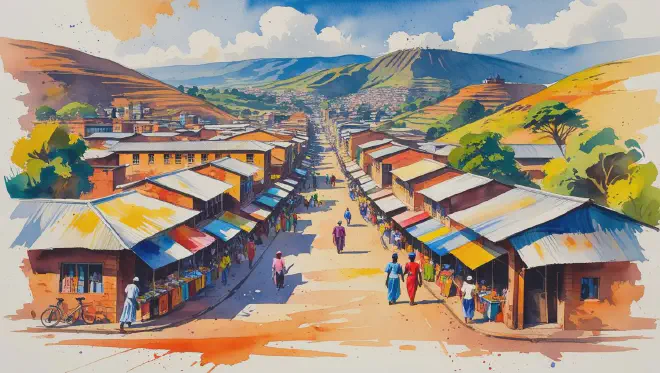
The moment I stepped off the plane at Kigali International Airport, a landscape utterly different from what I had imagined of Africa spread before my eyes. The airport was clean and modern, the staff courteous and warm. From the taxi window on the way into the city, the view unfolded like a painting—red-roofed houses scattered across green hills, with distant mountains fading into haze. I could confirm with my own eyes that the phrase “a thousand hills” was no exaggeration.
Though I arrived in the morning, jet lag urged me to rest first at my hotel. My accommodation was a small boutique hotel in central Kigali, its lobby adorned with paintings by local artists. The receptionist, Grace, spoke fluent English and shared recommendations for exploring the city. Her smile was particularly memorable. “Kigali is a city you can explore on foot,” she said. “Take your time and wander.”
In the afternoon, I walked fifteen minutes from the hotel to Kimisagara Market. Stepping inside, I was greeted by a riot of colors—vegetables, fruits, spices—their aromas mingling in the air. Tomatoes, cabbage, bananas, avocados, and tropical fruits I had never seen before overflowed with nature’s abundance. Women in beautiful Umushanana moved gracefully through the aisles, large baskets balanced on their heads as if in a dance.
One woman approached me, speaking fluent English. Her name was Immaculée. “This is umutsima—cassava,” she said, showing me a white root vegetable. “This is the one we cook with for when we stew beef.” The red tomato-based sauce looked delicious just from appearance alone. Listening to her explanations, I began to sense the richness of Rwandan food culture.
As evening approached, I made my way to Heaven Restaurant near my hotel. Inside, warm lighting filled the space, and traditional ingoma drums decorated the walls. The menu listed dishes whose names I had learned at the market that afternoon: ibiharage (bean stew), isombe (cassava leaf stew), and inyama n’indijji (beef stew).
I ordered ugali (a staple made from maize flour) with ibiharage, and a Mützig beer. When the food arrived, I was struck by its humble yet profound flavors. The ibiharage had a perfect balance of the beans’ natural sweetness and a well-spiced tomato sauce. The ugali was subtly sweet, versatile enough to complement any dish. The Mützig was light and refreshing, perfectly suited to the cool evening air of high-altitude Kigali.
That night, I stood on my hotel balcony gazing out over the city. Lights scattered across the hills twinkled like stars. From somewhere in the distance came the sounds of night insects and what might have been folk songs. The beautiful cadence of Kinyarwanda dissolved into the evening silence. In that moment, I was certain I could feel the heartbeat of Rwanda.
Day 2: Tracing the Weight of Memory and the Light of Hope
Morning arrived with the aroma of Rwandan coffee at the hotel breakfast. This country’s coffee is internationally renowned, and a single sip revealed why—an exquisite balance of acidity and sweetness, with a freshness unique to highland-grown beans. The fruit selection was equally abundant: papaya, mango, and passion fruit, each bursting with tropical richness.
In the morning, I decided to visit the Kigali Genocide Memorial. With heavy steps, I took a taxi up the hill to the memorial site. This sacred space, where more than 250,000 victims of the 1994 genocide rest, is a place where sorrow and hope intersect.
Walking through the exhibits, I felt the weight of what this nation’s people had endured. The photographs, testimonies, and personal belongings conveyed a shock beyond words. Yet I also sensed a powerful determination toward reconciliation and rebuilding. The word “Kwibuka”—“remember”—was inscribed on the wall. To never forget, and to move forward. I was deeply moved by the strength of Rwanda’s people in honoring both.
Beautiful flowers filled the memorial gardens, white roses swaying in the breeze as symbols of peace. There I met Jean, a guide who spoke quietly. “We do not forget our past,” he said. “But we have chosen love and hope over hatred.” The weight of his words and the gentleness of his expression will stay with me always.
In the afternoon, I shifted my focus to witness Kigali’s present by exploring the city. First, I visited Kandt House Museum of Natural History, then made my way to a cultural center where I could experience traditional Rwandan culture. Women dressed in colorful Umushanana performed the traditional “Umushagirire” welcome dance. Their movements, synchronized to the rhythm of drums, were both graceful and powerful, and I found my own heart keeping time.
I was given the chance to try basket weaving myself. The traditional baskets called “agaseke” are made by carefully weaving thin grasses. My instructor was a woman named Marie, who patiently guided my clumsy hands. “This skill is passed from mother to daughter, generation after generation,” she said proudly. The baskets born from her hands were nothing short of art.
In the late afternoon, I climbed to a viewpoint to survey the city. In every direction, green hills stretched to the horizon. The setting sun painted them from gold to soft purple. Lost in this beauty, I was approached by a young local man named Eric, an architecture student at the university.
“This Kigali is our pride,” he said. “Twenty years ago, we could never have imagined it would become such a beautiful city.” Indeed, the cityscape below was orderly and verdant. With plastic bags banned, not a single piece of litter marred the streets. “We value ‘ubwanwa’—cleanliness,” Eric explained.
For dinner, I went to a local favorite called The Hut, where I ordered igihufu (steamed bananas) and inkoko (chicken stew), along with ubuki (honey wine). The igihufu was sweet and nourishing; the inkoko was rich with vegetables and spices. The ubuki had a light sweetness, its natural honey flavor lingering on the palate.
Live music filled the restaurant—ingoma drums and the inanga (a traditional harp) resonated through the space. When the musician began to recite “imyambo,” classical poetry set to song, the entire room fell silent to listen. Watching this scene, I felt the deep love Rwandans hold for their culture.
Day 3: A Farewell Morning Wrapped in Coffee’s Fragrance
On my final morning, I woke early to visit a coffee farm on the outskirts of Kigali. When I asked Grace at the front desk, she recommended Buf Coffee Company. “Their coffee is famous worldwide. The owner, Emmanuel, is very kind,” she told me.
After a thirty-minute taxi ride from central Kigali, I arrived at a coffee plantation on hills rising to 1,700 meters. Coffee trees laden with red cherries covered the slopes, creating an ethereal landscape in the morning mist. Emmanuel, the farm’s owner, welcomed me warmly. A gentle man in his late forties, he explained the cultivation process in fluent English.
“Rwandan coffee benefits from our high altitude, volcanic soil, and balanced rainfall,” he said. Walking through the farm, I noticed other crops growing between the coffee trees. “This is our shade tree system. The banana trees protect the coffee from direct sunlight and enrich the soil.”
I was allowed to try harvesting coffee cherries myself. Selecting and picking only the ripe red ones proved surprisingly difficult, and I admired the skilled hands of the women working the farm. “Good coffee is born from love,” said Joséphine, who helped guide my picking, with a gentle smile. Her hands were weathered by soil and sun, yet her fingers moved with remarkable dexterity.
The coffee tasting at the farm was an unforgettable experience. Freshly harvested beans were roasted and carefully hand-ground before brewing. The rising steam, the aroma, and that first sip—complex and rich. A fruity acidity giving way to sweetness, followed by a long, lingering finish. It was as though I had never truly tasted coffee before.
“We call this coffee ’the blessing of a thousand hills,’” Emmanuel explained. “It is special coffee, nurtured by Rwanda’s earth and the hearts of its farmers.” Indeed, I could feel the country’s nature and its people’s devotion contained within a single cup.
In the afternoon, back in Kigali, I enjoyed one last walk through the city. At Kimisagara Market, I found Immaculée and said goodbye, purchasing an agaseke basket as a souvenir. “Use it in Japan,” she said with a smile, handing me the basket filled with the warmth of handcraft.
In the late afternoon, I climbed Nyamirambo Hill. From there, I could see all of Kigali spread before me. The sun began to set, painting the western sky, and the thousand hills grew quiet in the fading light. The city where I had spent two days stretched beyond the hills—red-roofed houses, verdant gardens, orderly roads. And above all, the smiling faces of everyone I had met rose in my memory.
A small café stood at the hilltop, and I ordered my final Rwandan coffee. The elderly owner greeted my “Muraho” with a delighted smile. He spoke no English, but gestures and kind expressions bridged our communication effortlessly. There was a warmth that transcended language.
That night, as my taxi headed toward the airport, I looked back to see Kigali’s lights beginning to glow. My stay had been brief, but I had felt this country’s beauty, its people’s strength, and their hopeful stride toward the future. The taxi driver waved and said “Urabehoo”—goodbye. I waved back from the window, knowing in my heart that I would return someday to this Land of a Thousand Hills.
What Felt Certain, Though Imagined
This journey was a story woven within my imagination, yet strangely, it remains in my memory as if I had truly walked Rwanda’s soil and felt Kigali’s breeze. Grace’s warm smile, my conversation with Immaculée at the market, the rich aroma at the coffee farm, and the beauty of a thousand hills bathed in sunset light—these experiences, though born of imagination, are etched firmly in my heart.
Perhaps travel is not solely about physical movement. When the heart is moved, when we touch a new world and reflect upon ourselves through encounters with others, that too is a true journey. By contemplating Rwanda’s history and present, its natural abundance and its people’s resilience, I did indeed travel to this beautiful country.
Rwanda, the Land of a Thousand Hills. Though this was a journey of imagination, it lives on beautifully in my heart, accompanied always by the fragrance of coffee.