
A Village Embraced by a Turquoise Valley
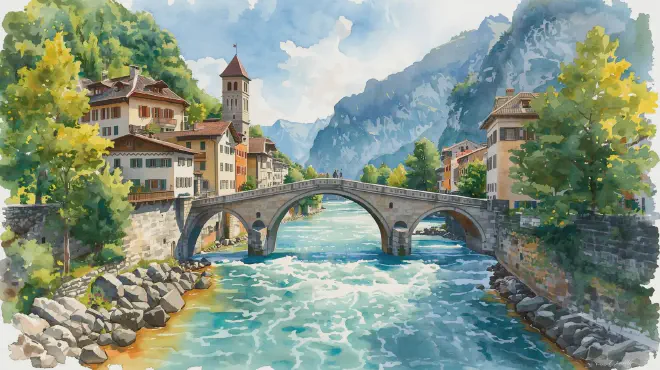
Deep in the Ticino region, the small village of Lavertezzo sits quietly in the Verzasca Valley. With a population of barely 900, this modest settlement is sometimes called “the Maldives of Switzerland” for its beauty. The granite riverbed carved over countless years by the Verzasca River cradles crystal-clear turquoise waters, creating a landscape reminiscent of a natural swimming pool.
Italian-speaking residents have inhabited this area since the 13th century, their stone houses dotting the valley slopes to form a distinctive landscape. In summer, tourists from around the world arrive seeking the transparent river waters, but it’s in the quieter seasons of spring and autumn that the true character of this place reveals itself. A unique location where the grandeur of the Alps merges with the warmth of Italian culture. That is Lavertezzo.
Day 1: The Stone Bridge Linking Past and Present
From Zurich, I took connecting trains to Tenero station. From there, a bus ride of about 40 minutes along winding mountain roads, and suddenly the view opened up. Spread below was a scene straight from a painting: the Verzasca River glowing turquoise, and above it the graceful arch of a 17th-century stone bridge, the Ponte dei Salti. The soft morning light danced on the water’s surface, the bridge’s shadow painting beautiful patterns on the riverbed.
As I stepped off the bus, mountain air filled my lungs. This place at roughly 500 meters elevation felt cooler than the lowlands, and with each deep breath my spirit grew lighter. I walked along narrow cobblestone paths toward my lodging, pulling my small suitcase behind me. The stone houses lining both sides were all modestly built, about three stories each, with red geraniums blooming in the window boxes.
My accommodation was a small pension in the village center called “Casa Verzasca.” The family-run establishment occupied a converted stone building, and the owner, Marco, welcomed me warmly. “The river water is especially beautiful today,” he told me in fluent English, his smile easing my travel fatigue. My room was on the second floor, with a small balcony offering a sweeping view of the valley. After setting down my luggage, I immediately wanted to see that stone bridge up close.
The afternoon light was stronger than morning, and the river had transformed into a deeper turquoise. The Ponte dei Salti was more majestic than I’d imagined, each stone bearing the weight of 400 years of history. Looking down at the river from the bridge, I was amazed by the water’s transparency. The granite stones laid on the riverbed were visible as if within arm’s reach, and occasionally small schools of fish swam past like shadows.
I decided to rest at a small café near the bridge called “Bar Centrale.” When I ordered an espresso, the barista told me, “It’s warm today, so some people are swimming in the river.” Indeed, local youths were playing below the bridge, jumping into the water. Their laughter echoed through the valley, and I envied their freedom.
As evening approached, the sun began to sink behind the mountains. The time when the stone bridge and water surface turned golden was truly magical in its beauty. On my way back to the lodging, I stopped at a small church, the “Chiesa di San Brizio.” Built in the 12th century, this simple stone church contained old frescoes inside. In the dim sanctuary, gazing at the Madonna and Child illuminated by candlelight, I felt the depth of faith rooted in this land.
For dinner, I had local cuisine in the pension’s dining room. Ticino’s specialty “Risotto al Pesce” featured locally caught river fish with a delicate flavor that paired wonderfully with white wine. Marco proudly explained, “This fish was caught in the river this morning.” With a glass of grappa after dinner, I looked up at the night sky from the balcony. In this place far from city lights, the stars felt close enough to touch. I fell into a deep sleep with the murmur of the river as my lullaby.
Day 2: Tracing Memories of Forest and Stone
At 6 a.m., I woke to birdsong. Stepping onto the balcony, morning mist gently enveloped the valley. The ridgelines of the mountains emerged faintly, as if I were inside an ink painting. Before breakfast, I decided to take a walk along the riverside path. Grass and flowers wet with morning dew sparkled, and the air was transparent and cold. Sunlight danced on the river surface, showing yet another expression from yesterday.
Breakfast at the lodging was simple but heartfelt: local cheese and ham, with freshly baked bread. Marco spread out a map and suggested, “The hike to Froda Valley is recommended for today.” It was a mountain trail heading north from Lavertezzo where you could see old water mills and abandoned village ruins.
In the morning, I changed into hiking boots and headed for the mountain path. The ascent started gently but gradually became steeper. Still, the trail through mixed forests of larch and beech was beautiful, offering new discoveries with each step. After about 30 minutes of walking, stone ruins appeared deep in the forest. Imagining the lives of those who once lived here warmed my chest. The stone houses without windows were returning to nature, their walls wrapped in ivy, small trees growing from their roofs.
Going deeper, I found the ruins of an old water mill. The mill wheel blades had rotted away, but the stone foundation remained solid. I could almost hear the sound of grain being ground here long ago. The murmur of a nearby stream evoked those past activities. Eating the sandwich I’d brought for lunch, I thought about the passage of time. People may leave, but nature continues eternally. Somehow, that fact brought me peace.
In the afternoon, I returned to the village and visited a local craftsman’s workshop. Giovanni, a stonemason over 70, still actively participated in stone bridge restoration work. His workshop was at the edge of the village, with various shapes of granite piled in the workspace. “This stone will last 500 years, maybe even 1,000,” he said, gripping his chisel with practiced ease, his hands bearing the marks of years of experience. Watching him actually carve stone, I was overwhelmed by the delicacy and strength of his work. In the craftsman’s figure, pouring soul into each stone, I felt the profound depth of this land’s culture.
In the evening, I headed back to the stone bridge. Wanting to see the bridge from a different angle than yesterday, I crossed to the opposite bank. From this side, the stone bridge appeared more three-dimensional and powerful. Below the bridge, local children were playing in the river. Watching their carefree smiles, I understood how precious this place was to the local people. Not just as a tourist destination, but as a part of daily life, this was a river continuously loved.
That night I had dinner at a small trattoria in the village, “Osteria del Ponte.” The menu was entirely in Italian, and the owner Antonio patiently explained each dish. “Polenta con Brasato” (polenta with braised beef) was a traditional local dish, with cornmeal polenta topped with beef braised in red wine. Simple but deeply flavored, it was a dish that conveyed the mountain’s bounty. It paired beautifully with the local red wine “Merlot del Ticino,” and I savored it slowly over time. After the meal, I spoke briefly with Antonio. He too was born in this village, had once left for the city, but homesickness brought him back. “Here we have a flow of time that doesn’t exist in cities,” he said, words that stayed with me.
Day 3: A Treasure Found on the Morning of Departure
On my final morning, I woke earlier than usual. Wanting to see the morning river one more time, I was out of bed by 5:30. The morning cold stung my cheeks, but its freshness felt pleasant. A thin mist hung over the river surface, creating a dreamlike atmosphere. The sun slowly rose beyond the stone bridge, tinting the mist golden. I stood still for a while, burning this moment into my memory.
After breakfast, I used the time until checkout to take one last walk through the village. I carefully observed small alleyways and architectural details I’d previously missed. Beautiful moss grown over the ages covered the old stone walls. In a small plaza stood a statue of the village’s patron saint, flowers laid before it. Wherever I walked, I could feel the lived reality of the village people.
I visited a small cemetery at the edge of the village. From here, you could overlook the entire valley—a spectacular viewpoint. The gravestones bore names of people who had lived rooted in this land for generations. Some ancient tombstones dated back to the 18th century, testifying to the village’s long history. Those who rest here eternally must also look down on this beautiful scenery each day. With that thought, even death seemed beautiful.
As my last act of the morning, I walked across the stone bridge once more. This time I stopped in the center, gazing at the river’s flow. The transparent water weaving between stones seemed like time itself made visible. This river had flowed through this valley in the same way for thousands of years. And after I’m gone, it will surely continue flowing just the same. That permanence brought me a strange peace.
For lunch, I returned to “Bar Centrale” for something light. It was a simple meal of panini and cappuccino, but the view of the river through the window provided the perfect seasoning. The barista smiled and said, “Please come again.” Over these two days, I’d felt the warmth of the village people many times. I was deeply grateful for their attitude of welcoming tourists not merely as passing customers but as temporary members of the community, if only briefly.
In the afternoon, I left the pension with a heavy heart. Marco’s words, “This village will always be waiting for you,” resonated deeply. I watched his figure seeing me off to the bus stop until he disappeared from the bus window. As the bus began descending the mountain road, the full panorama of Lavertezzo spread below. The turquoise river and stone bridge, surrounded by mountains. The landscapes etched in my heart over these two days vividly returned.
While waiting for the train at Tenero station, I thought about what I’d gained from this journey. The beautiful scenery and delicious food, of course, but more valuable was being able to change the way time flowed. By leaving the urban clamor behind and surrendering to nature’s rhythm, I could notice many things I usually miss. The sound of the river, birdsong, the touch of wind. And above all, I learned anew the meaning of cherishing this present moment.
The train slid into the platform. Sitting by the window, gazing at the scenery flowing past, I reflected on my time in Lavertezzo. The faces of people I’d met in that village, the feel of paths I’d walked, the taste of meals I’d eaten. Everything had become irreplaceable memories, engraved deep in my heart. Each one would light small beacons in my everyday life to come.
What Felt Real Though Imagined
This two-night, three-day journey to Lavertezzo was not something I actually experienced. Yet while writing this account, I felt as though I truly had walked that land, breathed that air, and connected with those people. Perhaps this is not merely a product of imagination, but another kind of reality woven by the human heart’s longing for beauty and its spirit of exploration toward unknown lands.
The turquoise flow of the Verzasca River continues unchanged even now in the Swiss mountains. The 17th-century stone bridge still welcomes many people today, and the village residents surely continue greeting travelers with unchanged warmth. I put down my pen, hoping this imaginary journey will someday become a step toward a real one.
Travel is not necessarily only about moving one’s body. By opening our hearts and letting imagination take flight, we can journey anywhere in the world. And the emotions and discoveries gained from such journeys may hold value equal to, if not greater than, actual travel. These imaginary three days in Lavertezzo taught me that—an irreplaceable experience.