
Gateway to the Heavenly Realm
Lhasa—this ancient capital, whose name means “Place of the Gods” in Tibetan, rests quietly on a plateau at 3,650 meters above sea level. Located at the northern foot of the Himalayas, this sacred land, surrounded by crystal-clear blue skies and snow-capped mountains, has flourished for over a millennium as the heart of Tibetan Buddhism.
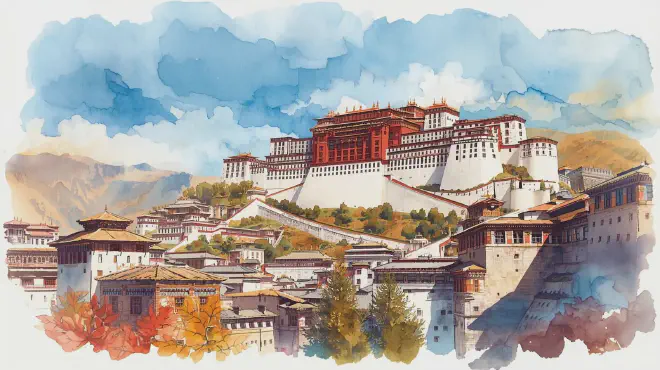
The majestic Potala Palace rises above the Lhasa River valley, encircled by traditional white-walled houses lining the streets below. In the morning, the sound of sutra chanting from temples rides the wind and envelops the entire city, while at dusk, pilgrims practicing full-body prostrations can be seen at street corners throughout the town. The air is thin, yet this very quality seems to lighten the spirit, accentuating the unique stillness and solemnity of this land.
Tibetan culture, nurtured in the harsh natural environment of the plateau, possesses a distinctive worldview formed by the fusion of Buddhist teachings and ancient Bon traditions. Colorful prayer flags (lungta) flutter in the wind, and the sound of turning prayer wheels resonates as the city’s background music. The warm glow of yak butter lamps creates a mystical atmosphere in nighttime Lhasa.
These three days spent in this celestial sanctuary will surely awaken something deep within the soul.
Day 1: First Steps into Sacred Ground
Morning light illuminates the runway at Gonggar Airport. From the airplane window, the city of Lhasa looks small, like a map, yet unmistakably present. The reality of the altitude hits the moment I descend the stairs. Attempting a deep breath, I feel a slight dizziness from the thin air. This was my first encounter with Lhasa.
From the bus window on the journey from airport to city, vast plateau landscapes unfold continuously. In the distance, the snow-covered peaks of the Nyenchen Tanglha Mountains gleam white, while in the foreground, herds of yaks graze across the yellowish-brown earth. As the bus progresses, the shape of Potala Palace gradually comes into view. The moment when what started as a tiny dot reveals its full, dignified form is truly moving.
After checking into my hotel before noon, I first rest in my room as a precaution against altitude sickness. From the window, I can hear the bustle of Barkhor Street below. The sounds of drums, bells, and pilgrims’ footsteps blend together in the unique rhythm of this city.
In the afternoon, I finally begin exploring the streets. First, I head toward Jokhang Temple. Walking along Barkhor’s stone pavement, I pass pilgrims making full prostrations as they circle the sacred site. The regular sound of wooden hand boards striking the stones echoes rhythmically. The depth of their faith makes me stop involuntarily to watch.
The square before Jokhang Temple is truly the center of faith. The golden roofs shine in the afternoon sun, and before the temple, pilgrims continuously repeat their prostrations without pause. Inside the temple, countless yak butter lamps flicker in the dimly lit corridors, and people pray before Buddha statues. Here flows a continuity of prayer that has endured for over 1,300 years.
In the evening, I decide to walk the full circuit of Barkhor. I let myself flow with the clockwise movement of pilgrims along the kora path. Souvenir shops, teahouses, and restaurants line the streets, and the aroma of butter tea drifts from here and there. Turquoise jewelry, colorful prayer flags, and brass prayer wheels displayed at shop fronts make me lose track of time just browsing.
I encounter an elderly woman reciting scriptures while turning a large prayer wheel. She greets me with a gentle smile etched in wrinkles. Though we share no common language, her warmth reaches me clearly.
For dinner, I eat at a traditional Tibetan restaurant. The momos (dumplings) have chewy skin filled with generously spiced yak meat. But most impressive is the taste of butter tea. At first, I’m taken aback by the salty tea, but in the plateau’s dry air, the salt and fat seem to permeate my body.
On the way back to the hotel, I look up at the illuminated Potala Palace in the night. The lit palace exudes a different solemnity than during the day, towering against the starry sky. My first night in Lhasa quietly deepens with this dreamlike scene.
Day 2: Embraced by Palace and Lake
The morning air is crystal clear, and taking a deep breath, the freshness reaches deep into my lungs. Perhaps accustomed to the altitude now, I feel well. Today is the day to finally visit Potala Palace.
After a simple breakfast at the hotel, I head to Potala Palace early. Looking up from the palace’s base, the building is far more massive and imposing than I imagined. The white and red exterior walls shine beautifully in the morning sun, while the golden roofs at the summit stand out against the blue sky. This palace, rising 117 meters high, truly deserves the name “Heavenly Palace.”
After receiving my entrance ticket, I finally enter the palace interior. Climbing the stone steps one by one, I reflect on the time when the Dalai Lama resided here. Each room displays Buddha statues and religious paintings decorated with gold and silver, but especially the rooms housing the stupas of successive Dalai Lamas leave me breathless with their grandeur. From the windows, the entire city of Lhasa spreads out below, and in the distance, I can see the road to the airport I traveled just days ago.
After touring the palace, it’s already past noon. I decide to rest at a nearby teahouse. Drinking butter tea among local people, I watch passersby through the window. Children in traditional dress walking home from school, women carrying shopping baskets—these scenes tell of the city’s everyday life.
In the afternoon, I join a day trip to Namtso Lake. About four hours by car from Lhasa, this lake sits at 4,718 meters above sea level and is known as one of Tibet’s three sacred lakes. Along the way, the plateau scenery gradually changes from grassland to rocky mountains to snow-covered peaks.
The moment I arrive at Namtso Lake, I’m speechless at its beauty. The deep blue surface extends to the horizon, as if the sky itself had descended to earth. Along the shore, colorful prayer flags flutter, and complete silence spreads, broken only by the sound of wind. In this quietness, my own heartbeat sounds unusually loud.
Walking along the lakeshore, I meet a nomadic family. A young man herding yaks speaks to me in broken Chinese about the lake’s beauty. His eyes are as clear as the lake itself, conveying deep love for this land.
In the evening, we begin the return journey to Lhasa. The sunset viewed from the car window paints the entire sky in the vivid orange unique to the plateau. The blue memory of Namtso Lake mingles in my heart with the warm colors of sunset, deepening the day’s experience.
Returning to Lhasa, I walk Barkhor again at night. Unlike last night, this time I walk each step carefully, feeling like a pilgrim myself. I find myself naturally joining the line of people turning prayer wheels and chanting scriptures. Beyond differences in religion and culture, I sense something we share in common.
For dinner, I try a different restaurant, ordering thukpa (a noodle dish like udon) and grilled yak meat. The clear broth of the thukpa warms my body, and the yak meat is lighter and more palatable than I expected. A local diner at the next table teaches me the proper way to eat tsampa (barley flour)—mixed with butter tea.
Tonight I sleep even more soundly than last night. The blue silence of Namtso Lake and the solemnity of Potala Palace resonate quietly deep within.
Day 3: Thoughts on a Morning of Farewell
On my last morning, I wake earlier than usual. Outside the window, it’s still dim, but the ridgelines of distant mountains are beginning to show faintly. Thinking that today marks my farewell to Lhasa, an indescribable loneliness wells up.
Before breakfast, I decide to walk Barkhor once more. The early morning Barkhor shows a completely different face than during the day. Though shops haven’t opened yet, pilgrims making full prostrations along the kora path are already present. Morning chanting sounds from the temples, mingled with the chirping of early-rising birds.
Before Jokhang Temple, I see a monk lighting butter lamps. In the dimness, the flickering flame beautifully illuminates the temple’s golden decorations. Seeing this morning scene makes rising early worthwhile.
Returning to the hotel for breakfast, I begin preparing for checkout. While packing, I recall the many scenes carved into my heart over these three days. The majesty of Potala Palace, the silence of Namtso Lake, the prayers of pilgrims, and the warm gazes of local people.
In the morning, I go out for one last walk through the city. I visit Ramoche Temple, a small temple I hadn’t yet seen. Though not as large as Jokhang, this is a quiet temple beloved by locals. In the courtyard, elderly people chat while turning prayer wheels—a glimpse of the everyday faith of this city.
My final lunch tastes the most delicious of the three days. Shabaley (Tibetan-style meat buns) and suja (sweet milk tea) offer gentle flavors that heal the fatigue of travel on the plateau. When the restaurant owner calls out “Come again!” in broken Japanese, my chest tightens with emotion.
In the afternoon, it’s time to head to the airport. From the bus leaving Lhasa, I gaze at Potala Palace one last time. Its form stands as majestically as when I arrived, yet looks completely different than three days ago. No longer merely a tourist building, it has been etched into my heart as the very soul of this land.
On the road to the airport, each scene from the window feels precious. Herds of grazing yaks, prayer flags fluttering in the wind, distant snow mountains—everything connects to my memories of these three days and strikes me with special meaning.
Arriving at Gonggar Airport, I complete check-in procedures. Gazing at the runway from the waiting area, I see the strong plateau sunlight illuminating the ground. Will I ever be able to forget this light, this air, this silence?
The plane takes off, and the city of Lhasa gradually shrinks below. Beneath the window, the peaks of the Himalayas stretch in a line, beyond which the vast plateau continues. Viewing this magnificent landscape, I realize that though these three days in Lhasa were not long, something within me has certainly changed. It’s not so much religious faith as a more fundamental sensation—as if I’ve been reminded of something essential to being human.
An Imaginary Journey That Felt Undeniably Real
Though this journey is a product of imagination, it remains in my heart as vividly as a path actually walked. The texture of Lhasa’s stone pavement, the salty taste of butter tea, the thin air of the plateau, and the view of the city from Potala Palace—I can still recall everything clearly.
Perhaps precisely because this was an imaginary journey, these three days held meaning beyond mere tourism. It was also a time to confront myself through encounters with a different culture. Touching the faith of pilgrims, being enveloped in the silence of Namtso Lake, and experiencing the warmth of local people reminded me of important things easily forgotten in daily life.
The power held by Tibet as a sacred place may be experienced not only by physically visiting, but also by feeling the place in one’s heart. Even in an imaginary journey, approaching with respect and curiosity toward that land, allowing imagination to roam, can create an experience that etches itself into the heart as genuine.
The smiles of people met in Lhasa, the continuous echo of chanted sutras, the prayer flags fluttering in the wind—all of these, though imaginary, live on in my heart as travel memories that feel undeniably real.